

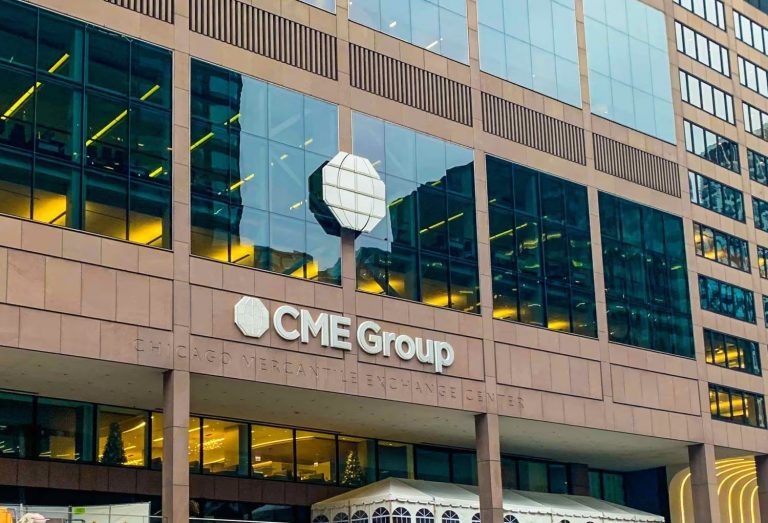
CME Group, the world’s leading derivatives marketplace officially confirmed it will launch 24/7 trading for its regulated cryptocurrency futures and options, starting May 29, 2026 pending final regulatory review and approval.
Trading will occur continuously on the CME Globex platform. It begins at 4:00 p.m. CT (Central Time) on Friday, May 29 — equivalent to 5:00 p.m. ET or 10:00 p.m. UTC, depending on daylight saving adjustments. There will be at least a two-hour weekly maintenance period over the weekend to allow for system upkeep.
Weekend and holiday trades from Friday evening through Sunday evening will carry the trade date of the following business day, with clearing, settlement, and regulatory reporting handled accordingly on that next business day.
This move aligns CME’s crypto derivatives more closely with the always-on nature of spot cryptocurrency markets like Bitcoin and Ethereum trading on exchanges that never close. Currently, CME’s crypto products including Bitcoin, Ether, and newer ones like Solana, XRP, Cardano, Chainlink, and Stellar have more limited hours, typically around 23 hours per day with daily breaks.
Register for Tekedia Mini-MBA edition 20 (June 8 – Sept 5, 2026).
Register for Tekedia AI in Business Masterclass.
Join Tekedia Capital Syndicate and co-invest in great global startups.
Register for Tekedia AI Lab.
The decision comes amid strong institutional demand: CME reported record volumes in its crypto suite, including $3 trillion in notional volume across 2025, showing growing interest in regulated tools for hedging and exposure to digital assets. This is covered directly in CME’s official press release and echoed across major crypto/finance outlets.
If approved without issues, it could further bridge traditional finance (TradFi) and crypto by giving institutions more flexible, round-the-clock risk management options. The CME Group’s decision to launch 24/7 trading for its regulated cryptocurrency futures and options starting May 29, 2026 represents a significant evolution in bridging traditional finance (TradFi) with the always-on crypto ecosystem.
This builds on record-breaking activity: $3 trillion in notional volume across 2025 and strong 2026 momentum; average daily volume up 46% year-over-year to ~407,200 contracts, with open interest also rising. Institutions can now react to news, events, or price moves at any time including weekends and holidays, eliminating overnight/weekend risk buildup that previously existed due to limited CME hours ~23 hours/day with breaks.
Reduced basis risk — Better alignment between CME derivatives and 24/7 spot crypto markets on exchanges like Binance or Coinbase minimizes discrepancies and improves hedging efficiency. This caters to surging demand from banks, asset managers, hedge funds, and corporates.

Experts view it as a structural shift toward treating crypto as a mature asset class with sophisticated, regulated tools—further integrating it into portfolios. Round-the-clock access on a major regulated platform like CME Globex should attract more participants, tightening spreads and increasing depth, especially in futures/options for Bitcoin, Ether, Solana, XRP, and others.
More efficient price discovery — Continuous trading reduces gaps from weekend spot moves not reflected in derivatives until Monday, leading to smoother convergence. Potential for reduced volatility in some scenarios — Better real-time risk management could dampen extreme swings, though high-frequency trading (HFT) and algorithmic activity might introduce new short-term volatility.
The infamous Bitcoin “CME gap” (price discrepancies from weekend spot moves vs. closed futures) effectively ends post-launch, as trading becomes continuous. This removes a predictable pattern some traders exploited or feared. Stronger institutional participation often stabilizes prices long-term and signals maturity, potentially boosting confidence and inflows via ETFs or direct exposure.
Mixed views on control — Some critics argue it enables greater Wall Street influence via cash-settled contracts allowing “paper” shorts without owning underlying assets, potentially leading to more manipulation or suppression tactics seen in commodities like gold/silver.

Others see it as validation that crypto’s nonstop model is winning out, with TradFi adapting rather than resisting. Signal of crypto maturation — Amid record volumes and new listings like Cardano, Chainlink, Stellar futures, this reinforces regulated derivatives as a gateway for mainstream capital.
Precedent for other markets — It parallels discussions around 24/7 stock trading on Wall Street, showing crypto leading the push toward always-on global finance. Early commentary ranges from bullish (“Wall Street copying crypto”) to cautious (“institutional capture”), but no immediate massive price surge noted—focus remains on long-term structural benefits.
This is widely seen as bullish for long-term adoption and legitimacy, especially among institutions seeking reliable, CFTC-regulated tools in a volatile space. It doesn’t change crypto’s decentralized core but further embeds it within global financial infrastructure. If volumes continue climbing post-launch, expect even tighter integration between spot and derivatives markets.