

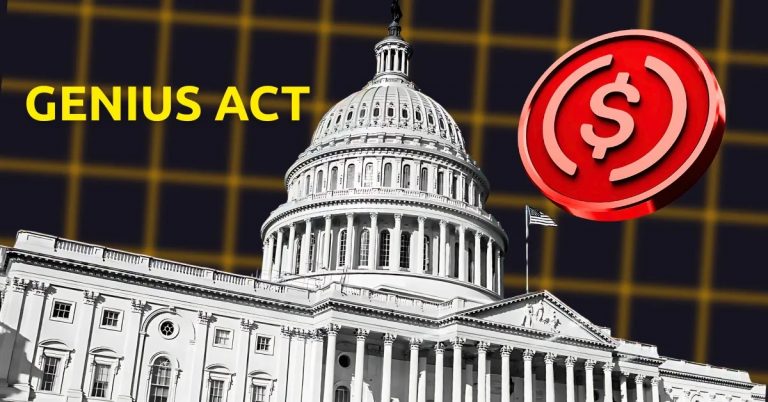
Coinbase has issued a stark warning over provisions in the proposed GENIUS Act, arguing that restrictions on stablecoin rewards and incentives could undermine the United States’ leadership in digital payments and innovation.
Faryar Shirzad, Coinbase’s Chief Policy Officer, argues that such an act will cede ground to China’s Digital Yuan, which announced interest payments starting January 2025 to accelerate adoption after a decade of testing.
In a post on X, he wrote,
Register for Tekedia Mini-MBA edition 20 (June 8 – Sept 5, 2026).
Register for Tekedia AI in Business Masterclass.
Join Tekedia Capital Syndicate and co-invest in great global startups.
Register for Tekedia AI Lab.
“For those who misunderstand what’s at stake in the debate on offering rewards on US-issued stablecoins under the GENIUS Act, a sobering and timely announcement from the People’s Bank of China that they plan to pay interest on the Digital Yuan. Tokenization is the future and the GENIUS Act was a visionary move by @POTUS and Congress to ensure US dollar stablecoins issued under US rules would be the primary settlement instrument of the future.
“If this issue is mishandled in Senate negotiations on the market structure bill it could hand our global rivals a big assist in giving non-US stablecoins and CBDCs a critical competitive advantage at the worst possible time. Lobbyists for entrenched incumbents will always fight change. It’s critical for negotiators to protect the primacy of the US dollar and the US financial system, not just incumbent interests.”
Critics view the prohibition as a safeguard against speculative risks, while supporters urge Senate negotiators to prioritize innovation over incumbent banking lobbies to maintain US leadership in tokenized assets.

According to Reuters, starting January 1, e-CNY held in wallets will earn interest at demand deposit rates, making it the world’s first interest-bearing central bank digital currency.
“This will help increase users’ willingness to adopt the digital yuan, expand its usage scenarios, and further solidify China’s leading position in the global exploration of central bank digital currencies,” the state broadcaster CCTV said.
In line with this, the central bank has set up a global operations centre in Shanghai to promote the international use of the digital yuan and has said it would support more commercial banks in operating e-CNY businesses.

The U.S GENIUS Act, signed into law by President Trump in July 2025, establishes a federal framework for regulating US-issued payment stablecoins, emphasizing dollar primacy and AML compliance.
However, its ban on interest (Section 4(a)(11)) sparks debate over competitiveness versus financial stability. The GENIUS Act bans yield on payment stablecoins to prioritize payments over investments, protecting banks’ interest revenue, but critics warn it disadvantages US assets against yielding foreign CBDCs.
Brian Armstrong CEO of Coinbase argues that there should be interest on US-issued stablecoins under the Genius act to enhance global competitiveness.
He wrote on x,
“U.S stablecoins must remain competitive on the global stage”.
Last week, Coinbase CEO Brian Armstrong said any attempt to reopen the GENIUS Act would cross a “red line,” accusing banks of lobbying Congress to limit stablecoin rewards to protect their deposit base. He said Coinbase would continue to oppose efforts to revise the law, adding that he was surprised such lobbying was happening so openly.
Armstrong also argued that banks are misjudging the issue, predicting they will eventually push to offer interest and yield on stablecoins themselves once the opportunity becomes clear. He described the current lobbying effort as “unethical,” saying it would ultimately fail.
By prohibiting rewards on U.S.-issued stablecoins, the GENIUS Act risks handing a long-term strategic advantage to China’s digital yuan at a critical inflection point in global finance. Digital currencies compete not only on trust and regulation, but on economic utility. As the People’s Bank of China moves to introduce interest on e-CNY balances, it is effectively positioning the digital yuan as a superior store-and-transfer instrument compared to non-yielding U.S. stablecoins.
Over time, this incentive gap could reshape user behavior. Corporations, fintech platforms, and cross-border traders, particularly in emerging markets are likely to favor digital currencies that preserve value while settling transactions.
If U.S. stablecoins are structurally barred from offering rewards, global users may increasingly adopt the digital yuan for trade settlement, treasury management, and on-chain liquidity, gradually normalizing its use outside China’s borders
Outlook
The debate over rewards in the GENIUS Act represents a pivotal moment for U.S. financial leadership. As tokenization accelerates and CBDCs move from experimentation to real-world deployment, policy choices made today will shape global settlement systems for decades.
Pressure is likely to intensify on lawmakers as evidence mounts that yield-bearing digital currencies drive adoption.
Allowing carefully regulated rewards on U.S.-issued stablecoins could reinforce dollar dominance, stimulate innovation, and ensure that the United States sets the rules for the future of digital money.