

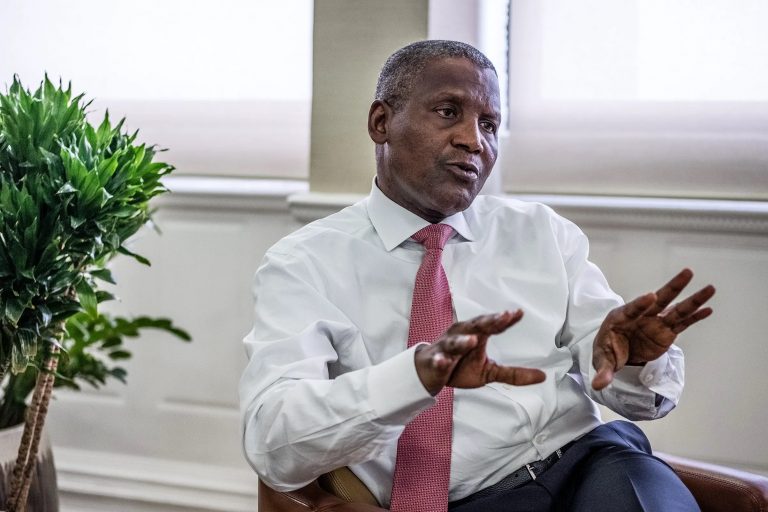
Africa’s most prominent industrial conglomerate is preparing for a partial opening of its flagship energy asset, a move that signals both confidence in its operational turnaround and a shift toward capital recycling for an aggressive expansion programme spanning refining, petrochemicals, and mining.
Aliko Dangote confirmed in Washington that about 10% of Dangote Petroleum Refinery and Petrochemicals FZE will be listed across African exchanges, with advisers including Stanbic IBTC Capital, Vetiva Advisory Services, and FirstCap already engaged in structuring what could become a benchmark transaction for the continent’s energy sector.
The listing is being framed as a minority float, but its implications extend far beyond the size of the stake being sold. Dangote said the refinery will pay dividends in dollars, a design choice that directly addresses one of the most persistent constraints in African capital markets: currency risk. For institutional investors, dollar-denominated returns effectively insulate earnings from local currency volatility, making the asset more comparable to global energy peers than typical regional industrial firms.
Register for the next Tekedia Mini-MBA.
Register for Tekedia AI in Business Masterclass.
Join Tekedia Capital Syndicate and co-invest in great global startups.
“We will list as much as possible, maybe 10 per cent or so,” Dangote said, offering limited detail on valuation but underscoring flexibility in timing and structure.
The decision to list comes at a moment when the refinery is transitioning from construction-led execution to steady-state production. The 650,000-barrels-per-day facility has reached full operational capacity after a difficult ramp-up phase marked by logistics constraints, feedstock alignment challenges, and commissioning delays. Its current output profile is now shifting toward export growth, particularly in diesel and jet fuel, with shipments already reaching markets in West Africa and parts of Europe.
That export momentum is structurally important as it signals that the refinery is not only displacing imports in Nigeria but beginning to behave as a regional balancing supplier, stepping into gaps created by tighter European refining capacity and shifting global trade flows. This means it is moving from a domestic infrastructure project to a participant in global fuel arbitrage.

The planned IPO is tightly interwoven with a broader capital programme estimated at $40 billion over the next five years. That programme spans upstream refining expansion, petrochemical scaling, and diversification into resource processing in mineral-rich African economies. The refinery itself is expected to more than double capacity to about 1.4 million barrels per day, a scale that would place it among the largest single-site refining complexes globally if fully realized.
Parallel expansions in petrochemicals are equally significant. Polypropylene output is projected to rise from 900,000 metric tons annually to 2.4 million tons, a shift that would deepen downstream integration and reduce exposure to imported industrial inputs across West Africa’s manufacturing base. This vertical expansion strategy reflects a broader industrial logic to capture value across the entire hydrocarbon chain rather than concentrating on refining margins alone.
The financing architecture behind this expansion is already unusually diversified for a privately controlled African industrial group. Support from the African Export-Import Bank, which underwrote $2.5 billion of a $4 billion syndicated loan, alongside equipment financing from XCMG Construction Machinery Co., Ltd., highlights the blended public-private, local-global funding model underpinning the project. The planned equity listing adds a third leg, shifting part of the capital burden from debt markets to equity investors.

That transition is notably structural. It is believed that by introducing public shareholders, the refinery would gain a market valuation benchmark, increased disclosure obligations, and a new discipline around capital allocation. At the same time, it opens exposure to investor sentiment cycles that could influence expansion pacing and capital deployment decisions.
The choice of multiple African exchanges rather than a single listing venue is also seen as a reflection of both regulatory fragmentation and an attempt to broaden investor participation across jurisdictions where the refinery’s output already has commercial relevance. It may also help deepen liquidity in regional markets that have historically struggled to support large-scale listings of industrial assets.
However, the transaction has posed a broader question about how African megaprojects are financed. Large-scale infrastructure has traditionally relied on sovereign balance sheets, development finance institutions, and syndicated debt. A partial IPO introduces a different model: one in which private industrial assets are progressively financialized and distributed across public markets.
That shift carries both opportunity and exposure as it allows capital recycling into new sectors such as fertilizer, mining, and upstream industrial inputs. Also, it subjects long-cycle infrastructure to shorter-term market expectations, particularly in environments where macroeconomic volatility remains high.
But as the refinery grows into a regional supplier, it becomes increasingly sensitive to global pricing dynamics, shipping arbitrage, and geopolitical disruptions in fuel markets. Its competitiveness will depend not only on production efficiency but also on logistics reliability, feedstock security, and foreign exchange management.
That will create structural implications for Nigeria. Domestic refining capacity at this scale reduces import dependence, alters foreign exchange demand for fuel purchases, and shifts the country’s position in regional energy trade flows. Over time, it could convert Nigeria from a structural importer of refined products into a net exporter, with downstream effects on trade balances and industrial input costs.
The IPO, therefore, sits at the intersection of industrial policy and capital market development. Experts see it not as a liquidity event but a test case for whether large, vertically integrated African industrial assets can be absorbed into public equity markets without losing momentum or strategic coherence.