

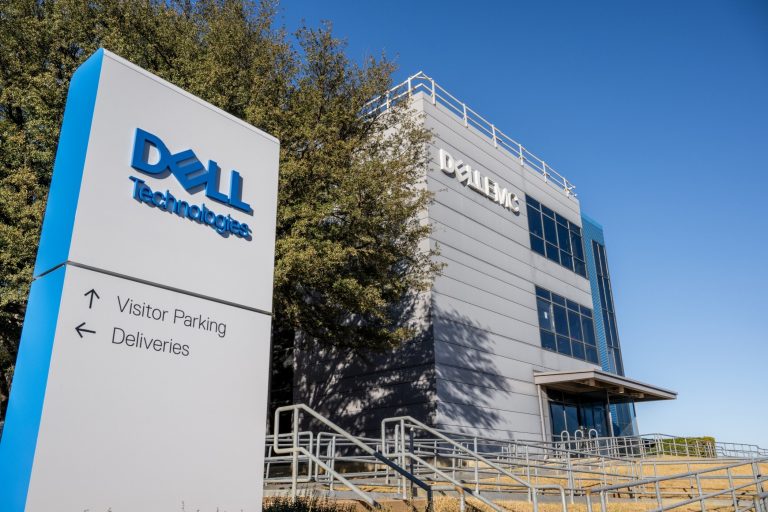
Dell Technologies posted stronger-than-expected quarterly results, but investors reacted sharply to its softer near-term profit outlook, sending shares down more than 5% in extended trading on Thursday.
The systems integrator topped Wall Street expectations on both earnings and revenue. Adjusted earnings per share came in at $2.32, just above the $2.30 consensus estimate, while revenue reached $29.78 billion, surpassing the forecasted $29.17 billion. On the strength of its results, Dell raised its full-year outlook, projecting revenue of $107 billion at the midpoint and diluted earnings per share of $9.55. Both figures stand above Wall Street’s estimates of $104.6 billion and $9.38 per share.
Still, investors zeroed in on Dell’s weaker guidance for the upcoming quarter. The company projected third-quarter earnings per share of $2.45, shy of the $2.55 expected by analysts, even as it guided for revenue of $27 billion, above the $26.1 billion consensus. Dell explained that profitability would be skewed toward the fourth quarter, citing seasonal dynamics in its storage business.
Register for Tekedia Mini-MBA edition 20 (June 8 – Sept 5, 2026).
Register for Tekedia AI in Business Masterclass.
Join Tekedia Capital Syndicate and co-invest in great global startups.
Register for Tekedia AI Lab.
The company’s top-line growth was driven largely by its booming data center division. Revenue from servers and networking surged 69% year-over-year to $12.9 billion, fueled by strong demand for AI servers. Dell has become one of Nvidia’s most important customers, purchasing its chips to build AI-optimized computers for end users such as cloud provider CoreWeave. In just the past two quarters, Dell shipped $10 billion worth of AI servers and now expects to double that pace, projecting $20 billion in AI server sales in fiscal 2026.
But while the AI wave has supercharged Dell’s infrastructure business, other divisions showed signs of strain. Storage revenue declined 3% to $3.86 billion, falling short of StreetAccount estimates of $4.1 billion. Its Client Solutions Group, which includes PC sales to enterprises and was once Dell’s largest business, grew just 1% year-over-year to $12.5 billion—lagging far behind the company’s rapidly expanding data center operations.
Dell also highlighted shareholder returns, noting it spent $1.3 billion on share repurchases and dividends during the quarter.

The Shift From PC Maker to AI Infrastructure Powerhouse
Dell’s latest results highlight not only quarterly performance but also the company’s broader transformation. Once synonymous with consumer and enterprise PCs, Dell has been steadily shifting its focus toward data centers and artificial intelligence infrastructure.
This shift accelerated over the past decade as PC demand matured, margins tightened, and enterprises looked to cloud computing and AI-driven workloads. Michael Dell’s decision to take the company private in 2013 and its later re-entry to public markets gave Dell the flexibility to reposition itself away from its legacy image as just a PC maker.
Central to this transformation has been its deepening partnership with Nvidia. Dell has become one of the world’s leading providers of AI servers—an area that is rapidly overtaking PCs as the company’s defining business, by leveraging Nvidia’s GPUs. Dell’s systems, which integrate Nvidia’s cutting-edge chips, now power some of the largest cloud and AI platforms in operation.

The result is a company increasingly defined by its AI and data center ambitions rather than its traditional client solutions group. While PC sales remain steady, it is Dell’s AI server shipments and infrastructure deals that investors are watching most closely as a barometer of future growth.
However, the company’s guidance suggests investors may need to be patient as seasonal swings in storage and the timing of AI server deployments shift more of the year’s profits into the back half.