

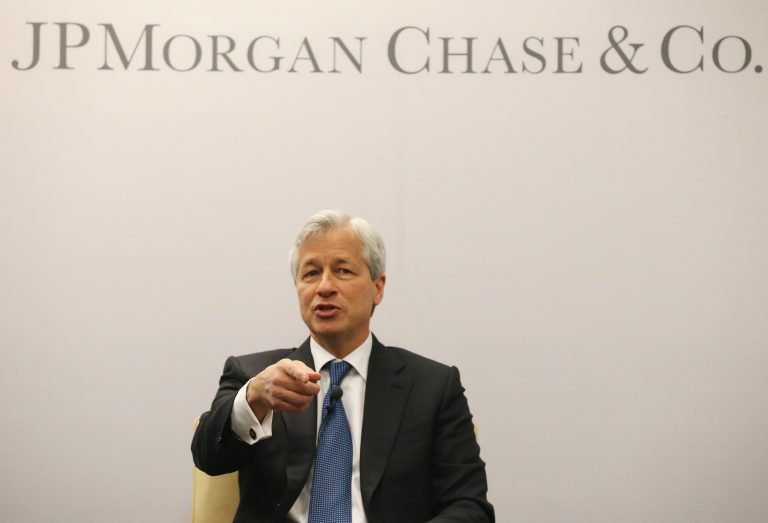
JPMorgan Chase chief executive Jamie Dimon has opened the door to the possibility of the bank entering the fast-expanding prediction markets space, a development that, if pursued, could mark a significant moment in the institutionalization of a market long viewed as sitting somewhere between finance and wagering.
Speaking in an interview with CBS News, Dimon said the bank is studying how such a business could work within the framework of a highly regulated financial institution, while making clear that any move would come with strict internal limits and compliance controls.
“It’s possible one day we’ll do something like that,” Dimon said, referring to prediction market platforms such as Kalshi and Polymarket, where participants trade contracts tied to the outcomes of real-world events.
Register for Tekedia Mini-MBA edition 20 (June 8 – Sept 5, 2026).
Register for Tekedia AI in Business Masterclass.
Join Tekedia Capital Syndicate and co-invest in great global startups.
Register for Tekedia AI Lab.
The remarks are notable not merely because of what they suggest about JPMorgan’s strategic thinking, but because they underscore how prediction markets are increasingly moving into mainstream financial discussion.
Once largely seen as niche betting platforms, these markets have grown rapidly into a widely watched gauge of sentiment around elections, inflation, recession risks, central bank decisions, corporate outcomes, and geopolitical events. In recent months, traders and analysts have increasingly used them as real-time probability indicators alongside bond yields, options markets, and economic surveys.
For a bank of JPMorgan’s scale, entry into this space would be far more than a product launch. It would represent a powerful legitimizing signal for the sector.

Still, Dimon was careful to draw firm boundaries around what the bank would and would not consider.
“We’re not going to be in sports. We’re not going to be in politics. There’s a bunch of stuff we won’t do,” he said.
Sports and political contracts remain among the most popular products on current prediction platforms, but they are also the areas most vulnerable to regulatory scrutiny and reputational risk. By explicitly ruling them out, Dimon appears to be steering the conversation toward event contracts tied to economics, business performance, and market outcomes, areas that can more plausibly sit within a financial institution’s risk and research ecosystem.

This raises an important strategic question: what kind of prediction market could a bank like JPMorgan Chase realistically build?
The most likely route would be through market-based probability tools linked to economic indicators, corporate events, and macro outcomes. For example, contracts could be tied to whether the Federal Reserve cuts interest rates by a specific date, whether U.S. GDP growth exceeds a threshold, or whether a major commodity price remains within a defined range.
Such instruments would have a more direct analytical and hedging function than traditional betting markets. This is where Dimon’s comments on insider information become especially significant.
“You cannot use inside information at all for any reason, including prediction markets,” he said.
For a bank that sits at the center of global capital markets, the compliance risks are immense. JPMorgan advises companies on mergers, restructurings, debt issuance, and strategic transactions. It also operates one of the world’s largest trading businesses. Any participation in markets where event outcomes are traded would inevitably raise concerns about information barriers, conflicts of interest, and market integrity.
In effect, prediction markets inside a bank would need to operate with controls at least as strict as those governing its securities trading and investment banking divisions.
That is why Dimon’s emphasis on “guardrails” should be read as more than rhetorical caution. It is likely a signal that any future product would be designed as a tightly controlled institutional offering rather than a retail-style open betting venue.
Dimon also offered a candid assessment of the nature of these markets.
“I think for the most part it’s more like gambling,” he said.
However, he introduced an important nuance, noting that in certain situations, particularly where participants have deep domain expertise and are taking the opposite side of a trade based on informed conviction, the activity can begin to resemble investing.
That distinction goes to the heart of the debate surrounding prediction markets. To critics, they are simply speculative platforms dressed in financial language, while to supporters, they are highly efficient information aggregation mechanisms that can often outperform traditional forecasting models by pricing collective probabilities in real time.
Indeed, during periods of heightened uncertainty, such as the current geopolitical tensions in the Middle East and persistent recession concerns, market-implied probabilities from these platforms have increasingly been used by analysts as an informal sentiment tool.
Dimon’s broader comments suggest a pragmatic rather than ideological stance.
“People have been gambling forever … every country I’ve ever been in, people gamble,” he said.
He added, “I’m against it if it’s an addiction that ruins your life type thing. I’m a little bit of a libertarian. You have the right to do what you want, the way you want. You know, just take care of yourself.”
That framing places the issue in the context of risk management rather than moral opposition. JPMorgan, currently, has made no formal commitment to launch such a service. But the fact that Dimon is publicly acknowledging the possibility suggests that prediction markets are beginning to attract serious attention from the highest levels of Wall Street.
If the bank ultimately moves forward, it could accelerate the sector’s transition from speculative niche to recognized financial instrument, while also forcing regulators to confront new questions around market structure, information controls, and consumer risk.