

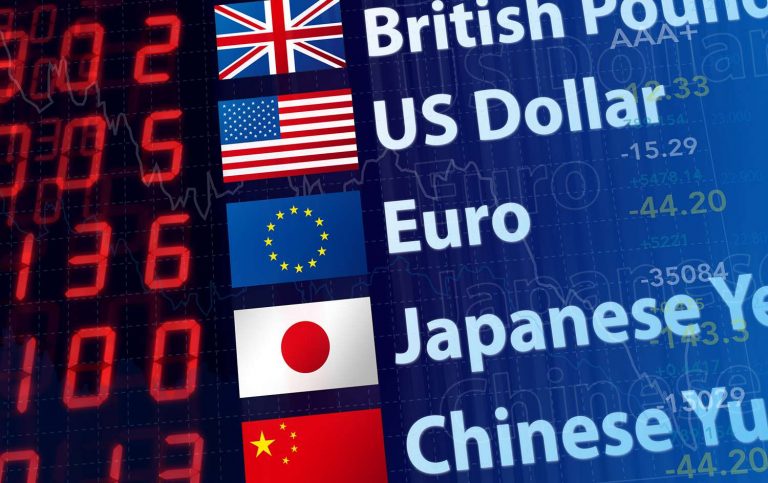
The U.S. dollar plunged to its lowest level in three years on Monday, deepening a slide that has unsettled global markets and sent investors scrambling for safer assets, particularly gold, which surged past $3,500 an ounce for the first time in history.
The ICE U.S. Dollar Index, a benchmark that measures the strength of the greenback against a basket of six major currencies, fell to 97.92 before settling slightly higher at 98.38 by mid-day trading. This marked its lowest level since March 2022, according to data from FactSet.
The sharp decline in the dollar comes amid intensifying concerns over President Donald Trump’s open confrontation with the Federal Reserve. Investors were rattled after Trump renewed his attacks on Fed Chair Jerome Powell, referring to him as “Mr. Too Late” and “a major loser” in a post on Truth Social. The president’s continued undermining of the central bank’s independence, combined with reported efforts by White House officials to explore the legality of removing Powell, has created a crisis of confidence among investors and market participants.
Register for Tekedia Mini-MBA edition 20 (June 8 – Sept 5, 2026).
Register for Tekedia AI in Business Masterclass.
Join Tekedia Capital Syndicate and co-invest in great global startups.
Register for Tekedia AI Lab.
“We’re seeing a clear signal from the market that it doesn’t like even the idea that the president might try to remove the Fed chair,” said Krishna Guha, vice chairman at Evercore ISI, during an appearance on CNBC’s Squawk Box on Monday. “There has been some loss of confidence in U.S. economic policy making in recent weeks. We’ve seen that in this very odd combination of upward pressure at times on longer-term bond yields combined with a weaker dollar. That suggests global investors pulling capital out of the U.S.”
The political brinkmanship has pushed global investors to reassess their exposure to U.S. assets, triggering an exodus that has accelerated over the past several weeks. Business leaders are increasingly voicing concern that the current trajectory is sending all the wrong signals about America’s economic stability and institutional coherence.
“Gold is not just any commodity, it’s money,” said Peter Schiff, Chief Economist and Global Strategist at Euro Pacific Capital. “Under normal circumstances gold does not move the way it is now. It’s already up another $58 tonight [Monday], trading above $3,483. This is the end of the U.S. dollar’s dominance. Life in America is about to change in ways few can imagine.”

The rally in gold, long considered a refuge during economic uncertainty, has been dramatic. Spot prices breached the $3,500-per-ounce mark early Tuesday, up from $2,623 at the start of the year. Analysts now believe the metal could push past $4,000 in the coming weeks, noting the pace at which it broke the $3,000 barrier was already unprecedented.
Historically, during periods of market turmoil, investors have turned to U.S. dollars and Treasuries. But this time, with Washington itself at the center of the storm, many are abandoning traditional havens in favor of gold and other non-U.S. assets. The dollar’s weakness has been accompanied by sharp drops in major stock indexes, with Wall Street continuing to bleed.
On Monday, the Dow Jones Industrial Average fell by nearly 1,000 points — a 2.5% decline — making it one of the worst single-day losses in recent months. The index is now on track to record its worst April performance since 1932, deepening anxieties that the political conflict in Washington is evolving into a broader financial crisis.

Other major currencies gained sharply against the dollar. The euro rose 1.3%, while both the Japanese yen and Swiss franc advanced as traders moved to unwind dollar holdings. Treasury yields also fell as prices rose, reflecting rising demand for government bonds even as questions swirl about the long-term credibility of U.S. fiscal and monetary policy.
Andy Laperriere, head of U.S. policy at Piper Sandler, warned clients in a note that the president’s behavior could continue to roil markets.
“We are looking at a president who is determined to turn Washington upside down,” Laperriere wrote. “Investors who ignored Trump’s own words proclaiming higher tariffs were ill-served by doing so. Likewise, it would be a mistake to brush aside Trump’s own words and actions on these other issues.”
While Trump’s supporters argue that the president is simply pushing for accountability and better economic results, the markets are reacting to what appears to be an erosion of institutional guardrails. The Fed, traditionally an apolitical actor charged with safeguarding monetary stability, has now been dragged into a battle that could redefine its role.
Thus, the dollar’s decline, the record-setting rally in gold, and the red ink across stock markets suggest investors are bracing for more instability in the weeks ahead. While Washington remains embroiled in political wrangling, Wall Street is signaling that the price of unpredictability may already be showing up in the balance sheets of global portfolios.