

There is a shift taking place within the boardrooms and executive suites of organizations across the globe. For decades, the primary focus of senior leaders has been on developing and executing a solid strategic plan. They would spend countless hours poring over data and crafting a three-year plan to achieve the company’s objectives. The majority of their time would be spent putting the plan into action, relying on the input from market data and trends that were relatively predictable.
When technologies first came out, they were “cutting edge.” Six months later, however, they have become table stakes for any company looking to remain competitive. With the pace of technological shift happening at unprecedented rates, many senior leaders are struggling to make key technology buying decisions for their companies when they do not even have a good working knowledge of the technologies that are in play.
Delegating technical understanding to the technical teams is no longer sufficient for senior leaders to make decisions regarding technologies and practices that have not yet had time to mature and gain widespread adoption. Modern senior leaders must develop their own upskilling practice in order to lead with the necessary clarity and authority in a rapidly changing environment.
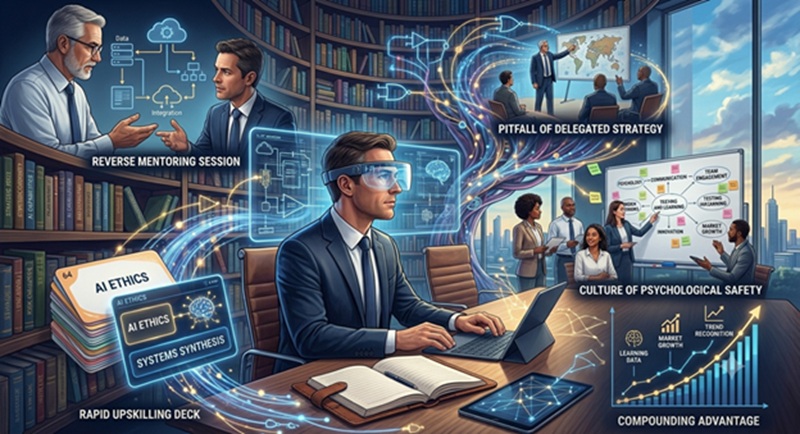
The Pitfall of Delegated Strategy
One of the biggest mistakes that a leadership team can make in an environment that is changing fast is treating technical knowledge as if it were a low-level task that can be delegated to someone else. That’s the line of thinking that says the leader of the organization has got to have a high level vision, that the leader of the organization has got to be able to think about the really big strategic issues of the organization, and that the technical details of how things work, the technical details of how new tools work, that those are things that can be left to the specialists.
Delegating certain tasks to technical specialists is necessary for organizations to scale, but it is not wise for senior leaders to remain completely detached from the technical realities of the tasks that are being delegated. The senior leader must understand enough about the new tools and processes to evaluate the risks involved in their adoption, to recognize opportunities to increase the operational efficiency of the organization, and to avoid investing large sums of capital in solutions that are likely to become outdated before they have a chance to pay back their cost.
Moreover, when leaders lack the necessary knowledge, their teams quickly recognize the discrepancy and begin to doubt the leader’s ability to provide relevant and effective guidance. Because the leader is not able to provide reliable insights into the operational aspects of the work, guidance will lack substance and become irrelevant.
Upskilling as an executive is not necessarily to learn to code or to build software. Its primary function is to help the executive understand the capabilities and limitations of technology and how it can be integrated into business processes to gain a competitive advantage.
Building a System for High Velocity Learning
The biggest obstacle executives face when upskilling is time. When your calendar is packed with back-to-back meetings, deep study sessions feel like an impossible luxury.
To make rapid learning work, you must build high-efficiency habits into your existing routine. The goal is to maximize knowledge absorption while minimizing time friction.
First, focus on structural synthesis. Instead of trying to read entire technical books or lengthy whitepapers, leverage modern processing workflows. Converting dense technical reports, industry updates, or a complex PDF to flashcards allows you to break down overwhelming documents into bite-sized review decks. This enables active recall during tiny pockets of downtime, like waiting for a flight or traveling between meetings.
Second, leverage internal expertise as a learning resource. Schedule brief reverse mentoring sessions with senior engineers or product specialists within your own organization. Ask them to explain key concepts, current bottlenecks, and emerging tools in plain language.
Third, test your understanding through direct application. Explain a new concept back to someone else, or use it to re-evaluate a current business process. Active recall and immediate application accelerate retention far faster than passive reading.
Cultivating Psychological Safety and Learning Agility
Rapid upskilling requires embracing being a beginner again. This is hard for many Senior Executives as they have spent years building the knowledge and expertise to become a Subject Matter Expert, and want to continue to command a room. They fear appearing to not know the answer, especially when others in the room are unlikely to know the answer either.
Showing an organization that learning is a process for everyone during a time of disruption and uncertainty leads to a culture where, when a CEO shows that he or she doesn’t have all the answers, that allows for psychological safety for others to do the same. This leads to a culture and organization that learns together and, thus, adapts together.
Creating a culture of psychological safety at work means your employees will feel safe experimenting, trying new things, and learning from their mistakes. This is very important in an era of change and for companies that want to adapt quickly to the market.
The Compounding Advantage of Strategic Curiosity
Executives who successfully navigate through disruption are not necessarily the most technically savvy. More importantly, they are people with strategic curiosity who continue to learn and absorb as many new concepts as possible.
Whether the new technological changes have occurred within your industry or outside of it, consistently finding the time to upskill will open your eyes to new concepts and make your strategic intuition sharper. Not only will you start to recognize trends early enough to prepare your business for the changes to occur before they hit your market, but also be able to more critically evaluate vendor proposals to find the best solution to add value to your organization on a sustainable basis.
Finally, upskilling as an executive is not a short-term campaign, but rather a discipline that must be practiced on an ongoing basis to enable a business to become resilient, relevant and ready for the future.