

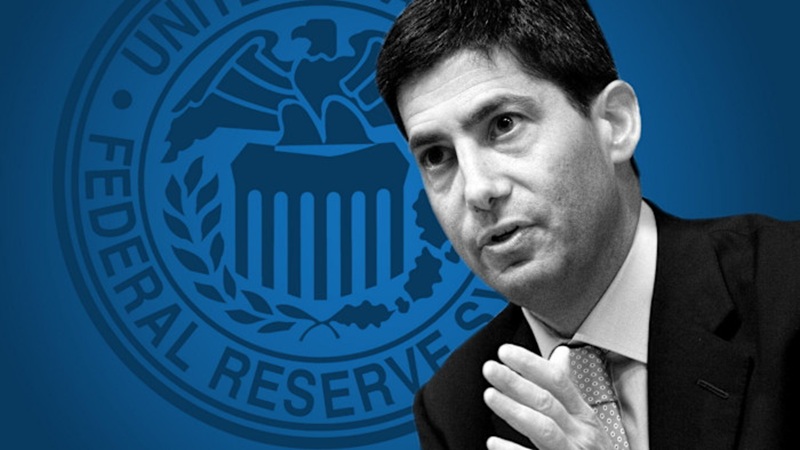
Federal Reserve Chairman Kevin Warsh has expressed confidence in the resilience of the US economy and its prospects for stronger long-term growth, noting that a surge in artificial intelligence investment is supporting demand even as energy shocks and persistent inflation complicate the outlook for monetary policy.
Speaking at the International Monetary Fund and World Bank annual meetings in Bangkok on Friday, Warsh said he was surprised by how well the global economy had withstood geopolitical tensions, rising energy costs and tighter monetary conditions. However, he warned that the investment boom, initially concentrated in AI but increasingly spreading into other sectors, was generating a near-term demand shock that was adding to inflationary pressure.
His remarks underpin the tension facing central banks: investment is helping sustain economic activity, but the additional demand is making it more difficult to bring inflation back to target.
Register for the next Tekedia Mini-MBA.
Register for Tekedia AI in Business Masterclass.
Join Tekedia Capital Syndicate and co-invest in great global startups.
“I came out of meetings here yesterday and today and it’s hard to be in a discussion with central bankers and not compare notes and hear the same thing about the surge in prices,” Warsh said.
He described inflation as a shared global challenge, noting that central banks had tightened monetary policy across most major economies.
“With inflation a common challenge,” he said, central banks have undertaken a synchronous tightening in monetary policy in most places around the world, and that means there’s no free riders.”

The coordinated approach reflects the difficulty of controlling inflation when economies face similar pressures from energy markets, investment demand and other cost increases. It also means that policymakers have limited scope to ease monetary conditions independently without risking renewed price pressures or undermining confidence in their commitment to price stability.
Warsh declined to indicate whether the Federal Reserve would raise interest rates again before the end of the year, maintaining his position of avoiding commitments ahead of individual policy meetings.
In the United States, he said the central bank had demonstrated its determination to restore price stability by withdrawing some monetary accommodation through its September interest-rate increase.

“We made very clear that we would deliver price stability, and we removed a dose of accommodation about a month ago,” he said.
However, Warsh offered no indication of whether another increase would be necessary or how policymakers were interpreting the latest inflation data.
“I don’t prejudge meetings,” he said during a discussion with IMF Managing Director Kristalina Georgieva. “I don’t believe in saying now what I might do at the meetings that we have in the balance of this year.”
His caution contrasts with comments from other Federal Reserve officials, many of whom have indicated that additional monetary tightening may be required if inflation remains persistent. At the same time, most have emphasized the need for more economic data before deciding whether another increase is justified.
Financial markets have interpreted those remarks as a signal that the Fed is unlikely to raise rates again this month, with investors instead assigning greater likelihood to a December increase. That expectation persisted even after reports released during the week showed two separate measures of inflation rising more than anticipated, moving further away from the Fed’s 2% target.
Warsh’s refusal to offer a near-term policy signal leaves that market assessment largely unchanged. His comments suggest that the central bank remains focused on the broader inflation challenge rather than committing to a predetermined sequence of rate decisions.
The assertion matters for businesses and investors because interest rates influence borrowing costs, asset valuations, consumer spending, and the financing of capital-intensive projects. If inflation remains elevated, the Fed may have to maintain restrictive conditions for longer, even as investment supports economic growth.
AI Investment Boosts Demand Before Productivity Gains Materialize
Warsh was more explicit about his expectations for artificial intelligence, describing it as a major potential source of productivity growth and long-term wealth creation. But he cautioned that the economic benefits would not emerge smoothly or immediately.
He noted that AI investment was stimulating demand before the technology had generated its full productivity benefits across the wider economy. That timing creates a potential imbalance: companies spend heavily on computing infrastructure, equipment and related services today, while the gains from more efficient production may take years to become widespread.
“It’s obviously hitting the demand side of the economy before it’s going to hit the supply side of the economy,” Warsh said.
The distinction is important for monetary policy. Strong investment can support employment, spending and output, but if productive capacity does not expand quickly enough to meet the additional demand, inflation may remain elevated. In that scenario, the same investment boom that supports growth could also complicate the Fed’s efforts to contain prices.
Warsh nevertheless expects AI to improve economic performance over the medium term, particularly in countries and businesses that deploy the technology effectively.
“We don’t know in the next 12 or 18 months its effect on employment, but if you believe like I believe, which is it will make economies and countries that put it to good use more productive, that it’s going to make it so that we will have more wealth, then that has to be a very good thing,” he said.
He hereby acknowledges a central uncertainty surrounding AI adoption: whether productivity improvements will arrive quickly enough to offset the substantial costs of investment and any disruption to employment. Businesses are spending heavily on AI systems, data centers and computing capacity, but the scale and timing of economy-wide returns remain difficult to establish.
To examine those effects, Warsh said a task force convened to advise the Fed on AI’s impact on productivity and employment would hold a field hearing in the San Francisco Bay Area on November 16. The event will provide the first public indication of the group’s work.
However, the initiative points to a broader challenge for policymakers. AI could raise the economy’s productive capacity and support stronger growth without generating the same inflationary pressures over time. But in the transition, the effects on labor markets, business costs and aggregate demand may complicate decisions on interest rates.
Warsh also attributed part of the US economy’s strength to an investment surge extending beyond artificial intelligence. He said the broader expansion was providing support for growth and helping the economy withstand external shocks.
“It means we’ve got plenty of tailwinds that are giving some strength and durability to this economy,” he said. “That sort of momentum is certainly not found everywhere in the world.”
His assessment was not limited to the United States. Warsh said the resilience of the global economy had exceeded his expectations, given the geopolitical tensions and regional conflicts confronting policymakers.
But that resilience does not eliminate the risks facing the outlook. Higher energy prices can raise production and transportation costs, squeeze household purchasing power and force central banks to maintain tighter monetary conditions. The effects can be difficult for economies that depend heavily on imported energy or have limited fiscal room to cushion households and businesses.
The IMF said earlier in the week that AI-related investment was helping keep global economic growth above 3% this year, partly offsetting the drag from oil prices hovering above $100 per barrel. It also warned that elevated debt levels and a potential sharp reversal in AI investment and asset values posed significant risks.
Those concerns expose the uncertainty behind the current investment-led expansion. If AI spending continues to spread through the economy and eventually delivers meaningful productivity gains, it could support a more durable period of growth. If investment retreats before those gains materialize, the resulting decline in spending and asset values could weaken economic momentum.
Warsh expressed confidence that the United States would emerge from the current period in a stronger position, pointing to the importance of credible monetary policy in sustaining business and household confidence.
He said central bankers meeting in Bangkok shared a commitment to protecting price stability and were taking action to demonstrate that commitment, providing the confidence needed for growth to continue.
“I believe optimistically — you might think naively — at least in the United States, we’re going to come out of this stronger with a more durable economy, more capable of leading the world on economic growth,” Warsh said.