

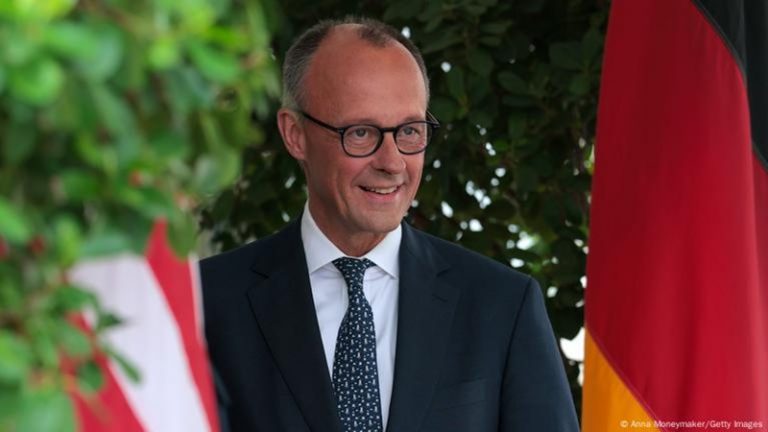
Recent opinion polling in Germany, conducted in the lead-up to the next federal election expected by March 2029, indicates a modest boost for Chancellor Friedrich Merz’s center-right coalition government.
Formed after the CDU/CSU’s victory in the February 2025 snap election securing 28.6% of the vote and leading a grand coalition with the SPD, the administration has navigated economic stagnation, immigration debates, and rising unemployment.
Current trends show the governing parties—primarily CDU/CSU and SPD—collectively polling at around 45.2% nationally, up from post-election lows but still trailing the surging far-right Alternative for Germany (AfD) at 25.4%.
Register for Tekedia Mini-MBA edition 20 (June 8 – Sept 5, 2026).
Register for Tekedia AI in Business Masterclass.
Join Tekedia Capital Syndicate and co-invest in great global startups.
Register for Tekedia AI Lab.
This minor lift is attributed to Merz’s focus on tax cuts, economic revitalization, and stricter migration controls, which resonate amid public concerns over inflation and border security. Data aggregated from recent polls; AfD’s gains highlight ongoing polarization, while the coalition’s edge provides short-term stability.
Analysts note this uptick could be fleeting, as the AfD continues to erode support from both conservatives and the center-left by capitalizing on anti-immigration sentiment.
AfD Stumbles in Key Mayoral Run-Off, Failing to Claim First Major City Win
In a closely watched local election on October 12, 2025, the far-right AfD fell short in its bid to secure its first mayoral position in a significant German city.

The run-off in Frankfurt an der Oder—a border town in Brandenburg with around 58,000 residents—pitted AfD candidate Wilko Möller against independent Axel Strasser. Preliminary results show Strasser winning decisively with 69.8% of the vote to Möller’s 30.2%, amid a 49.4% turnout.
This outcome blocks what would have been a symbolic breakthrough for the AfD, which has been classified as a “suspected right-wing extremist” organization by German intelligence and faces ongoing surveillance.
The race followed a tight first round on September 21, where Strasser edged Möller 32.4% vs. 30.2%, eliminating candidates from the CDU and SPD. Political observers, including University of Potsdam’s Jan Philipp Thomeczek, had warned that an AfD victory could signal the party’s viability in urban centers beyond its eastern strongholds.
Instead, the loss reinforces the “firewall” strategy by mainstream parties, who refuse coalitions with the AfD despite its national polling surge.This defeat echoes earlier setbacks for AfD mayoral hopefuls, such as losses in North Rhine-Westphalia run-offs in late September 33% in Gelsenkirchen, 28% in Hagen.

However, the party did notch a historic small-town win in July 2025 with Hannes Loth in a rural eastern municipality, underscoring its rural-urban divide in appeal. On X, the result sparked quick reactions, with users sharing Al Jazeera coverage and debating the AfD’s broader momentum.
These developments highlight Germany’s deepening political fault lines: a stabilizing but vulnerable center-right government against an AfD capitalizing on discontent, yet repeatedly rebuffed at executive levels.
The minor boost reflects public approval of Merz’s focus on tax cuts and stricter migration policies, addressing economic stagnation and immigration concerns. However, with unemployment rising and inflation persistent, sustained gains depend on tangible economic results by 2026.
The CDU/CSU (25.1%) and SPD (14.4%) face internal tensions, as the SPD’s declining share (-2.0% since February 2025) pressures the coalition’s unity. Failure to align on contentious issues like migration or budget deficits could erode this uptick.
The AfD’s strong 25.4% polling, closing in on the CDU/CSU, underscores a polarized electorate. The coalition’s modest gains may not withstand AfD’s anti-establishment appeal if economic or social crises intensify, particularly in eastern Germany.
A stabilized German government could bolster the EU’s center-right leadership, especially as Germany pushes for tighter EU migration policies. However, the AfD’s influence may complicate Berlin’s ability to project unity in Brussels.
AfD’s Mayoral Run-Off Loss
The loss reinforces the AfD’s struggle to break through in urban centers, where diverse electorates and mainstream party “firewalls” block its path. This contrasts with its rural successes like Hannes Loth’s 2025 small-town win, highlighting a geographic limit to its executive ambitions.
The decisive victory of independent Axel Strasser, backed by a united anti-AfD front, shows the effectiveness of mainstream parties’ refusal to cooperate with the AfD. This strategy, if maintained, could cap AfD’s local governance gains, even as its national polling surges.
An AfD mayoral win would have been a historic milestone, amplifying its legitimacy and media presence. The defeat tempers its momentum, potentially cooling donor and activist enthusiasm, though its strong showing (30.2%) still alarms opponents.
Despite the loss, the AfD’s ability to reach a run-off in a city like Frankfurt an der Oder signals growing acceptance among some voters, especially in the east. Its national polling strength (25.4%) suggests that future local breakthroughs remain possible, particularly in smaller municipalities or if mainstream parties falter.
The AfD’s rise, coupled with the coalition’s fragile gains, points to a volatile electorate ahead of the 2029 federal election. Smaller parties like The Left (10.8%) and Greens (11.6%) could play kingmaker roles if the coalition weakens further.
The AfD’s anti-immigration rhetoric, while divisive, resonates with a significant minority, risking deeper societal divides. The government’s pivot to stricter migration controls may mitigate this but alienates progressive voters.
The AfD’s strength in eastern Germany like in Brandenburg versus its urban rejections highlights a regional divide that could shape future campaign strategies and resource allocation.
The government’s slight popularity boost offers breathing room but not security, while the AfD’s mayoral loss delays its local ascent without diminishing its broader challenge. Both trends underscore Germany’s delicate political balance, with economic performance and migration debates likely to dictate future shifts.