

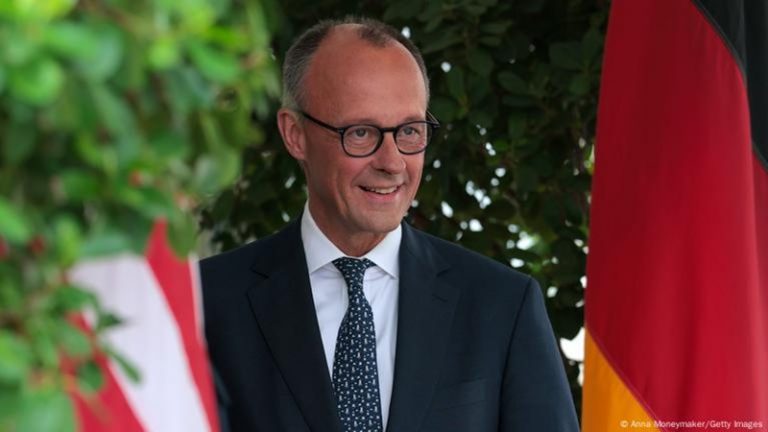
Germany’s fuel-price crisis has moved from an economic concern to an immediate political and household pressure point, with Chancellor Friedrich Merz now promising measures to ease the burden on consumers.
Speaking in Berlin on September 15, Merz said that for many people who depend on cars every day, a limit had been reached. However, his government has yet to settle on the precise mechanism for providing relief.
The urgency is reflected at Germany’s petrol stations. The average national price for E10 petrol reached a record €2.286 per litre, according to figures cited by Tagesschau and the ADAC.
Register for the next Tekedia Mini-MBA.
Register for Tekedia AI in Business Masterclass.
Join Tekedia Capital Syndicate and co-invest in great global startups.
Diesel stood at €2.412 per litre, only a few cents below its previous record. For commuters, logistics companies and businesses dependent on road transport, the increase represents more than a higher household bill: it raises the operating cost of moving people and goods throughout Europe’s largest economy.
The immediate driver is the international energy shock. Disruptions associated with the conflict in the Middle East have tightened oil supplies and pushed crude prices higher. Physical European oil cargoes recently moved above $130 a barrel.
While Brent futures approached $110, illustrating the scale of the supply concerns confronting energy markets. Yet Germany’s debate is not simply about international oil prices. Domestic taxes and levies form a substantial part of the price motorists pay at the pump.

Making government intervention one possible route to reducing the immediate burden. Earlier this year, Berlin temporarily cut fuel taxes by about 17 cents per litre for petrol and diesel for two months, a package the government estimated would provide around €1.6 billion in relief.
The renewed crisis, however, has exposed divisions inside Merz’s governing coalition. Social Democratic politicians have advocated stronger intervention, including a fuel-price cap and a windfall tax on energy companies.
Merz has rejected the windfall-tax proposal, while members of the Union have considered alternatives such as temporarily reducing energy taxes or providing targeted financial assistance to households.

That disagreement reflects a broader policy dilemma. A fuel-price cap could provide rapid and visible relief, but it would require determining how the government would manage the difference between regulated prices and volatile international costs.
A tax reduction could lower prices more directly, but would reduce government revenue and might not fully offset movements in global crude prices. Targeted transfers could concentrate assistance on households most affected, although they would not directly lower the price displayed at petrol stations.
Merz has indicated that the government is working with federal states and coalition partners and intends to present a proposal soon. He has also pointed toward Germany’s competition authorities, noting that the Federal Cartel Office already has powers to investigate abusive pricing.
However, the chancellor acknowledged that consumers’ experience suggests existing oversight has not been sufficient to resolve the immediate pressure. The fuel crisis therefore places Germany between two forces.
An external energy shock that Berlin cannot directly control and domestic political expectations that the government should shield households from its consequences. The eventual response will have to balance consumer relief, fiscal costs, market competition and the possibility that elevated energy prices could persist.
For Germany’s economy, the stakes extend beyond the petrol station. Persistently expensive fuel can feed into transportation costs, business expenses and consumer prices, potentially prolonging broader inflationary pressure.
The government’s forthcoming package will consequently be measured not only by how much it reduces the price of filling a tank, but by whether it can provide meaningful relief without creating a costly policy commitment that becomes difficult to sustain if global energy markets remain volatile.
Germany’s Wholesale Prices Signal Renewed Inflation Pressure
Germany’s wholesale economy delivered a notable warning in August, with wholesale prices rising at their fastest pace in three and a half years, according to the Federal Statistical Office.
The development points to renewed cost pressures within Europe’s largest economy and raises questions about how businesses, consumers and policymakers will navigate an environment in which input prices are accelerating.
Wholesale prices occupy an important position between producers and retailers.
When the cost of goods traded at the wholesale level increases significantly, businesses can face higher expenses for raw materials, energy, agricultural products and manufactured goods. Those costs may eventually be passed along supply chains, although the extent and timing depend on competition, demand and companies’ ability to absorb higher expenses.
The August increase therefore matters beyond the wholesale sector itself. Germany has spent much of the recent period attempting to manage weak economic growth while dealing with elevated living costs and persistent uncertainty across European industry.
A renewed acceleration in wholesale prices could complicate that adjustment by placing additional pressure on companies already confronting higher operating and financing costs. For manufacturers, the consequences can be particularly significant.
Germany’s industrial economy relies heavily on complex supply chains and substantial quantities of energy, machinery, metals, chemicals and other intermediate goods. When wholesale prices rise rapidly, producers must decide whether to accept narrower margins, increase selling prices or seek efficiency gains elsewhere.
Smaller businesses may have less capacity to absorb such increases than larger corporations. The effect on consumers is less immediate but potentially important. Wholesale inflation does not automatically translate into equivalent increases in consumer prices.
Retailers and manufacturers may absorb part of the additional cost, while falling demand can prevent businesses from fully passing expenses to customers.
Nevertheless, sustained wholesale inflation can create an environment in which consumer prices face renewed upward pressure.
The latest development also comes at a sensitive moment for Germany’s broader economy. Companies have been navigating subdued industrial activity, international trade uncertainty and changing energy conditions.
For an economy with a large manufacturing base, price movements in upstream markets can influence investment decisions, employment plans and expectations about future demand. There is also a wider European dimension.
Germany remains the largest economy in the euro area, meaning changes in its domestic cost structure can influence regional supply chains and inflation dynamics. If higher wholesale prices persist rather than representing a temporary movement.
Businesses and policymakers across Europe will have to monitor whether those pressures spread into producer and consumer prices. For the European Central Bank, the distinction between a temporary supply shock and persistent inflation will be particularly relevant.
Monetary policy responds primarily to broader inflation dynamics rather than a single wholesale-price reading. Consequently, the August data alone does not establish a new inflationary trend.
Future readings on producer prices, consumer prices, wages and economic activity will help determine whether the pressure is becoming entrenched.
The immediate issue is straightforward: the cost environment is becoming more challenging. Companies may need to reassess procurement strategies, pricing decisions and investment plans as they attempt to protect margins without weakening demand.
The acceleration in wholesale prices is therefore more than a statistical milestone. It provides an early signal of changing conditions further up Germany’s economic supply chain. Whether it develops into broader inflation will depend on how long the increase lasts and how businesses respond.
For now, the figures underline the continuing tension between Germany’s need for economic recovery and the renewed risk of rising costs.