

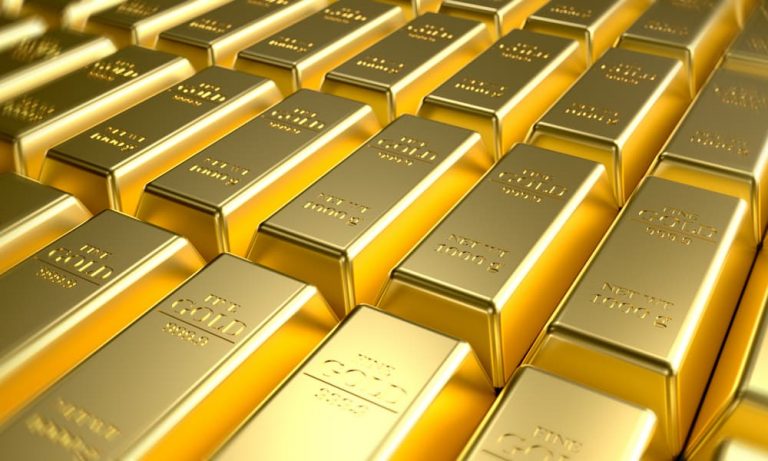
Gold prices edged higher on Tuesday morning but failed to alter what is shaping up to be the metal’s sharpest monthly decline since the depths of the 2008 global financial crisis.
The U.S.-Iran conflict, surging oil prices, and a stronger dollar continue to drive heavy liquidation across the bullion market.
Spot gold rose about 1 per cent in early trading to around $4,553.69 per ounce, while front-month futures climbed 0.6 per cent to roughly the same level. Even so, bullion remains firmly on course for its steepest monthly drop in nearly 17 years. Recent market data published by CNBC show gold is down between 11.8 per cent and 14.6 per cent for March, depending on the close, which would make it the worst monthly performance since October 2008.
Register for Tekedia Mini-MBA edition 20 (June 8 – Sept 5, 2026).
Register for Tekedia AI in Business Masterclass.
Join Tekedia Capital Syndicate and co-invest in great global startups.
Register for Tekedia AI Lab.
The rebound comes amid continuing uncertainty over the war in the Middle East, now in its fifth week.
A report by The Wall Street Journal said President Donald Trump told aides he was prepared to halt military hostilities against Iran even if the Strait of Hormuz remained largely closed, a signal that briefly improved sentiment across markets.
Trump later wrote on Truth Social that Washington was “in serious discussions” with Iranian officials, while warning that if a deal was not reached quickly, U.S. forces would target electricity plants, oil wells, and the strategically critical Kharg Island.

The mixed messaging has left markets caught between hopes of de-escalation and the risk of a broader energy shock. That uncertainty was reinforced by Secretary of State Marco Rubio, who said in an interview that Washington’s objectives in Iran would take “weeks, not months” to achieve.
Reports that 2,500 U.S. Marines from the 82nd Airborne Division had arrived in the region over the weekend further underscored the risk that the conflict may yet intensify. Ordinarily, such geopolitical turmoil would strengthen gold’s appeal as a haven asset. Instead, the market has moved in the opposite direction.
The key reason is that the conflict’s economic transmission has come through energy markets rather than direct flight-to-safety buying.

The effective closure of the Strait of Hormuz, a major conduit for global crude and gas flows, has sent oil prices nearly 50 per cent above pre-war levels, sharply lifting inflation expectations. That has forced investors to reprice the outlook for U.S. monetary policy.
Markets that had earlier expected multiple rate cuts this year are now leaning toward one or none, a shift that has pushed Treasury yields and the U.S. dollar higher, both of which traditionally weigh on non-yielding assets such as gold.
Wayne Nutland, investment manager at Shackleton Advisers, said the market has reverted to its pre-Ukraine-war behavior.
“Prior to the Ukraine war, the gold price tended to be inversely correlated to real bond yields and the US dollar, with the gold price rising when those metrics fell, and gold falling when those metrics rose,” he said.
“The period after the Ukraine war upended these relationships, in particular in 2025 and into early 2026 when gold rose very strongly, far in excess of the moves suggested by those historic relationships.”
He added that the Iran war has now restored those traditional correlations.
“Bond yields and the U.S. dollar have both moved higher, and against this backdrop gold has demonstrated its traditional inverse sensitivity to these metrics, falling as a result,” he said.
“Gold’s declines have perhaps also been exacerbated by the strength of the gold price going into 2026 and possibly a desire amongst investors to liquidate profitable positions.”
Gold entered the year from an exceptionally elevated base, having surged to a record high above $5,595 per ounce in late January after a powerful multi-year rally driven by central bank buying, geopolitical hedging, and reserve diversification away from the dollar.
This means part of the current sell-off is less about a collapse in the long-term investment thesis and more about profit-taking in an overcrowded trade.
Iain Barnes, chief investment officer at Netwealth, said recent price moves have been unusually violent.
“International central banks seeking to diversify their reserves away from U.S. dollars may have started gold’s bull market in the past few years, but in the end the market ran out of new financial buyers and instead saw widespread profit-taking as wider uncertainty hit markets and the dollar rebounded,” he said.
Barnes also drew parallels with the 2008 financial crisis.
“In the first half of 2008, investors doubled down on the emerging market growth story, fueling commodity price increases alongside dollar weakness even as western economies hit the buffers,” he said.
“As the global financial crisis spread wider, global risk appetite collapsed and gold was hit alongside more productive commodities such as oil and copper as the dollar surged.”
He added: “This year, the market has again found where investors are most exposed: excessive positioning in gold as it was seen as the last remaining safe haven asset.”
That comparison helps explain why gold is falling even during wartime. In periods of market stress, investors often liquidate profitable assets to raise cash or meet margin calls elsewhere, temporarily overwhelming traditional haven demand.
Goldman Sachs, however, remains constructive on the medium-term outlook.
In a note on Monday, the bank said: “[But] we continue to forecast gold prices reaching $5,400/toz by end-2026, as central bank diversification continues, currently low speculative positioning normalizes, and the Fed delivers the 50bp of cuts our economists expect.”
The bank added that while risks remain skewed to the downside in the near term, the broader structural drivers remain intact.
“Over the medium term, risks are skewed to the upside if the Iran episode — together with broader geopolitical developments (e.g., Greenland, Venezuela) — were to accelerate diversification into gold and to weigh on perceptions of Western fiscal sustainability,” it said.
In effect, the market is witnessing a clash between short-term macro pressure and long-term structural demand. This explains why higher yields, a stronger dollar, and forced liquidation are currently dominating price action.
But beneath the current sell-off, central bank accumulation and geopolitical reserve diversification continue to provide support for the longer-term bull case. That tension is what makes this one of the most dramatic reversals in gold since 2008.