

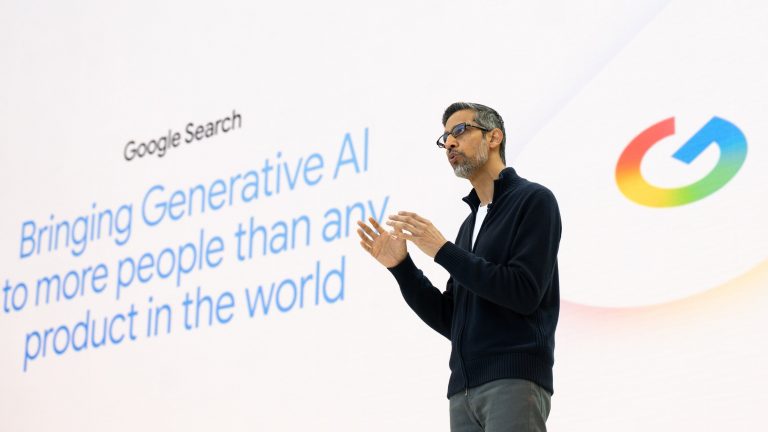
Alphabet Chief Executive Sundar Pichai mounted a forceful defense of Google’s artificial intelligence strategy on Wednesday, seeking to reassure investors that the company remains at the forefront of AI innovation even as delays to its flagship Gemini model have intensified concerns that rivals are gaining ground.
During Alphabet’s second-quarter earnings call, Pichai acknowledged areas where Google has fallen behind, particularly in AI coding and autonomous software agents, but argued that the company continues to lead in several key aspects of frontier AI and remains confident its next generation of models will restore its competitive position.
The unusually direct defense comes amid mounting investor scrutiny of Google’s AI execution at a time when OpenAI, Anthropic, xAI and an expanding group of Chinese AI developers are releasing increasingly capable models at a rapid pace, raising questions about whether Google has lost the momentum it once enjoyed in artificial intelligence research.
Register for the next Tekedia Mini-MBA.
Register for Tekedia AI in Business Masterclass.
Join Tekedia Capital Syndicate and co-invest in great global startups.
Investors have become increasingly concerned after Google postponed the release of Gemini 3.5 Pro, a flagship model originally expected in June. The delay has been particularly significant because Gemini 3.5 Pro was widely anticipated to strengthen Google’s position in AI-assisted software development and autonomous “agentic” systems, two of the industry’s fastest-growing and most commercially valuable segments.
The postponement has boosted a broader narrative that Google’s historically measured approach to model releases may be allowing competitors to capture mindshare among developers and enterprise customers, even as the company continues to invest more heavily than most rivals in AI infrastructure.
Facing pointed questions from analysts, Pichai conceded that Google has work to do.

“We’ve had clearly frontier models. There are many attributes on which we are still at the frontier; there are areas where we’ve acknowledged we need to improve and coding and agentic coding is an example of that,” he said in response to JPMorgan analyst Doug Anmuth, who questioned whether Gemini could remain competitive at the industry’s leading edge.
Rather than focusing on the delayed Gemini 3.5 Pro model, Pichai emphasized Google’s broader AI portfolio, particularly the Gemini Flash family of models, which prioritize speed, efficiency and lower operating costs. He described Flash as Google’s “workhorse” model, noting that it is increasingly being deployed across cybersecurity, enterprise software, customer service automation and data analytics, areas where demand for cost-efficient AI is expanding rapidly.
Pichai highlighted the release of Gemini 3.6 Flash earlier this week, saying the model improved by more than 10 points on a key coding benchmark while requiring fewer computational tokens than its predecessor, an indication of greater efficiency. Google also introduced Gemini 3.5 Flash-Lite, designed for lower-cost AI applications, alongside Flash Cyber, a model tailored for cybersecurity workloads. Meanwhile, Gemini 3.5 Pro remains in testing with selected partners before a broader rollout.

The strategy suggests Google is prioritizing commercial deployment across multiple market segments rather than relying solely on one flagship model to compete with OpenAI’s GPT series or Anthropic’s Claude family.
Looking ahead, Pichai attempted to shift investor attention toward Gemini 4, which he described as Google’s next major leap in frontier AI.
“I think people will be pleased” when Google unveils Gemini 4, he said, calling it a “very ambitious effort.”
He added that Google is training a significantly larger model intended to compete at the highest level of AI performance and stressed that the company remains “very committed and very confident” about maintaining leadership in frontier AI.
Responding to questions from Barclays analyst Ross Sandler about Google’s slower model release schedule, Pichai disclosed that the Gemini 4 roadmap envisions releasing new models “almost at a monthly cadence,” signaling a substantial acceleration in Google’s product development cycle.
The comments indicate Google is attempting to address one of Wall Street’s biggest concerns: that competitors have established a faster innovation rhythm that allows them to capture developer attention more effectively.
OpenAI, Anthropic and xAI have adopted rapid release cycles, frequently updating models with improvements in reasoning, coding, multimodal capabilities and autonomous agent functionality. Chinese developers have also accelerated launches as competition intensifies globally.
For Google, the challenge extends beyond model quality. The company must convince investors that its integrated AI ecosystem, spanning research, cloud infrastructure, proprietary Tensor Processing Units (TPUs), developer platforms and billions of users across Search, Workspace, Android and YouTube, provides a durable competitive advantage that rivals cannot easily replicate.
That ecosystem continues to produce strong financial results.
Alphabet reported that Google Cloud revenue surged 82% year over year, substantially exceeding analysts’ average expectation of 64% growth. The performance highlights robust enterprise demand for AI infrastructure, cloud computing and generative AI services, helping establish Google Cloud as one of the company’s fastest-growing businesses.
Strong cloud growth also supports the importance of Google’s AI investments, as enterprise customers increasingly purchase AI models, computing capacity and development tools through Google Cloud. However, those gains are being accompanied by sharply rising investment costs.
Alphabet increased its projected capital expenditures by an additional $15 billion, lifting its expected annual spending to between $195 billion and $205 billion. The spending will primarily support AI data centers, next-generation TPUs, networking infrastructure and the computing capacity needed to train increasingly sophisticated foundation models.
The higher spending places Alphabet among the technology companies making the largest AI infrastructure investments, alongside Microsoft, Amazon and Meta, reflecting an industry-wide race to secure the computing resources required for frontier AI development.
Even so, investor sentiment remained cautious.
Alphabet shares fell more than 3% in after-hours trading following the earnings report. The stock has declined roughly 9% since the end of April as investors weigh Google’s robust financial performance against concerns about delays to Gemini, increased competition in frontier AI and several high-profile executive departures.