

Sending money across borders remains one of the most frustrating financial experiences for millions of people in emerging markets. A worker in Lagos sending money to family in Nairobi, or a small business in Manila paying a supplier in Buenos Aires, often faces a maze of intermediary banks, opaque fees, and multi-day settlement delays. Traditional cross-border payment rails were built decades ago for a world of slower trade and fewer, larger transactions, not for the millions of small, frequent transfers that define today’s global economy.
At the same time, financial infrastructure across much of Africa, Latin America, and Southeast Asia remains fragmented. Banking penetration is uneven, currency controls are common, and local financial systems are often disconnected from the global correspondent banking network that underpins international transfers.
Into this gap has stepped a new generation of tools: stablecoins, blockchain-based settlement rails, and non-custodial crypto exchanges. These technologies are not simply speculative assets anymore; they are increasingly functioning as practical infrastructure for moving value across borders faster, cheaper, and with fewer intermediaries than the legacy system allows.
Why Cross-Border Payments Remain a Challenge in Emerging Markets
To understand why crypto is gaining traction, it helps to look at what’s broken in the traditional system.
Most international transfers still rely on correspondent banking, a network of banks holding accounts with one another to facilitate transactions between countries that don’t have direct banking relationships. Every additional correspondent in the chain adds cost, delay, and a point of potential failure. For countries with smaller or less-connected banking sectors, this often means transfers route through two, three, or more intermediary banks before reaching their destination.
FX restrictions compound the problem. Many emerging-market currencies are subject to capital controls, official exchange rate mismatches with parallel markets, or outright shortages of foreign currency liquidity. Businesses and individuals in countries like Nigeria, Argentina, or Egypt have grown accustomed to navigating official and unofficial exchange rates that can diverge significantly.
Fees remain stubbornly high. According to World Bank data, the global average cost of sending remittances hovers around 6%, and in some African corridors it can exceed 8–10%, far above the UN’s Sustainable Development Goal target of 3%. For a migrant worker sending a few hundred dollars home each month, that’s a meaningful tax on already limited income.
Settlement times add another layer of friction. While some remittance services offer near-instant delivery, many bank-to-bank transfers still take two to five business days, particularly when multiple currencies and jurisdictions are involved.
Finally, all of this feeds into a broader financial inclusion gap. An estimated 1.4 billion adults globally remain unbanked, according to the World Bank’s Global Findex database, many of them concentrated in the same regions most dependent on remittance inflows. When the formal banking system doesn’t reach people, alternative rails become not just convenient but necessary.
From Bank Accounts to Digital Wallets
One of the quieter but more significant shifts of the past several years has been the move from bank accounts to crypto wallets as a store and transmission mechanism for value.
A crypto wallet, whether a mobile app, browser extension, or hardware device, allows a user to hold and control digital assets without needing a bank account at all. This is the essence of self-custody: the user, not a financial institution, holds the private keys that control access to their funds. There’s no waiting for account approval, no minimum balance requirement, and no dependency on a local bank having correspondent relationships abroad.
This matters enormously in markets where opening a bank account can be slow, costly, or simply inaccessible for large segments of the population. A smartphone and an internet connection are often sufficient to participate in a wallet-based financial system, bypassing the traditional intermediary layer entirely.
Self-custody also shifts the trust model. Instead of relying on a bank to safeguard and move funds, users interact directly with blockchain networks. This doesn’t eliminate all risk; losing a private key means losing access to funds, but it removes dependency on institutions that may be slow, expensive, or in some cases politically constrained in how they can move money internationally.
The Rise of Non-Custodial Crypto Services
As self-custody has grown, so has demand for tools that let users convert between different crypto assets, or between crypto and stablecoins, without surrendering control of their funds to a centralized platform.
This is where non-custodial crypto exchanges come in. Unlike traditional custodial exchanges, which require users to deposit funds into an account controlled by the platform, non-custodial exchanges facilitate direct wallet-to-wallet swaps. The user sends funds from their own wallet, the platform executes the swap through liquidity partners, and the converted asset is sent straight back to a wallet address the user controls, often without requiring registration, KYC for smaller amounts, or an account at all.
StealthEX is one example of a service built around this model. The platform allows users to exchange crypto assets without holding those funds on the platform itself; swaps happen directly between wallets, with StealthEX acting as a routing and price-discovery layer rather than a custodian.
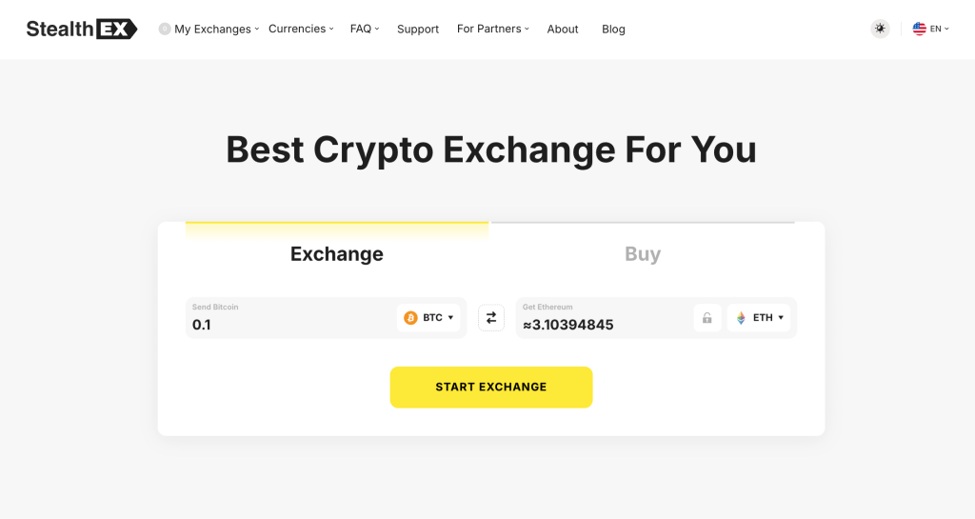
According to StealthEX’s own website, the service supports more than 2,000 coins and tokens and explicitly states that user funds are never stored on the platform, with transactions instead passing through the system only for the duration of the swap before being forwarded to the recipient’s address.
For someone in an emerging market who has received stablecoins as payment or remittance and needs to convert them into another asset, or into a locally liquid cryptocurrency, a non-custodial swap service like this removes a step that would otherwise require a centralized exchange account, identity verification, and a waiting period. It’s a small piece of plumbing, but multiplied across millions of transactions, it becomes meaningful infrastructure.
Stablecoins, Crypto Swaps, and African Markets
Nowhere is this dynamic more visible than in Africa, where USDT and USDC have become de facto dollar substitutes in several economies grappling with currency instability.
In Nigeria, Ghana, and parts of East Africa, stablecoins are increasingly used for remittances, allowing families to receive dollar-denominated value that can be held or converted locally, often at rates more favorable than official bank channels. Business payments have followed a similar pattern; importers and cross-border traders use stablecoins to settle invoices with suppliers in Asia or Europe without navigating local FX bottlenecks or waiting for central bank dollar allocations.
The appeal is straightforward: currency volatility in many African markets makes holding local currency risky for anyone trying to preserve value or transact internationally. A dollar-pegged stablecoin offers a hedge without requiring a foreign bank account.
But stablecoins alone don’t solve everything; users still need to move between different blockchain assets, convert stablecoins into local crypto liquidity, or swap between chains (Tron-based USDT versus Ethereum-based USDC, for example). This is where liquidity between different blockchain assets becomes critical, and where non-custodial swap platforms provide practical utility, letting users convert between stablecoin variants and other crypto assets without funneling funds through a centralized custodian first.
What Needs to Improve Before Crypto Becomes Mainstream Payment Infrastructure
Despite this momentum, crypto-based cross-border payments are far from a finished product.
Regulation remains the biggest variable. Many emerging-market regulators are still defining their stance on stablecoins and crypto exchanges, and inconsistent rules across jurisdictions create uncertainty for businesses trying to build on top of these rails.
Wallet UX is still a barrier for mainstream users. Managing private keys, understanding gas fees, and navigating different blockchain networks remains intimidating for people used to simple banking apps.
Security concerns, from phishing to wallet compromises, highlight that self-custody shifts responsibility onto the user, which is empowering but also risky without better safeguards and education.
Liquidity across smaller markets and less-traded assets can still be thin, leading to price slippage on swaps. Consumer protection mechanisms common in traditional finance, like chargebacks or deposit insurance, largely don’t exist in crypto. And interoperability between different blockchains, wallets, and payment providers still needs significant work to feel as seamless as tapping a card.
Conclusion
Crypto is unlikely to fully replace banks in emerging markets anytime soon, and it may not need to. What’s emerging instead is an additional layer of financial infrastructure that runs alongside traditional banking: stablecoins for value transfer, self-custodied wallets for control, and non-custodial exchanges for conversion between assets. Together, these tools are giving people in underserved markets more options for moving money across borders, not a wholesale replacement of the existing system, but a meaningful complement to it.