

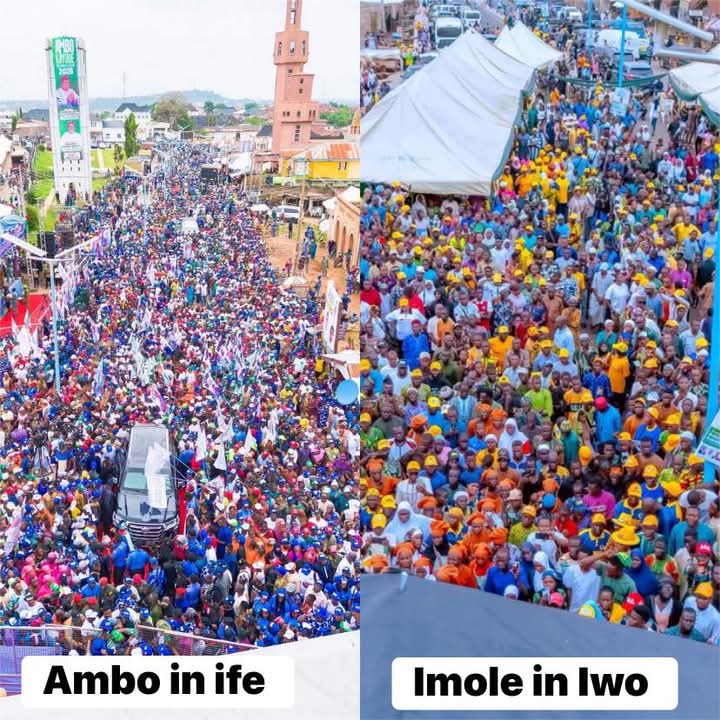
As Osun State gradually moves towards the 2026 governorship election, political campaigns are becoming increasingly visible, not only on the streets but also across social media. One of the most common ways political parties seek to demonstrate their strength is by sharing photographs of campaign rallies. Within minutes of a rally ending, competing political camps flood Facebook, X, WhatsApp and Instagram with images claiming to have attracted the largest crowd.
Recently, photographs from the All Progressives Congress (APC) rally in Ife and the Accord Party rally in Iwo sparked precisely this debate. Supporters of both parties confidently declared victory in the contest of numbers. Yet the more important question is not which party filled more streets, but whether photographs alone can answer that question. The simple answer is no.
A photograph captures a moment, but it does not necessarily capture the whole reality.
Register for the next Tekedia Mini-MBA.
Register for Tekedia AI in Business Masterclass.
Join Tekedia Capital Syndicate and co-invest in great global startups.
The APC rally photograph presents what appears to be an enormous gathering stretching along a major road. Taken from a very high position, the image allows viewers to see the crowd occupying a large section of the town. Buildings, roads and surrounding landmarks provide a sense of scale, making the gathering appear almost endless. For many observers, the immediate conclusion is that the APC attracted an overwhelming number of supporters.
The Accord rally photograph tells a different story. Instead of focusing on the length of the crowd, the camera is positioned much closer to the people. Faces are clearly visible, supporters appear tightly packed together, and the dominant yellow campaign caps create a striking visual identity. Rather than communicating geographical spread, the image communicates unity, enthusiasm and energy.
Both photographs are impressive. Both succeed in projecting political strength. However, they achieve this in different ways.

This is where citizens must become more careful consumers of political information.
Political campaign photographs are rarely taken by chance. Every decision, including where the photographer stands, the angle of the camera, the height from which the image is taken and the exact moment the photograph is captured, can shape how people interpret the event. A photograph taken from a rooftop can make a gathering appear much larger than one taken from street level. A tightly cropped image can remove empty spaces and create the impression that the crowd is denser than it actually is. Similarly, taking photographs when attendance is at its peak naturally produces a more dramatic image than taking them before or after the main event.
None of these practices necessarily amount to deception. They are simply part of modern political communication.

Political parties understand that elections are fought not only through policies and campaigns but also through public perception. Images of large crowds send a powerful message that many people support the party and that its campaign is gathering momentum.
This matters because people often associate popularity with credibility. When citizens repeatedly encounter images of overflowing streets, they may begin to believe that a particular candidate is becoming the inevitable winner. This perception can influence undecided voters who prefer to identify with a campaign that appears to be gaining widespread acceptance.
However, rally attendance and electoral support are not the same thing.
Many people attend political rallies for reasons that have little to do with how they will eventually vote. Some attend out of curiosity. Others are mobilised by community leaders or local political structures. Traders continue their businesses around rally venues, while some people simply accompany friends or relatives. Others come to witness the excitement that accompanies major political events.
A crowded rally should therefore never be interpreted as direct evidence of future electoral success.
Political history offers many examples of candidates who attracted enormous crowds but failed to win elections. It also provides examples of candidates whose rallies appeared modest but who eventually secured victory at the polls. Elections are determined by the number of valid votes cast, not by the number of people visible in campaign photographs.
Another important point is that photographs often show what campaign teams want the public to see while leaving out what they do not want people to notice. Images rarely reveal how long supporters remained at the venue, whether they travelled from neighbouring communities, or whether they stayed until the end of the programme. They cannot tell us whether those present are registered voters, whether they are eligible to vote in that particular constituency, or whether they genuinely intend to vote for the party whose rally they attended.
In other words, photographs capture visibility rather than voting intention.
This does not make rally photographs unimportant. On the contrary, they provide useful insights into how parties organise themselves, mobilise supporters and project their public image. They reveal campaign energy, organisational capacity and the ability to command public attention. These are meaningful indicators in any election.
Nevertheless, they represent only one part of a much broader picture.
To understand the true state of an election, citizens should also pay attention to party structures across local governments, the quality of candidates, campaign messages, voter registration patterns, public opinion surveys, previous election results, grassroots engagement and the issues that matter most to voters. Collectively, these factors provide a more reliable indication of electoral prospects than a single photograph circulating on social media.
As the race for the 2026 Osun governorship election gathers pace, competing parties will continue to showcase impressive images designed to inspire confidence among supporters and persuade undecided voters. More photographs claiming record breaking attendance will appear. More comparisons between rallies will circulate online. More debates about which party attracted the larger crowd will dominate political conversations.
Instead of asking, “Which rally was bigger?”, perhaps citizens should ask a different question: “What is this image trying to make me believe?”
That question encourages a more thoughtful approach to political communication. Democracy is strengthened not when people accept every campaign image at face value, but when they examine it carefully, place it in context and recognise that every political photograph is part of a broader effort to shape public opinion.