

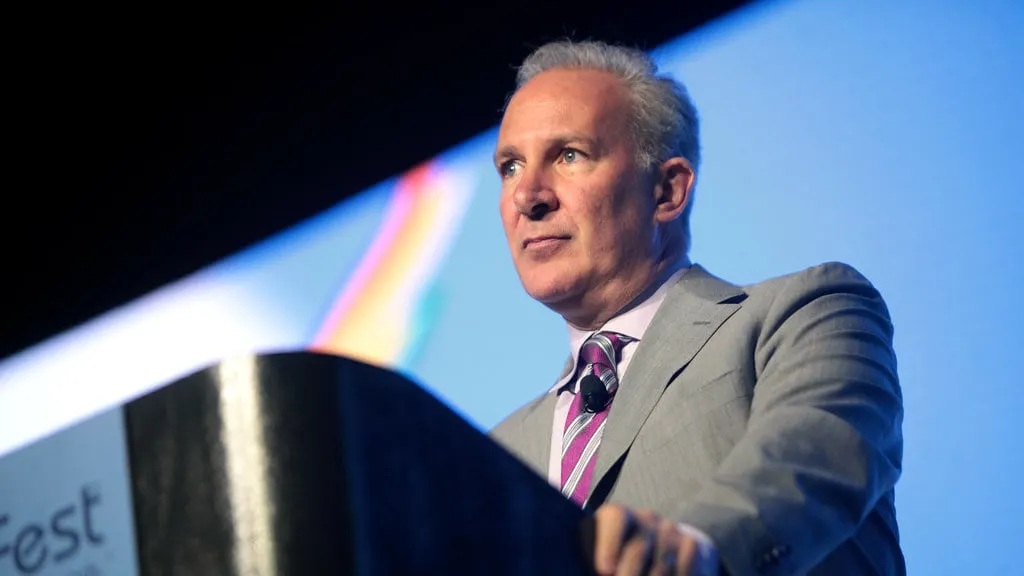
Economist and gold advocate Peter Schiff has argued that artificial intelligence destroying more jobs than it creates should not be viewed as a crisis, but as a sign of economic progress.
Far from fearing mass job losses, Schiff views them as a natural and positive outcome of genuine economic progress.
In a post on X, he wrote,
Register for the next Tekedia Mini-MBA.
Register for Tekedia AI in Business Masterclass.
Join Tekedia Capital Syndicate and co-invest in great global startups.
“Of course AI will destroy more jobs than it creates, that’s progress. It means humans won’t have to work as much, as more of what we need will be produced by machines. But for those who still need or want to work, better-paying employment opportunities will become available.”
Schiff’s post suggests that for too long employment has been treated as an end in itself rather than a means to produce what society needs. He argues that when machines powered by AI take over more production, humans don’t have to work as much.
In essence, more goods and services are produced with less human effort and time. That according to him is the very definition of rising living standards and increasing abundance.

Also, for those who still need or want to work, better opportunities await. The remaining jobs will be higher-skilled, more productive, and better compensated. AI handles the routine and repetitive tasks, elevating the value of human creativity, judgment, and innovation.
Workers who adapt will see their earnings rise precisely because each hour of human labor becomes far more effective when amplified by intelligent technology.
Public reaction to Peter Schiff’s comments was divided, with users on X offering sharply contrasting views on artificial intelligence’s impact on jobs and the broader economy.

Some commenters questioned Schiff’s argument, pointing to the long-held belief that new technologies ultimately create more jobs than they eliminate. Others expressed deep skepticism about the distribution of AI’s benefits.
Check out some comments on X,
@MesoWx wrote,
“Absolutely none of the billionaires working AI will do a thing to help those hurt. They will buy elections and power to make that so. Only until so many are hurt we rise and execute the wealthy will things get better.”
@MrM1rr0r wrote,
“Highly doubt this is correct. AI is a double-edged sword that will cut down many and will only benefit monetarily those that control it.”
@Matt wrote,
“Disagree. Humans want to work. But things that used to be “hobbies” will become “work”. Work will look different because of AI, which is progress.”
@Harry Plendl wrote,
“I disagree. It’s going to allow for events to occur faster, meaning, the death of bureaucracy and fraud. Authentication will be instantaneous, authorization will be granted or revoked instantaneous, & results will be looped back to the decision makers in minutes versus months.”
@Mark Bennett wrote,
“I don’t know about this. If productivity doubles, you can either get the same output with half the number of people or double the output with the same number of people. Who’s to say it won’t go the latter?”
The Impact of Artificial Intelligence on Jobs
The advent of artificial intelligence (AI) has profoundly impacted the employment landscape, raising concerns about potential job displacement.
The International Monetary Fund (IMF) noted that AI will impact 40% of global jobs, with many roles at risk of replacement. Although AI increases productivity, especially in automation and services, it also eliminates jobs in repetitive and routine tasks.
The rise of generative AI tools such as ChatGPT, Gemini, Claude, and Microsoft Copilot has demonstrated the technology’s ability to perform tasks once considered exclusive to humans.
From writing reports and analyzing data to generating software code and assisting with customer service, AI is becoming a valuable workplace assistant across numerous industries.
This growing capability has fueled concerns that machines could replace large segments of the workforce. However, most labor experts argue that AI is more likely to transform jobs than eliminate them.
McKinsey Global Institute says that at the global average level of adoption and absorption and advances in AI implied by their simulation, AI has the profound impact of delivering additional global economic activity of around $13 trillion in the foreseeable future and by 2030, or about 16% higher cumulative GDP compared with today.
It further added that by 2030, the average simulation shows that some 70% of companies will have embraced the AI revolution and adopted at least one type of AI technology.
However, the greatest risks associated with artificial intelligence may not stem from the technology itself, but from the policies and governance frameworks that shape how it is developed, deployed, and regulated.
While AI is inherently a tool designed to augment human capabilities, poorly designed regulations, inadequate oversight, and inconsistent governance can amplify its negative consequences and limit its potential to deliver broad societal benefits.
Experts increasingly argue that technology is neither inherently beneficial nor harmful; rather, its impact depends on the decisions made by governments, businesses, and institutions.
Outlook
Artificial intelligence is expected to remain one of the defining forces shaping the global economy over the next decade.
While debate continues over whether AI will ultimately create more jobs than it eliminates, there is broad agreement that it will fundamentally transform the nature of work.
Ultimately, the long-term impact of AI is unlikely to be determined by the technology alone. As Peter Schiff argues, automation has historically been associated with economic progress and rising productivity.
Whether that progress translates into broadly shared prosperity will depend on how policymakers regulate the technology, how businesses distribute its gains, and how effectively workers adapt to changing labor market demands.