

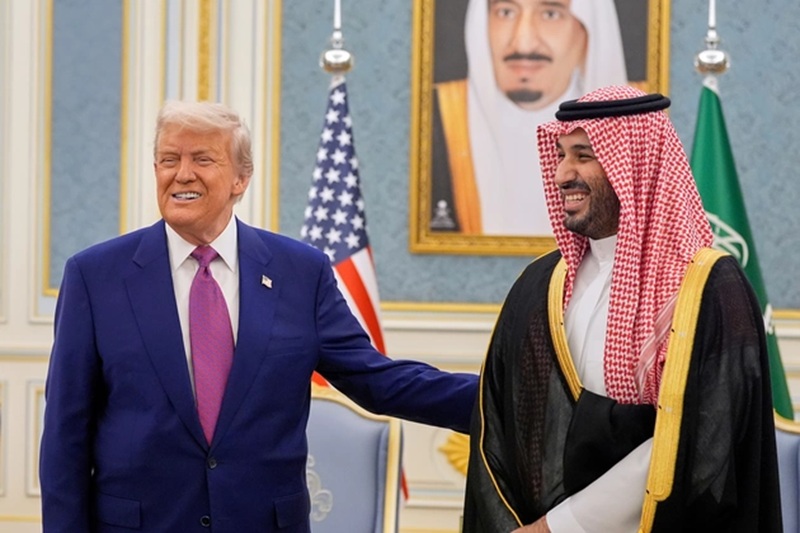
Saudi Crown Prince Mohammed bin Salman (MBS) announced during an Oval Office meeting with US President Donald Trump that Saudi Arabia would increase its committed investments in the United States from $600 billion to nearly $1 trillion.
This pledge builds on prior discussions and aligns with Saudi Arabia’s Vision 2030 economic diversification strategy, emphasizing sectors like technology, artificial intelligence (AI), critical minerals including magnets, energy, aerospace, defense, and sports.
The announcement was framed as “real investment” to create jobs and opportunities, with Trump highlighting its role in bolstering US national security through economic ties. The commitment came during a bilateral meeting at the White House, where Trump welcomed MBS with military honors.
Trump described the deal as a sign of Saudi Arabia being a “great ally” and joked that he might “work on” MBS to push it to a full $1 trillion. MBS responded affirmatively, stating, “Today and tomorrow, we are going to announce that we are going to increase that $600 billion to almost $1 trillion of investment.”
Register for Tekedia Mini-MBA edition 20 (June 8 – Sept 5, 2026).
Register for Tekedia AI in Business Masterclass.
Join Tekedia Capital Syndicate and co-invest in great global startups.
Register for Tekedia AI Lab.
Investments will prioritize high-tech and strategic industries. A White House fact sheet outlined expansions in US exports, reduced trade barriers, and partnerships in AI, nuclear energy, and defense sales including F-35 jets to Saudi Arabia. Additional deals include a memorandum of understanding on AI cooperation and sales of advanced AI chips to the kingdom.
MBS emphasized that the pledge is driven by Saudi Arabia’s “huge demand” for US computing power and innovation, not short-term oil price fluctuations despite recent drops to around $60 per barrel. He tied it to long-term projects like the kingdom’s Humain AI company, backed by the Public Investment Fund (PIF).
Trump noted the investments would “create jobs” and “a lot of power for the United States,” echoing similar $450 billion pledges from his first term though past analyses showed actual US exports to Saudi Arabia totaled only about $92 billion from 2017-2020.

The meeting signals a thaw in ties strained under the Biden administration. Trump praised MBS’s human rights record despite ongoing concerns (e.g., the 2018 Jamal Khashoggi murder, which MBS called a “huge mistake”). Discussions also touched on potential Saudi normalization with Israel via the Abraham Accords and countering Iran/Houthi threats.
The US approved F-35 sales, though Israel expressed opposition over regional air superiority concerns. AI chip exports mark a first for Saudi Arabia, potentially accelerating its tech ambitions but raising questions about technology transfer risks amid Riyadh’s ties to China.
While hailed as a win for US jobs and exports, experts note historical overpromising—e.g., a 2017 $110 billion defense deal resulted in only $23 billion in notified sales by 2020. Oil price volatility could strain funding, though PIF’s $925 billion assets provide a buffer.

X Posts highlighted Trump’s quote on the investment as “national security,” while some speculated on quid pro quo for AI tech access. Saudi Ambassador to the US Princess Reema bint Bandar Al Saud called it a “significant day” for bilateral ties, emphasizing job creation and security.
This deal underscores deepening US-Saudi economic interdependence, with potential to drive US growth but also geopolitical complexities. Follow-up announcements on specific projects are expected soon.