

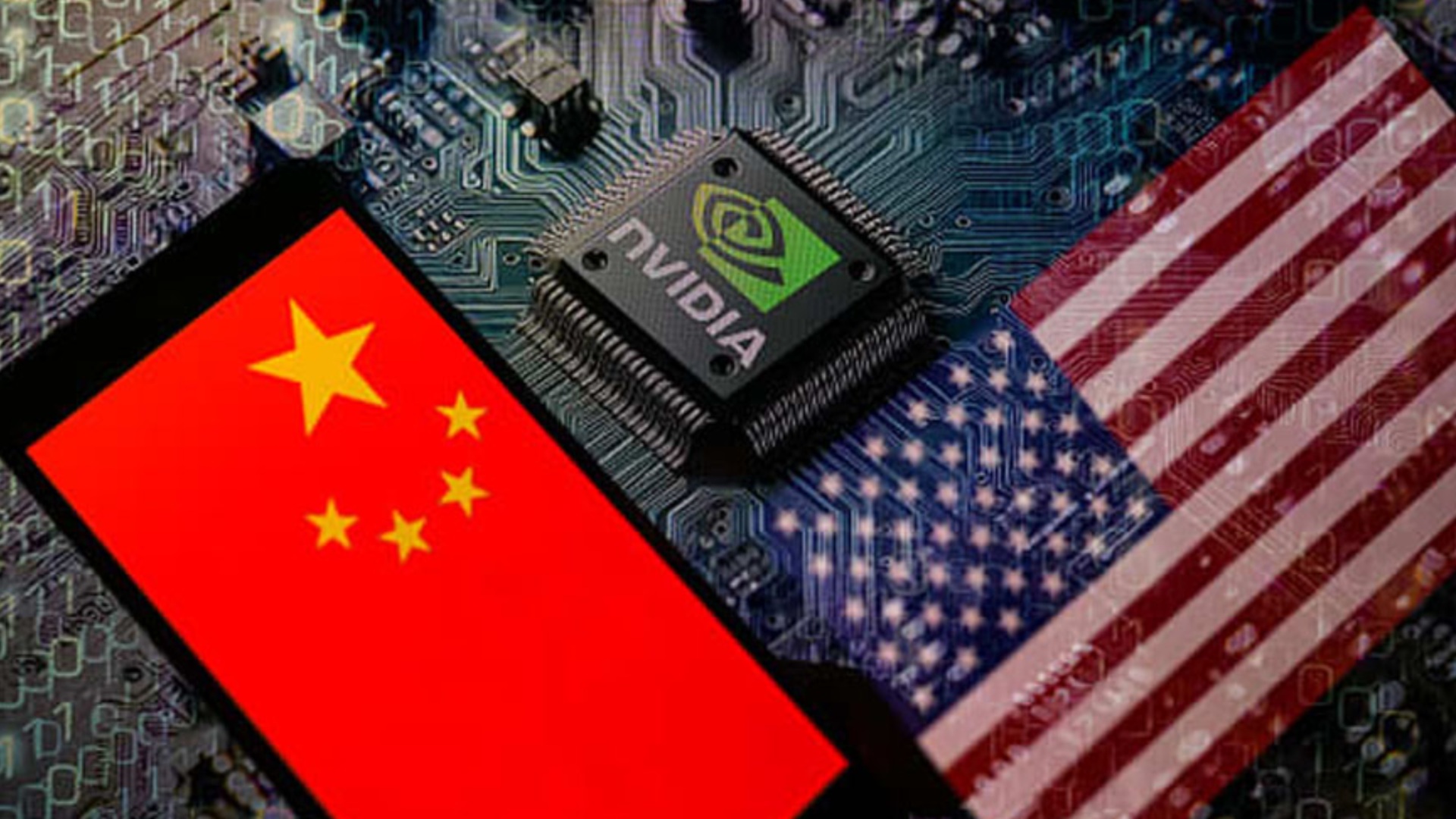
Nvidia CEO Jensen Huang has dismissed national security fears surrounding the sale of advanced semiconductors to China, insisting that collaboration between the two superpowers is not only safe but essential for the growth of artificial intelligence and global technological advancement.
Speaking to reporters in Seoul, South Korea, on Friday, Huang emphasized that China remains a crucial part of the global semiconductor market, calling it a “singular, vital, important, dynamic market” that no other economy can replace.
“The way to think about the China market is, it’s a singular, vital, important, dynamic market, and nobody can replace that,” he said. “It’s in the best interest of America to serve that China market. It’s in the best interest of China to have the American technology company bring … technology to the China market … It’s in the best interest of both countries, and I hope that policymakers will ultimately come to that conclusion.”
Register for Tekedia Mini-MBA edition 20 (June 8 – Sept 5, 2026).
Register for Tekedia AI in Business Masterclass.
Join Tekedia Capital Syndicate and co-invest in great global startups.
Register for Tekedia AI Lab.
Huang, whose company sits at the center of the world’s artificial intelligence revolution, is navigating an increasingly tense geopolitical environment defined by Washington’s efforts to curb China’s access to advanced computing technologies. The United States has repeatedly argued that such technologies could be used to enhance Beijing’s military capabilities, leading to a series of export restrictions on Nvidia’s most powerful AI chips.
President Donald Trump confirmed Thursday that he and Chinese President Xi Jinping discussed semiconductor exports during their meeting in South Korea. While the leaders did touch on Nvidia’s operations in China, Trump clarified that their talks did not cover the company’s most advanced Blackwell graphics processing units, which are currently restricted under U.S. export rules.
“I said that’s really between [China] and Nvidia, but we’re sort of the arbitrator,” Trump told reporters aboard Air Force One after the meeting.

Washington has maintained that the restrictions are aimed at limiting both China’s access to U.S.-designed chips and its capacity to develop homegrown equivalents capable of supporting AI-driven applications. But Huang suggested that these measures may no longer be relevant, pointing out that China has made significant progress in semiconductor development and no longer depends solely on U.S. technology.
“China makes plenty of AI chips themselves, and the Chinese military surely have plenty of access to chips that are created in China,” Huang said in an interview with CNBC’s Eunice Yoon. “So, whatever national security concerns, have to take into consideration the fact that China has blocked H20 [an Nvidia chip] and, so, in a lot of ways, China is saying that, ‘listen, we have plenty of AI technology ourselves’.”
He added that the logic behind national security concerns has weakened, noting that Beijing’s decision to restrict purchases of Nvidia’s own chips demonstrates that China is confident in its domestic capabilities.

“The national security concern, from that perspective, I think, is really answered by the fact that China doesn’t want H20 or any American chips,” Huang said.
The H20 is a modified AI chip Nvidia designed specifically for the Chinese market to comply with U.S. export controls. While the chip was intended to balance performance with regulatory compliance, Chinese authorities have reportedly discouraged its purchase, favoring locally produced chips from domestic firms such as Huawei Technologies.
Respect for Huawei’s Technological Strength
In his remarks, Huang also addressed the rapid rise of Huawei, describing it as a formidable competitor with deep technological expertise. Despite the U.S. ban on federal use of Huawei products and restrictions preventing American companies from doing business with the telecom giant, Huang said it would be “foolish” to underestimate the company’s innovation and resilience.
“It is foolish to underestimate the might of China and the incredible, competitive spirit of Huawei,” he said. “This is a company with extraordinary technology. They dominate the world’s 5G telecommunication standards and technology. They build amazing smartphones, they build amazing chips, they’re incredible at networking and so when they announced CloudMatrix, I was not surprised that they were able to create such an amazing thing.”
Huawei’s CloudMatrix supercomputing system, unveiled last month, is designed to rival Nvidia’s AI hardware and marks a major step in China’s push for self-reliance in semiconductor and cloud computing technologies. Huang said Nvidia’s leadership takes such competition seriously and uses it as motivation to innovate faster.
“It’s deeply uninformed to think that Huawei can’t build systems,” he said. “We take competition very seriously. We respect the competition, we respect deeply the capabilities of China. That’s why we run so fast, and that’s why we dedicate ourselves to inventing the future so we can get there before anybody else.”
Huang’s comments underline a growing divide between business leaders and policymakers on the future of U.S.-China technological cooperation. While Washington views the semiconductor industry through the lens of national security, companies like Nvidia, which derive as much as 20 percent of their revenue from China, continue to see the country as indispensable for innovation and growth.
Analysts say Huang’s stance highlights a pragmatic reality: despite trade restrictions, China remains the world’s largest market for computing hardware, and access to that market could shape the trajectory of AI development globally.