

Markets treated Sanae Takaichi’s landslide election victory as a green light for a renewed, more assertive version of Japan’s growth-first economic experiment.
Japanese equities surged to fresh record highs on Monday, leading gains across Asia after Prime Minister Sanae Takaichi secured a decisive election victory that markets swiftly interpreted as a mandate for aggressive pro-growth policies, fiscal expansion, and a looser monetary stance.
The ruling Liberal Democratic Party clinched a two-thirds supermajority in the 465-seat lower house, according to public broadcaster NHK, giving Takaichi an unusually strong grip on parliament and clearing the path for policy execution with minimal legislative resistance.
Register for Tekedia Mini-MBA edition 20 (June 8 – Sept 5, 2026).
Register for Tekedia AI in Business Masterclass.
Join Tekedia Capital Syndicate and co-invest in great global startups.
Register for Tekedia AI Lab.
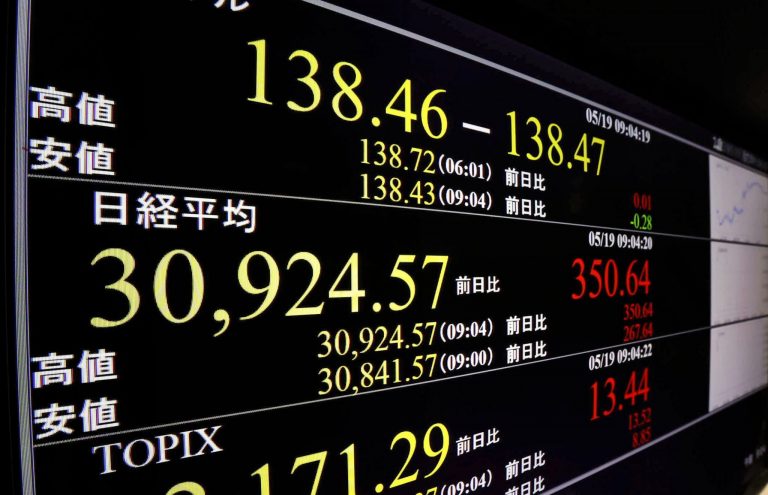
The Nikkei 225 briefly surged past the 57,000 mark for the first time in history before paring gains to close 3.9% higher at 56,363.94. The broader Topix index also ended at a record, rising 2.3% to 3,783.94, underscoring the breadth of the rally beyond heavyweight exporters and technology stocks.
Market participants have increasingly positioned for what has become known as the “Takaichi trade,” a reflationary bet built around expectations of higher government spending, corporate-friendly tax reforms, and a continuation of the policies that underpinned the Abenomics era. Investors see her victory as removing lingering political uncertainty that had weighed on sentiment following last year’s legislative setbacks for the LDP.
“A decisive win for Takaichi is arguably the best outcome for markets over the medium term,” said Sree Kochugovindan, senior research economist at Aberdeen Investments.

He pointed to the likelihood of strategic public investment, supply-side reforms, and tax measures that could lift corporate earnings and sustain equity valuations.
Takaichi’s platform has emphasized industrial policy, defense, and technology investment, and incentives aimed at reversing decades of underinvestment. With a commanding parliamentary majority, analysts say her administration now has the political capital to push through budgetary expansion even as public debt remains elevated by global standards.
The rally in equities was accompanied by notable moves in currency and bond markets, reflecting expectations of more accommodative financial conditions. The yen strengthened modestly to 156.88 against the dollar, while Japanese government bond yields climbed, signaling anticipation of heavier debt issuance and stronger nominal growth. Yields on the 10-year JGB rose nearly 4 basis points to 2.274%, while 20-year yields gained around 3 basis points to 3.158%.

Crédit Agricole CIB said in a post-election note that the result gives Takaichi’s government stronger momentum to pivot decisively toward proactive fiscal policy, backed by a clear electoral mandate. That stance could complicate the Bank of Japan’s gradual normalization path, particularly if fiscal stimulus reignites inflationary pressures.
The election also marks a sharp political turnaround. It follows a turbulent period in which the LDP lost its majority in the Upper House last year and suffered a defeat in the Lower House in 2024, developments that ultimately led to the resignation of former Prime Minister Shigeru Ishiba in September. Takaichi’s gamble to call a fresh election now appears to have paid off handsomely.
There was a swift International reaction to the outcome. U.S. President Donald Trump congratulated Takaichi in a post on TruthSocial, praising her leadership and describing the election outcome as a strong endorsement from Japanese voters. His message reinforced expectations of continuity in U.S.-Japan relations at a time of heightened geopolitical and trade tensions.
The bullish mood spilled across the region. South Korea’s Kospi jumped 4.1% to 5,298.04, while the tech-heavy Kosdaq added 4.3%. Australia’s S&P/ASX 200 rose 1.85% to 8,870.1. In Greater China, Hong Kong’s Hang Seng Index climbed 1.71%, and mainland China’s CSI 300 gained 1.63%. India’s Nifty 50 was also higher, adding 0.61% by early afternoon local time.
Thailand stood out after its own political catalyst, with the SET Index surging nearly 4% following a decisive general election victory for Prime Minister Anutin Charnvirakul’s Bhumjaithai Party, reinforcing the theme of political clarity lifting risk appetite across Asia.
U.S. equity futures edged higher, extending momentum from Friday’s rally on Wall Street, when tech stocks rebounded after several sessions of heavy selling and bitcoin recovered from a deep pullback. The Dow Jones Industrial Average closed above 50,000 for the first time, while the S&P 500 and Nasdaq Composite posted strong gains, helping the broader market claw back into positive territory for 2026.
The scale of Monday’s rally reflects more than short-term relief for Japan. Investors are increasingly betting that Takaichi’s victory represents a structural inflection point, one that could finally align political stability, fiscal activism, and corporate reform. But some analysts believe that the realization of the expectations will depend on execution.
However, markets are currently signaling confidence that Japan’s new political chapter could extend its equity boom well beyond recent records.