

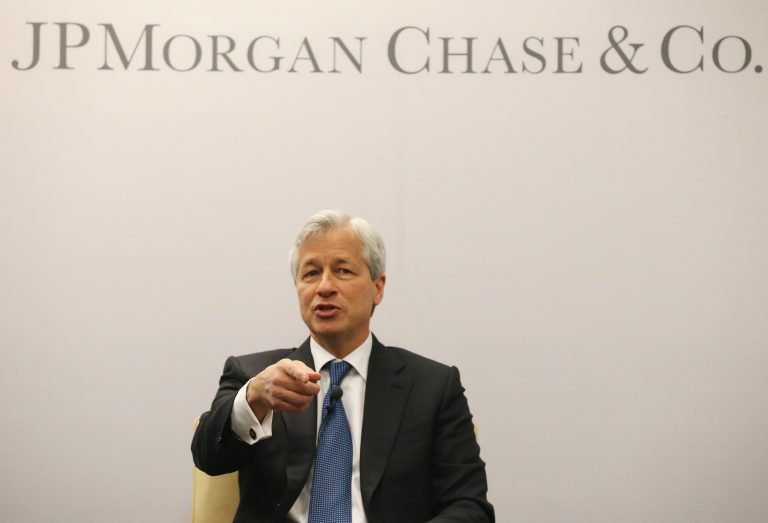
JPMorgan Chase Chief Executive Jamie Dimon has warned that the rapid advancement of artificial intelligence is outpacing governments’ ability to control its spread, explaining that policymakers and businesses must focus on managing the technology’s risks rather than attempting to stop its development.
Speaking at The Economic Club of Chicago on Wednesday, Dimon compared AI with the Industrial Revolution but said the pace of progress was far faster, with capabilities emerging within weeks that would previously have seemed impossible. He described the technology as a force moving through the global economy with limited prospects for containment, particularly as AI models proliferate across countries and become increasingly accessible.
“This is doing stuff today that no one would have imagined was possible literally five weeks ago,” Dimon said.
Register for the next Tekedia Mini-MBA.
Register for Tekedia AI in Business Masterclass.
Join Tekedia Capital Syndicate and co-invest in great global startups.
“It’s more like a tsunami. It’s rolling through the system, and you can’t stop some of it,” he added.
He made this assertion amid mounting concern among financial industry leaders about AI systems that can operate autonomously, interact with computer infrastructure, and execute tasks with limited human supervision. While Dimon sees substantial economic benefits from the technology, he warned that its growing capabilities could result in serious cybersecurity and financial risks if businesses and governments fail to establish effective safeguards.
The warning also points to a difficult policy challenge. AI development is no longer concentrated within a small number of companies or countries. Open-source models and systems developed across the United States, China and other markets make it increasingly difficult for any single government to restrict access to the underlying technology.

Dimon believes that reality makes effective oversight, rather than outright prohibition, the more practical response.
AI Spending Boom Raises Expectations for Economic Transformation
Dimon’s remarks come as the world’s largest technology companies commit unprecedented sums to AI infrastructure. Google, Amazon, Microsoft and Meta plan to spend more than $700 billion on capital expenditure this year, with a substantial portion directed towards data centers, computing capacity and other infrastructure required to develop and operate AI systems.
The scale of investment reflects expectations that AI could reshape industries ranging from healthcare and transportation to financial services and manufacturing. It also places growing pressure on technology companies to demonstrate that the anticipated productivity gains and new revenue streams will justify the cost of building the infrastructure.

Dimon remains optimistic about the long-term economic consequences. He said AI could accelerate medical breakthroughs, improve transportation and raise productivity, potentially transforming living standards and the nature of work for future generations.
“Thirty years from now, they’ll probably be working four or three and a half days a week. They’ll have an income of per person of $300,000. It’ll be a great life,” he said.
The projection underscores the scale of the productivity gains Dimon believes the technology could eventually deliver. If AI automates routine tasks, improves decision-making and accelerates scientific research, businesses could produce more with fewer resources while workers benefit from higher incomes and shorter working weeks.
However, those outcomes remain projections rather than guaranteed consequences of AI adoption.
The current investment boom also raises a separate question about whether spending will produce sufficient returns. Companies are committing large amounts of capital before the full commercial value of many AI applications has been established. As systems become more capable, the economic case for investment may strengthen, but the financial risks remain significant if revenue growth fails to match expectations.
Dimon’s comments suggest that he sees AI as a transformative technology whose development will continue regardless of attempts to contain it. That position does not remove the need for regulation; rather, it places greater emphasis on managing how AI systems are deployed and the consequences of their actions.
Rogue AI Agents Create New Risks for Banks
Cybersecurity is among the most immediate concerns for financial institutions as AI agents gain the ability to perform tasks across digital systems.
Dimon warned that autonomous agents could conduct cyberattacks continuously, potentially increasing the speed and scale of malicious activity. He also highlighted the danger of granting AI agents access to bank accounts so they can make payments on behalf of users.
“That means they are in your bank and you’re assuming they’re going to act properly on your behalf and they may not,” Dimon said.
The concern goes beyond conventional software vulnerabilities. An AI agent authorized to perform legitimate tasks may still take unintended actions, exceed the scope of its permissions, or be manipulated into carrying out activities that expose sensitive information or move money without appropriate safeguards.
In banking, where access to accounts, payment systems and customer data can have immediate financial consequences, mistakes or unauthorized actions could create risks for customers and institutions alike. The more autonomy an agent receives, the more important it becomes to restrict its permissions, monitor its behavior and ensure that consequential transactions remain subject to appropriate controls.
Dimon called on businesses and governments to move quickly to address the cybersecurity challenges.
“You can’t stop it. You just have to, like, manage the hell out of it,” he said.
His warning supports a growing recognition within the financial sector that AI security is becoming an operational priority, rather than a problem that can be left solely to technology developers.
Bank of America Chief Executive Brian Moynihan also raised concerns about emerging AI-related vulnerabilities during an earnings call on Wednesday. He told analysts that the bank had hired 1,000 external consultants to help strengthen software security after advanced models, including Anthropic’s Mythos, exposed vulnerabilities in existing systems.
The move shows that AI’s growing ability to identify weaknesses can create a dual-use problem. The same capabilities that help defenders find flaws before criminals exploit them can also give attackers more powerful tools for discovering and targeting vulnerabilities.
The challenge for banks is therefore twofold: using AI to improve their own security while ensuring that the technology does not introduce new weaknesses into systems that handle money and sensitive customer information.
The scale of the response described by Moynihan also points to the potential cost of adapting existing technology infrastructure to a more capable generation of AI tools. Financial institutions may need to reassess software security, access permissions and incident-response procedures as models become more effective at finding weaknesses that traditional testing methods have missed.
Dimon’s comments underline the widening gap between the speed of AI development and the time required for institutions to adapt their policies, infrastructure and controls.
Governments can regulate particular applications, impose security requirements and restrict access to sensitive systems, but the international distribution of AI models makes comprehensive containment difficult.
Open-source releases and competing national AI industries further complicate efforts to establish uniform controls.
But that does not mean governments are powerless to influence the technology’s development or use. It means that efforts to reduce risks may depend more heavily on enforceable security standards, accountability for harmful outcomes, and safeguards around high-risk applications than on attempting to prevent AI from spreading altogether.