

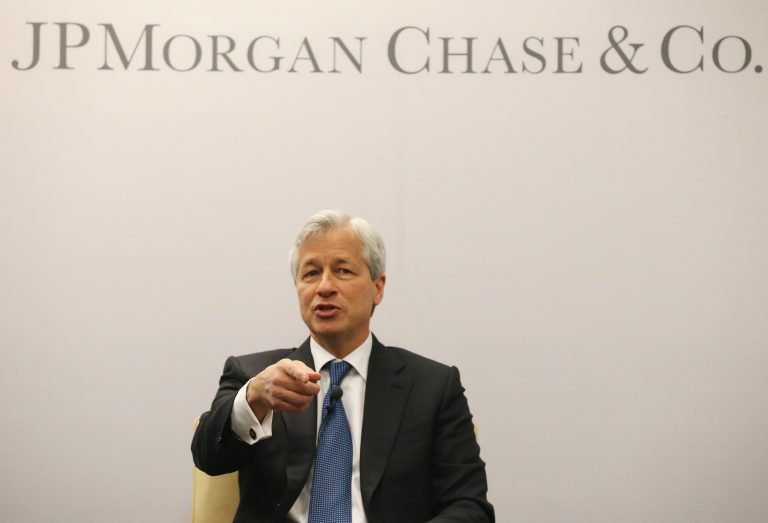
JPMorgan Chase CEO Jamie Dimon said on Tuesday that new government data confirms the U.S. economy is slowing, underscoring growing unease among investors and policymakers.
The Labor Department revised its nonfarm payrolls data lower for the year through March 2025 by 911,000 jobs from initial estimates. The revision was at the high end of Wall Street’s expectations and marked the largest downward adjustment in more than two decades.
“I think the economy is weakening,” Dimon said. “Whether it’s on the way to recession or just weakening, I don’t know.”
Register for Tekedia Mini-MBA edition 20 (June 8 – Sept 5, 2026).
Register for Tekedia AI in Business Masterclass.
Join Tekedia Capital Syndicate and co-invest in great global startups.
Register for Tekedia AI Lab.
The updated numbers showed the world’s largest economy produced far fewer jobs than initially thought, adding to concerns that growth momentum is faltering. That followed a July report that had already signaled trouble, with employment growth slowing to a near halt at just 73,000 jobs added. The August figures offered little reassurance, with payrolls increasing by only 22,000.
The political backdrop has amplified tensions. President Donald Trump last month fired the Bureau of Labor Statistics commissioner just hours after the weak July report was released, a move that fueled debate about the independence of federal agencies.
Dimon’s comments carry weight on Wall Street given his two-decade tenure leading the biggest U.S. bank by assets through the 2008 financial crisis, the pandemic, and other shocks. Yet he has also built a reputation for sounding alarms about risks that sometimes take longer to materialize than expected.

JPMorgan’s vantage point gives it a unique lens on the economy. Dimon noted that the bank tracks a spectrum of data across consumers, corporations, and global trade. For now, he said, most consumers still have jobs and are spending, though confidence appears to have taken a hit. Meanwhile, corporate profits remain strong.
“There’s a lot of different factors in the economy right now,” Dimon said, citing the weakening consumer alongside still-robust corporate earnings. “We just have to wait and see.”
Attention is now shifting to the Federal Reserve. Dimon predicted the Fed will “probably” cut its benchmark interest rate at its upcoming meeting later this month, though he suggested such a move may not have a meaningful impact on the real economy.

The market jitters cut across global markets. Europe’s largest economy, Germany, has seen slowing hiring across its manufacturing-heavy sectors, while the U.K. has reported persistently high inactivity rates. Japan, meanwhile, is struggling with an aging workforce and wage stagnation despite low unemployment. In this global context, the U.S. jobs revision underscores how even resilient labor markets are straining under higher borrowing costs and shifting trade dynamics.
Analysts are now framing the path to 2026 around two central scenarios. In the best case, the U.S. achieves a soft landing where growth slows but remains positive, unemployment rises only modestly, and Federal Reserve rate cuts help stabilize credit conditions. Under this trajectory, gross domestic product could expand by about one to one and a half percent, corporate profits would hold up, and consumer spending would continue at a cautious but steady pace. Markets would gradually reward cyclical sectors and investment-grade credit as confidence improves.
The worst case, however, points toward a recession. If payroll weakness broadens and layoffs accelerate, consumer confidence could collapse, triggering sharp declines in spending. Under such conditions, even robust corporate balance sheets would begin to crack, and Fed rate cuts might fail to offset tightening credit standards. A downturn of this sort would see GDP contract, unemployment rise by several percentage points, and equity markets shift into defensive mode as investors move capital toward Treasuries and higher-quality credit.
Some strategists are also flagging a low-probability tail risk scenario in which systemic stress emerges, potentially from corporate debt markets or a policy misstep. This could require direct interventions to preserve financial stability. While such an outcome is less likely, the stakes remain high enough to warrant attention.
Across all scenarios, investors are watching indicators such as weekly jobless claims, median wage growth, consumer confidence surveys, and corporate capital expenditure plans. Credit spreads and equity breadth are also being closely monitored for early signs of stress. Dimon himself suggested the Federal Reserve will “probably” reduce its benchmark interest rate at its next meeting later this month, though he cautioned that the impact on the real economy might not be consequential.
Given the potential implications for investors, companies are expected to build liquidity buffers and delay discretionary buybacks, while households at lower income levels will continue to feel pressure as savings erode. Higher-income consumers may sustain some demand, but confidence has already begun to weaken. For markets, the challenge lies in balancing the resilience of corporate profits with the fragility of household sentiment.