

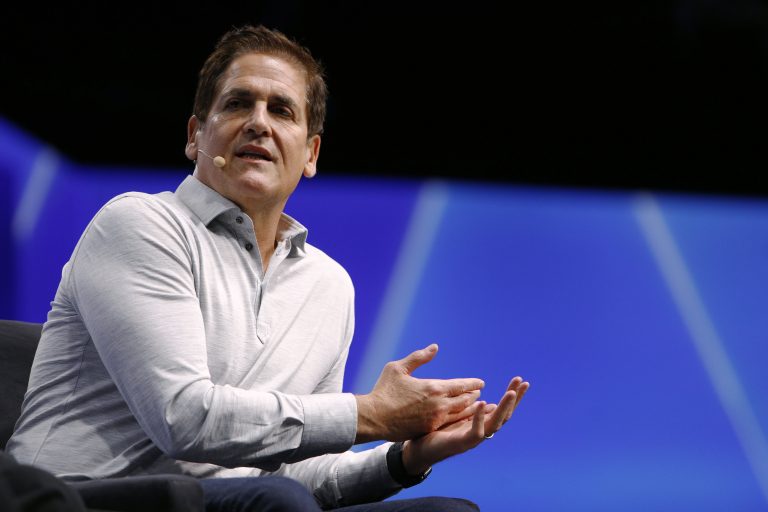
Billionaire investor Mark Cuban says artificial intelligence is no longer a distant disruption but an active force reshaping how people learn, work, and compete—one that is already separating workers into two distinct camps.
Speaking on the Big Technology Podcast at the Dallas Regional Chamber’s Convergence AI event, Cuban drew a stark distinction between those who use AI to expand their capabilities and those who use it to avoid effort altogether.
“I think right now we’re bifurcating into two types of ways or two types of people that use AI — people who use AI so they don’t have to learn anything and people who use AI so they can learn everything,” he said.
Register for the next Tekedia Mini-MBA.
Register for Tekedia AI in Business Masterclass.
Join Tekedia Capital Syndicate and co-invest in great global startups.
That divide is emerging at a critical moment when companies across sectors are integrating AI into daily workflows, automating routine processes, and compressing timelines for decision-making. In that environment, the marginal value of human labor is shifting away from execution and toward interpretation. Cuban’s warning is that workers who fail to adapt risk being displaced not by AI itself, but by peers who use it more effectively.
“If you’re just using it just so you don’t have to do the work and it’s your drunk intern, you’re going to struggle,” he said, reiterating his view that AI can act as a powerful but unreliable assistant.
The analogy points to a broader operational risk: overreliance without oversight can degrade both output quality and individual competence.

This concern is echoed across the research and policy landscape. Vivienne Ming, chief scientist at the Possibility Institute, has warned that AI adoption is producing a growing cognitive divide, where a minority of users leverage it to sharpen their reasoning while a larger group becomes dependent on it for thinking. Over time, she argues, that imbalance could erode critical thinking skills at scale.
Innovation theorist John Nosta frames the issue as a reversal of the traditional learning process. By delivering fully formed answers instantly, AI tools can bypass the questioning and synthesis stages that underpin expertise. Meanwhile, Rebecca Hinds has described the phenomenon as an “illusion of expertise,” where users appear more capable than they actually are because the system is compensating for gaps in knowledge.
Cuban’s intervention brings those abstract concerns into sharper focus for the labor market. He argues that the real risk is not that AI will replace entire professions, but that it will hollow out roles built around repetitive or low-complexity tasks.

“If all you’re doing is reformatting, you know, or you’re answering a question yes or no, then you know you’re there’s a good chance you’re going to be replaced by AI,” he said.
That aligns with broader hiring trends. Employers are increasingly prioritizing workers who can combine domain knowledge with AI fluency, using tools to test assumptions, model outcomes, and synthesize information, rather than those who simply execute predefined tasks. The result is a shift in what constitutes productivity: speed alone is no longer enough; depth of understanding and judgment are becoming more valuable.
Cuban emphasized that AI’s limitations reinforce this shift. While models can process vast amounts of data and generate responses quickly, they lack contextual awareness and accountability.
“If you learn how to use these tools, and you know how to think critically, you’re curious, so you’re always learning, you’re always going to have a job because AI doesn’t know the consequences of its action,” he said.
That distinction between output and understanding is likely to define career trajectories in the coming years. Workers who treat AI as a cognitive partner, using it to explore ideas, challenge conclusions, and deepen expertise, stand to benefit from significant productivity gains. Those who rely on it as a substitute for thinking may find their roles increasingly commoditized.
There are also implications for organizations. As AI tools become ubiquitous, the competitive advantage shifts from access to capability. Companies will need to invest not just in deploying AI systems, but in training employees to use them effectively. Failure to do so could lead to uneven performance within teams, where a subset of workers drives disproportionate value.
Cuban concluded, noting that AI, in his view, is neither a universal threat nor a guaranteed opportunity. It is an amplifier.
“Those people who are curious and just want to keep on learning more, AI is phenomenal. You will always have an edge over everybody around you,” he said.
As adoption deepens, that edge may become the defining feature of the modern workforce—separating those who evolve with the technology from those who are overtaken by it.