

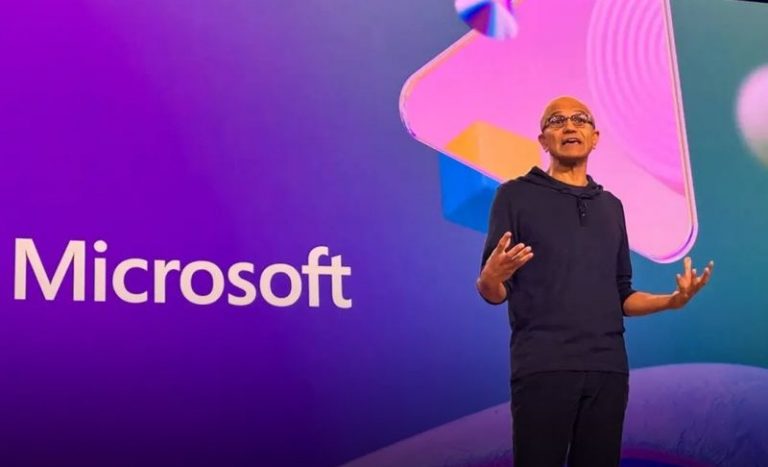
Microsoft said it is on track to invest $50 billion by the end of the decade to expand artificial intelligence infrastructure and capabilities across countries in the Global South, marking one of the most ambitious long-term AI commitments aimed at developing and emerging economies.
The announcement was delivered at the AI Impact Summit in New Delhi, where senior executives from major technology firms gathered alongside policymakers to discuss AI’s economic and geopolitical implications. The pledge positions Microsoft not only as a technology vendor but as a strategic partner in national development agendas across Africa, Asia, Latin America and parts of the Middle East.
Microsoft President Brad Smith said the initiative is designed to make “AI diffusion real at scale,” emphasizing infrastructure, skills training, trust-building and measurable progress. The company’s framing is deliberate: diffusion, rather than deployment, suggests an ecosystem strategy — embedding AI capabilities deeply within institutions, education systems and local innovation networks rather than merely exporting tools.
Register for Tekedia Mini-MBA edition 20 (June 8 – Sept 5, 2026).
Register for Tekedia AI in Business Masterclass.
Join Tekedia Capital Syndicate and co-invest in great global startups.
Register for Tekedia AI Lab.
India as a Strategic Anchor
India sits at the center of Microsoft’s plan. The company aims to train 5.6 million people in AI skills in 2026 alone and reach 20 million Indians by 2030. Through programs such as Microsoft Elevate for Educators, it intends to support two million teachers across more than 200,000 schools.
The scale reflects India’s dual role as both a market and a talent engine. With an estimated 24 million developers, India now hosts the second-largest national developer community on GitHub. Growth has accelerated sharply in recent years, with annual expansion exceeding 26 percent since 2020 and surpassing 36 percent year-on-year by late 2025.
Indian developers rank second globally in open-source contributions and generative AI project participation. This matters strategically. AI diffusion depends not only on infrastructure but on local technical capacity to adapt models, build applications and localize solutions. A deep developer base reduces reliance on imported expertise and strengthens the domestic innovation cycle.

Microsoft’s earlier $17.5 billion AI investment commitment in India laid the groundwork for this broader Global South strategy, reinforcing the country’s position as a regional hub for AI research, cloud services, and enterprise deployment.
Infrastructure and Cloud Expansion
A significant portion of the $50 billion commitment is likely to be allocated to cloud infrastructure, including data centers and regional compute capacity. AI systems require substantial processing power and data storage, which historically have been concentrated in North America, Europe, and parts of East Asia.
Expanding infrastructure in the Global South addresses several constraints simultaneously. It reduces latency for local users, improves data sovereignty compliance, and lowers entry barriers for startups and public institutions seeking to deploy AI solutions. It also strengthens Microsoft’s Azure footprint in markets where competition from regional cloud providers and Chinese technology firms is intensifying.

However, infrastructure investments carry geopolitical weight. Digital infrastructure increasingly intersects with national security, trade policy, and economic diplomacy. By embedding AI capacity in emerging economies, Microsoft reinforces long-term commercial relationships while aligning with broader U.S. technology influence abroad.
Multilingual and Cultural Adaptation
A core challenge in scaling AI beyond advanced economies is linguistic diversity. Many global models are trained predominantly on English-language data, limiting usability in regions where local languages dominate public life and commerce.
Microsoft’s emphasis on multilingual and multicultural AI capabilities signals recognition that adoption depends on contextual relevance. AI systems that cannot process regional dialects, indigenous languages, or culturally specific data risk entrenching digital inequality.
Local adaptation extends beyond language. In agriculture, AI tools may be trained to predict crop yields under specific climate conditions. In healthcare, diagnostic tools must reflect local epidemiology. In financial services, credit scoring models must incorporate region-specific economic patterns. Diffusion, in this sense, requires co-development rather than one-way transfer.
Economic Upside and Structural Risks
For developing economies, AI holds potential to accelerate productivity growth, particularly in sectors with administrative bottlenecks or limited access to specialized expertise. Governments see opportunities in digitized public services, precision agriculture, remote education, and telemedicine.
However, the expansion also raises structural concerns. AI adoption can widen skill gaps if workforce retraining lags behind automation. Smaller local firms may struggle to compete with global technology providers controlling foundational models and infrastructure. Questions around data governance, privacy, and algorithmic bias become more complex in jurisdictions with evolving regulatory frameworks.
Microsoft’s emphasis on training millions of individuals reflects awareness that workforce readiness will determine whether AI becomes inclusive or polarizing. Skills investment is not merely philanthropic; it is foundational to sustained demand for AI services.
The Global South has become a key arena in global AI competition. Chinese firms have expanded digital infrastructure and cloud services across Africa and Southeast Asia. U.S. companies, including Microsoft, are intensifying engagement to maintain influence and secure long-term growth in markets.
Regulatory approaches remain uneven. Some emerging economies are drafting AI frameworks inspired by the European Union’s risk-based model, while others prioritize innovation flexibility. By working closely with governments through summits and public-private partnerships, Microsoft positions itself as both collaborator and standards influencer.
The AI Impact Summit itself reflects the political salience of the technology. Leaders are weighing how to attract investment while maintaining sovereignty and safeguarding labor markets.
Measuring Diffusion
One notable element of Microsoft’s program is the emphasis on measurement. Tracking AI adoption, workforce training outcomes, and sector-specific impact introduces accountability into what might otherwise be broad corporate pledges. Measurable diffusion allows policymakers to assess whether AI is reaching rural communities, small enterprises, and public institutions — or remaining concentrated among large corporations.
Over the remainder of the decade, the success of Microsoft’s $50 billion commitment will depend on execution across three fronts: infrastructure deployment, talent development, and localized innovation.