

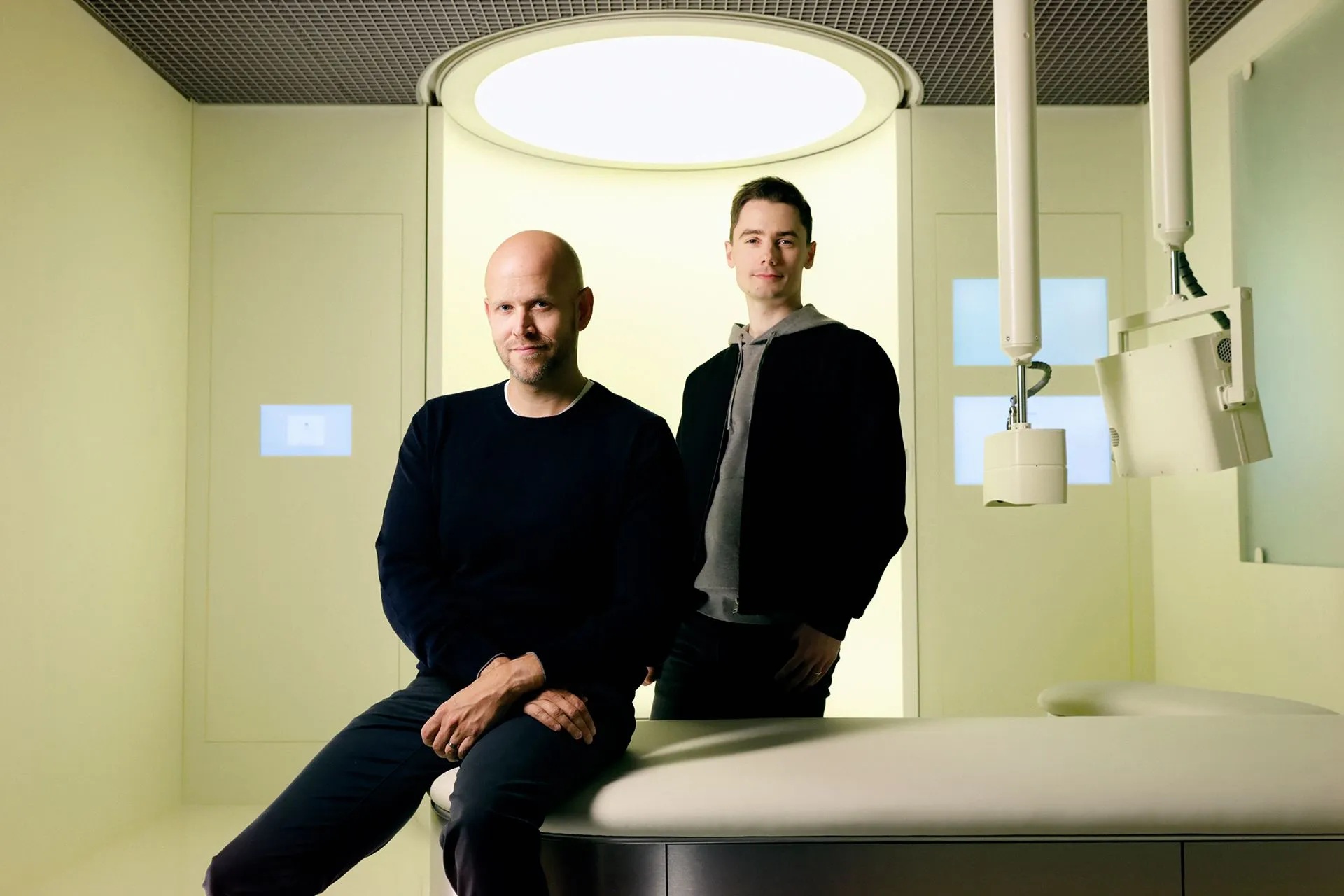
For years, preventive healthcare has operated on a simple rhythm: wait for a problem, visit a doctor, run a few tests and hope nothing serious appears. Neko Health is proposing a different model.
Scan first, understand the data quickly and potentially identify warning signs before they become obvious. Its arrival in New York puts that idea directly in front of American consumers for $499.
The Swedish health-tech company, co-founded by Spotify creator Daniel Ek, opened its first U.S. clinic in Manhattan’s SoHo neighborhood this week. The company had already accumulated a waitlist of roughly 25,000 New Yorkers, illustrating the appetite for consumer-focused preventive medicine.
Register for the next Tekedia Mini-MBA.
Register for Tekedia AI in Business Masterclass.
Join Tekedia Capital Syndicate and co-invest in great global startups.
Neko previously operated in Sweden and the United Kingdom, where more than 100,000 Europeans have reportedly used its services. The centerpiece is a full-body scan that uses cameras and other sensors to examine the skin and collect information about body composition.
Rather than simply taking a photograph, the system is designed to document thousands of images and track marks on the body that could warrant further investigation. That feature may be particularly relevant for people concerned about melanoma and other skin cancers.
But Neko’s examination goes beyond skin. Patients undergo blood-pressure measurements on all four limbs, blood tests covering markers such as cholesterol and blood sugar, an electrocardiogram, grip-strength testing and an eye-pressure examination.

The visit is designed to take roughly an hour, with results discussed with a clinician during the same appointment. That speed is arguably one of Neko’s biggest selling points. Traditional healthcare can involve separate appointments, laboratory visits, waiting periods and follow-ups.
Neko packages several measurements into one consumer-oriented experience and attempts to make the resulting data understandable rather than leaving patients to interpret a collection of numbers. There is also evidence that the technology can generate useful follow-up.
In a recent test of the New York service, a reviewer was contacted after the appointment because a mole on the torso was considered worthy of additional dermatological investigation. Neko says fewer than one in 10 customers are referred externally for follow-up.

Yet the $499 price raises an important question: how much of this is genuinely new medicine, and how much is better packaging? Several components of the examination are already available through conventional primary care.
Preventive examinations and many basic measurements can be covered by insurance for eligible patients, while dedicated skin-cancer screening may cost considerably less than $499. Neko therefore is not necessarily selling access to tests that cannot be obtained elsewhere.
It is selling convenience, speed, integration and a highly designed healthcare experience. That distinction matters because more data does not automatically mean better healthcare. A scan can identify something worth investigating.
But follow-up with specialists remains essential. Neko itself says its service is not intended to replace traditional hospital care. Its screening should therefore be viewed as an additional layer of preventive monitoring, rather than a universal substitute for established diagnostic medicine.
For $499, Neko is essentially betting that consumers will pay for a frictionless health checkup. For some people, especially those who value rapid information and structured monitoring, that convenience may have significant value.
For others, the same money could be directed toward conventional preventive care, exercise, specialist consultations or other established health services. The larger significance of Neko may therefore extend beyond the scanner itself.
Healthcare is increasingly becoming a consumer technology market, where speed, data visualization and user experience compete alongside clinical capability. Whether $499 represents good value depends less on how futuristic the machine looks and more on whether the information it produces leads to meaningful medical action.