

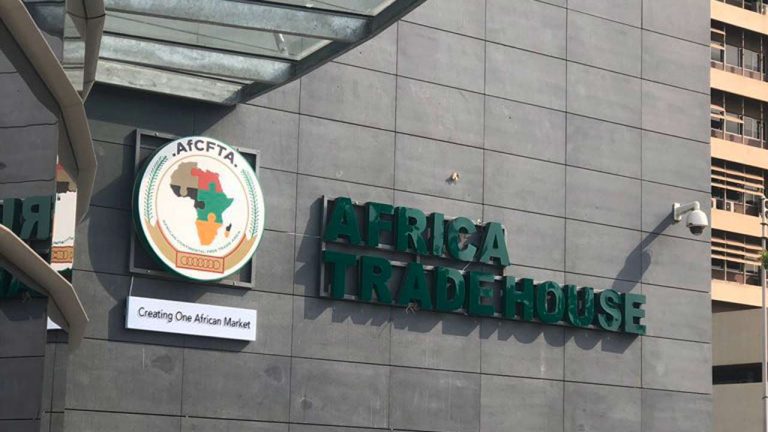
In a significant step toward deepening its participation in the African Continental Free Trade Area (AfCFTA), Nigeria has officially launched a dedicated air corridor linking Nigerian exports directly to three key African markets — Kenya, Uganda, and South Africa.
The announcement was made on Sunday, May 19, by Nigeria’s Minister of Industry, Trade and Investment, Dr. Jumoke Oduwole, via her official X (formerly Twitter) account.
“On Africa Day, we launch a bold new air corridor linking Nigerian goods to AfCFTA markets—via Uganda Airlines—cutting logistics costs by 50–75%. This opens access to Uganda, Kenya & South Africa,” Oduwole said, noting the initiative’s alignment with the objectives of the continental trade bloc.
Register for Tekedia Mini-MBA edition 20 (June 8 – Sept 5, 2026).
Register for Tekedia AI in Business Masterclass.
Join Tekedia Capital Syndicate and co-invest in great global startups.
Register for Tekedia AI Lab.
The air corridor, to be operated by Uganda Airlines, is designed to support the export of Nigerian-made products — including textiles, cosmetics, and agro-products — into participating AfCFTA markets with greater efficiency, reliability, and affordability. Exporters are expected to see a drastic reduction in logistics costs, which have long been a barrier to accessing African markets.
The launch also coincides with Nigeria’s formal gazetting of AfCFTA tariffs, a move that now legally enforces the country’s tariff commitments under the trade agreement. The Federal Government has confirmed that Nigerian exporters will now benefit from significantly reduced tariffs on 90% of goods, positioning Nigerian products to compete more effectively across the continent.
A Key Step in Unlocking AfCFTA’s Promise
The development marks a major milestone in Nigeria’s efforts to move beyond oil dependency by boosting non-oil exports and expanding access to the African market through infrastructure tailored to the continent’s growing economic integration.

The AfCFTA, established in 2018 and operational since January 2021, aims to create a single market for goods and services across 54 of Africa’s 55 countries, representing a population of 1.4 billion people and a combined GDP of over $3.4 trillion. By eliminating tariffs on 90% of goods and removing other non-tariff barriers, the agreement seeks to increase intra-African trade, which currently stands at just 15% of the continent’s total trade — one of the lowest regional trade levels in the world.
Nigeria, Africa’s 4th largest economy, was among the last countries to sign the agreement in 2019 but has since moved to speed up implementation. In April 2025, the country formally transmitted its ECOWAS Tariff Schedule for Trade in Goods to the AfCFTA Secretariat, enabling it to operationalize zero duties on 90% of traded products under the bloc.
According to the Ministry of Industry, Trade and Investment, Nigeria has already commenced a phased implementation of its tariff commitments, reducing import duties on trade with least-developed African countries by 50% and cutting them entirely — by 100% — for trade with developing African countries. These tariff reductions, applied annually, are part of the 10-year strategy designed to ease Nigeria into the full AfCFTA framework.

The air corridor is seen as a practical and immediate intervention to back these policy changes with real trade facilitation. By offering exporters quicker, safer, and more direct logistics options, the corridor is expected to create better access to continental demand and allow Nigerian SMEs — particularly in manufacturing and agro-processing — to compete on stronger footing.
Broader Economic Potential of AfCFTA
The United Nations Economic Commission for Africa (UNECA) estimates that the AfCFTA could boost intra-African trade by 52.3% by 2025. If successfully implemented, the agreement could lift 30 million Africans out of extreme poverty and raise the incomes of 68 million others, according to a joint report by the World Bank and the AfCFTA Secretariat.
The AfCFTA is also projected to generate combined consumer and business spending in Africa of $6.7 trillion by 2030, according to the African Export-Import Bank (Afreximbank). Analysts see this as a golden opportunity for African countries to shift away from extractive exports and toward value-added production that circulates within the continent.
While the current air corridor covers just three countries — Kenya, Uganda, and South Africa — it is expected to expand in the near future.
The idea is to replicate the corridor framework to other high-demand export destinations within the AfCFTA bloc, such as Ghana, Egypt, Rwanda, and Côte d’Ivoire, depending on trade flows and product demand.
Uganda Airlines, the carrier for the initial route, is expected to release further operational details, including freight schedules and cargo handling processes. Government sources say preparations are being finalized to ensure exporters can begin booking cargo space “within weeks.”
Nigeria Moves From Promises to Action
The launch of the air corridor and the gazetting of AfCFTA tariffs show a marked shift in Nigeria’s approach, which had previously been criticized as slow and bureaucratic. Trade experts have long pointed to the need for structural reforms, customs harmonization, and trade infrastructure as prerequisites for Nigeria to take full advantage of AfCFTA.
With the air corridor now in place, coupled with legally enforced tariff reductions, Nigeria is beginning to translate its AfCFTA commitments into actionable programs with visible impact.
For Nigerian exporters and manufacturers, the hope is that this corridor will be the first of many, making intra-African trade not just possible, but profitable.