

Nigeria’s budget deficit surged to N12.95 trillion in 2024, exceeding the government’s projection by 41%, as revenue shortfalls and rising expenditure widened the fiscal gap.
This figure, captured in the Central Bank of Nigeria’s (CBN) Quarterly Economic Reports, reflects a 0.77% year-on-year increase from the N12.85 trillion deficit recorded in 2023, reinforcing concerns over the country’s deteriorating fiscal balance.
The government had initially budgeted for a N9.16 trillion deficit in 2024, but by year-end, that target had been significantly overshot. Despite efforts to bridge the gap through borrowing and fiscal adjustments, expenditure pressures and weak revenue collection ensured the deficit remained persistently high.
Register for Tekedia Mini-MBA edition 20 (June 8 – Sept 5, 2026).
Register for Tekedia AI in Business Masterclass.
Join Tekedia Capital Syndicate and co-invest in great global startups.
Register for Tekedia AI Lab.
Total expenditure for 2024 stood at N21.5 trillion, marking a 12% increase from N19.19 trillion in 2023. Despite this rise, spending was still 25.2% lower than the N28.76 trillion budgeted for the year, reflecting spending constraints caused by revenue shortages. While revenue grew significantly—rising by 34.8% to N8.55 trillion from N6.34 trillion in 2023—it remained 56% lower than the government’s target of N19.56 trillion. This revenue underperformance worsened the fiscal gap, as expenditures continued to outpace earnings.
The CBN’s Q4 2024 Economic Report shows that government expenditure increased in the fourth quarter due to higher personnel costs and interest payments on debt. Recurrent expenditure dominated, accounting for 75.13% of total spending, while capital expenditure stood at just 17.1%, highlighting limited investment in infrastructure. Transfer payments constituted 7.77% of the total budget. The data further reveals that personnel costs rose by 23.31% in Q4 2024, while interest payments surged by 6.98%, underscoring Nigeria’s increasing debt burden.
While the fiscal deficit narrowed slightly in Q4 2024, the numbers remain troubling. According to the CBN, the primary deficit fell by 22.62% quarter-on-quarter, while the overall deficit declined by 3.61% to N3.08 trillion. The improvement was due to a modest increase in revenue that outpaced spending growth. However, despite this marginal improvement, the government remains significantly off target in meeting its fiscal projections.

Against this backdrop, the National Assembly, in December, approved the extension of the 2024 Budget’s lifespan to June 2025, a decision aimed at ensuring the continuity of fiscal operations and the uninterrupted execution of critical government projects.
2025 Budget Set to Follow the Same Path
With Nigeria’s 2025 budget also projecting a N14 trillion deficit, concerns are growing that the fiscal crisis will continue, particularly as the assumptions underpinning the budget are considered overly optimistic by economic analysts.
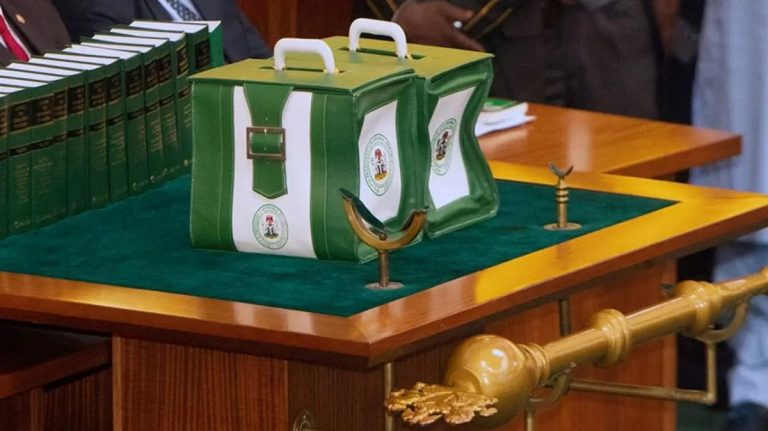
In December 2024, President Bola Ahmed Tinubu presented a N49.7 trillion budget proposal to the National Assembly, emphasizing bold economic targets, including a dramatic reduction in inflation and the stabilization of the naira.

During his address, Tinubu forecasted a sharp drop in inflation from 34.6% at the time to 15% in 2025, along with an improvement in the exchange rate from approximately N1,700 per US dollar to N1,500 per dollar.
“This is an ambitious but necessary budget to secure our future,” Tinubu said during his presentation. “The Budget projects inflation will decline from the current rate of 34.6 percent to 15 percent next year, while the exchange rate will improve from approximately 1,700 naira per US dollar to 1,500 naira, and a base crude oil production assumption of 2.06 million barrels per day.”
While the government’s targets signal optimism, many economic analysts are skeptical, warning that these projections are based on unrealistic assumptions and fail to account for Nigeria’s economic volatility.
Several key assumptions in the 2025 budget raise concerns that the deficit will likely exceed projections, just as it did in 2024. Inflation stood at 34.6% when the budget was presented, and the government expects it to drop to 15% within a year. Given the ongoing weakness of the naira, high food prices, and rising cost of living, analysts believe such a rapid decline is improbable.
The budget assumes the naira will appreciate to N1,500 per US dollar from the N1,700 level recorded in late 2024. However, foreign exchange volatility and low dollar inflows pose serious challenges to achieving this target. The CBN’s continued interventions in the FX market and Nigeria’s reliance on oil earnings, which have suffered decline over the years due to low oil output, could further strain reserves.
The crude oil production assumption of 2.06 million barrels per day is also seen as overly optimistic. Nigeria has consistently struggled to meet its OPEC production quota, with oil output fluctuating around 1.3–1.5 million barrels per day in 2024 due to oil theft, pipeline vandalism, and operational inefficiencies. If production remains below target, revenue shortfalls will worsen, pushing the deficit higher.
The 2024 budget deficit was partly financed through borrowing, including plans announced in November 2024 to issue a $1.7 billion Eurobond. With Nigeria’s public debt already exceeding N97 trillion as of late 2024, analysts caution that excessive borrowing could push the country into an unsustainable debt crisis.
They added that unless structural economic reforms are implemented to boost non-oil revenue, improve tax compliance, and enhance spending efficiency, Nigeria’s budget deficits are likely to persist, deepening the country’s financial challenges.