

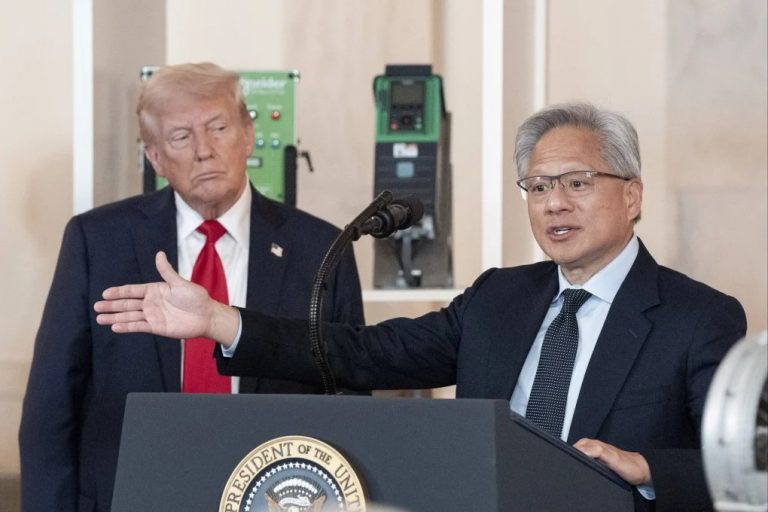
Nvidia and AMD have struck an unprecedented agreement with the Trump administration to hand over 15 per cent of revenues from certain chip sales in China in exchange for export licences, the FT has reported, citing people familiar with the arrangement, including a U.S. official.
The deal, disclosed days after Nvidia chief executive Jensen Huang met President Donald Trump at the White House, allows the companies to resume selling chips tailored for the Chinese market despite earlier export restrictions.
Under the agreement, Nvidia will pay 15 per cent of revenue from sales of its H20 chip in China, while AMD will do the same for sales of its MI308 chip. The administration has not yet determined how the funds will be used.
Register for Tekedia Mini-MBA edition 20 (June 8 – Sept 5, 2026).
Register for Tekedia AI in Business Masterclass.
Join Tekedia Capital Syndicate and co-invest in great global startups.
Register for Tekedia AI Lab.
Export control experts say no U.S. company has ever been required to share a portion of revenues as a condition for an export license. The move fits a broader pattern in which Trump has urged companies to make concessions—such as domestic investments—to secure favorable trade or regulatory terms.
Bernstein analysts estimate Nvidia could sell about 1.5 million H20 chips in China in 2025, generating roughly $23 billion in revenue.
The H20 was designed after former President Joe Biden’s administration imposed restrictions on advanced AI chips. In April, Trump announced a ban on H20 exports to China, but reversed course in June after meeting Huang. By late July, Nvidia was still waiting for the Bureau of Industry and Security (BIS) to issue licences. The process moved forward last week after Huang again raised the issue with Trump.

AMD and Nvidia have not commented in detail. Nvidia said only: “We follow rules the U.S. government sets for our participation in worldwide markets.”
The arrangement has triggered criticism in Washington. Security experts warn that the H20 could boost China’s military and erode U.S. leadership in artificial intelligence.
“Beijing must be gloating to see Washington turn export licenses into revenue streams,” said Liza Tobin, a former National Security Council China specialist now at the Jamestown Foundation. “What’s next — letting Lockheed Martin sell F-35s to China for a 15 per cent commission?”

Some BIS officials have privately voiced unease with the reversal. In a letter to Commerce Secretary Howard Lutnick, former deputy national security adviser Matt Pottinger and 19 other experts urged the administration not to grant licenses, calling the H20 “a potent accelerator of China’s frontier AI capabilities.” Nvidia dismissed those claims as “misguided.”
The decision comes as Washington and Beijing prepare for high-level trade talks, which Trump hopes will lead to a summit with Chinese President Xi Jinping. Sources told the FT that the Commerce Department has been instructed to freeze new export controls on China to avoid disrupting negotiations.
Beijing is also pressing the U.S. to ease restrictions on high-bandwidth memory (HBM) chips—vital components for advanced AI manufacturing—raising further questions over how far Washington may go in relaxing export curbs.
The deal offers Nvidia a lifeline to a Chinese market that accounted for roughly 20% of its revenue before the 2023 export bans on its flagship AI chips. The company had been blocked from selling its most powerful processors—citing concerns that they could be used in Chinese military AI programs—forcing it to develop downgraded “China-compliant” versions. Those chips, while less capable, are still powerful enough to remain attractive to Chinese buyers, making the 15% licensing cost a price Nvidia appears willing to pay.
However, analysts say this move is not merely about regulating AI chip exports—it signals a broader shift in the Trump administration’s trade strategy toward China. Washington seems to be testing whether it can both protect national security and extract economic value from controlled technologies by turning export restrictions into a revenue-generating tool.
This approach, which blends sanctions with direct fiscal gain, could become a template for future high-tech trade negotiations, especially as the U.S. seeks to fund its domestic semiconductor push without raising taxes.
But analysts are warning about implications beyond the AI chip sector. Some have warned that the unprecedented 15% licensing deal is likely to blur the line between security-based export controls and profit-driven policy. While the arrangement has given Nvidia a renewed foothold in the world’s second-largest economy, some believe it sets a precedent that could embolden Washington to treat other sensitive technologies—quantum computing, aerospace, advanced biotech—the same way.
This is like a government collecting bribe to relax regulations. Trump has officially turned the US government into a mafia group, with him as the ringleader. There’s nothing to emulate here, just a desecration. If there is a national security concern with selling to China, how will a 15% cut from sales proceeds address that? The thugs have finally lost the remaining sanity.
A corporation will be willing to do anything to gain access to a lucrative market, it has been happening for decades, with investigations and charges coming at intervals. What no one expected was for a US government to openly promote itself as an ignoble mafia empire. It is not the sort of things any other progressive nation should learn or emulate, because it’s both illegal and unethical.
If you want corporations to pay more to the government, then increase corporate taxes, but to collect bribe in order to permit your corporations to sell to your supposed rivals, even North Korea is more honourable in this regard.
Say no to government illegality at scale.