

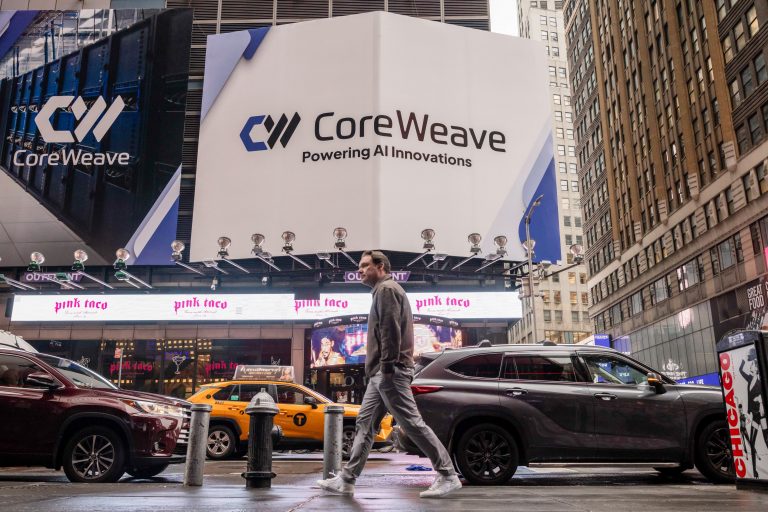
OpenAI and Anthropic are moving in opposite directions in cryptocurrency-linked private-market contracts as mounting concerns over AI infrastructure financing weigh on CoreWeave, highlighting how investor sentiment is increasingly differentiating between the two leading artificial intelligence developers.
OpenAI’s implied valuation fell more than 4% over 24 hours, briefly slipping below $1.5 trillion, according to perpetual futures prices on decentralized exchange Hyperliquid. Anthropic’s contracts, by contrast, rose 2.4% over the same period, recovering from an overnight decline and indicating a valuation of slightly more than $2 trillion.
The gap appears as CoreWeave, a major provider of computing infrastructure for AI developers, faces renewed scrutiny over its debt-financing strategy. Its shares touched a new one-year low on Thursday, extending their decline over that period to 54%.
Register for the next Tekedia Mini-MBA.
Register for Tekedia AI in Business Masterclass.
Join Tekedia Capital Syndicate and co-invest in great global startups.
OpenAI’s deeper commercial ties with CoreWeave could help explain why its valuation-linked contracts have come under greater pressure during the latest sell-off. Anthropic also relies on the infrastructure provider, but the reported scale and duration of its relationship with OpenAI distinguish the two companies’ exposure.
Despite their different performances over the latest 24-hour period, both companies remain under pressure compared with recent peaks. According to Hyperliquid pricing, OpenAI and Anthropic are each down approximately 15% from their highs last month, suggesting that the latest divergence is occurring within a broader retreat in their implied valuations.
CoreWeave’s declining share price has become a focal point for concerns about the financial risks associated with the AI infrastructure boom. The company supplies computing capacity and data-center technology needed to train and run advanced AI models, making its business closely linked to the spending plans of major developers.

OpenAI’s relationship with CoreWeave stretches back several years. As of September 2025, the relationship was valued at no less than $22 billion, including a five-year agreement to provide data centers and technology.
The scale of that commitment creates an important connection between OpenAI’s expansion and the financial health of a key infrastructure supplier. As AI developers compete to expand computing capacity, long-term infrastructure agreements can secure access to critical resources. However, they also expose the companies involved to risks if financing becomes more expensive or the economics of large-scale computing investment deteriorate.
CoreWeave’s falling share price has raised questions about whether its debt-funded expansion can generate sufficient returns to justify its financing costs. For investors assessing OpenAI through its private-market valuation, concerns about the infrastructure supporting its operations may be influencing expectations about the company’s costs, capacity commitments and future financial performance.

Anthropic also has a commercial relationship with CoreWeave. In April, CoreWeave announced an agreement to power Anthropic’s Claude products, although it did not disclose the value of the deal.
The existence of that agreement means Anthropic is not entirely insulated from concerns surrounding CoreWeave. However, the available information does not establish the precise financial exposure of either AI developer or demonstrate that CoreWeave’s share-price decline directly caused OpenAI’s sharper drop in perpetual futures.
The latest price movements nevertheless suggest that traders are differentiating between the companies based partly on their relationships with infrastructure providers and the risks associated with financing the rapid expansion of AI computing.
The valuations cited in the latest market movements come from perpetual futures contracts on Hyperliquid rather than conventional transactions in OpenAI or Anthropic shares.
Perpetual futures are derivative contracts that have no fixed expiry date. On Hyperliquid, deployers, which develop and maintain specific markets, establish funding rates that help align futures prices with reference prices. For private companies, those reference prices can draw on third-party information, including private funding rounds and secondary-market transactions, to estimate valuations that are otherwise difficult to observe continuously.
That structure allows traders to take positions on the implied valuations of companies that have not completed public listings. However, the resulting figures should not be treated as equivalent to confirmed company valuations established through a financing round or an initial public offering.
That becomes more relevant when market liquidity is limited. Futures prices can move sharply as traders adjust positions, while the underlying private-company valuation may not have changed through a new funding round or a completed share transaction.
Open interest, which Hyperliquid defines as the combined value of outstanding long and short positions in a contract, also indicates a substantial difference in trading activity between the two companies. Anthropic’s contract had more than $41 million in open interest, compared with less than $7 million for OpenAI, making the Anthropic market more than five times larger by that measure.
Higher open interest indicates a larger outstanding derivatives market, but it does not by itself establish that a valuation is more accurate or that more investors expect the company’s price to rise. Each open position has both a long and a short side.
The pre-IPO contracts are currently maintained by Entropy IO, the developer operating the markets on Hyperliquid. TradeXYZ, a prominent market developer on the platform, generally waits until companies have publicly filed their registration statements, known as S-1 filings, before listing pre-IPO perpetual futures, according to David Schamis, chief executive of Hyperliquid Strategies, a publicly traded treasury company that invests in the HYPE token powering the exchange.
Schamis said the market could become more liquid if TradeXYZ lists the companies.
“Liquidity will probably be deeper once TradeXYZ lists these companies,” he said.
He added that the contracts generally trade at a premium to the eventual IPO price, although he believes they can provide a useful indication of where a company might trade after going public.
That assessment remains a market participant’s view, rather than a guarantee that perpetual futures will accurately predict an IPO valuation. Derivatives prices can reflect speculative positioning and liquidity conditions as well as expectations about a company’s underlying business.
The contrasting performances of OpenAI and Anthropic show how quickly sentiment can shift across the private AI market as concerns about infrastructure financing intensify.
OpenAI’s implied valuation has fallen more sharply over the latest 24-hour period, while Anthropic’s has recovered. Yet the approximately 15% decline in both contracts from their highs last month indicates that neither company has escaped the wider reassessment taking place among traders.
Analysts believe the divergence may reflect differences in perceived infrastructure exposure, but it should not be interpreted as conclusive evidence that Anthropic’s underlying business is stronger or that OpenAI’s long-term prospects have deteriorated by the same magnitude as its futures price.
Both companies operate in a market where demand for AI services is expanding alongside enormous requirements for computing capacity.
The CoreWeave sell-off is currently exposing a vulnerability in the AI investment narrative: the financial performance of model developers cannot be considered entirely separate from the companies financing and supplying the infrastructure on which their products depend.
As derivatives traders reassess those connections, the gap between OpenAI and Anthropic has become a visible measure of shifting sentiment.