

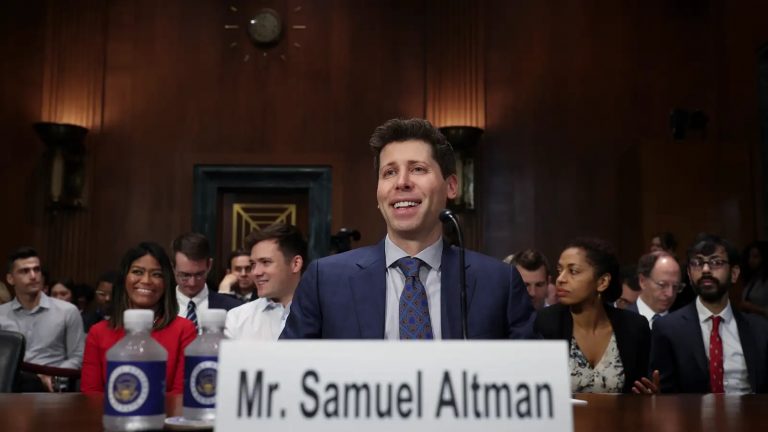
OpenAI chief executive Sam Altman has warned that the United States may be underestimating both the scale and complexity of China’s rapid progress in artificial intelligence, stressing that export controls alone are unlikely to stop Beijing’s rise.
“I’m worried about China,” Altman said, during an unusually candid on-the-record conversation with a small group of reporters over Mediterranean tapas in San Francisco’s Presidio. He described the AI race between Washington and Beijing as “deeply entangled” and far more consequential than a simple scoreboard comparison of which side is ahead.
“There’s inference capacity, where China probably can build faster. There’s research, there’s product; a lot of layers to the whole thing,” he explained. “I don’t think it’ll be as simple as: Is the U.S. or China ahead?”
Register for Tekedia Mini-MBA edition 20 (June 8 – Sept 5, 2026).
Register for Tekedia AI in Business Masterclass.
Join Tekedia Capital Syndicate and co-invest in great global startups.
Register for Tekedia AI Lab.
Altman’s skepticism was most pointed on the question of U.S. export controls. Washington has steadily tightened restrictions on semiconductor sales to China, hoping to choke off the hardware needed for advanced AI development. But Altman suggested the approach is mismatched against technical realities.
“You can export-control one thing, but maybe not the right thing… maybe people build fabs or find other workarounds,” he said, referring to fabrication plants that produce cutting-edge chips.
“I’d love an easy solution,” he added. “But my instinct is: That’s hard.”

The Biden administration had previously imposed curbs on the sale of high-end GPUs, but in April, President Donald Trump went further, ordering a halt on shipments of advanced processors altogether — including models that had been redesigned to comply with Biden-era rules. The result was a sweeping embargo that rattled Silicon Valley and further strained U.S.–China relations.
Yet the policy has already begun to loosen under pressure from American industry. Nvidia’s CEO Jensen Huang had criticized the restrictions, saying that it costs the company about $50 billion in revenue. He added that it emboldens China’s domestic production.
Last month, Washington quietly granted Nvidia approval to export its H20 processor to Chinese clients, a chip designed to meet “China-safe” thresholds while still offering enough computing power for commercial AI tasks. The move came as part of a broader agreement that controversially requires Nvidia and AMD to hand over 15 percent of their China-related chip revenue to the federal government — a compromise critics say illustrates the difficulty of balancing national security with corporate interests.

China, meanwhile, has responded with caution. Beijing’s cybersecurity regulators recently summoned Nvidia officials to discuss “serious security concerns” about U.S.-made AI processors, warning that chips such as the H20 could contain backdoors capable of tracking or disabling Chinese systems remotely. Analysts say the move highlights Beijing’s determination to double down on self-reliance by accelerating domestic chip production, with Huawei and other Chinese suppliers already stepping up to fill the gap left by U.S. restrictions.
Altman’s warning underscores the risk that Washington’s export-control strategy may not only fall short but also spur China to invest even more aggressively in its own semiconductor ecosystem.
“My instinct is that doesn’t work,” he said of U.S. restrictions.
The challenge is thus becoming clear to policymakers in Washington: limiting chip exports to China will only aid its domestic semiconductor manufacturing, creating a leadership opportunity for the Asian giant in the AI arms race.