

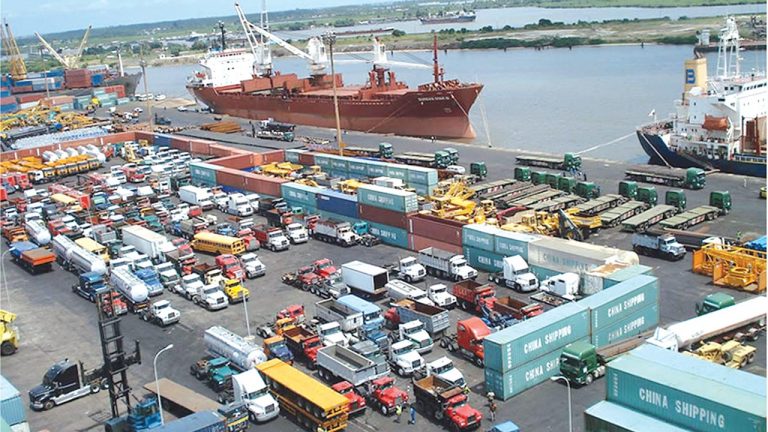
Governor Alex Otti has moved to revive one of the Southeast’s oldest economic ambitions, unveiling plans for a proposed seaport and inland waterways corridor that business leaders say could fundamentally alter trade and industrial activity across Nigeria’s eastern corridor.
The governor disclosed on Wednesday that his administration would seek approvals from President Bola Ahmed Tinubu, the Nigerian Ports Authority, and the Federal Ministry of Marine and Blue Economy for the proposed Azumini–Obeaku Sea Port and Inland Waterways Corridor project.
Otti made the disclosure after a meeting with a delegation from China Harbour Engineering Company Limited led by Mr. Nicolas Liu.
Register for the next Tekedia Mini-MBA.
Register for Tekedia AI in Business Masterclass.
Join Tekedia Capital Syndicate and co-invest in great global startups.
According to the governor, the state has already approved an immediate feasibility study and directed that the process be accelerated to shorten the timeline initially proposed by the company.
“We received a delegation from the China Harbour Engineering Company Limited led by Mr. Nicolas Liu, where we discussed the proposed Azumini – Obeaku Sea Port and Inland Waterways Corridor project in Abia State,” Otti said in a statement posted on his official X account.
The announcement has generated renewed attention because the push for a functional seaport in Nigeria’s eastern corridor has long been viewed by manufacturers, traders, and industrial groups as an economic necessity rather than a prestige infrastructure project.

For years, business leaders in the Southeast and South-South have argued that successive governments placed disproportionate emphasis on airport projects while neglecting maritime infrastructure capable of driving large-scale industrial growth and export activity.
Industry groups have repeatedly maintained that airports, though important, cannot match the economic multiplier effect of deep seaports, which serve as gateways for manufacturing supply chains, heavy cargo movement, exports, and regional logistics integration.
The absence of a major fully operational modern seaport in the eastern corridor has left manufacturers and traders heavily dependent on Lagos ports, despite the region’s strong commercial base.

Cities such as Aba, Onitsha, Nnewi, Port Harcourt, Uyo, and Calabar remain among Nigeria’s most active trading and manufacturing centers, yet businesses there continue to grapple with expensive logistics costs tied to moving cargo through Lagos.
Importers frequently complain that containers destined for the Southeast spend weeks trapped in Lagos congestion before being transported by road over long distances, increasing costs for businesses and consumers alike.
Economists say the logistics burden has weakened industrial competitiveness in the region and slowed the growth of export-oriented manufacturing clusters.
The renewed attention on the Abia proposal also stems from frustration that several riverine states in the eastern corridor, despite their coastal advantages, have struggled for decades to successfully advance large-scale seaport projects beyond announcements and early-stage approvals.
Projects linked to states such as Akwa Ibom, Bayelsa, and even older port expansion efforts in Cross River have faced repeated delays tied to financing constraints, political transitions, technical concerns, environmental challenges, and federal bottlenecks.
That history is why some analysts view Otti’s intervention as potentially significant.
Unlike many previous proposals framed largely around political declarations, the Abia initiative appears to be combining inland waterways development with seaport ambitions while simultaneously seeking early federal engagement and technical assessments.
The governor emphasized that technical viability would remain central to the project, especially issues surrounding dredging requirements and navigational access.
“I have also encouraged the team to visit the proposed site to assess its viability, given its proximity to the High Sea and the technical requirements such as dredging,” Otti stated.
Maritime experts note that dredging remains one of the most expensive and technically demanding components of seaport development in Nigeria, particularly for states seeking to create deep-water access channels capable of handling large vessels.
Still, proponents argue that the economic upside could be enormous if the project succeeds. A functioning maritime corridor in Abia could open new opportunities for manufacturing exports, agro-processing, warehousing, inland logistics, and industrial park development while reducing the pressure on overstretched western ports.
It could also reposition the Southeast as a more integrated participant in regional trade under the African Continental Free Trade Area framework.
The inclusion of inland waterways in the proposal is viewed as particularly strategic because it suggests a broader logistics ecosystem rather than a standalone port facility. Such integration could eventually support barge transportation, bulk cargo movement, and lower-cost freight systems connecting multiple commercial centers across the region.
The project also aligns with the Tinubu administration’s broader push to expand Nigeria’s blue economy, an area federal officials believe remains vastly underdeveloped relative to the country’s coastline and inland water potential.
China Harbour Engineering Company’s participation further reflects China’s continuing dominance in African infrastructure construction and financing. Chinese firms have been deeply involved in major Nigerian infrastructure projects spanning rail, roads, airports, and port construction over the past decade.
However, analysts caution that large-scale infrastructure projects involving foreign financing will likely face heightened scrutiny amid concerns over debt sustainability, project execution, and long-term returns.
But the seaport proposal could become one of the defining infrastructure bets of Otti’s administration if it advances beyond the feasibility phase.
“The project has the potential to transform Abia State’s economy and contribute significantly to Nigeria’s maritime development,” the governor said. “With strong commitment, proper funding, and strategic partnerships, we can make the Azumini Sea Port a reality.”
However, it is believed that the success of the initiative ultimately depends on federal political backing, technical feasibility, investor appetite, and the government’s ability to avoid the long list of abandoned or stalled port ambitions that have defined maritime infrastructure development in Nigeria’s eastern corridor for decades.