DD
MM
YYYY

PAGES

DD
MM
YYYY

spot_img

PAGES

Home Blog Page 1006

Nano Labs Announces $500M Convertible Notes For Binance Coin (BNB) Treasury

0

Nano Labs, a Nasdaq-listed Chinese Web3 infrastructure provider, has announced a $500 million convertible notes issuance to fund a Binance Coin (BNB) treasury, aiming to acquire up to $1 billion worth of BNB. The zero-interest notes mature in 360 days and are convertible into Class A ordinary shares at $20 per share, subject to adjustment. The company plans to hold 5-10% of BNB’s circulating supply, signaling a shift to a multi-asset treasury strategy alongside its existing Bitcoin reserves.

The move has sparked market enthusiasm, with Nano Labs’ stock surging significantly, up to 200% in pre-market trading. BNB’s price also rose 3% to around $637-$640. This reflects growing institutional interest in BNB as a strategic reserve asset, though the deal’s completion is subject to customary closing conditions. The announcement by Nano Labs to issue $500 million in convertible bonds to establish a BNB treasury has several implications, both for the company and the broader crypto and financial markets.

By adding BNB to its existing Bitcoin reserves, Nano Labs is diversifying its crypto holdings, potentially reducing risk tied to a single asset’s volatility. This could position the company as a more resilient player in the Web3 space. The significant stock surge (up to 200% in pre-market trading) suggests strong investor approval, viewing the BNB treasury as a bold, forward-thinking move to align with the growing Binance ecosystem.

Issuing zero-interest convertible bonds allows Nano Labs to raise funds without immediate interest expenses, preserving cash flow while offering investors potential upside through equity conversion. Acquiring 5-10% of BNB’s circulating supply could drive demand, supporting BNB’s price (already up 3% to ~$637-$640). This could enhance BNB’s status as a reserve asset, akin to Bitcoin for some institutions.

Institutional backing from Nano Labs signals confidence in Binance’s infrastructure (e.g., Binance Smart Chain), potentially attracting more developers and projects to the ecosystem. Large-scale BNB accumulation may temporarily reduce market liquidity, potentially increasing volatility if other institutions follow suit.

Nano Labs’ move could inspire other public companies to adopt crypto treasuries, particularly for altcoins like BNB, beyond Bitcoin and Ethereum. This may accelerate mainstream crypto adoption. Large crypto treasury holdings by a Nasdaq-listed firm could draw attention from regulators, especially in jurisdictions like the U.S. or China, where crypto policies are stringent.

The positive price reaction in both Nano Labs’ stock and BNB suggests a bullish sentiment, but it could also fuel speculative bubbles if overhyped. If Nano Labs’ stock price doesn’t reach or exceed the $20 conversion threshold, bondholders may face losses, impacting investor confidence. BNB’s price is subject to market fluctuations, and a significant drop could impair Nano Labs’ treasury value, affecting its financial stability.

The deal’s success hinges on meeting closing conditions, and any delays or failures could erode market trust. Investors driving the 200% stock surge likely view the BNB treasury as a visionary move, betting on BNB’s long-term growth and Nano Labs’ Web3 leadership. They see convertible bonds as a low-risk way to gain equity exposure.

Some investors may question the wisdom of tying a public company’s treasury to a volatile altcoin like BNB, especially given regulatory uncertainties and the speculative nature of crypto markets. They may prefer traditional assets or Bitcoin-only strategies. Binance’s community and BNB holders likely see this as a major win, validating BNB’s utility and reinforcing Binance’s dominance in Web3. The price bump reflects this enthusiasm.

Other crypto factions (e.g., Ethereum or decentralized finance advocates) may view this as further centralization around Binance, a platform often criticized for its centralized control. This could fuel debates about ecosystem dominance. Authorities, especially in China (where Nano Labs is based) or one of the countries with stricter crypto regulations, may scrutinize this move, fearing it could circumvent capital controls or encourage speculative behavior.

Web3 companies and crypto advocates may see this as a progressive step, pushing for greater integration of crypto into corporate finance and challenging regulatory conservatism. Legacy financial institutions may view Nano Labs’ strategy as risky, preferring stable assets like bonds or gold over crypto treasuries. This could widen the gap between traditional and crypto-native corporate strategies.

Web3 firms may see Nano Labs as a trailblazer, setting a precedent for public companies to leverage crypto for growth and innovation. Nano Labs’ $500 million convertible bond issuance to build a BNB treasury is a bold move with significant implications for its financial strategy, the Binance ecosystem, and the broader crypto market. It signals growing institutional confidence in altcoins but also introduces risks tied to volatility and regulation.

The divide between optimists and skeptics, BNB supporters and critics, regulators and innovators, and traditional finance versus crypto-native firms underscores the polarizing nature of this strategy. While it could cement Nano Labs’ position in Web3 and boost BNB’s prominence, its success will depend on execution, market conditions, and regulatory developments.


Implications of CRCL’s $300 ATH and Surpassing Circulating Supply of USDC

0

Circle Internet Group (CRCL), the issuer of the USDC stablecoin, hit a new all-time high stock price of $300, pushing its market capitalization to approximately $66 billion, surpassing the $61.3 billion circulating supply of USDC. This milestone, achieved just weeks after its June 5, 2025 IPO at $31 per share, reflects an 800%+ stock surge driven by investor confidence in Circle’s broader fintech ecosystem, including tokenization, corporate fund management, and international payments.

The U.S. Senate’s passage of the GENIUS Act, advancing stablecoin regulation, further fueled the rally, positioning USDC as a key player in DeFi, real-world assets, and cross-border transactions. However, some analysts caution that CRCL’s high valuation multiples, like a 216x net income P/E ratio, may signal a potential bubble, with growth hinging on USDC adoption and regulatory clarity. Meanwhile, Tether’s USDT retains a dominant 62% market share at $156 billion.

Circle’s stock surge to $300, valuing the company at $66 billion, reflects strong investor belief in its potential beyond USDC. Its fintech offerings—tokenization, corporate fund management, and international payments—are seen as high-growth areas, especially in DeFi and real-world asset (RWA) markets. The flip of USDC’s $61.3 billion market cap signals that investors value Circle’s infrastructure and future revenue streams more than the stablecoin’s current circulation.

The U.S. Senate’s GENIUS Act, passed recently, provides a clearer regulatory framework for stablecoins, boosting USDC’s credibility as a compliant, transparent alternative to Tether’s USDT. This could accelerate USDC adoption in institutional finance, cross-border payments, and Web3 applications. However, regulatory scrutiny could increase operational costs or limit innovation if compliance becomes overly restrictive.

Despite USDC’s growth, Tether’s USDT dominates with a $156 billion market cap (62% share). Circle’s valuation suggests investors expect it to challenge Tether, but USDT’s entrenched use in crypto trading pairs and offshore markets remains a hurdle. Circle’s focus on transparency and U.S. compliance gives it an edge in institutional markets, but Tether’s opacity appeals to privacy-focused users, deepening the divide.

CRCL’s 216x P/E ratio raises bubble concerns. If USDC adoption or Circle’s fintech ventures underperform, the stock could face sharp corrections. High valuations may pressure Circle to deliver consistent growth, potentially leading to aggressive expansion or acquisitions. USDC’s rise strengthens the stablecoin sector’s legitimacy, encouraging mainstream adoption in payments, remittances, and DeFi. However, it could concentrate market power among a few players, raising systemic risk concerns.

Stablecoin growth may draw more regulatory attention globally, impacting smaller issuers or decentralized stablecoins. USDC/Circle represents the compliant, regulated side, appealing to institutions, governments, and traditional finance. Its transparency (e.g., monthly attestations) aligns with U.S. regulatory demands but limits appeal in privacy-centric markets.

USDT/Tether thrives in less-regulated environments, popular among crypto traders and offshore users. Its opacity and questionable reserve backing create trust issues but maintain its dominance in trading volume. Circle targets institutional adoption (e.g., BlackRock’s tokenized funds, Visa’s payment integrations), positioning USDC as a bridge between TradFi and DeFi. This caters to large-scale, regulated use cases.

Tether serves retail-heavy crypto markets, particularly in regions with limited banking access, where USDT acts as a de facto digital dollar. USDC’s centralized model, backed by Circle and regulated reserves, contrasts with decentralized stablecoins like DAI or algorithmic stablecoins. Centralized stablecoins dominate due to stability and trust but face criticism for custodial risks and regulatory dependence.

Decentralized alternatives struggle with scalability and volatility but appeal to crypto purists prioritizing censorship resistance. CRCL’s $66 billion valuation reflects speculative optimism about Circle’s future, not just USDC’s current $61.3 billion supply. This disconnect could widen if growth falters, creating a divide between investor expectations and operational reality.

Tether’s lack of public valuation (private company) obscures its financial health, leaving the market to speculate on its reserves and profitability. Circle’s U.S.-focused compliance aligns with Western regulatory trends, giving it an edge in developed markets but limiting penetration in regions with restrictive crypto policies or distrust of U.S. oversight.

Tether’s global reach, especially in Asia and emerging markets, stems from its regulatory arbitrage and accessibility, but it faces risks from international crackdowns. Circle’s $300 ATH and market cap flip of USDC underscore its rising influence in the stablecoin and fintech sectors, fueled by regulatory clarity and institutional interest. However, the divide between compliant (USDC) and less-regulated (USDT) stablecoins, centralized vs. decentralized models, and speculative valuations vs. fundamentals will shape the industry’s future.

Circle’s success hinges on scaling USDC adoption and delivering on its fintech vision, while navigating regulatory and competitive pressures. The broader crypto market must balance innovation with stability to avoid systemic risks as stablecoins grow.

Crypto Short Sellers Took A Hit Following De-escalation Of Conflict Between Israel and Iran

0

Geopolitical events, like a ceasefire, often influence crypto markets. A de-escalation in tensions, such as between Israel and Iran, could reduce market uncertainty, boosting risk assets like Bitcoin. If tensions ease, investors might shift from safe-haven assets (e.g., gold or USD) to riskier ones, potentially driving BTC prices up. This could harm short sellers, who bet on price declines, as a sudden rally might trigger liquidations if BTC surges past their margin thresholds.

For example, a hypothetical ceasefire announcement could have caused BTC to rebound from a recent low, say $98,000, to above $105,000, as markets react to reduced geopolitical risk. Such a move could liquidate short positions, especially if leveraged traders were caught off-guard. The implications of a Trump-announced Israel-Iran ceasefire on June 24, 2025, for Bitcoin (BTC) short sellers and the broader market divide are significant, driven by the crypto market’s sensitivity to geopolitical events and investor sentiment shifts.

The ceasefire announcement led to a sharp Bitcoin rally, with prices climbing 3.7% to $105,000 and peaking at $106,000, recovering from a low of $98,615 triggered by earlier U.S. airstrikes on Iran. This rapid rebound likely caught short sellers—those betting on price declines—off guard. Short positions, especially leveraged ones, faced significant liquidations as BTC surged past key resistance levels like $103,800.

Coinglass data indicates that a drop below $100,000 could have risked $1.74 billion in long positions, but the rally instead pressured shorts, with liquidations contributing to $500 million in market-wide liquidations when Iran reportedly breached the ceasefire later that day. The ceasefire news, brokered by Trump with Qatar’s mediation, signaled a temporary easing of Middle East tensions, boosting risk-on sentiment. Investors moved away from safe-haven assets like gold and the U.S. dollar, pouring capital into riskier assets like BTC, Ethereum (up 7% to $2,396), Solana, and XRP (both up 6–7%).

This shift squeezed short sellers, as the market’s 2.4% capitalization increase to $3.35 trillion reflected renewed optimism, leaving bearish traders underwater. The ceasefire’s fragility, with Israel accusing Iran of violations hours after the announcement and reports of renewed strikes, introduced volatility. This uncertainty likely amplified losses for short sellers who didn’t close positions quickly, as BTC fluctuated between $99,000 and $106,000 in response to conflicting reports. Analysts warned that renewed hostilities could reverse gains, keeping short sellers on edge.

The rally pushed the Crypto Fear & Greed Index to 65 (“Greed” territory), up 18 points, signaling bullish momentum. Altcoins like Solana and XRP outperformed BTC, with 7–8% gains, reflecting speculative appetite in a de-escalation environment. Some analysts, like Cas Abbé, predicted BTC could reach $130,000–$135,000 by Q3 2025, driven by rising On-Balance Volume (OBV). Traders saw the dip to $98,615 as a buying opportunity, with “smart money” accumulating at lower levels.

Cautious traders remained wary due to the ceasefire’s instability. Israel’s Defense Minister accused Iran of violations, and reports of missile launches post-ceasefire fueled fears of renewed conflict. This led to a $500 million liquidation event when markets pulled back, reflecting bearish pressure from risk-off moves. Analysts like Lucas McCarthy noted BTC’s behavior as a high-risk asset rather than a safe-haven, questioning its “digital gold” status during crises.

BTC’s recovery above the 50-period exponential moving average ($103,800) and a 4% rise in the 1-week 25 Delta Skew indicated bullish call option demand. Trading volume surged 6.9% to $52.8 billion, reflecting heightened activity. However, short-term support levels near $103,000 remained critical, with potential retests if tensions escalated. The market’s reaction underscored BTC’s sensitivity to geopolitical stability. While the ceasefire boosted prices, historical data (e.g., an 8.4% BTC drop during Iran’s April 2024 attack on Israel) suggests vulnerability to renewed conflict.

Investors were divided between viewing BTC as a speculative asset benefiting from risk-on sentiment and those seeing it as a hedge against traditional market disruptions, creating a split in long-term vs. short-term strategies. Retail investors on platforms like Reddit expressed mixed views, with some dismissing the conflict’s long-term impact on BTC, citing global economic factors like M2 growth and inflation as dominant drivers. Institutional players, however, showed caution, with stablecoin outflows (e.g., 4% Tether redemptions) signaling de-risking.

Spot Bitcoin ETF inflows of $1.37 billion over five days ending June 20 suggested institutional confidence, but this was tempered by volatility post-ceasefire. The market’s reaction to the ceasefire reveals a broader issue: BTC’s narrative as a “safe-haven” asset remains unconvincing during geopolitical shocks, behaving more like a high-beta tech stock. Short sellers were indeed “burned” by the rally, but the ceasefire’s fragility and subsequent violations suggest their caution wasn’t entirely misplaced.

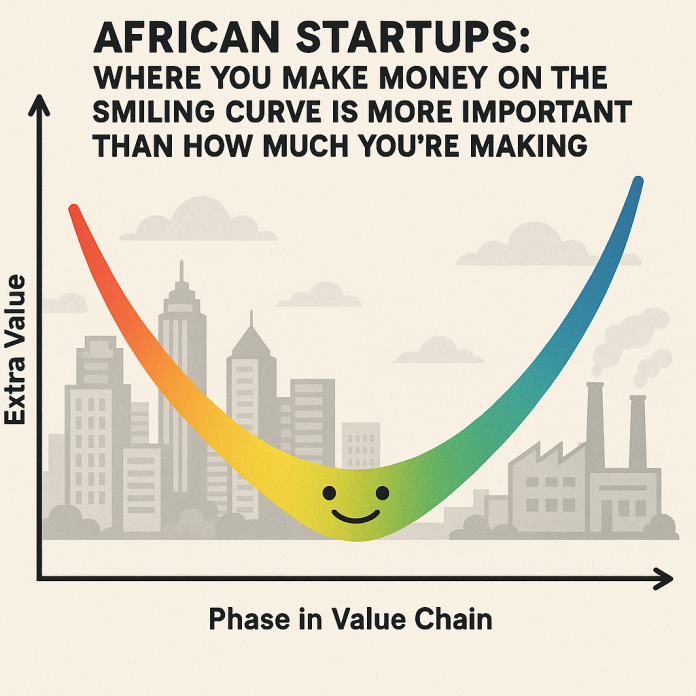
African Startups: Where You Make Money on the Smiling Curve Is More Important Than How Much You’re Making

1

In the relentless pursuit of growth and market dominance, many startups, particularly across our emerging economies, often find themselves trapped in a value paradox. They build, they produce, they hustle, yet the margins remain thin, and true wealth creation feels elusive. The fundamental challenge, I submit, lies not in their effort, but in their strategic positioning along the value chain. This brings us back to the construct of “Smiling Curve”—a framework that remains remarkably pertinent for any startup aspiring to build a sustainable, defensible enterprise.

If you operate at the center of the curve which typical means delivery & centralization, you do not capture a lot of value. But if you operate at the edges of the curve, which has origination & creation or discovery & aggregation, you will capture extra value. Largely, where you make money is more important than how much money you’re making, as you’re looking for compounding capabilities and positioning over time.

Dangote Cement operates at the edges and the center. Elon Musk’s Tesla does the same for cars. These companies are category-king companies, and they typically have great margins provided they optimize the investments at the center.

A bank could be operating at the center, hosting and supporting bank accounts in a country for citizens. But a card company like Interswitch Verve can focus on origination for payment and capture extra value at an edge even as fintech firm like Flutterwave does aggregation via APIs to merchants at the other side of the edge. Just like that, those at the edges will see better valuation because they do not have to spend as much as the bank which supports the ecosystem but captures little value, when benchmarked by assets deployed.

The Smiling Curve illustrates that in most industries, the highest value-added is found at the ‘edges’ of the value chain: namely, Research & Development (R&D), Design, and Intellectual Property (IP) at the upstream end, and Branding, Marketing, Distribution, and After-sales Services at the downstream end. The ‘bottom’ of the smile, where value is lowest, is typically occupied by manufacturing, assembly, and mere production.

For too long, our focus has been disproportionately skewed towards the manufacturing and assembly phase – the very belly of the smiling curve where competition is fiercest, margins are razor-thin, and differentiation is a constant, exhausting battle. When startups operate solely here, they become commoditized, easily replaceable cogs in a larger machine. This is not the pathway to building generational companies.

Why Startups Must Gravitate Towards the Edges:

  1. The Left Edge: Innovation and Uniqueness This is where ideas are born, where patents are filed, and where proprietary knowledge resides. Startups that invest heavily in R&D, unique design, and the creation of intellectual property build moats around their businesses. Think of software-as-a-service (SaaS) companies developing unique algorithms, biotech firms creating novel therapies, or material science startups inventing next-generation composites. They are not just selling a product; they are licensing an idea, solving a problem uniquely, and holding the keys to future iterations. This is a game of deep insight and sustained investment in knowledge creation.
  2. The Right Edge: Brand, Distribution & Customer Lock-in Once a product or service is created, its perceived value and accessibility determine its market capture. This edge is about building powerful brands that resonate with consumers, establishing efficient and expansive distribution networks, and fostering deep, lasting customer relationships through exceptional service. Consider the power of a global brand like Apple, whose manufacturing is outsourced, but whose design, marketing, and customer ecosystem command premium pricing and unparalleled loyalty. Here, customer data, network effects, and trust become your most valuable assets.

The African Startup Imperative:

For African startups, embracing the smiling curve is not merely an option; it is an imperative for leapfrogging traditional development paradigms. We cannot afford to compete solely on cheap labor in a globalized manufacturing landscape that increasingly favors automation. Instead, we must strategically:

  • Innovate for Local Contexts, Scale Globally: Develop IP and solutions that address unique African challenges but are robust enough to scale internationally. This means investing in local R&D, design thinking, and data-driven insights.
  • Build Authentic Brands: Connect with consumers emotionally. Storytelling, community building, and delivering consistent value will differentiate you beyond price.
  • Master Digital Distribution and Service: Leverage mobile penetration and digital platforms to reach customers directly, collect feedback, and provide seamless after-sales support, bypassing traditional infrastructural limitations.

The future of value creation for startups lies in mastering the nexus points of innovation, design, brand narrative, and customer experience. It means moving beyond simply “making things” to “owning ideas” and “owning customers.” Analyze your current position on the smiling curve. Where can you shift your resources and focus to climb towards those high-value edges? This strategic pivot is not just about survival; it’s about building the enduring enterprises that will drive our continent’s economic renaissance.

Implications of Removing “Reputational Risk” From Federal Reserve Bank Supervisory Exams

0

The Federal Reserve announced on June 23, 2025, that it will no longer include “reputational risk” as a component of its bank supervisory examination programs. This decision aligns with similar moves by the Office of the Comptroller of the Currency (OCC) and the Federal Deposit Insurance Corporation (FDIC), which had already removed reputational risk from their supervisory frameworks earlier in 2025. The Fed is revising its supervisory materials, including examination manuals, to eliminate references to reputational risk and, where appropriate, replace them with more specific discussions of financial risk.

Examiners will be trained to ensure consistent implementation across supervised banks, and the Fed will coordinate with other federal banking regulators to promote uniform practices. This change addresses industry concerns about the subjectivity of reputational risk, which was previously defined as the potential for negative publicity to harm a bank’s business or lead to costly litigation. Critics, particularly in the cryptocurrency sector, argued that reputational risk was used to justify “debanking,” where banks denied services to certain clients, such as crypto firms, due to perceived public perception issues.

The shift to focusing on measurable financial risks is seen as a move to enhance transparency and consistency in supervision, potentially easing banking access for crypto and other high-risk but compliant sectors. The Fed emphasized that this change does not lower expectations for banks to maintain robust risk management practices to ensure safety, soundness, and compliance with laws and regulations. Banks may still consider reputational risk in their internal risk management processes, but it will no longer be a formal supervisory metric.

By replacing reputational risk with measurable financial risks, banks gain clearer regulatory expectations. The subjective nature of reputational risk often led to inconsistent examiner judgments, creating compliance uncertainty. Banks can now focus on quantifiable metrics like credit, market, and operational risks. The Fed, alongside the OCC and FDIC, aims to standardize supervisory practices, reducing ambiguity. This shift may streamline examinations and reduce the risk of legal challenges from banks over vague supervisory criteria.

Cryptocurrency firms, cannabis businesses, and other industries often faced restricted banking access due to banks’ fears of reputational risk penalties, a practice critics called “debanking.” Removing this risk as a supervisory factor could encourage banks to serve these compliant but controversial sectors, fostering financial inclusion and innovation. Easier banking access for crypto firms may lower transaction costs and improve service availability for users of digital assets.

While reputational risk is no longer a supervisory requirement, banks may still address it internally to protect customer trust and market position. However, without regulatory pressure, some may deprioritize it, potentially increasing vulnerability to public relations issues that could indirectly affect financial stability. The emphasis on financial risks strengthens oversight of core banking safety and soundness but may limit regulators’ ability to address non-financial risks that could escalate, such as consumer backlash or litigation from high-profile controversies.

Reduced regulatory barriers could spur growth in fintech and crypto, aligning with pro-innovation sentiments from some policymakers and the incoming Trump administration’s crypto-friendly stance. Investors and customers may perceive banks serving high-risk industries as riskier, potentially affecting stock prices or deposit flows, though this depends on how banks communicate their risk management.

Banks and crypto advocates, including groups like the Blockchain Association, welcome the change, arguing that reputational risk was a pretext for overreach, stifling innovation. They see this as a victory for fairer regulation. Some regulators and consumer advocates worry that removing reputational risk weakens oversight of systemic risks tied to public perception, such as bank runs triggered by negative publicity (e.g., Silicon Valley Bank’s collapse in 2023). They argue it could embolden banks to take on riskier clients without adequate safeguards.

The decision aligns with Republican-led efforts to curb perceived regulatory hostility toward crypto, as seen in criticisms of the SEC and prior Fed policies under Democratic leadership. The Trump administration’s 2025 crypto agenda, including a national Bitcoin stockpile, amplifies this shift. Critics, including figures like Senator Elizabeth Warren, argue that loosening oversight risks financial instability and consumer harm, especially if banks engage with volatile sectors like crypto without robust checks. They view reputational risk as a tool to enforce ethical banking practices.

Despite the change, some banks may remain hesitant to serve crypto firms due to lingering compliance costs, AML/KYC requirements, and market volatility, creating friction with crypto firms seeking banking access. Crypto firms, backed by favorable regulatory shifts, are pressing for integration into traditional finance, but their rapid growth and regulatory gaps fuel skepticism among conservative bankers.

Younger, tech-savvy consumers and investors support easier banking for crypto, viewing it as progress toward financial modernization. Others, wary of crypto scams and volatility, fear that reduced oversight could expose the financial system to fraud or instability, eroding trust in banks. The removal of reputational risk from Federal Reserve exams clarifies and focuses regulatory oversight, potentially unlocking banking access for crypto and other high-risk sectors.

However, it risks overlooking non-financial factors that can destabilize banks and deepens divides between innovation advocates and risk-averse stakeholders. The long-term impact depends on how banks balance internal risk management with new opportunities and whether regulators can address emerging risks without reputational risk as a tool. The decision reflects a broader shift toward pro-crypto, deregulation-friendly policies in 2025, but tensions between innovation and stability persist.