DD
MM
YYYY

PAGES

DD
MM
YYYY

spot_img

PAGES

Home Blog Page 1082

Business Model: The Biggest Invention by Elon Musk In Tesla

0

Elon Musk is his generation’s finest innovator. But he is not there because he makes great physical products like SpaceX rockets, Tesla cars, etc. The best part of Musk’s business is in pricing. Since Bill Gates changed the ordinance on how software is priced in the late 1970s, away from giving it free for hardware contracts as IBM was doing, no other person has brought better ideas than Musk on pricing physical things.

Musk launched Tesla. And if he had kept Toyota, Ford and GM’s pricing models, the company would have failed. What did Musk do? He invented a software pricing framework for a car which means you never finish paying for your Tesla. Indeed, there are subscriptions here and there to the extent that if you should sell the car, the next owner will still need to get in touch with Tesla to activate something.

Contrast with your Toyota, once you pay 100% and leave the dealer with the car, you have forever paid, and Toyota will not get anything from you again. Tesla has recurring revenue like software while other car brands are one-off like your old Nokia phone. That explains the higher multiples investors use in Tesla stock valuation as a Tesla car could be earning revenue for Tesla Inc until it goes to the landfill. Other car companies do not have that ability.

Musk is extending that pricing sagacity into the fledgling era of autonomous taxis: “Tesla’s long-awaited robotaxi debut kicked off Sunday in Austin, Texas — and with it came not just a successful technical demonstration, but a pricing shockwave that could redefine the ride-hailing market. Offering autonomous rides for just $4.20 flat, Tesla’s entry is now being touted as a potential category killer that could disrupt incumbents like Uber and Lyft, whose fares in the area typically range from $25 to $40 per trip. “

Did you read that? Flat fee! Who will use Uber and Lyft if you have a brand that offers you a flat fee? Why is Tesla doing this? Total vertical integration as Tesla owns and makes the cars, and that means it can use the one oasis strategy to milk the system. In other words, Tesla can get carbon credit of $2 per trip and when everything is computed, it would be fine financially because there are oil companies and other EU car companies waiting to buy those carbon credits. (Tesla generates $billions by selling carbon credits on all cars sold!)

Uber and co are in trouble. And Google Waymo is also in trouble even though Google has big wallets to compete with Tesla, but this competition is not symmetric since Tesla makes its cars while Google only retrofits. And with that, Musk and team can even expand the flat fee framework.

Comment on Feed

Musk didn’t just disrupt industries, he rewrote the rules of value capture.
Other CEOs: ‘How do we make cars cheaper?’
Elon: ‘How do we charge customers forever?’
And just like that… the auto industry became Netflix.
While Detroit obsessed over ‘sticker prices,’ Musk built the Apple App Store for vehicles:
Own the OS (Tesla software)
Control the App Economy (FSD subscriptions, robotaxi fees)
Monetize the Ecosystem (carbon credits, driverless data)
Toyota sells cars. Tesla sells car-as-a-service, and Wall Street pays 10x multiples for the difference.
Robotaxi Shock Therapy: $4.20 fares aren’t charity, they’re loss leaders to dominate data/credit markets
The playbook? Sell the razor, monopolize the blades, then sell the shaving habits to third parties.
When historians write about 21st century capitalism, they won’t talk about Musk’s rockets or cars. They’ll study how he turned physical products into financial derivatives.

Tesla’s Robotaxi Rollout Ignites Stock Surge and Analyst Praise, as $4.20 Fare Threatens Uber and Lyft

Tesla’s Robotaxi Rollout Ignites Stock Surge and Analyst Praise, as $4.20 Fare Threatens Uber and Lyft

0

Tesla’s long-awaited robotaxi debut kicked off Sunday in Austin, Texas — and with it came not just a successful technical demonstration, but a pricing shockwave that could redefine the ride-hailing market.

Offering autonomous rides for just $4.20 flat, Tesla’s entry is now being touted as a potential category killer that could disrupt incumbents like Uber and Lyft, whose fares in the area typically range from $25 to $40 per trip.

Following CEO Elon Musk’s announcement of the launch on X, Tesla shares closed up 8.2% on Monday, as Wall Street digested early footage and firsthand reviews from invited users who tested the new service. Around 10 to 20 modified Tesla Model Y SUVs, each wrapped in “Robotaxi” livery, are operating in a geofenced area of Austin, supervised by in-vehicle safety operators and remote teleoperation teams.

Analysts say the $4.20 price point, while clearly symbolic in its number, could give Tesla a real edge as it pushes into the ride-hailing space. It drastically undercuts the dominant players, and if Tesla can scale the service while maintaining safety and reliability, the model could force an industry-wide price realignment.

“There are countless skeptics of the Tesla robotaxi vision with many bears thinking this day would never come,” said Dan Ives, senior equity analyst at Wedbush Securities and one of Tesla’s most vocal bulls.

Ives took two 15-minute rides in the robotaxi and came away convinced.

“Going into it, we expected to be impressed but walking away from it, all there is to say is that this is the future,” he wrote in a note Sunday night.

He believes Tesla’s early moves in autonomy are more than just hype — they’re groundwork for something enormous.

“We view this autonomous chapter as one of the most important for Musk and Tesla… as we believe the AI future at Tesla is worth $1 trillion to the valuation alone over the next few years.”

Ives predicted that Tesla’s robotaxi service could expand to “25 to 30 cities” by 2026, mirroring Elon Musk’s own prediction that “millions” of robotaxis would be on the road by the second half of that year.

While Tesla has not disclosed expansion timelines or when the broader public can begin using the service, the pilot program in Austin already demonstrates key integration features. Riders can sync their Tesla accounts with the vehicle, automatically loading personalized media apps such as Netflix, Spotify, Hulu, and Disney+, creating a tailored in-cabin experience.

Ives noted that in one scenario, the robotaxi handled a narrow, chaotic street in Austin filled with parked cars, open doors, and opposing traffic — “masterfully maneuvering with patience and safety among this chaos.”

Safety Still a Major Hurdle

However, analysts and regulators are closely watching safety and scalability. Tesla’s system still includes human monitors — a Tesla employee in the front passenger seat and a remote operator system — a sign that full autonomy remains a work in progress.

Earlier on Monday, Reuters reported that Tesla’s responses to safety questions posed by the National Highway Traffic Safety Administration (NHTSA) were classified by the company as confidential business information, prompting concern among transparency advocates.

Tesla’s rollout comes in the shadow of earlier setbacks for competitors. Uber pulled back on autonomous testing after a 2018 pedestrian fatality, and GM’s Cruise suspended operations after a high-profile incident in San Francisco last year.

But the early signs from Austin may put Tesla ahead of the pack, at least in public perception — particularly with bullish investors.

Dan Ives also suggested that the current U.S. administration under President Donald Trump is likely to support autonomous vehicle deployment and may remove regulatory roadblocks that have delayed progress in the past.

“We expect the Trump administration will clear the runway for Tesla, especially as the robotaxi rollout pivots from the recent ‘soap opera’ of legal questions into commercial reality,” Ives said.

Scaling the Vision

To reach Musk’s lofty vision of a million autonomous rides daily, Tesla must prove it can scale production, deploy thousands of cars, and build out infrastructure for cleaning, charging, and maintenance — all without traditional driver income offsetting those costs.

Tesla also must contend with fierce competition from players like Waymo (Alphabet) and Zoox (Amazon), both of which have logged millions of autonomous miles and have been slower — and more cautious — in bringing full autonomy to market.

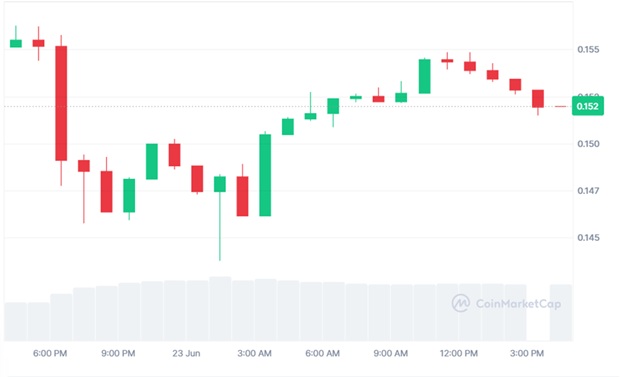
Dogecoin Price Holds Key Support at $0.156 After Dip – Could This Be the Turning Point for DOGE?

0

The original meme coin is once again keeping investors interested. But as people wonder over whether this represents a resurgence or merely a break in the fall. People are asking whether DOGE is still the future of meme?currencies or if it’s ready for growth.

A new type of meme coin is gaining popularity—one that combines fun with usefulness and community with real-world applications. Leading the new generation is the Angry Pepe Fork project, generating significant attention on Twitter and Telegram with its coin $APORK.

Is Dogecoin Still Worth Buying?

DOGE’s volatility has been as unstable as the Tesla share price. The internet culture surrounding Dogecoin was driving the price up instantly with Elon Musk’s viral support. Each of Musk’s tweets in the past has ballooned DOGE, often hand in hand with Tesla’s price movements.

Angry Pepe Fork is different from this narrative. Angry Pepe Fork expands on this idea by not only attaching itself to the meme and viral potential of $PEPE, but it also provides actual utility by way of CommunityFi and GambleFi, or simply put, it pays the user for their support of the project versus just holding on to the tokens.

What Sets the Angry Pepe Fork ($APORK) Apart?

Dogecoin largely depends on celebrity hype as?well; Elon Musk and Donald Trump have both talked about meme coins. Angry Pepe Fork ($APORK) proves it’s popular for its form, not just its?symbol. Here are keypoints that make $APORK, different from DOGE coin:

Play-to-Earn GambleFi Games: The GambleFi platform enables users to play mini-games to win $APORK.

CommunityFi Rewards: Content providers, meme makers, and promoters are rewarded for spreading the word.

Multi-Chain Launch: DOGE is limited to a single blockchain, and unlike DOGE, Angry Pepe Fork will be available on Ethereum, BNB, and Solana, boosting reach while lowering transaction fees.

Beginning of a New Meme Cycle?

As the cryptocurrency market continues to grow, meme coins are shifting towards a new trend. Imagine how Tesla’s stock price shoots up every time Elon Musk tweets or unveils a?new product. Likewise, meme?coins today are responding to broader ecosystem forces, not just viral events.

This move opens the way for smarter, more sophisticated meme tokens—those that generate profits through strategy. Taking cues from tremendous success stories like Bonk, which exploded after community-first activation, Angry Pepe Fork looks to be one of the few surfing the wave with meaning.

The Bottom Line: Hold DOGE or Buy APORK?

Looking at the charts, Dogecoin may hold the $0.156 support level. It may even recover following a news cycle or a Musk tweet. In the meantime, prospective buyers are constantly searching for new presale possibilities with strong tokenomics and fewer barriers to participation.

$APORK pricing at $0.0269 in presale and staking incentives exceeding 10,000% APY can be a great time for investors wishing to invest before a major listing. Dogecoin may have sparked the meme revolution, but projects like Angry Pepe Fork have the potential to revolutionize what meme coins will look like in the future.

Metaplanet’s Acquisition of 1,111 BTC Underscores Its Commitment To Bitcoin Even as BTC Loses Value

0

Metaplanet, a Japanese investment firm, acquired an additional 1,111 Bitcoin (BTC) for approximately ¥17.26 billion ($117-118 million), at an average price of ¥15,535,502 (~$106,408) per BTC. This purchase increased their total holdings to 11,111 BTC, valued at over $1.1 billion, making them the eighth-largest corporate Bitcoin holder globally, surpassing Coinbase. Metaplanet’s aggressive Bitcoin accumulation strategy, which began in April 2024, aims to reach 30,000 BTC by the end of 2025, 100,000 BTC by 2026, and 210,000 BTC (1% of Bitcoin’s total supply) by 2027.

The acquisition was funded through capital raises, including zero-coupon bonds and stock warrants. Their quarter-to-date BTC Yield, a metric tracking Bitcoin per share, reached 107.9%, with a year-to-date yield of 306.7%. Despite the purchase, Metaplanet’s stock fell 5-8% that day, possibly due to geopolitical tensions affecting broader markets. Metaplanet’s acquisition of 1,111 BTC, bringing their total to 11,111 BTC, has significant implications for both the company and the broader cryptocurrency market, while also highlighting a growing divide in corporate and investor sentiment toward Bitcoin.

Metaplanet’s aggressive accumulation, positioning it as the eighth-largest corporate Bitcoin holder, signals growing institutional confidence in Bitcoin as a treasury asset. This aligns with the strategy of companies like MicroStrategy, which holds over 279,000 BTC. By treating Bitcoin as a hedge against inflation and currency devaluation (especially given Japan’s yen weakening), Metaplanet is setting a precedent for other Asian firms, particularly in Japan, where economic policies have strained fiat stability.

Their ambitious targets—30,000 BTC by 2025, 100,000 by 2026, and 210,000 by 2027 (1% of Bitcoin’s 21 million supply)—suggest a long-term commitment to Bitcoin as a core asset, potentially inspiring other corporations to follow suit. The purchase of 1,111 BTC, valued at ~$117-118 million, represents a significant capital inflow into Bitcoin, contributing to price stability or upward pressure, especially in a market sensitive to large transactions. With Bitcoin’s price around $106,408 per coin at the time of purchase, such moves can reduce available supply, potentially driving prices higher as demand persists.

Metaplanet’s strategy of funding purchases through capital raises (e.g., zero-coupon bonds and stock warrants) demonstrates a creative approach to acquiring Bitcoin without liquidating core assets, which could become a model for other firms. Despite the acquisition, Metaplanet’s stock fell 5-8% on June 23, 2025, possibly due to broader market concerns, such as geopolitical tensions (e.g., U.S.-China trade disputes or regional conflicts). This suggests that while Bitcoin accumulation is central to Metaplanet’s strategy, investors may perceive risks in its heavy exposure to a volatile asset like Bitcoin, especially in turbulent market conditions.

The high BTC Yield (107.9% quarter-to-date, 306.7% year-to-date) reflects strong performance in Bitcoin’s value relative to shares, but stock price declines indicate a disconnect between Bitcoin’s performance and investor confidence in the company’s overall financial health. As a Japanese firm, Metaplanet’s moves could position Japan as a hub for corporate Bitcoin adoption in Asia, contrasting with more cautious approaches in other regions. This is particularly relevant given Japan’s historically progressive stance on crypto regulation, which could encourage further institutional investment.

Companies like Metaplanet and MicroStrategy view Bitcoin as a store of value and a hedge against fiat depreciation. They argue that Bitcoin’s fixed supply and decentralized nature make it a superior long-term asset compared to traditional investments. Metaplanet’s bold targets (e.g., 1% of Bitcoin’s supply) reflect this conviction. Other corporations and investors remain wary of Bitcoin’s volatility, regulatory uncertainties, and environmental concerns (due to mining energy consumption). The 5-8% drop in Metaplanet’s stock suggests that some investors are unconvinced about tying corporate value so closely to Bitcoin, especially in a risk-off market environment.

Retail investors on platforms like X often celebrate corporate Bitcoin purchases as bullish signals, with posts praising Metaplanet’s “stacking sats” strategy and comparing it to MicroStrategy’s success. However, institutional investors may view such heavy exposure as risky, preferring diversified portfolios or traditional safe-haven assets like gold or bonds. This divide is evident in market reactions: while Bitcoin’s price may benefit from corporate buying, Metaplanet’s stock decline indicates institutional caution.

In Japan, where yen devaluation and economic stagnation are concerns, Bitcoin adoption by firms like Metaplanet resonates as a hedge against local currency risks. However, globally, attitudes vary: some markets (e.g., the U.S.) see Bitcoin as a speculative asset, while others (e.g., El Salvador) treat it as legal tender. This creates a divide between regions embracing Bitcoin and those maintaining stricter regulatory or skeptical stances.

Metaplanet’s strategy is inherently long-term, aiming for significant Bitcoin holdings by 2027. However, short-term market volatility and stock price reactions highlight a divide between investors seeking immediate returns and those aligned with a multi-year vision of Bitcoin’s value appreciation. The high BTC Yield (306.7% year-to-date) appeals to long-term holders, but short-term traders may be deterred by Bitcoin’s price swings and external market pressures.

Metaplanet’s acquisition of 1,111 BTC underscores its commitment to Bitcoin as a treasury asset, potentially catalyzing further corporate adoption, particularly in Japan. However, it also highlights a divide between Bitcoin advocates and skeptics, retail and institutional investors, and short-term versus long-term perspectives. While the move strengthens Metaplanet’s position in the crypto space and could drive Bitcoin’s price higher by reducing supply, the stock market’s negative reaction suggests that not all investors are aligned with this high-risk, high-reward strategy.

Bitcoin Dip Below $100K Underscores Its Vulnerability To Geopolitical And Macro Shocks

Bitcoin fell below $100,000, hitting as low as $98,286.21, following Iran’s threat to close the Strait of Hormuz, a critical chokepoint for 20-30% of global oil supply. The move, approved by Iran’s parliament but pending final approval from the Supreme National Security Council, came after U.S. airstrikes on Iranian nuclear sites. This sparked fears of oil price spikes, with JPMorgan estimating Brent could reach $120-$130 per barrel, potentially pushing U.S. inflation to 5%. Rising energy costs and expectations of tighter Federal Reserve policy drove risk-off sentiment, leading to $950 million-$1.79 billion in crypto liquidations.

Bitcoin later recovered slightly to around $101,000, but volatility persists as markets await clarity on the Strait’s status and Fed responses. Other cryptocurrencies like Ethereum and XRP also saw sharp declines. Iran’s threat to close the Strait of Hormuz, a vital route for 20-30% of global oil, has heightened geopolitical tensions, driving oil price fears (Brent potentially hitting $120-$130/barrel). This fuels inflation concerns, with U.S. inflation possibly climbing to 5%, prompting expectations of tighter Federal Reserve monetary policy.

Bitcoin, often viewed as a risk asset despite its “digital gold” narrative, saw a sharp sell-off, dropping to $98,286.21 with $950M-$1.79B in crypto liquidations. The broader crypto market, including Ethereum and XRP, also faced heavy losses. The dip reflects Bitcoin’s sensitivity to macroeconomic shocks, particularly energy-driven inflation and interest rate hikes, undermining its role as an inflation hedge in the short term.

A Strait closure could disrupt global trade, spike energy costs, and strain supply chains, further pressuring equities and crypto markets. Bitcoin’s recovery to ~$101,000 suggests cautious optimism, but volatility remains high until Iran’s actions and U.S./Fed responses clarify. Investors may shift to traditional safe-havens like gold or bonds if tensions escalate, potentially delaying Bitcoin’s rebound.

Liquidations amplified the dip, with leveraged positions wiped out. This could lead to reduced leverage in the near term, stabilizing but slowing market momentum. Sentiment on platforms like X shows panic among retail investors, with some calling it a buying opportunity while others fear further drops if oil prices surge.

Crypto Bulls vs. Bears: Argue Bitcoin’s dip is temporary, driven by macro fears rather than fundamentals. They see it as a buying opportunity, citing long-term scarcity (21M cap) and adoption trends. Some on X claim Bitcoin could hit $150K by 2026 if tensions de-escalate.

Bears: Highlight Bitcoin’s correlation with risk assets, questioning its safe-haven status. They argue rising rates and inflation could suppress crypto for months, with one X analyst predicting a drop to $80K if the Strait closes.

X posts show retail traders split—some panic-sell, others “HODL” or buy the dip, driven by community sentiment and memes. Lack of macro expertise makes retail more reactive. Institutional likely contributed to the sell-off, as funds rebalance portfolios amid oil and rate concerns. Whales (large holders) may accumulate at lower prices, per on-chain data, but institutions remain cautious until Fed signals clarity.

Crypto Advocates see Bitcoin as a hedge against fiat debasement long-term, dismissing short-term dips as noise. They argue centralized policies (e.g., Fed hikes) expose fiat’s flaws. Traditional Finance views Bitcoin as speculative, lacking intrinsic value in crises. Analysts on X and web reports emphasize gold’s outperformance (~$2,600/oz) during geopolitical turmoil.

The Bitcoin dip below $100K underscores its vulnerability to geopolitical and macro shocks, particularly energy-driven inflation fears from Iran’s Strait threat. While short-term volatility is likely, the divide between bulls/bears, retail/institutional, and crypto/traditional finance highlights differing time horizons and risk appetites. Markets await Iran’s next move, Fed policy signals, and oil price developments to determine Bitcoin’s near-term trajectory.

Flutterwave Launches Digital Payments Services in Cameroon, Boosting Financial Inclusion

0

Flutterwave, a fintech company that provides a payment infrastructure for global merchants and payment service providers across the continent, has launched its digital payment services in Cameroon.

The fintech’s expansion to the Central African country is coming after it obtained a payment service provider license from the Central Bank of Central African States (BEAC). Partnering with Ecobank, this milestone advances Flutterwave’s goal of unifying Africa’s fragmented payment systems and expanding its presence across the continent.

The launch strengthens Flutterwave’s foothold in Francophone Africa, positioning it as a key driver of Cameroon’s digital transformation. Businesses, from local merchants to global enterprises, can now leverage a compliant digital payment platform supporting mobile money, cards, and bank transfers, tailored to Cameroon’s growing digital economy.

Small businesses can create shareable payment links for platforms like WhatsApp and Instagram, while larger firms benefit from advanced fraud detection, localized support, and seamless cross-border transactions.

Speaking on the expansion to Cameroon Flutterwave CEO Olugbenga Agboola said,

“Cameroon holds a central place in the future of Africa’s digital economy, and we’re proud to play a part in unlocking its potential. By offering secure, compliant, and accessible payment solutions, we’re creating opportunities for businesses of all sizes, from local merchants to global brands; to grow and thrive. Our presence here is not just about technology; it’s about long-term partnership, trust, and enabling prosperity across Central Africa.”

Also commenting, Bode Aregbesola, Senior Vice President for Sales, West Africa, added, “We know what it takes to run a business in Africa, and we’ve built our solutions to support that reality. Flutterwave is helping everyone — from local businesses to international brands — accept payments, streamline operations, and expand with confidence. With our digital payments license, we’re able to do all of that securely and at scale in Cameroon.”

In Cameroon, a key driver of financial inclusion is mobile money. Accounts reached 48 million in Central Africa by 2019, with transactions exceeding $30.4 billion. Operators like MTN and Orange dominate, offering services like bill payments, airtime purchases, and transfers via platforms like Monetbil, Zitopay, and Tranzak. Mobile money grew 19% from 2019 to 2020, with 24 trillion XAF ($40 billion) in transactions in 2024.

Platforms like Paytm, Razorpay, and NOWPayments, support online transactions, including credit/debit cards, e-wallets, and mobile money. These cater to e-commerce growth, with integrations for Visa, MasterCard, and local methods.

Cameroon’s payment system is evolving rapidly, driven by mobile money and digital gateways, but it faces hurdles like outdated infrastructure, delays, and limited rural access. Flutterwave’s entry is set to enhance financial inclusion by simplifying transactions for businesses and consumers. Small merchants can adopt digital payments without costly infrastructure, while global companies can process local currency payments, manage settlements, and issue refunds efficiently. Robust reporting and fraud management tools build trust in digital transactions, addressing cybersecurity concerns.

With its launch in Cameroon, Flutterwave is now operational in over 30 African countries, including Nigeria, Ghana, Kenya, South Africa, Egypt, Uganda, Tanzania, Rwanda, Ivory Coast, Senegal, and more. This wide geographical presence gives the fintech company one of the most extensive networks for digital payments in Africa.

One of Flutterwave’s most significant contributions is its support for small and medium-sized enterprises (SMEs). Through the Flutterwave Store, launched during the COVID-19 pandemic, the platform provided a free online marketplace for SMEs to set up digital storefronts and sell their products. Today, the store has empowered over 30,000 merchants, helping them reach wider markets and accept various payment options without the need for complex infrastructure.

Flutterwave’s payment technology supports multiple methods including cards, bank transfers, mobile money, and QR payments, ensuring that even unbanked populations can participate in the digital economy.

By unifying fragmented payment systems, Flutterwave accelerates Africa’s digital economy. Its presence in countries like Nigeria, Ghana, Kenya, and now Cameroon aligns with rising internet penetration and mobile connectivity.