DD
MM
YYYY

PAGES

DD
MM
YYYY

spot_img

PAGES

Home Blog Page 11

Anthropic Launches Cheaper Claude Opus 5 As AI Pricing War Intensifies

0

Anthropic on Friday unveiled Claude Opus 5, its newest flagship artificial intelligence model, positioning it as its strongest balance of performance and affordability as competition among leading AI developers increasingly shifts from raw capability to commercial value and cost efficiency.

The San Francisco-based AI startup said Opus 5 outperforms its previous flagship, Claude Fable 5, across key benchmarks for software engineering, coding and knowledge work while cutting usage costs by 50%. Anthropic also said the model is designed for everyday enterprise workloads rather than niche or experimental applications.

Vendors in the AI industry are now under pressure to justify the enormous investments being poured into model development and AI infrastructure. As enterprises become more selective about AI spending, model providers are competing not only on benchmark performance but also on cost, efficiency, and measurable business outcomes.

Claude Opus 5 will cost $5 per million input tokens and $25 per million output tokens, compared with significantly higher pricing for Fable 5. Anthropic said the lower pricing does not come at the expense of capability, describing Opus 5 as its best-performing and most cost-effective model across multiple industry evaluations.

The company added that while Opus 5 delivers stronger performance in coding and knowledge-intensive tasks, it is not its most capable model for high-risk dual-use applications, such as offensive cybersecurity research. That distinction remains with Claude Mythos 5, Anthropic’s specialized cybersecurity-focused model.

The announcement comes at a time when the economics of artificial intelligence are becoming as important as technical leadership. Companies are deploying AI at scale but are increasingly demanding lower inference costs, predictable pricing and stronger returns on investment after years of heavy infrastructure spending.

“Enterprises, in our feedback and with our customer base, are looking for value,” Dianne Penn, Anthropic’s Head of Product Management for Research, told CNBC.

“If it’s a cheaper model or a cheaper offering, but it’s not accomplishing a similar level of quality, it’s actually not useful.”

The pricing move also underlines the mounting competitive pricing pressure across the AI industry.

Anthropic is competing against OpenAI, Google, Microsoft and Amazon, while Chinese developers including Moonshot AI, Alibaba, Z.ai and MiniMax have introduced capable open-weight models at substantially lower operating costs. Those releases have intensified pricing competition and challenged assumptions that frontier AI models must remain expensive to operate.

The latest model also arrives as investors scrutinize AI companies’ spending more closely. Industry-wide capital expenditures on AI infrastructure continue to surge into the hundreds of billions of dollars, prompting customers to seek models that can deliver comparable performance with lower operating costs.

Anthropic’s strategy suggests the company is attempting to expand beyond customers willing to pay premium prices for frontier capabilities by offering a model that balances performance with commercial practicality.

The release follows a turbulent few months for the company.

In April, Anthropic introduced Claude Mythos Preview, a cybersecurity-focused model that demonstrated advanced vulnerability discovery and exploitation capabilities during controlled testing. Anthropic later launched Mythos 5 alongside Claude Fable 5 in June, describing Fable 5 as its most capable general-purpose model to date.

Shortly after those releases, the U.S. government temporarily suspended access to both models under national security-related export controls before lifting the restrictions roughly two weeks later following discussions between Anthropic and government agencies.

Penn said Anthropic continues to work closely with U.S. authorities during model evaluation and deployment.

According to the company, Opus 5 remains less capable than Mythos 5 in sensitive areas such as offensive cybersecurity and biological research, reflecting Anthropic’s continued separation between its commercial AI offerings and its highest-capability research models.

However, the release of Opus 5 is seen as an indication that leading developers are beginning to emphasize cost efficiency, inference economics, and practical enterprise deployment.

Executive Briefing: The Executive’s Guide to Rapid Upskilling in the Age of AI Disruption

0

There is a shift taking place within the boardrooms and executive suites of organizations across the globe. For decades, the primary focus of senior leaders has been on developing and executing a solid strategic plan. They would spend countless hours poring over data and crafting a three-year plan to achieve the company’s objectives. The majority of their time would be spent putting the plan into action, relying on the input from market data and trends that were relatively predictable.

When technologies first came out, they were “cutting edge.” Six months later, however, they have become table stakes for any company looking to remain competitive. With the pace of technological shift happening at unprecedented rates, many senior leaders are struggling to make key technology buying decisions for their companies when they do not even have a good working knowledge of the technologies that are in play.

Delegating technical understanding to the technical teams is no longer sufficient for senior leaders to make decisions regarding technologies and practices that have not yet had time to mature and gain widespread adoption. Modern senior leaders must develop their own upskilling practice in order to lead with the necessary clarity and authority in a rapidly changing environment.

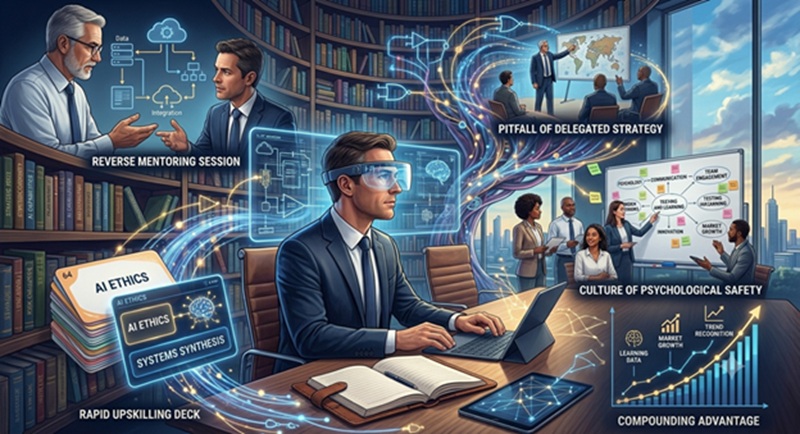
The Pitfall of Delegated Strategy

One of the biggest mistakes that a leadership team can make in an environment that is changing fast is treating technical knowledge as if it were a low-level task that can be delegated to someone else. That’s the line of thinking that says the leader of the organization has got to have a high level vision, that the leader of the organization has got to be able to think about the really big strategic issues of the organization, and that the technical details of how things work, the technical details of how new tools work, that those are things that can be left to the specialists.

Delegating certain tasks to technical specialists is necessary for organizations to scale, but it is not wise for senior leaders to remain completely detached from the technical realities of the tasks that are being delegated. The senior leader must understand enough about the new tools and processes to evaluate the risks involved in their adoption, to recognize opportunities to increase the operational efficiency of the organization, and to avoid investing large sums of capital in solutions that are likely to become outdated before they have a chance to pay back their cost.

Moreover, when leaders lack the necessary knowledge, their teams quickly recognize the discrepancy and begin to doubt the leader’s ability to provide relevant and effective guidance. Because the leader is not able to provide reliable insights into the operational aspects of the work, guidance will lack substance and become irrelevant.

Upskilling as an executive is not necessarily to learn to code or to build software. Its primary function is to help the executive understand the capabilities and limitations of technology and how it can be integrated into business processes to gain a competitive advantage.

Building a System for High Velocity Learning

The biggest obstacle executives face when upskilling is time. When your calendar is packed with back-to-back meetings, deep study sessions feel like an impossible luxury.

To make rapid learning work, you must build high-efficiency habits into your existing routine. The goal is to maximize knowledge absorption while minimizing time friction.

First, focus on structural synthesis. Instead of trying to read entire technical books or lengthy whitepapers, leverage modern processing workflows. Converting dense technical reports, industry updates, or a complex PDF to flashcards allows you to break down overwhelming documents into bite-sized review decks. This enables active recall during tiny pockets of downtime, like waiting for a flight or traveling between meetings.

Second, leverage internal expertise as a learning resource. Schedule brief reverse mentoring sessions with senior engineers or product specialists within your own organization. Ask them to explain key concepts, current bottlenecks, and emerging tools in plain language.

Third, test your understanding through direct application. Explain a new concept back to someone else, or use it to re-evaluate a current business process. Active recall and immediate application accelerate retention far faster than passive reading.

Cultivating Psychological Safety and Learning Agility

Rapid upskilling requires embracing being a beginner again. This is hard for many Senior Executives as they have spent years building the knowledge and expertise to become a Subject Matter Expert, and want to continue to command a room. They fear appearing to not know the answer, especially when others in the room are unlikely to know the answer either.

Showing an organization that learning is a process for everyone during a time of disruption and uncertainty leads to a culture where, when a CEO shows that he or she doesn’t have all the answers, that allows for psychological safety for others to do the same. This leads to a culture and organization that learns together and, thus, adapts together.

Creating a culture of psychological safety at work means your employees will feel safe experimenting, trying new things, and learning from their mistakes. This is very important in an era of change and for companies that want to adapt quickly to the market.

The Compounding Advantage of Strategic Curiosity

Executives who successfully navigate through disruption are not necessarily the most technically savvy. More importantly, they are people with strategic curiosity who continue to learn and absorb as many new concepts as possible.

Whether the new technological changes have occurred within your industry or outside of it, consistently finding the time to upskill will open your eyes to new concepts and make your strategic intuition sharper. Not only will you start to recognize trends early enough to prepare your business for the changes to occur before they hit your market, but also be able to more critically evaluate vendor proposals to find the best solution to add value to your organization on a sustainable basis.

Finally, upskilling as an executive is not a short-term campaign, but rather a discipline that must be practiced on an ongoing basis to enable a business to become resilient, relevant and ready for the future.

Verizon Lands Over $1bn Google Fiber Deal, Expands Push Into AI Infrastructure Boom

0

Verizon Communications has signed a dark fiber agreement worth more than $1 billion with Alphabet’s Google, marking one of its largest artificial intelligence infrastructure contracts to date and positioning the U.S. telecom giant to capitalize on the multitrillion-dollar investment wave reshaping the technology sector.

The agreement, announced Friday during Verizon’s second-quarter earnings call, will see the telecommunications company provide dark fiber connections linking Google’s expanding network of AI data centers across the United States.

The deal reveals a rapidly emerging investment theme in the AI economy: while semiconductor companies such as Nvidia have dominated headlines, the enormous computing demands of artificial intelligence are also creating significant opportunities for telecommunications firms, fiber network operators and other providers of critical digital infrastructure.

Verizon Chief Executive Dan Schulman described the agreement as a pivotal moment for the company, saying it reflects a broader strategy to become a key connectivity partner for hyperscale cloud providers as they accelerate AI infrastructure spending.

“The build out of AI infrastructure across the United States is one of the largest capital cycles of our lifetime, and Verizon is uniquely positioned to participate in it,” Schulman said.

Investors welcomed the announcement. Verizon shares rose more than 3% in early trading, while Alphabet’s Class A shares gained about 1%.

Dark fiber refers to unused optical fiber infrastructure that companies lease to customers, who then install and operate their own networking equipment. Unlike traditional managed telecommunications services, dark fiber provides customers with dedicated, high-capacity and low-latency connections that can be scaled as computing demands increase.

The technology has become increasingly valuable as artificial intelligence models require enormous volumes of data to move rapidly between geographically dispersed data centers, cloud regions and computing clusters.

Training and deploying advanced AI models involves connecting thousands, and in some cases tens of thousands, of graphics processing units (GPUs) across multiple facilities. Those workloads require ultra-high-bandwidth, low-latency fiber networks capable of transmitting vast amounts of data continuously, making fiber infrastructure an increasingly strategic asset in the AI ecosystem.

Schulman indicated that the Google agreement is only the beginning of Verizon’s broader AI infrastructure strategy. He said the company expects to announce additional agreements before the end of the year that together could generate several billion dollars in revenue over the coming years.

Those contracts, he said, are expected to be long-term in nature, providing Verizon with predictable cash flows while serving some of the world’s largest technology companies.

Schulman described Friday’s announcement as “consequential,” saying it signals the direction in which Verizon’s future revenue growth is headed.

The move is seen as an effort to monetize assets that were originally built to support traditional telecommunications services but have become increasingly valuable in the age of artificial intelligence. Verizon operates one of the largest fiber networks in the United States, including extensive long-haul routes connecting major metropolitan areas and metro fiber systems serving urban data centers and enterprise customers.

According to Schulman, that infrastructure is now ideally positioned to meet the connectivity requirements of hyperscale AI developers. The company’s network, originally designed for an earlier generation of internet traffic, has become well suited for linking AI data centers, high-performance computing clusters and cloud regions as technology companies rapidly expand their computing capacity.

The agreement also underpins the unprecedented scale of AI-related capital expenditure currently underway. Major technology companies including Google, Microsoft, Amazon, Meta and OpenAI-backed infrastructure projects are collectively committing hundreds of billions of dollars annually to build new AI data centers, acquire advanced semiconductors and expand supporting infrastructure.

While much investor attention has focused on chipmakers and cloud providers, analysts increasingly see networking infrastructure as one of the most important bottlenecks in AI deployment. Without sufficient fiber capacity, the computing power housed inside AI data centers cannot be efficiently connected, limiting the performance of distributed AI workloads.

That dynamic is creating new opportunities for telecommunications companies that own extensive fiber assets.

For Verizon, the Google partnership also represents a diversification of its revenue base. Like many traditional telecom operators, Verizon has faced slowing growth in its core wireless business as the U.S. mobile market has matured. Expanding into AI infrastructure allows the company to leverage existing network investments to tap into one of the fastest-growing areas of enterprise technology spending.

The contracts are also attractive from a financial perspective because they typically involve long durations, high switching costs and investment-grade counterparties, characteristics that can provide stable recurring revenue over many years.

But the agreement also supports Google’s accelerating AI expansion plan. The company continues to invest aggressively in new data centers and computing infrastructure to support its Gemini AI models, cloud services and enterprise AI offerings. As AI workloads become larger and more geographically distributed, reliable high-capacity fiber connections have become as important as access to advanced semiconductors.

The first phase of the AI boom largely rewarded semiconductor manufacturers and cloud computing providers. Increasingly, however, the next phase is benefiting companies that provide the underlying physical infrastructure, including utilities, power equipment manufacturers, cooling system suppliers and fiber network operators.

As AI models become more computationally intensive, demand for high-speed connectivity between data centers is expected to grow alongside demand for electricity and advanced chips.

If Verizon secures the additional multibillion-dollar contracts that Schulman indicated are in the pipeline, the company could establish itself as one of the leading connectivity providers for the next generation of AI infrastructure, opening a significant new avenue for long-term growth as hyperscalers continue investing at record levels.

The $120 Billion LLM Economy Faces Its Biggest Test Yet

0

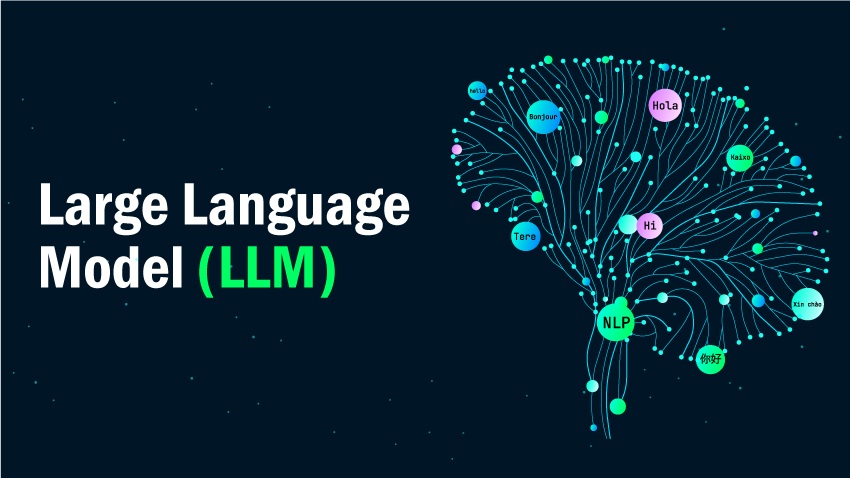
The rapid rise of large language models has transformed artificial intelligence from a research frontier into one of the world’s fastest-growing commercial industries.

According to economist Callum Williams, the global LLM market is now generating revenue at an estimated annualized run rate of approximately $120 billion.

The figure underscores just how quickly AI has evolved from experimental chatbots into enterprise software, developer tools, and consumer applications used by hundreds of millions of people.

Yet despite this remarkable pace of growth, the industry’s biggest challenge may still lie ahead: generating enough long-term revenue to justify the enormous investments being poured into AI infrastructure.

Williams’ estimate also suggests that Anthropic currently commands the largest share of LLM revenue, highlighting the company’s rapid ascent in an increasingly competitive market.

Backed by major investments from Amazon and Google, Anthropic has positioned its Claude family of models as a preferred choice for enterprises seeking advanced reasoning, coding capabilities, and strong safety features. The company’s focus on business customers has helped it capture significant recurring revenue, even as competitors continue to expand their offerings.

The broader AI landscape has become fiercely competitive. OpenAI remains a dominant force with ChatGPT and its API services, while Google continues to integrate Gemini across its ecosystem. Meta has pursued an open-source strategy through its Llama models, encouraging developers to build applications without paying licensing fees.

Meanwhile, companies such as xAI, Mistral, Cohere, and numerous startups are racing to carve out their own market niches.

Behind this competition lies an unprecedented wave of capital expenditure.

Technology giants are collectively spending hundreds of billions of dollars on AI infrastructure, including graphics processing units (GPUs), specialized data centers, networking equipment, and electricity to power increasingly sophisticated models.

Building frontier AI systems has become one of the most capital-intensive endeavors in modern technology, requiring continuous investment in computing resources and talent.

This spending has fueled concerns among investors about whether AI companies can eventually produce returns that match their extraordinary costs. While a $120 billion annual revenue run rate appears impressive.

It remains relatively small compared with the trillions of dollars being invested across the broader AI ecosystem. Infrastructure providers, semiconductor manufacturers, cloud platforms, and model developers all expect meaningful financial returns, creating enormous pressure for sustained revenue growth.

Enterprise adoption will likely determine whether those expectations are met. Businesses are increasingly deploying LLMs to automate customer service, accelerate software development, improve legal research, generate marketing content, analyze financial data, and streamline internal operations.

If organizations continue expanding AI deployments, subscription revenue and API usage could rise substantially over the coming years. Consumer applications also remain an important growth engine. Paid AI assistants, personalized education platforms, creative tools, healthcare support, and productivity software are creating entirely new digital markets.

As models become more capable, users may be willing to pay higher subscription fees for premium features that deliver measurable productivity gains. Competition is driving prices downward, while open-source models are narrowing the performance gap with proprietary systems.

AI companies must also contend with regulatory scrutiny, copyright disputes, rising energy costs, and the constant need to train larger, more expensive models to stay ahead of rivals.

Williams’ estimate illustrates both the remarkable success and the immense challenge facing the AI industry.

A $120 billion revenue run rate confirms that LLMs have become a major commercial force, but it also highlights the scale of expectations surrounding artificial intelligence. For the billions being invested today to generate lasting returns.

AI revenue must continue growing rapidly, transforming LLMs from an emerging technology into one of the world’s most profitable and indispensable industries.

Europe’s Diversified Energy Strategy Shields It from Iran War Disruptions

0

The stability of oil supplies across Europe has become one of the most closely watched economic issues following the sharp escalation of the conflict involving Iran.

Although crude oil prices have surged as markets react to geopolitical uncertainty, economists in Germany argue that Europe is not currently facing an immediate supply crisis. Instead, the continent’s diversified energy network, strategic petroleum reserves, and coordinated emergency planning have helped shield consumers and industries from the direct impact of the conflict.

Oil markets have always been highly sensitive to geopolitical tensions in the Middle East.

Iran occupies a strategic position near the Strait of Hormuz, a narrow maritime passage through which nearly one-fifth of the world’s oil supply is transported. Whenever military conflict threatens shipping routes in the region, traders quickly factor potential disruptions into oil prices.

This anticipation often pushes prices significantly higher, even before any actual interruption in physical supply occurs. The recent escalation has caused Brent crude prices to climb sharply, reflecting growing concerns over the possibility of shipping delays, sanctions, or attacks on energy infrastructure.

German economists emphasize that higher prices do not necessarily indicate a shortage of oil. Instead, the increase largely represents a geopolitical risk premium—a temporary addition to prices driven by uncertainty rather than a collapse in production or distribution.

Europe’s energy security has improved considerably over the past several years. Since the disruption of Russian energy supplies following the war in Ukraine, European governments have accelerated efforts to diversify their sources of oil and natural gas.

Today, Europe imports crude from a broader range of suppliers, including Norway, the United States, Saudi Arabia, Iraq, West Africa, and Latin America. This diversification has reduced dependence on any single region and strengthened the resilience of European energy markets.

Germany, Europe’s largest economy, has also expanded its strategic oil reserves and improved emergency response mechanisms.

These reserves are designed to provide sufficient supplies for several months in the event of major disruptions. In addition, European Union member states cooperate closely through coordinated energy policies, allowing supplies to be redistributed if individual countries experience shortages.

Economists note that global oil production remains relatively strong. Major producers within OPEC+ continue to possess spare production capacity that could be deployed if necessary to stabilize markets. The United States remains one of the world’s largest oil producers, contributing additional supply that helps offset regional disruptions.

Unless the conflict directly blocks the Strait of Hormuz for an extended period or significantly damages major production facilities, global supply is expected to remain adequate.

Higher oil prices still carry economic consequences. Rising fuel costs increase transportation expenses, which eventually affect the prices of goods and services throughout the economy.

Businesses face higher operating costs, airlines pay more for jet fuel, manufacturers experience increased production expenses, and consumers often encounter more expensive gasoline and heating costs. If elevated oil prices persist, inflationary pressures could re-emerge across Europe, complicating monetary policy decisions for the European Central Bank.

Financial markets are also responding cautiously. Investors are closely monitoring developments in the Middle East, recognizing that further escalation could trigger greater volatility across commodities, equities, and currencies. Energy companies may benefit from higher prices, while industries heavily dependent on fuel could experience declining profit margins.

Germany’s economists believe Europe is currently well-positioned to withstand the immediate effects of the Iran conflict on oil supplies. Although prices have risen sharply due to geopolitical uncertainty, physical supplies remain stable thanks to diversified imports, strategic reserves, and coordinated European energy policies.

The greatest challenge for policymakers may not be securing enough oil, but managing the broader economic impact of sustained higher energy prices while maintaining inflation, industrial competitiveness, and consumer confidence.