DD
MM
YYYY

PAGES

DD
MM
YYYY

spot_img

PAGES

Home Blog Page 12

BOJ Set for Highest Interest Rates Since 1995 as Inflation Risks Eclipse Growth Concerns

0

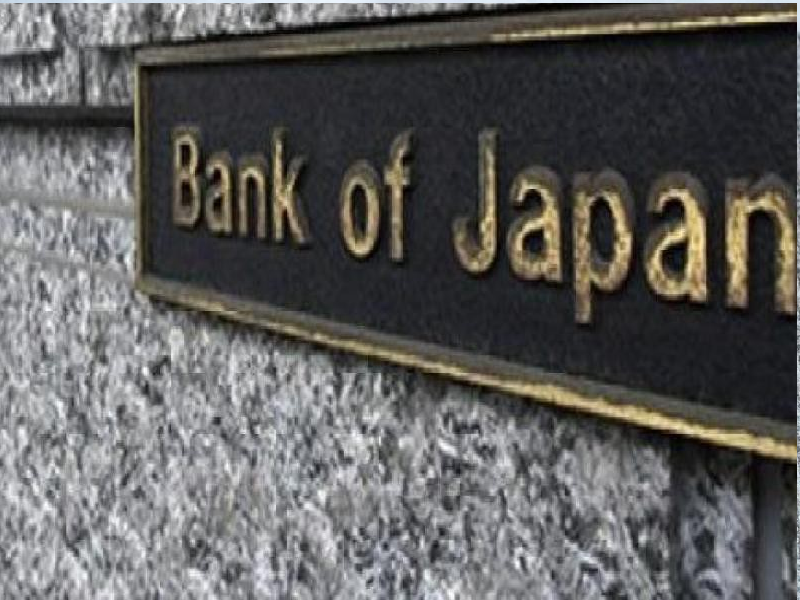
The Bank of Japan appears poised to deliver another historic shift in monetary policy next week, with policymakers expected to raise interest rates to 1%, the highest level in 31 years.

The move underscores how rapidly Japan’s inflation landscape has changed amid rising energy costs, a weak yen, and escalating geopolitical tensions in the Middle East, and would lift the policy rate from 0.75% and mark the first increase since December, further dismantling the ultra-loose monetary framework that defined Japan’s economy for decades.

The expected decision comes at an unpleasant moment for the central bank, with Governor Kazuo Ueda absent from the June 16 meeting due to hospital treatment, leaving Deputy Governor Shinichi Uchida to deliver the post-meeting briefing. However, an economist quoted by Reuters said the central bank governor’s absence won’t affect the decision.

“Ueda’s absence won’t affect the BOJ’s institutional decision to focus on mounting inflation risks rather than ?risks to growth from the Middle East conflict,” said Saisuke Sakai, senior economist at Mizuho Research Institute.

The anticipated rate increase would place the BOJ among a growing group of major central banks that have shifted toward tighter monetary settings as inflationary pressures intensify globally. While the U.S. Federal Reserve is expected to keep rates elevated for longer and the European Central Bank has resumed tightening amid energy-driven inflation concerns, Japan’s move would represent a particularly significant departure given its long history of deflation and near-zero rates.

Inflation, Not Growth, Driving Policy

The expected hike is borne of a growing conviction inside the BOJ that inflation risks now outweigh concerns about slowing economic growth.

The outbreak of conflict in the Middle East has pushed energy prices higher, increasing import costs for resource-dependent economies such as Japan. Combined with a persistently weak yen and a tight labor market, these developments have reinforced fears that inflation could become more deeply embedded in the economy.

Recent data underscore those concerns. Japan’s wholesale prices rose 6.3% year-on-year in May, the fastest pace in three years, reflecting higher energy and import costs. Economists expect those pressures to filter through to consumer prices in the second half of the year, potentially pushing core inflation well above the BOJ’s long-standing 2% target once the effects of government subsidies fade.

That outlook has strengthened the argument among policymakers that emergency-era monetary settings are no longer appropriate.

The expected decision also suggests that the BOJ is increasingly willing to prioritize price stability over growth support. For years, policymakers worried that tightening policy prematurely could derail fragile economic recovery. Now, the concern has shifted toward the risk of acting too slowly and allowing inflation expectations to become entrenched.

A Weak Yen Remains a Major Concern

Currency markets are another factor influencing policy deliberations. The yen has remained under pressure as the gap between Japanese and overseas interest rates widened. Although the BOJ has begun normalizing policy, the pace of tightening has lagged that of other central banks, contributing to yen weakness.

The currency is hovering around the psychologically important 160-per-dollar level, a threshold closely watched by investors because it has previously triggered official intervention by Japanese authorities.

A weaker yen boosts export competitiveness but also raises import costs, particularly for fuel, food, and industrial materials. Those higher costs ultimately feed into consumer prices and corporate expenses. As a result, policymakers face a delicate balancing act. Moving too slowly risks further currency depreciation and imported inflation. Moving too aggressively could undermine economic activity at a time when global growth remains uncertain.

This tension is expected to shape the messaging from Uchida following next week’s meeting.

While financial markets have largely priced in a move to 1%, investors are focused on what comes next. A Reuters survey of economists indicates expectations for another rate increase to 1.25% in the fourth quarter, suggesting markets believe Japan’s tightening cycle is far from over.

The challenge for investors will be interpreting guidance from Uchida, who is generally viewed as one of the more cautious voices on the policy board.

Analysts expect him to signal continued vigilance on inflation while avoiding commitments on the timing of future moves. Such an approach would allow the BOJ to retain flexibility amid uncertainty surrounding the economic fallout from the Iran conflict and broader global growth trends.

“While Uchida is seen as among the more dovish members of the board, he’ll probably try to sound fairly hawkish to avoid triggering unwelcome yen falls,” said Nobuyasu Atago, chief economist at Rakuten Securities Economic Research Institute.

“It’s a dilemma. The BOJ won’t want to pre-commit to any timing given so much uncertainty. But sounding too ?cautious about the next move could weaken ?the yen, push up prices and ?heighten the risk of being behind the curve.”

However, excessively cautious communication could reignite yen weakness, potentially forcing policymakers into more aggressive action later. That makes next week’s press conference nearly as important as the rate decision itself.

Bond Market Strategy Under Review

Beyond interest rates, the BOJ is also expected to provide fresh guidance on its government bond purchasing program. The central bank will review its current bond tapering framework, which runs through March next year, and outline plans for fiscal 2027 and beyond.

Sources familiar with the discussions told Reuters that policymakers may opt to maintain the current pace of bond purchases longer than previously expected. The rationale is to preserve stability in Japan’s government bond market, which has become sensitive to inflation risks and geopolitical uncertainty.

This appears as another balancing act confronting the BOJ. While it seeks to normalize policy and reduce its enormous footprint in financial markets, it must avoid triggering excessive volatility in a bond market that has operated under extraordinary central bank support for years.

The expected move to 1% would be symbolically important because it places Japan’s benchmark rate within the lower end of estimates for a neutral interest rate, generally considered to be between 1.1% and 2.5%.

That milestone suggests the BOJ is entering a new phase of policymaking. The central bank is confronting the traditional challenge faced by its global peers: containing inflation without choking off growth, rather than focusing primarily on stimulating demand and escaping deflation.

The transition marks one of the most significant changes in Japanese monetary policy in decades.

The implications, however, are said to be substantial for investors, businesses, and households. Borrowing costs are likely to continue rising, the era of virtually free money is fading, and policymakers appear willing to tolerate slower growth if that is what is required to prevent inflation from becoming entrenched.
4 Top Crypto Coins in 2026: BlockDAG, Dogecoin, Ondo & Pepe Coin Drive Real Adoption

0

Dogecoin keeps riding on community sentiment. Ondo Coin is quietly building a bridge between traditional finance and decentralized networks. Pepe Coin continues attracting traders who want raw volatility exposure on the Ethereum chain. All three hold their place among the top crypto coins worth watching right now.

BlockDAG, though, is operating on a completely different level. The Legacy Sale has crossed 1 billion coins sold, and the structure behind it is what separates it from everything else. Buyers entering at $0.00000044 and holding toward the confirmed $0.05 buy-back price are sitting on a calculable return gap that no meme coin or tokenized asset on this list can come close to matching.

1. BlockDAG (BDAG): $0.05 Buyback Value Creates a Unique Arbitrage Play

Something worth paying close attention to is happening inside the BlockDAG ecosystem right now. The Legacy Sale price sits at $0.00000044 per BDAG coin. The confirmed buy-back price within the program is $0.05 per coin. That gap between the two numbers is not a forecast or a price prediction. It is a structured arbitrage opportunity sitting inside a program backed by the ecosystem itself. Participants who buy through the Legacy Sale and register those coins through the dashboard to sell at the $0.05 buy-back price are working with a defined, calculable return rather than a speculative bet on market conditions.

The milestone of over 1 billion coins sold back to the network already shows how quickly this opportunity is being absorbed. Supply at Legacy Sale prices is not open-ended, and the pace of absorption reflects that clearly.

New buyers also benefit from uncapped daily sell limits when registering coins for the $0.05 exit, which removes the friction that typically slows participation in structured programs like this. Existing holders have their own dedicated buy-back tier priced at $0.00025 per BDAG, though that route operates with organized daily submission limits to keep the system stable.

Among the top crypto coins right now, BlockDAG offers something genuinely different. The return is not dependent on social media cycles or a sudden liquidity wave. It is built into the program structure, and the window for Legacy Sale pricing is narrowing as the available supply gets absorbed at a lightning pace.

2. Dogecoin (DOGE): Infinite Supply Lacks Any Built-In Utility

Dogecoin holds a unique position in crypto history, having turned a widely shared internet joke into a globally traded digital asset with real market weight. A fiercely loyal community and repeated attention from well-known public figures keep liquidity flowing into the coin regularly. That public visibility is exactly why many short-term traders keep DOGE on their radar when looking at top crypto coins during hype-driven market stretches.

Order execution tends to be fast, given the consistently high trading volume across major exchanges. The risks, though, are just as real as the hype. Dogecoin carries no built-in utility, and its token supply has no cap, meaning the value rests entirely on sustained social media attention. The moment sentiment shifts, there is no fundamental floor to slow the decline.

3. Ondo Coin (ONDO): Connects Traditional Finance With DeFi Rails

Ondo Coin has carved out a distinct space by bringing tokenized real-world assets directly onto decentralized finance networks. Structured yield products keep engagement high among DeFi participants who want exposure to institutional-grade financial instruments without leaving the on-chain environment. That unique positioning has earned Ondo a firm spot among the top crypto coins for traders focused on utility-driven setups rather than pure speculation.

That said, the regulatory environment surrounding tokenized securities is still unsettled in many jurisdictions. Any sudden legal development targeting this asset class could restrict liquidity quickly and put significant downward pressure on the token price. Short-term holders carry real exposure to that kind of external risk regardless of the platform’s technological strength.

4. Pepe Coin (PEPE): High Volatility Meme Token on Ethereum Network

Pepe Coin operates as one of the most liquid meme tokens on the Ethereum blockchain, drawing consistent attention from algorithmic trading systems and retail participants alike. The token tends to amplify broader Ethereum market moves, posting sharp gains when decentralized ecosystems see bullish conditions.

That behavior keeps it on the radar of traders scanning top crypto coins for fast, double-digit percentage swings within short timeframes. Deep exchange listings mean large orders can move without creating heavy slippage costs.

The other side of that picture is equally stark. Pepe Coin carries no underlying utility or real-world function whatsoever. Its price behavior is entirely speculative, and when retail enthusiasm exits the market, the token is fully exposed to severe and rapid value loss with nothing fundamental to cushion the fall.

Final Say

Dogecoin, Ondo Coin, and Pepe Coin each bring something recognizable to the table, whether that is community-driven liquidity, DeFi utility, or raw volatility. Each one also carries the kind of exposure that comes with depending heavily on external market conditions to deliver returns.

BlockDAG sits apart from all three. The Legacy Sale buy-back arbitrage puts a confirmed $0.05 exit price against a $0.00000044 entry, giving participants a structured return path rather than a speculative one. With over 1 billion coins already sold back through the Buyback Program and Legacy Sale supply shrinking, the window for this specific opportunity among the top crypto coins is not staying open indefinitely.

BlockDAG’s $0.00000044 Dashboard Swap and Fixed $0.05 Payout: Identifying the Best Crypto to Buy Today for October 2026

0

Retail cryptocurrency portfolios are currently absorbing the brunt of recent market corrections, leaving everyday traders completely exhausted by the relentless unpredictability of open order books. Ongoing market liquidations across June 2026 have triggered massive portfolio drawdowns across major utility tokens, forcing smaller traders to endure constant order book volatility and unpredictable exchange slippage.

Waking up daily to red candles and negative funding rates has made standard day trading a high-stress, low-probability endeavor. Retail participants are desperately searching for financial vehicles that provide absolute psychological relief and definitive exit parameters to safeguard their remaining capital.

Eliminating Decentralized Exchange Friction

The core of this retail investor transformation is the ease of the native user interface, which completely removes the technical friction typically associated with early-stage digital asset protocols. Users can secure their token allocations at the active entry rate of $0.00000044 and instantly navigate to the live Direct Swap tab. With just two clicks, participants can officially flag their newly acquired tokens for immediate registration into the Buyback Program. This simplicity removes the technical barriers that usually plague early-stage decentralized environments.

This seamless execution bypasses complicated smart contract interactions, fluctuating decentralized exchange routing fees, and network gas fee spikes, making it highly accessible for non-technical users. There are no complicated wallet permissions to configure and no decentralized exchange routers to decode. The entire experience is condensed into a clean, intuitive layout that focuses entirely on user allocation and immediate registration efficiency. This allows retail buyers to lock in their positions within seconds, securing their financial advantages effortlessly.

Securing Hardcoded Payout Value

Once registered via the Direct Swap interface, the user secures an identical financial posture to elite institutional entities. The system hardcodes a fixed payout value of $0.05 per token, distributed as a single payment in USDT. This provides absolute peace of mind and transforms a highly volatile asset position into a predictable, contractually backed financial timeline. This guaranteed 113X multiplier offers unparalleled upside for those willing to participate in the supply reduction strategy.

Retail buyers no longer have to worry about missing the exact peak of a bull market or getting trapped in a low-volume liquidity vacuum when trying to execute an exit. By establishing concrete parameters that remain legally valid until October 1, 2026, BlockDAG gives everyday participants the ultimate tool to accurately plan their future capital allocations. Knowing exactly when and how the yield will hit the dashboard ensures that users can execute future asset purchases precisely on schedule, entirely insulated from external market gravity.

Establishing Long-Term Capital Horizons

By moving capital away from speculative intraday environments, everyday investors are reclaiming power over their financial timelines. The ability to look past short-term corrections and focus on a locked settlement date changes how retail participants manage personal risk. This structural evolution effectively shifts the retail strategy from reactive panic-selling to proactive wealth management.

Instead of falling victim to manipulative market liquidation cascades, dashboard users can comfortably allow the network’s broader supply reduction mechanics to execute behind the scenes, confident that their target values are secure.

To Conclude

The cryptocurrency market scenario has highlighted the severe flaws of open-market speculation, making predictable exit strategies more valuable than ever. BlockDAG completely overhauls the retail experience by providing a guaranteed mathematical sanctuary accessed via a streamlined dashboard. By allowing users to acquire tokens at $0.00000044 and instantly lock them for a $0.05 USDT payout, the platform secures a clear 113X return with zero guesswork.

Locking your tokens before the October 1, 2026 deadline grants you total control over your financial timeline, completely protecting your principal from the unpredictable chaos of the current digital asset market.


Presale: https://purchase.blockdag.network

Website: https://blockdag.network

Telegram: https://t.me/blockDAGnetworkOfficial

Discord: https://discord.gg/Q7BxghMVyu

Trading on ExpertOption in Line with Sharia Law: A Practical Guide for Muslim Traders

0

For Muslim investors, choosing a trading platform is not only a financial decision but also an ethical one. Sharia law trading principles require that financial activity be free from interest, excessive uncertainty, and gambling-like behavior. As a result, the conversation around halal investing online has grown significantly, with traders looking for environments that combine modern market access with clear ethical structures.

However, there is no universal agreement in Islamic finance on online trading. Interpretations vary among scholars, making it important for each trader to understand the principles and apply them carefully when evaluating platforms like ExpertOption.

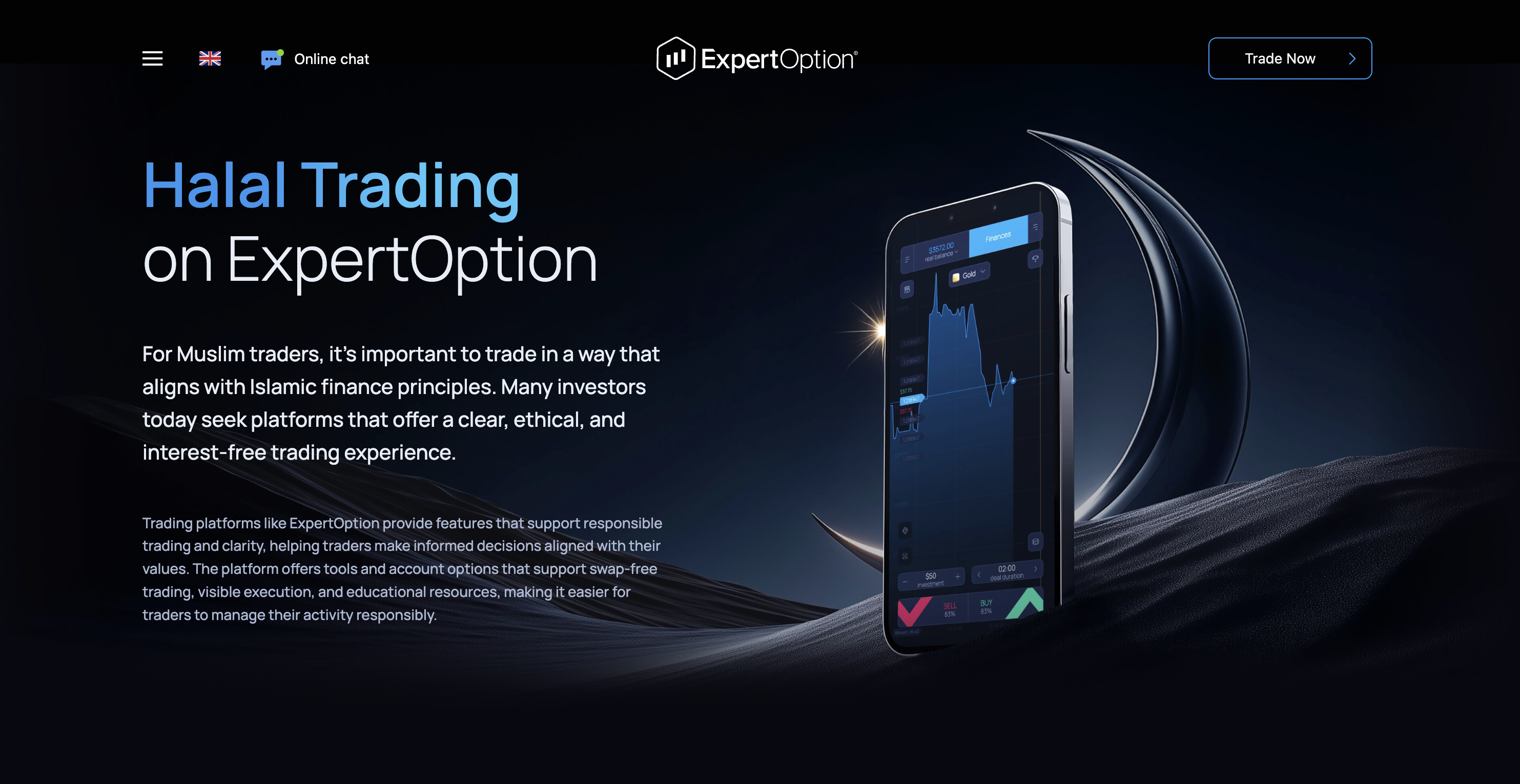
Within this context, Sharia-compliant trading on EO has become a frequently discussed topic. ExpertOption is an online trading platform that provides access to global financial markets through a proprietary interface available on the web and mobile. Users can trade currencies, international stocks, and commodities such as gold and oil from a single account, using chart-based tools, integrated analytics, and an economic calendar.

Beyond technology, trust plays a central role. ExpertOption is a regulated broker and a registered Member of The Financial Commission, and today it is trusted by more than 70 million clients worldwide. This independent organization provides external dispute resolution, requires transparent operational procedures, and gives eligible users access to a compensation mechanism. In practice, this structure strengthens accountability, supports secure withdrawals, and reinforces the platform’s reputation as a safe and reliable environment — an important factor when discussing Islamic finance compliance EO.

Understanding Sharia-Compliant Trading in Practice

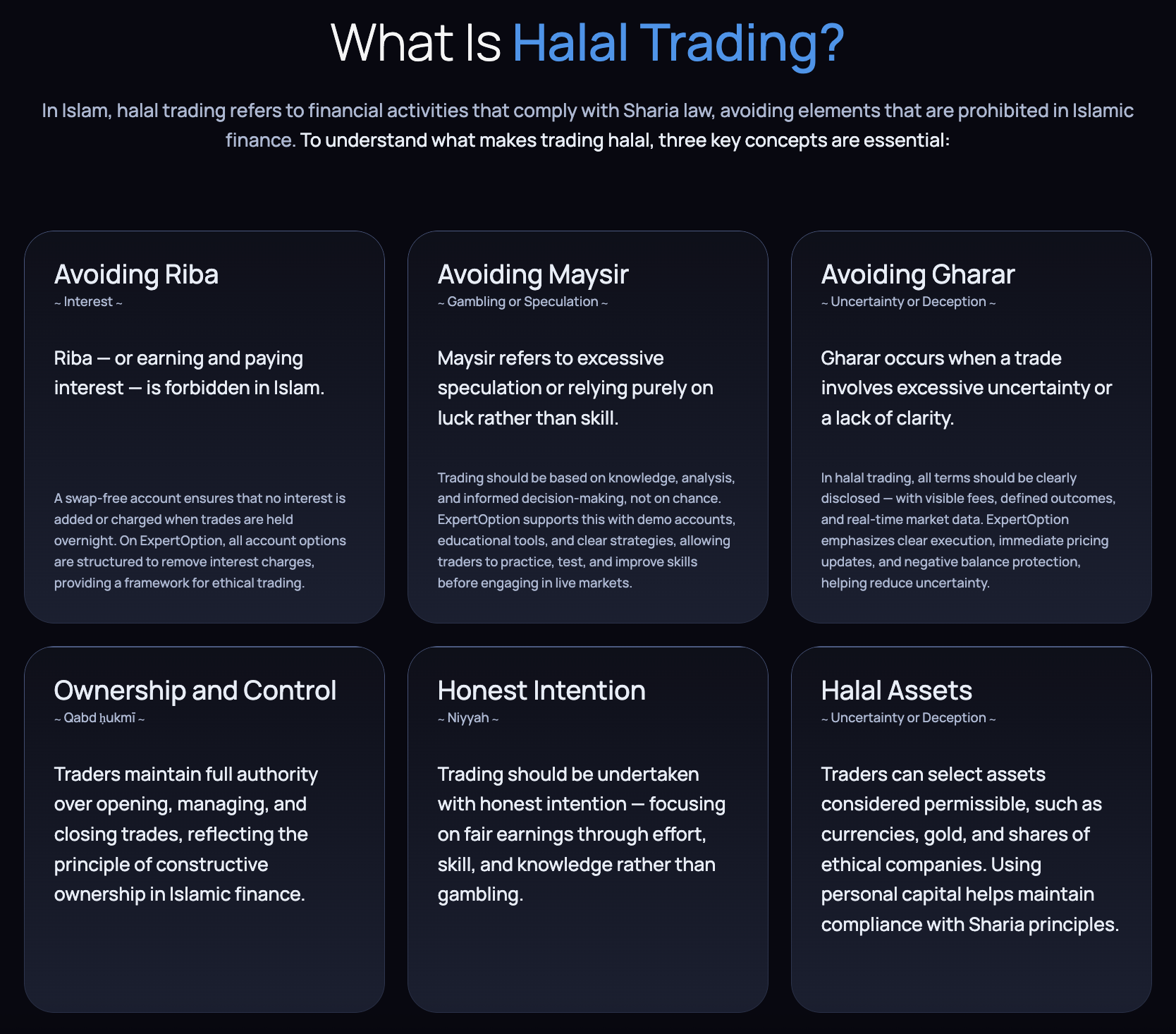
In Islamic finance, profit is permissible when it is connected to real risk, clear contractual terms, and lawful economic activity. These Islamic finance principles form the foundation of what is commonly referred to as ethical trading in Islam.

Halal online trading generally includes:

  • Transparent pricing mechanisms
  • Clearly defined contracts
  • No interest-based earnings
  • Real market exposure
  • Risk-sharing rather than guaranteed profit

An Islamic trading approach avoids overnight interest mechanisms and maintains clarity about how transactions are executed. The emphasis is on ethical trading in Islam: informed decisions, accountability, and fair opportunity.

Risk itself is not prohibited in Islam. Profit is legitimate when it results from shared risk and real economic activity. What is prohibited is unjust enrichment through interest or deceptive structures. Traders should ensure that any risk taken is reasonable, clearly understood, and within their personal comfort level, so losses remain manageable and decisions remain deliberate.

On ExpertOption, every trade is opened with full disclosure of its conditions. The trader sees the asset, the amount, the potential outcome, and the time frame before confirming the position. The result is determined only by market movement. This clarity directly addresses the issue of gharar because the agreement is transparent from the beginning.

How the ExpertOption Model Aligns with Islamic Finance

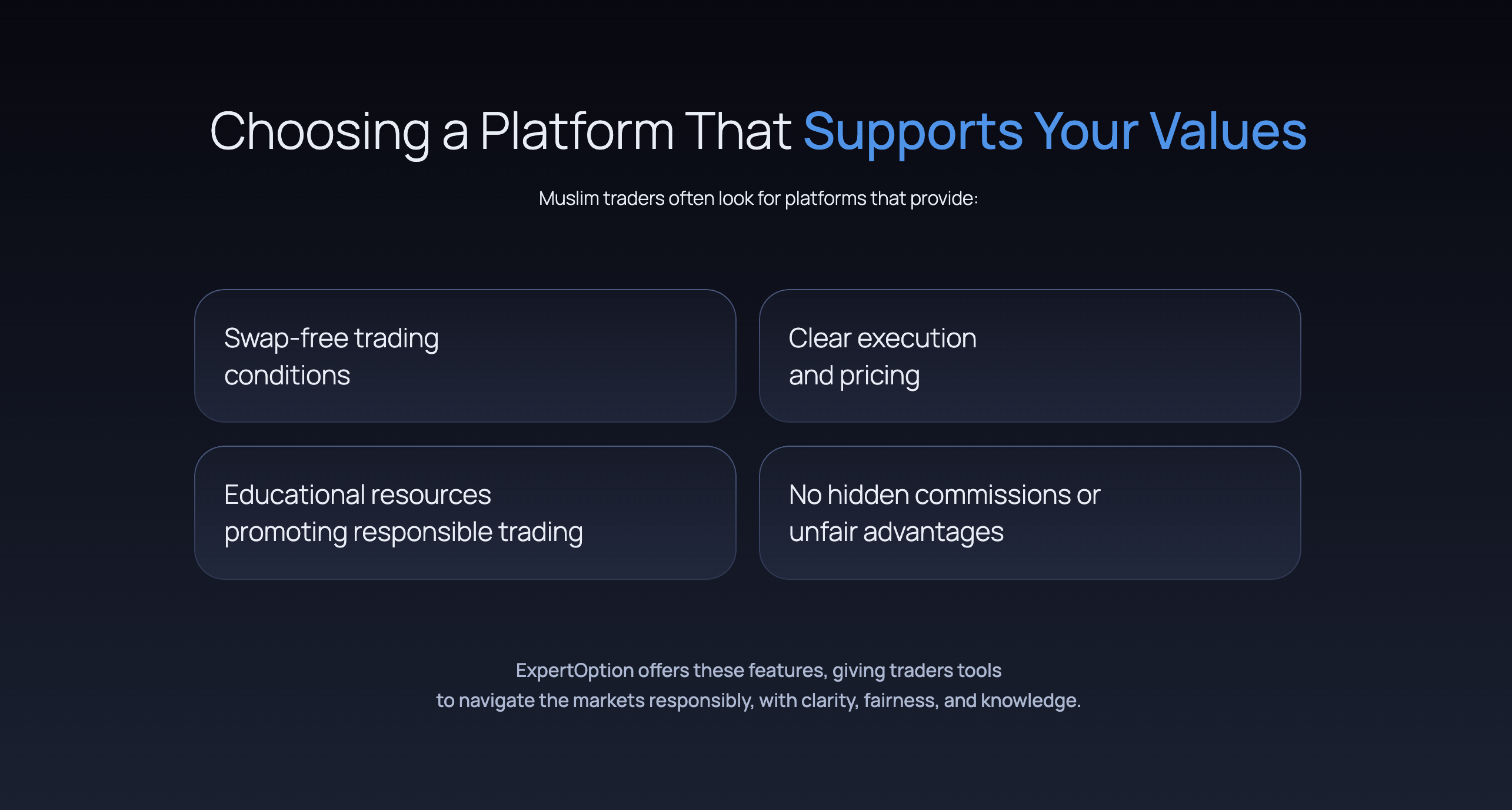
When evaluating the EO halal trading platform, structure matters more than labels. The platform operates as a self-directed trading environment where users control their capital, select their assets, and decide when to enter or exit the market.

ExpertOption operates as a global online trading platform providing access to financial instruments such as currencies, stocks, and commodities, including gold and oil. Users trade through a proprietary interface that displays real-time market data, charts, and execution controls.

From a structural standpoint, several elements support Islamic finance compliance.

1. No Interest-Based Earnings (Riba Avoidance)

ExpertOption does not function as a savings institution or interest-bearing deposit platform. Users do not earn guaranteed interest on balances. Profits or losses arise solely from market performance based on individual trading decisions.

This structure avoids riba because there are no fixed or predetermined returns. Outcomes depend on price movement and user choice, not on time-based interest accumulation.

Practical benefit for traders:

  • Focus on price-based trading, not passive interest income
  • Avoid strategies that depend on holding positions purely for time-based gains
  • Choose trades where outcomes are tied to real market movement, not predetermined returns

2. Transparent Contract Structure (Reducing Gharar)

Clarity is fundamental in Islamic finance.

The ExpertOption platform displays:

  • Entry price
  • Trade size
  • Potential outcome
  • Asset selection
  • Trade duration

All conditions are visible before confirmation and don’t change once the deal is opened. There are no hidden clauses altering the result after execution. Users decide whether to proceed based on fully disclosed parameters.

This transparency directly addresses gharar concerns. When contract terms are clearly defined and visible, excessive uncertainty is minimized.

For a trader, it means:

  • You can review the risk before entering, reducing uncertainty
  • It becomes easier to avoid unclear or rushed decisions
  • You stay in control by only entering trades you fully understand

3. Market-Based Risk, Not Gambling (Addressing Maysir)

A common concern in halal investing online is whether digital trading resembles gambling.

In gambling, outcomes are random and disconnected from economic fundamentals. In financial markets, price movements reflect real-world factors such as:

  • Supply and demand
  • Economic indicators
  • Geopolitical developments
  • Corporate performance

ExpertOption provides access to charts, indicators, and an economic calendar to support informed decision-making. Traders analyze market data before opening positions.

Ethical trading in Islam emphasizes intention and method. When a trader studies market conditions, applies a strategy, and accepts real economic risk, the activity differs fundamentally from maysir. Traders make decisions based on careful analysis rather than chance.

4. Ethical Market Access

ExpertOption offers instruments linked to global markets such as major currencies, international stocks, and commodities. The platform itself does not promote prohibited industries as a focal investment theme.

Traders can:

  • Choose assets that align with Islamic values (like EUR/USD or Gold)
  • Avoid assets linked to prohibited industries

5. Security, Verification, and Ethical Responsibility

For Muslim traders, compliance is also about operational integrity.

ExpertOption implements:

  • SSL encryption to protect sensitive information
  • KYC (Know Your Customer) procedures
  • AML (Anti-Money Laundering) checks
  • Structured withdrawal processes

Only verified users can deposit, trade, and withdraw funds. This prevents fraud and ensures that all participants operate within a transparent system.

From a Sharia perspective, these measures not only safeguard user funds and prevent deception but also uphold the principle of honesty (amanah), reflecting ethical conduct in every transaction.

Practical benefit for traders:

  • Greater confidence that funds and data are protected
  • Reduced risk of fraud or misuse
  • A more transparent and accountable trading environment

6. Educational Tools That Support Responsible Trading

An important part of the ExpertOption Islamic trading guide approach is education.

The platform provides:

  • A free demo account
  • Charting tools
  • Market news integration
  • An economic calendar

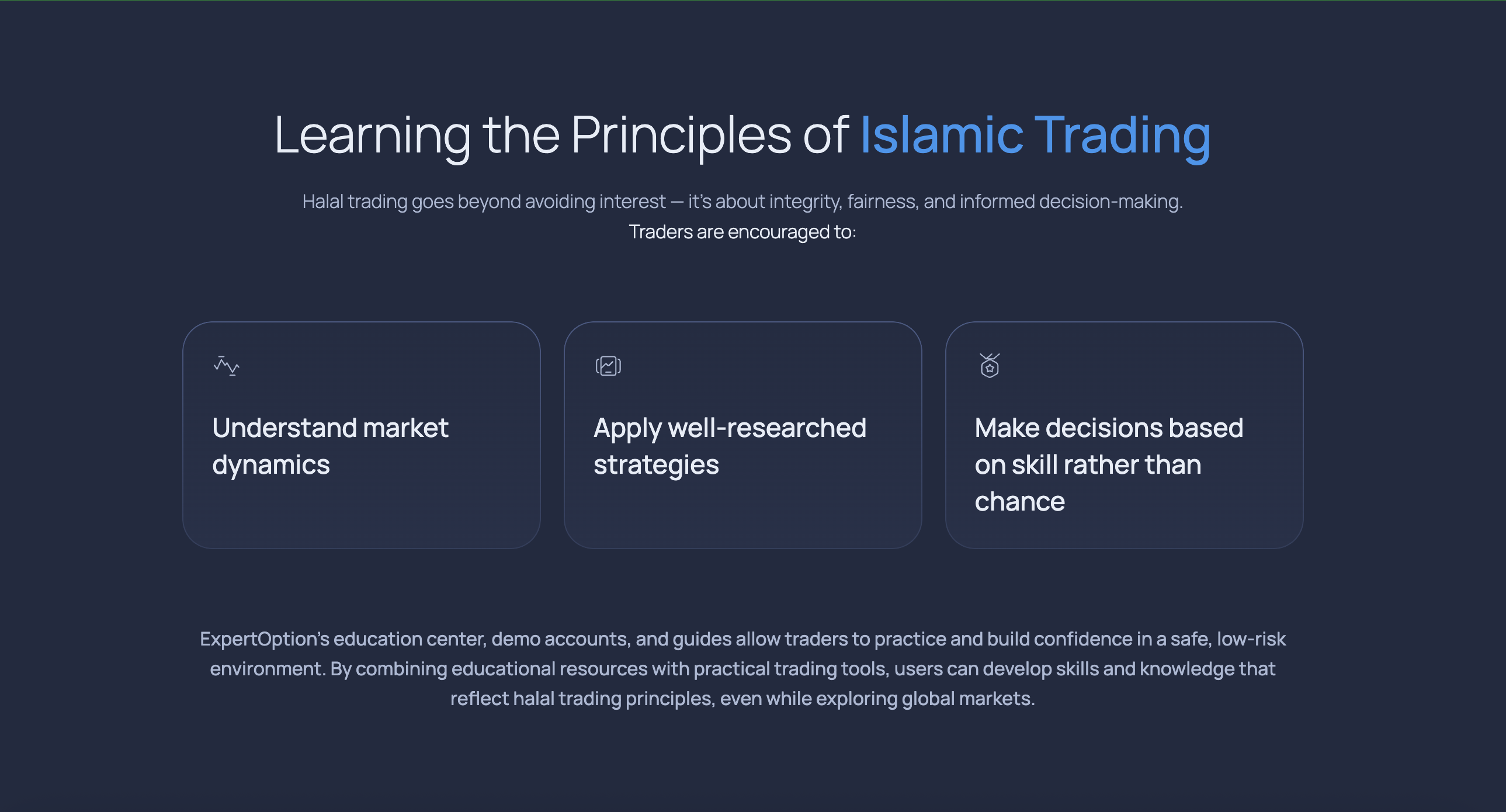
The demo environment allows users to practice without financial risk, helping them build knowledge before trading with real funds. This supports responsible engagement and reduces speculative behavior.

Access to Global Markets in a Halal Framework

One of the major advantages of modern digital platforms is the ability to participate in international markets from a single interface. Through ExpertOption, users can engage with widely traded instruments and apply their own ethical filters when selecting assets.

This flexibility allows traders to avoid sectors that conflict with their beliefs while still benefiting from global market opportunities. As a result, the platform is increasingly mentioned in discussions about halal online trading and responsible wealth generation in the digital era.

Because the system is based on transparent execution rather than automatic earnings, it supports the idea of trading as a form of lawful commercial activity rather than speculation driven purely by chance.

The Human Element in Halal Trading

No technology alone can determine whether an activity is halal. Intention, discipline, and risk awareness remain essential. A platform may provide the structure, but the trader’s behavior defines how that structure is used.

Ethical trading in Islam includes:

  • Avoiding excessive risk: Trade only a small, defined portion of your balance (e.g., 1–2%) and avoid multiple trades at once or impulsive positions during volatility. This keeps potential losses manageable.
  • Making informed decisions: Use charts, indicators, and economic news to understand price movements. Don’t blindly copy trades; ensure you know why a trade is opened before acting.
  • Maintaining realistic expectations: Accept that losses happen and focus on learning and consistent decision-making, rather than chasing quick gains or reacting emotionally to wins or losses.
  • Using halal funds: Trade only with money free from interest obligations or financial pressure, keeping essential living expenses separate from your trading capital.

Sharia-compliant trading on ExpertOption is therefore a combination of platform design and user intention. Approaching the market with analysis, clear risk limits, and realistic expectations keeps trading aligned with the ethical framework of Islam. The availability of educational resources and practice accounts on ExpertOption supports this gradual and informed approach, which is why many see it as part of an effective EO Islamic trading guide for beginners.

Practical Steps to Stay Aligned with Sharia Principles

Beyond platform structure, daily trading behavior plays a key role.

Simple checklist for traders:

  • Choose a trade amount you fully understand and accept
  • Avoid entering trades without analyzing the chart context
  • Focus on clear setups, not constant activity
  • Select assets that align with your ethical standards
  • Avoid overtrading or chasing losses
  • Use the demo account to build confidence before real trades

While platform features can support a Sharia-aligned approach, they do not replace personal responsibility. The most important factor is how the trader uses the tools.

When approached with discipline, transparency, and intention, ExpertOption can serve as a structured environment where users learn, analyze, and participate in the market thoughtfully — rather than trading impulsively or without direction.

Trust, Regulation, and Long-Term Reliability

In online finance, reputation is built through consistent performance. A platform that maintains secure transactions, transparent rules, and responsive support over time creates the stability required for ethical participation.

The fact that ExpertOption operates within a structured regulatory framework and serves tens of millions of users globally is a strong indicator of operational continuity. In discussions about Islamic finance compliance EO, this long-term consistency is particularly important because trust and fairness are central to Sharia-based financial activity.

Conclusion

The growth of digital markets has made it possible for Muslim traders to participate in global finance without compromising their values. The key is understanding how a platform works and how its structure relates to Islamic law.

ExpertOption provides a trading environment where transactions are transparent, interest is absent, and outcomes depend on real market movement. Its membership in The Financial Commission, its robust security framework, and the confidence of more than 70 million users reinforce its position as a reliable, ethically sound platform.

For those exploring Sharia-compliant trading EO, the combination of user control, clear contractual terms, and education-based participation creates a practical path toward halal investing in the modern financial world.

Halal trading is possible when the principles of transparency, no interest, and fair risk are met. ExpertOption provides these conditions, while the responsibility for ethical and informed use ultimately remains with the trader.

Honeywell CEO Vimal Kapur Said AI Is Set To Fundamentally Reshape Industrial Automation

0

Honeywell is positioning artificial intelligence as the cornerstone of its next phase of growth, arguing that AI’s biggest commercial impact may not come from chatbots or consumer applications, but from transforming the physical infrastructure that underpins the global economy.

Speaking to CNBC’s Jim Cramer, Honeywell Chief Executive Officer Vimal Kapur said AI is set to fundamentally reshape industrial automation, creating a significant opportunity for the company as it prepares to become a pure-play automation business following the planned June 29 spin-off of its aerospace division.

“The power of AI is going to redefine automation,” Kapur said.

The comments offer insight into how one of the world’s largest industrial technology companies views the next stage of the AI revolution. While investor attention has largely focused on AI model developers, semiconductor companies, and hyperscale data center operators, Honeywell is making the case that the real long-term value may emerge from applying AI to industrial operations, critical infrastructure, and real-world assets.

The aerospace separation marks the latest step in a broader restructuring effort aimed at simplifying Honeywell’s portfolio and sharpening its focus on higher-growth technology segments.

The company has spent several years reshaping itself around automation, software, and digital industrial solutions. Last year, it spun off Solstice Advanced Materials, continuing a strategy designed to streamline operations and concentrate capital on businesses with stronger long-term growth prospects.

Once the aerospace business is separated, Honeywell will emerge as a company centered on automation technologies deployed across a wide range of industries, including hospitals, airports, semiconductor fabrication facilities, data centers, energy infrastructure, and liquefied natural gas plants.

“We are taking the opportunity to build a pure play automation company across multiple sectors, and opportunity is more compelling now, with AI coming in,” Kapur said.

The restructuring places Honeywell at the intersection of two of the fastest-growing investment themes in global markets: artificial intelligence and industrial digitization.

Why Honeywell Sees a Different AI Opportunity

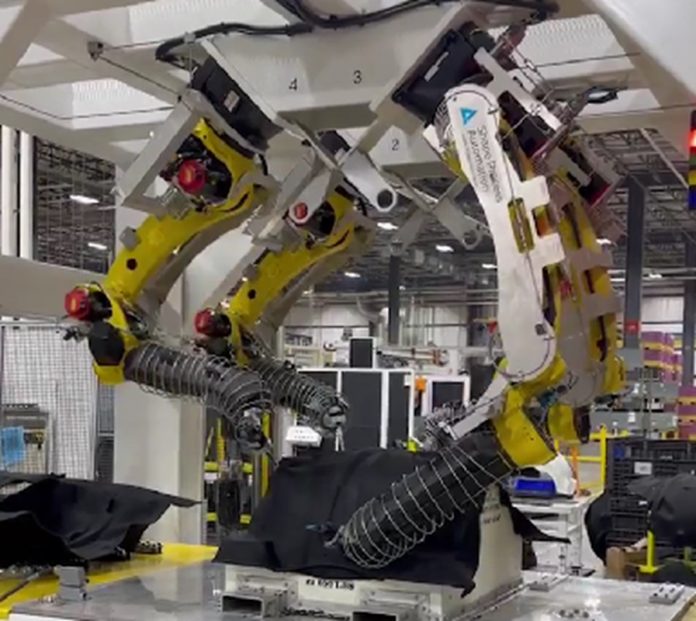
Unlike AI-focused companies competing to build ever more powerful large language models, Honeywell’s strategy revolves around what industry executives increasingly call “physical AI” — the application of artificial intelligence to machinery, industrial processes, and operational systems.

Honeywell’s automation platforms already collect enormous amounts of data from industrial equipment, sensors, and control systems. AI allows that information to be transformed into actionable intelligence that can improve efficiency, optimize operations, and automate complex decisions.

According to Kapur, this existing infrastructure gives Honeywell a competitive advantage.

“Physical AI for us is built on our domain knowledge,” he said. “It’s built upon the data which we possess in our system.”

That distinction is becoming increasingly important as investors look beyond generative AI applications and focus on how businesses can generate measurable returns from their AI investments.

While many enterprises are still experimenting with generative AI tools, industrial companies are increasingly exploring how AI can improve equipment reliability, energy efficiency, predictive maintenance, supply chain management, and operational performance.

For Honeywell, this creates an opportunity to monetize decades of expertise in industrial processes while layering AI capabilities onto existing customer relationships.

Labor Shortages Become a Major Tailwind

A key driver behind Honeywell’s optimism is a growing shortage of skilled labor across industrial sectors. Kapur said many of Honeywell’s customers are struggling to recruit and retain operators, technicians, and other specialized workers needed to run complex facilities.

The challenge is particularly acute in industries such as manufacturing, energy, transportation, and healthcare, where experienced workers are retiring faster than new workers are entering the labor force.

“Net workforce is not going to be increasing. It’s going to be decreasing over a period of time,” Kapur said.

Demographic trends support that assessment. Aging populations across North America, Europe, and parts of Asia are expected to place increasing pressure on labor markets over the coming decades. As a result, companies are investing heavily in automation technologies that can maintain productivity with fewer workers.

This trend is emerging as one of the strongest structural growth drivers for industrial automation providers, with businesses increasingly viewing AI-enabled systems as essential rather than optional.

One notable aspect of Kapur’s remarks is that customers are no longer viewing automation primarily as a cost-cutting exercise. Traditional automation investments were often justified through labor savings and efficiency gains. The emerging AI wave appears to be changing that equation.

“Our customers are looking at it not as a productivity opportunity,” Kapur said. “They are looking at it as a revenue-generation opportunity.”

In sectors such as semiconductor manufacturing, energy production, and logistics, even small improvements in operational performance can generate substantial financial returns.

However, much of the market’s focus has centered on AI model developers, chipmakers, and cloud computing providers. Honeywell is arguing that another major opportunity lies in applying AI to physical assets and industrial operations.

That thesis could become attractive as investors seek businesses capable of generating tangible returns from AI adoption rather than relying solely on future technological breakthroughs.

With its aerospace separation approaching, Honeywell is effectively making a strategic wager that the next phase of the AI revolution will occur not only inside data centers but also across factories, airports, hospitals, power plants, and industrial facilities worldwide.