DD
MM
YYYY

PAGES

DD
MM
YYYY

spot_img

PAGES

Home Blog Page 1222

PSG Crush Inter Milan 5–0 to Win First Champions League Title, Complete Historic Treble

0

Paris Saint-Germain have finally secured their long-coveted place among Europe’s elite, thrashing Inter Milan 5–0 in the UEFA Champions League final to lift the trophy for the first time in the club’s history.

The victory, achieved at Munich’s Allianz Arena, also sealed a treble for PSG, who had earlier claimed the Ligue 1 title and the Coupe de France.

The five-goal margin is the largest ever recorded in a European Cup or Champions League final since the competition began in 1956, surpassing the 4–0 wins recorded by AC Milan in 1994 and 1989, and Bayern Munich in 1974.

Achraf Hakimi opened the scoring in the 12th minute with a tap-in against his former club after a smart assist from 19-year-old Désiré Doué. The teenager then scored twice himself—his first deflecting in off Federico Dimarco before calmly slotting in a second just after the hour mark. Khvicha Kvaratskhelia, another of PSG’s young stars, added a fourth, and 17-year-old substitute Senny Mayulu put the icing on the cake with a fifth in the 86th minute.

“I have no words,” Doué said, still overwhelmed by the magnitude of his contribution. “That was just incredible. Simply incredible.”

A Bitter Irony for Mbappé

The win could not have come with more dramatic irony. Kylian Mbappé, who departed PSG for Real Madrid at the end of last season in pursuit of the Champions League title, watched from Spain as his former club reached the pinnacle without him—defeating the very Inter Milan side that had knocked Madrid out in the semifinal.

PSG’s triumph, long viewed as inevitable given the billions invested since Qatar Sports Investments took over in 2011, had eluded the club through years of heartbreak. Big-money signings like Zlatan Ibrahimovic, Edinson Cavani, Neymar, Lionel Messi, and Mbappé himself had been brought in to win the Champions League, only to fall short of their goal.

But this first European crown came not in an era defined by superstars, but rather through a shift in philosophy. Two years ago, PSG changed course, opting to phase out their expensive galáctico project and focus on young, dynamic talents. In their very first season without Mbappé, the results of that gamble have stunned Europe.

“We have made history, we have written our names in the history of this club,” Hakimi said. “For a long time, this club deserved it, we are very happy. We have created a great family.

Enrique Makes Coaching History

Manager Luis Enrique has now entered rarefied territory. The former Barcelona coach, who led the Catalan club to a treble in 2015, has become only the second manager in football history to win a treble with two different clubs—joining Pep Guardiola, who achieved the feat with Barcelona in 2009 and Manchester City in 2023.

“He is the man who has changed everything at PSG,” said Hakimi. “Since he came here, he’s changed the way football is seen in Paris. He deserves this more than anyone.”

Under Enrique, PSG have abandoned the individualistic play of past years for a fast, aggressive, collective style. His trust in youth—starting the likes of Doué, Warren Zaïre-Emery, and Kvaratskhelia in a Champions League final—was vindicated in the most spectacular fashion.

For veteran PSG defender Marquinhos, the night was as much about vindication as celebration.

“It’s a mix of joy, of all the emotions we’ve spent together,” PSG defender Marquinhos said. “I’ve suffered, but I’ve grown up with this team. I think of all the players who have come through and not succeeded. My idol Thiago [Silva], Lucas, Zlatan, [Edinson] Cavani, [Angel] Di Maria.

“So many players who have come through here who deserved this and didn’t succeed. Now we’re here and we’re bringing it home. I’m thinking of all the supporters who have been with us, those at the Parc des Princes and those around the world. I love you, enjoy it and we’re going to enjoy it here. This is the best day of my life.”

The last time PSG reached the final, in 2020, they fell to Bayern Munich in a hauntingly quiet stadium closed to fans due to the COVID-19 pandemic. This time, the Allianz Arena—again the stage—was filled with thousands of PSG supporters waving flags and lighting flares as they watched their team finally fulfill its promise.

With this win, PSG became only the second French club to lift Europe’s most prestigious trophy, following Marseille’s success in 1993. But whether this is the beginning of a PSG dynasty or a fleeting triumph will depend on whether the club stays the course.

Meta AI Hits One Billion Users, Doubling Its User Base From 500 Million Monthly Active Users in 2024

0

Meta CEO Mark Zuckerberg has announced that Meta AI, the company’s AI-powered chatbot, has reached a significant milestone of one billion active users across its suite of apps.

This figure marks a dramatic rise from doubling from 500 million monthly active users reported in September 2024. The announcement was made during Meta’s annual general meeting on Wednesday, where Zuckerberg described the achievement as a key step in the company’s long-term vision for AI.

He emphasized that the next phase would focus on deepening user experience through enhanced personalization, voice conversations, and entertainment, to make Meta AI the top personal AI platform globally.

Meta’s AI surge comes amid fierce competition in the AI landscape. In comparison with several top platforms, OpenAI’s ChatGPT currently has 400 million weekly active users and about 10 million paying subscribers, while Google’s Gemini boasts over 400 million monthly active users as of May 2025.

Originally launched as a voice assistant on the second-generation Ray-Ban Meta smart glasses in September 2023, Meta AI has evolved rapidly. In April 2024, the assistant was upgraded to support multimodal input through computer vision. By July, Meta AI with Vision was integrated into Horizon OS (v68) for Quest 3 and Quest Pro, enabling real-time object detection in passthrough mode — replacing the older voice assistant software. Quest 2 users continue to access a version of Meta AI without Vision support.

Since its launch, Meta AI has positioned itself as a major contender in the competitive AI market alongside ChatGPT, Grok, and Gemini. Zuckerberg noted that Meta is prioritizing the development of the assistant before transitioning to monetization. Potential revenue streams include offering premium features via subscription or integrating paid recommendations.

“It may seem kind of funny that a billion monthly activities don’t seem like it’s at scale for us, but that’s where we’re at,” Zuckerberg told shareholders, highlighting the company’s broader ambitions.

Unlike its rivals, Meta AI remains free across Meta’s ecosystem — including WhatsApp, Facebook, and Instagram. However, with the recent launch of a standalone Meta AI assistant, Meta is eyeing a larger share of the generative AI market currently led by Google and OpenAI.

Meta AI is powered by Llama 4, the company’s most advanced large language model to date, offering enhanced reasoning, multilingual support, and improved efficiency. The assistant is also designed to remember user-specific details, such as travel preferences or language learning goals. Through Meta’s Accounts Centre, it can pull context from linked Facebook and Instagram accounts to personalize interactions further.

Meta AI’s research encompasses several areas, including:

Natural Language Processing (NLP)

Meta AI develops advanced language models that enable machines to understand, generate, and interact using natural language. Their work includes projects like BlenderBot, a state-of-the-art chatbot, and advancements in multilingual models.

Computer Vision

Meta AI is at the forefront of developing systems that understand and interpret visual data, which is crucial for applications in augmented reality (AR) and virtual reality (VR). Research in this domain includes projects like image recognition, object detection, and understanding 3D environments.

Reinforcement Learning

Meta AI focuses on reinforcement learning techniques that enable machines to learn from interactions and improve their performance over time. This is particularly relevant for developing intelligent systems that can autonomously adapt and make decisions in complex environments.

Robotics

Meta AI explores using AI in robotics to create systems that can understand and navigate physical spaces. This research aims to improve robot manipulation, perception, and control in real-world scenarios.

Responsible AI and Ethics

Meta AI is committed to ethical AI development, focusing on fairness, transparency, and accountability. The division actively researches to mitigate biases in AI models, ensure privacy, and create inclusive technologies.

Looking Ahead

Meta AI is at the forefront of artificial intelligence research and development, contributing significantly to the field with its open science approach, innovative projects, and commitment to ethical AI.

As Meta continues to expand the assistant’s reach and capabilities, its integration with AI-powered glasses and existing mobile apps signals a major push to make Meta AI a central part of users’ digital lives.

21Shares SUI ETF Could Significantly Bridge TradFi-DeFi Divide

0

21Shares, a prominent issuer of crypto exchange-traded products, filed an S-1 registration statement with U.S. Securities and Exchange Commission (SEC) on May 1, 2025, to launch a spot SUI ETF in the U.S. This follows their earlier filing for a SUI ETF in Delaware and a SUI Staking ETP launched in Europe in July 2024. If approved, the ETF would be the first U.S.-listed fund offering direct exposure to SUI, allowing investors to gain exposure through traditional brokerage accounts without directly holding the cryptocurrency.

The ETF aims to track the performance of SUI using the CF Sui-Dollar Reference Rate Index, with Coinbase managing asset custody. It will not involve staking or leverage, focusing solely on price exposure. Nasdaq also filed a 19b-4 form on May 23, 2025, to list the 21Shares SUI ETF, marking a key regulatory step. The SEC has 45 days for an initial decision, with potential extensions up to 240 days (final decision by January 18, 2026).

This filing comes after Canary Capital’s SUI ETF proposal on March 17, 2025, indicating growing institutional interest in the Sui ecosystem, which has a market cap of over $12 billion and ranks 13th among cryptocurrencies. SUI’s price has shown bullish momentum, trading at approximately $3.70 with an 8% increase in the last 24 hours as of May 28, 2025, and a trading volume up 5.16% to $12.21 billion. Technical analysis suggests potential price targets of $4.56 or even $5.00 if ETF approval drives broader adoption, though bearish scenarios could see support at $3.50 or $3.00.

The Sui Foundation’s partnership with Fireblocks and its response to a $223 million exploit on the Cetus exchange further bolster institutional confidence. The SUI ETF, if approved, allows investors to gain exposure to the Sui blockchain’s native token through regulated brokerage accounts, bypassing the need for crypto wallets or exchanges. This lowers barriers for institutional and retail investors unfamiliar with DeFi.

An SEC-approved ETF signals regulatory acceptance, potentially boosting Sui’s credibility and driving broader adoption. Sui’s $12 billion market cap and layer-1 blockchain features (high scalability, low latency) could attract more institutional capital. Increased demand via the ETF could push SUI’s price higher (current price ~$3.70, with analysts eyeing $4.56–$5.00 on approval). However, it may also introduce volatility if institutional flows dominate.

Following spot Bitcoin and Ethereum ETFs, a SUI ETF approval would mark a milestone for altcoin ETFs, potentially paving the way for other layer-1 tokens like Solana or Cardano. The SEC’s decision (due by January 18, 2026) will signal its stance on newer cryptocurrencies. The filing’s timing, alongside Canary Capital’s SUI ETF proposal, reflects growing competition among issuers, which could accelerate regulatory clarity but also strain SEC resources.

The ETF aligns with Sui’s rising prominence, bolstered by partnerships (e.g., Fireblocks) and a robust DeFi ecosystem ($2 billion TVL, 18% growth in 2025). This could amplify development on Sui, attracting more dApps and users. However, the ETF’s non-staking structure limits exposure to Sui’s yield-generating potential, which may disappoint DeFi-native investors seeking full ecosystem benefits.

The ETF brings Sui into TradFi’s regulated framework, making it accessible to investors who avoid direct crypto ownership due to custody, security, or regulatory concerns. This could funnel significant capital into Sui, narrowing the divide. DeFi purists may view ETFs as diluting crypto’s ethos of decentralization, as they rely on centralized custodians (e.g., Coinbase) and don’t offer staking rewards. This creates a trade-off: broader adoption versus reduced functionality.

Many ETF investors may not understand Sui’s technology (e.g., its Move programming language or parallel transaction processing), potentially leading to speculative trading rather than informed investment in the ecosystem. Large players (e.g., hedge funds, pension funds) can leverage ETFs to allocate significant capital to SUI, potentially outpacing retail investors who face higher costs or risks on crypto exchanges. This could exacerbate wealth concentration.

Conversely, the ETF democratizes access for retail investors without crypto expertise, leveling the playing field by offering a regulated, low-friction investment vehicle. Institutional inflows via ETFs could lead to price swings that affect retail holders more acutely, especially if large players exit during market downturns. Retail investors may also lack the tools to hedge against such volatility.

The ETF primarily targets U.S. investors, potentially widening the gap between regions with access to regulated crypto products and those without. Emerging markets with high crypto adoption but limited ETF access may remain reliant on riskier platforms. Wealthier investors with brokerage accounts benefit more readily, while underbanked populations, who often use crypto for financial inclusion, may not access ETF-driven gains.

SEC rejection or delays could dampen enthusiasm and SUI’s price, reinforcing skepticism about altcoin ETFs. Institutional dominance in ETF trading could lead to price distortions, impacting retail holders on DeFi platforms. If ETFs prioritize TradFi-friendly assets, less prominent altcoins may struggle for attention, concentrating capital in top-tier projects like Sui.

The 21Shares SUI ETF could significantly bridge the TradFi-DeFi divide by integrating Sui into mainstream finance, boosting adoption and price potential. However, it may also deepen divides by favoring institutional investors, sidelining DeFi’s full potential, and creating disparities in access.

This Alternative Crypto to Shiba Inu Will Skyrocket 44x in 8 Weeks, Currently Undervalued at Just $0.20

0

The cryptocurrency market is gaining momentum as Shiba Inu (SHIB) and rising projects like Rexas Finance (RXS) attract investor attention. Shiba Inu is preparing for a potential breakout, backed by historical patterns and strong technical indicators. Meanwhile, Rexas Finance is offering investors a new opportunity through its real-world asset tokenization platform. With projections suggesting a 44x surge after launch, RXS could be one of the most undervalued tokens in 2025. This article reviews the potential of both cryptocurrencies.

Shiba Inu (SHIB) Positions for Breakout in May 2025

Shiba Inu (SHIB), a popular Ethereum-based memecoin token, is indicating a potential breakout. The historical performance of SHIB also indicates that the month of May is beneficial, as average rates were high last year. Thus, in May 2021, the SHIB coin increased by more than 350%, although later results became quite average. Currently, SHIB is trading near $0.00001411. According to technical analysis, the token is in the range of a symmetrical triangle , which is a formation associated with significant price movements. Analyst noted that, The trade idea taken from here is a break above the key level at $0.0000135, eyeing a target at $0.00023, a target that is 17x higher than the current price. Supporting this outlook, Shiba Inu’s on-chain activity has strengthened. The burn rate recently increased by more than 1300%, with nearly 28 million tokens removed from circulation in one day. Reducing supply while maintaining or increasing demand can boost price movement.

Analysts project that if the total capitalization of digital assets reaches $30 trillion, the capitalization of Shiba Inu may grow from $8.6 billion to $87 billion. This means an almost nine-fold price surge, but only if SHIB keeps its market share intact, of course. However, strong selling pressure at $0.000013-$0.000015 might put immense pressure on future rallies.

Rexas Finance (RXS) Emerges as a Strong Alternative

While waiting for Shiba Inu to make its next move, other tokens such as Rexas Finance (RXS) are gaining popularity with investors. Currently, RXS is an Ethereum-based platform that deals with the tokenization of real-world items like real estate, paintings, and more. Its presale price is $0.20 for the tokens, and the token will cost $0.25 after its launch on June 19, 2025. Rexas Finance is equipped with a comprehensive set of blockchain solutions, such as the Rexas Token Builder, a decentralized launchpad, and DeFi trading. These platforms enable P2P as well as the trade of assets without a technological interface as a limitation. More than $48.3 million has been raised towards the presale and over 462 million RXS tokens have been sold.

Security was also a critical area Rexas Finance has recently passed through an audit by the blockchain security company, CertiK. In this regard, listings on prominent tracking sites like CoinMarketCap and CoinGecko have enhanced the visibility of the project.

However, analysts say that communication on the project has been more focused on funding activities, and there is no clear plan on ecosystem rollouts. This could lead to the creation of doubts primarily after the token’s public offering. There are other real-world asset tokenization projects that could pose competition, such as Solaxy (SOLX).

Comparing the Growth Potential of Shiba Inu and Rexas Finance

This work aims at distinguishing which of the two is more suitable to investors in 2025, Shiba Inu or Rexas Finance. Shiba Inu is a decentralized community token that targets a technical revival with a rich history supported by on-chain metrics. On the other hand, Rexas Finance is positioning itself to create value in the long run by integrating real-world assets into blockchain networks. Its early presale and practical application tool give a different kind of chance for growth. Both projects indicate a broadening of use case scenarios in the cryptocurrency space, but they have different approaches. Compared to RXS, the rapid-bullish progression of SHIB could be appealing but choosing between the two depends on whether one prefers a more speculative play on a cryptocurrency or a practical, real-life application.


Website: https://rexas.com

Whitepaper: https://rexas.com/rexas-whitepaper.pdf

Twitter/X: https://x.com/rexasfinance

Telegram: https://t.me/rexasfinance

Ndubuisi Ekekwe, MBA (UNICAL) – “50 Most Distinguished Alumni With Impactful Contributions To National Development”

0

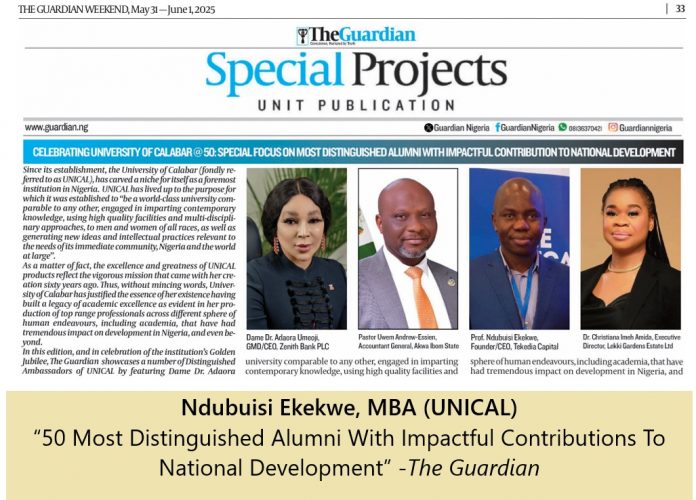
Good People, the University of Calabar and The Guardian have selected an Ovim village boy on the 50th anniversary of UNICAL as one of the “50 Most Distinguished Alumni With Impactful Contributions To National Development”.

You see – things happen. If not, how do you include the name of a village guy when there are “His Excellencies”, “Her Excellencies”, “Honourables”, etc, that can easily make up the list? To my fellow Malabites and Malabresses, and to our great university, Thank You.

I have a tough LOVE for UNICAL because they taught me Business Strategy and Market Competition by the best in the game. Those days they hired former executives of companies and banks to teach students, and the MBA classes were academic-boardrooms, with practical, actionable, intellectual raw materials for professional ascension. My focus was on global markets and international currencies, and I wrote briefs for the World Bank, AU, etc. You can read this seminal one on the single African Currency (I remain against it until there is a prior convergence of regional economies under a supranational banking institution, so as to avoid welfare losses) which I presented before the African Union Congress on invitation.

Prof CK Ayo, ex-Vice chancellor of Covenant University, supervised my thesis and it was all about mathematics and statistics. When a professor of mathematics with focus on numerical computation guides you on analysis of currency and competition, you will see things from a different angle. He introduced me to SPSS and actually taught me how to use it. Prof whom I visited many times when he was in Covenant has since gone to heaven.

Of course, on a day like this, I will dedicate this to venerable banker, Chairman Paschal Dozie, who recently exited the solid bounds of the earth for the ecclesiastical heaven, with cherubim, seraphim and angels welcoming him, for the uncommon grace and favour I found before him when I was in Diamond Bank.

UNICAL – the best university for an impactful MBA in Nigeria. Get a print copy of the Guardian and read my short interview.

File