DD
MM
YYYY

PAGES

DD
MM
YYYY

spot_img

PAGES

Home Blog Page 14

Again, Iran War Fuel Shock Boosts Europe’s Shift to EVs as New and Used Demand Surges

0

Rising fuel prices triggered by the Iran war are giving fresh momentum to electric vehicle adoption across Europe, with industry data showing sharp increases in both new registrations and used-car interest even as some executives caution that the surge could prove temporary if energy costs ease.

New EV registrations jumped 34% year-on-year in May across 17 key markets that account for more than 90% of EU and European Free Trade Association car sales, according to figures provided to Reuters by research group New Automotive and industry body E-Mobility Europe. Fully electric models now represent nearly one in four new registrations in those markets, a notable milestone in the region’s slow transition away from combustion engines.

The conflict, now in its fourth month, has kept global oil markets tight despite a fragile ceasefire framework. Shipping disruptions through the Strait of Hormuz mean fuel prices are likely to stay elevated for weeks or even months, making the total cost of ownership for petrol and diesel vehicles less attractive and pushing consumers toward electrified options.

Renault’s EV order book has grown by 50% in certain countries since late February, CEO Francois Provost told Reuters last week. Ford’s Europe chief, Jim Baumbick, acknowledged that the war has “increased customers’ interest” in EVs, though he warned against reading too much into the shift.

Affordable Models and Chinese Competition Drive Momentum

The timing has aligned with a broader push by automakers to make EVs more accessible. A wave of lower-priced models, including several from Chinese manufacturers, is addressing one of the biggest historical barriers: high upfront costs compared with traditional cars. Chinese brands are moving beyond premium SUVs into smaller, more affordable segments, exemplified by BYD’s launch of the Dolphin G hatchback in Berlin last week.

“Consumer interest in EVs is clearly stimulated by low-cost, very good Chinese cars arriving on the market,” said Andy Palmer, a former Nissan executive who helped bring the mass-market Leaf EV to Europe.

Supply of used EVs is also expanding rapidly, meeting strong buyer demand. Online marketplace OLX reported that sales leads for Chinese brands in France more than quadrupled year-on-year in May. In Germany, Carwow said EV interest — measured by customer configurations and purchase enquiries — has stabilized between 70% and 75%, up significantly from around 40% earlier this year.

“This development has long since evolved from a short-term effect to a sustainable trend,” said Philipp Sayler von Amende, managing director of Carwow Germany.

Prices for used EVs remain notably lower than equivalent internal combustion engine vehicles. In Britain, two- to four-year-old EVs retain about 33% of their original price on average, compared with 52% for fossil-fuel cars, according to dealer services firm Cox Automotive. Danish platform Bilbasen expects used EV prices to rise around 10% this year as demand strengthens, but they are still trading at a discount that makes them compelling for cost-conscious buyers.

Infrastructure Gains and Policy Support Underpin Longer-Term Shift

Beyond the immediate fuel price shock, structural improvements are helping embed EVs more deeply into the European market. Better charging networks, particularly in urban and highway corridors, are reducing range anxiety. Policy incentives in several countries, including purchase subsidies and tax breaks, continue to play a role, though the war-induced price pressure appears to be acting as an additional catalyst.

The data points to a market that is maturing. While early EV adoption was driven largely by environmental concerns and generous incentives, current momentum reflects more pragmatic calculations around running costs and total ownership economics. Chinese entrants are intensifying competition, forcing legacy European brands to accelerate their own affordable EV pipelines.

Still, industry voices remain measured. Renault’s Provost predicted that growth rates “will decrease” if fuel prices fall back significantly. Ford’s Baumbick echoed that sentiment, noting that while the conflict has boosted interest, it may not represent a permanent behavioral change.

Cox Automotive’s insight director Philip Nothard offered a more optimistic view, arguing that the growing supply of affordable new and used EVs should sustain demand even if petrol prices moderate.

“The market should stabilize. I very much doubt that we’ll see a downturn,” he said.

Geopolitical Uncertainty Keeps Pressure on Fuel Markets

The U.S.-Iran framework agreement aims to extend the ceasefire and reopen the Strait of Hormuz, but shipping and logistics executives caution that normalization could take weeks. Until then, elevated energy costs are likely to continue influencing consumer choices. European economies, many of which import nearly all their oil, remain exposed to these swings.

For automakers, the current environment offers a window to convert curiosity into commitment. Chinese manufacturers in particular are capitalizing on the moment, using price competitiveness to gain share in segments where European brands have traditionally dominated.

Analysts, however, note that whether this acceleration becomes structural will depend on several factors, including the durability of the Middle East peace process, the pace of charging infrastructure rollout, and how quickly battery costs continue to decline.

But the numbers emerging from May suggest the region’s transition is gaining real traction. This is seen as an indication that, as more affordable options reach showrooms and used markets, and as drivers calculate monthly costs in an era of volatile oil prices, electric vehicles are moving closer to the mainstream.


FERC Fast-Tracks Grid Access for AI Data Centers as Surging Power Demand Tests U.S. Energy Infrastructure

0

Federal regulators on Thursday took a major step to ease the strain on America’s creaking electric transmission system, unanimously approving measures that will allow large energy users, particularly power-hungry artificial intelligence data centers, to connect to the grid more quickly.

The Federal Energy Regulatory Commission (FERC) directed utilities and grid operators to prioritize timely and orderly interconnections for these massive loads, responding to urgent calls from the Trump administration to prevent bottlenecks that could slow U.S. progress in the global AI race. The move reflects growing concern that outdated interconnection processes are holding back critical infrastructure at a time when data centers are reshaping electricity demand across the country.

Energy Secretary Chris Wright had pressed FERC to act swiftly, arguing that faster grid access is essential for America to maintain its competitive edge against China in AI development. Tech companies and data center developers welcomed the decision, seeing it as a practical solution to years-long wait times that have delayed projects and inflated costs.

However, the decision has sparked unease among utilities, state regulators, and regional grid operators, who fear a loss of local control over the interconnection process. Clean energy advocates, meanwhile, worry that the changes could undermine state-level renewable energy mandates by prioritizing speed over sustainability.

Balancing Speed, Costs, and Reliability

In a unanimous vote, FERC Chair Laura Swett, a Trump appointee, emphasized that the commission was acting with ratepayers in mind.

“I know that Americans across the country are concerned about affordability, and so are we,” Swett said. “Many Americans are increasingly concerned about the interconnection of large loads, and data centers will increase their bills in that stress. As chairman, I am taking extremely seriously the mission that Congress has entrusted us to ensure that rates are reasonable and that Americans pay their fair share or less.”

Under the new order, data centers and other large users will be required to cover the full cost of any necessary grid upgrades for their connections. This “participant funding” approach aims to shield existing ratepayers from bearing the burden of new high-demand facilities. Yet experts note that the decision does little to address the deeper problem of tightening overall electricity supplies, as data center construction races ahead of new power plant development.

The action builds on an earlier FERC decision in December that allowed tech companies to effectively plug data centers directly into nearby power plants in certain cases. It also follows months of lobbying from the technology sector, which has warned that interconnection delays, sometimes stretching five to seven years, threaten to undermine massive AI investments.

Explosive Growth Meets Grid Reality

The scale of the challenge is staggering. Data centers currently account for roughly 5% of U.S. electricity demand, according to the Electric Power Research Institute, but that share could triple by 2035. In Virginia, already a major hub, data centers consume more than 25% of electricity and could exceed 40% by 2030.

More than 4,000 data centers operate in the United States today, with another 3,000 planned or under construction. Many of the newest facilities are vastly larger than their predecessors to handle the computational intensity of training and running advanced AI models.

Tech giants, including Google, Microsoft, Meta, Amazon, Oracle, OpenAI, and Elon Musk’s xAI, have all signed Trump’s Ratepayer Protection Pledge. In it, they commit to building or procuring new power generation for their facilities, covering infrastructure upgrade costs, providing backup power during emergencies, and hiring locally for construction.

Despite these pledges, challenges persist. A J.P. Morgan report last month, based on satellite imagery, found that over 60% of planned data center capacity scheduled for 2027 has not yet broken ground, with another 7% already delayed. Permitting hurdles, shortages of gas turbines and transformers, and a lack of skilled labor are frequently cited as bottlenecks.

The rapid expansion has also triggered growing local opposition. Residents in multiple states have protested new data centers, citing fears of higher electricity bills, increased pollution, heavy water consumption for cooling, and the loss of farmland or rural character. In some areas, projects have faced legal challenges and zoning battles.

Trump has pushed back against these concerns, viewing AI as essential to attracting foreign investment and preserving U.S. economic and military superiority. Earlier this month, he signed an executive order establishing a national security review process for the most advanced AI systems before their public release.

With AI compute demand growing exponentially, the United States is in a race not only against China but also against its own aging infrastructure. Delays in connecting new facilities risk ceding ground in a technology that many believe will define the next decade of economic and strategic competition.

By shifting more responsibility and costs onto the data center operators themselves, regulators hope to accelerate development while protecting everyday consumers.

Meta’s LeCun Calls Musk’s xAI, “a Failure”, Warns of Industry ‘Bubble Explosion’

0

The artificial intelligence boom that has propelled a handful of companies to trillion-dollar valuations may be heading toward a harsh financial reality, according to Yann LeCun, founder of AMI Labs and one of the most influential figures in modern AI research.

In a fresh broadside against Elon Musk and his artificial intelligence venture xAI, LeCun argued that the company is struggling to remain competitive at the cutting edge of AI development and warned that the broader industry faces a reckoning as soaring costs collide with uncertain paths to profitability.

His comments revive a long-running feud between two prominent figures in the AI industry and come at a time when investors are increasingly scrutinizing the economics underpinning the sector’s explosive growth.

“xAI is kind of a failure, frankly, because the founding team has departed,” LeCun said in an interview with CNBC.

Earlier this year, Musk merged xAI with SpaceX in a transaction that valued the combined business at roughly $1.25 trillion, instantly placing it among the most valuable technology enterprises in the world.

Yet LeCun suggested that xAI faces a fundamental challenge that goes beyond technology.

“Elon is now in a position that is very, very difficult for him to kind of hire top people in AI, because he’s kind of, you know, not behaved in sort of very good ways toward the … previous team,” he said.

The criticism follows a series of high-profile departures from xAI over the past year, raising questions about talent retention at a time when competition for elite AI researchers has become one of the industry’s most intense battlegrounds.

Talent Wars Intensify

The battle for AI talent has become as important as the race for computing power. Leading companies, including OpenAI, Anthropic, Google, Meta, Tencent, Alibaba, and DeepSeek have been aggressively competing for a relatively small pool of world-class researchers capable of developing frontier AI systems.

Recent reports from China have highlighted how AI companies are increasingly worried about talent defections. DeepSeek reportedly even required prospective investors in its latest funding round to agree not to poach employees or encourage them to launch competing ventures.

Against that backdrop, LeCun’s suggestion that Musk may be struggling to attract elite researchers strikes at the heart of xAI’s long-term competitiveness. While Musk has invested heavily in computing infrastructure, LeCun argued that infrastructure alone is not enough.

“I’m not very positive about the prospect of xAI,” he said, adding that he does not expect the company to compete effectively with industry leaders OpenAI and Anthropic.

Massive Infrastructure, Mounting Losses

The criticism comes as the economics of AI development face increasing scrutiny. Building frontier AI models requires enormous investments in specialized chips, data centers, and energy. Companies are spending tens of billions of dollars annually to train and operate increasingly sophisticated models.

According to recent financial disclosures, SpaceX’s AI division, which includes xAI, recorded a $2.5 billion operating loss in the three months ended March 31.

LeCun noted that the economics of AI remain deeply challenging.

“The prices are going up of those AI services, but the cost of running them is going down, but not nearly fast enough,” he said.

“And so all of those companies are losing money, and basically, the use for most people is funded by the investors. That can’t go on for a very long right?”

The comments echo growing concerns across the industry that many AI services remain heavily subsidized by venture capital and public market investors. Even OpenAI CEO Sam Altman recently acknowledged that AI costs remain a significant issue, reportedly noting that companies are more focused on the amount they spend on AI services.

LeCun’s most striking warning was directed at the broader AI sector rather than xAI alone. He noted that current business models may prove unsustainable unless companies either raise prices, cut costs, or discover new revenue streams.

“The prices are going up of those AI services, but the cost of running them is going down, but not nearly fast enough,” he said.

“The AMI Labs founder added that labs like OpenAI and Anthropic are ‘going to have to increase prices, they’re going to have to cut costs, or there’s going to be a big bubble explosion.’”

That warning arrives as investors continue pouring money into AI companies at unprecedented valuations. Anthropic recently achieved a valuation approaching $1 trillion. OpenAI has been valued at hundreds of billions of dollars. DeepSeek has reportedly surpassed a $50 billion valuation after its first external funding round.

Meanwhile, infrastructure spending across the sector continues to soar, with major technology companies expected to spend hundreds of billions of dollars this year alone on AI-related investments.

A Deeper Debate About AI’s Future

LeCun’s criticism is not merely financial. It reflects a broader philosophical disagreement over the direction of artificial intelligence.

While companies such as OpenAI, Anthropic, and xAI continue to build increasingly powerful large language models (LLMs), LeCun remains skeptical that current approaches can ultimately deliver truly reliable artificial general intelligence.

Instead, he has championed what he calls “world models.”

Large language models learn patterns in language and predict what comes next, making them highly effective for applications such as coding, writing, and reasoning tasks. World models seek to understand how the real world functions through cause and effect, physical interactions, and environmental awareness.

“I personally don’t think we’re going to have generalized reliable agentic systems until they’re based on world models,” LeCun said.

Much of the AI industry is betting heavily on autonomous AI agents capable of performing complex tasks with minimal human supervision. Companies from OpenAI and Anthropic to Qualcomm and Salesforce are investing heavily in agent-based systems that they believe will transform software, customer service, and productivity applications.

LeCun, however, believes current architectures may ultimately hit limits.

The debate centers on whether the current AI boom can generate sustainable profits. Many of the industry’s leading models require enormous computing resources to operate, creating high ongoing costs even after development is complete.

LeCun suggested that this imbalance between operating costs and customer willingness to pay remains unresolved.

“LLMs are useful for areas such as coding or math,” he acknowledged.

But, he added, “the cost of running those systems with this kind of performance is very high compared to the amount of money that users are ready to pay.”

That challenge has become more visible as competition intensifies. OpenAI is reportedly considering significant pricing changes. Anthropic has faced growing pressure over model costs. Hardware providers are spending heavily to support the AI ecosystem, while investors increasingly demand clearer paths to profitability.

Cash Tables vs Poker Tournaments Need Different Budget Rules

0
Split poker budget decision paths

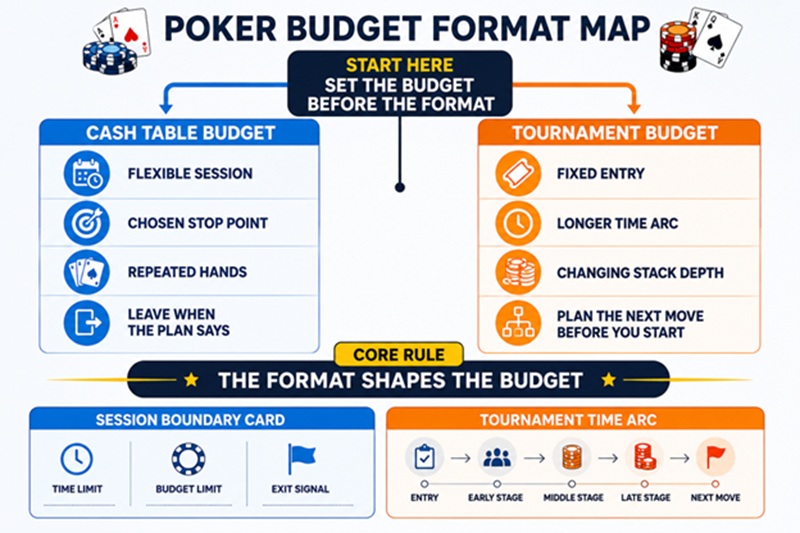
A poker budget works only when it is attached to a format. Cash tables and tournaments both use cards, chips, blinds, and pressure, yet they ask different things from the same set-aside amount. A cash table gives the player more control over session length. A tournament gives a clearer entry point, then adds time, patience, and changing stack depth. Mixing those formats without naming the difference turns figuring out your budget into guesswork.

That is why the first decision is not the table. It is the boundary. A 2024 PLOS One scoping review on money-management behavior separated budgeting, saving, spending, borrowing, and debt settlement as distinct behaviors, which is a useful reminder here. A poker budget is cleaner when it is treated as a specific entertainment choice, with its own limit and stop point.

Match The Budget to the Poker Format

Poker budget format comparison

Once the boundary is set, the next question is format. If you’re planning to play real money poker, then start by looking for a site that offers a wide selection of games, such as cash games, Zone Poker, Sit & Go’s, multi-table tournaments, Mystery Knockouts, and Incognito Poker. That means you will have plenty of options so you can choose something that fits both your preferences and your intended budget.

A cash table usually suits someone who wants control over duration and exit timing. A Sit & Go gives a smaller tournament rhythm because the event begins when the table fills. A multi-table tournament asks for a longer attention span because the player may sit through changing blind levels, table moves, and stack swings. The budget should match that shape before the first hand is dealt, especially for casual players who want poker to stay clear, contained, and enjoyable. A player with 45 minutes and a defined stopping point should think differently from someone with an evening available for a tournament path.

A short Xuan Liu poker clip shows that format shift without turning it into theory. She starts inside a WSOP $2K tournament, talks us through her dinner break with a strong stack, later notes that several all-in spots changed the day, then moves toward a cash-game seat after busting in 26th. The useful detail is the change in tempo. The tournament has breaks, field size, and elimination pressure. The cash game scene has a different pace.

Cash Tables Need a Clear Exit

Cash tables can feel easier to plan because the player is not tied to a tournament clock. That flexibility is exactly why the exit point matters. Without one, the session can stretch because there is always another orbit, another playable hand, another chance to see whether the table still feels good.

A cash table budget works best when it answers three ordinary questions. How long is the session meant to last? What amount has been set aside for this session? What signal ends the session? That signal can be time, tiredness, a planned chip boundary, or the feeling that concentration is slipping.

The format also changes how decisions arrive. Cash play gives repeated hands at a steadier rhythm. A player can fold, observe table behavior, choose better spots, and leave when the plan says the session is complete. That can make cash tables easier to contain than a long tournament day. Flexibility should make the budget easier to follow, not easier to forget.

Tournaments Ask for More Than the Entry

A tournament looks simpler at the start because the entry is named upfront. That does not mean your budget only covers money, of course. It also includes time, attention as blinds rise, and patience when the stack moves through different phases.

The same entry can feel different depending on structure. A Sit & Go gives a compact event. A multi-table tournament can run through longer stages where the best decision may be a quiet fold, a patient wait, or a carefully timed hand. The player is choosing a rhythm.

Tournament budgets also need a plan for what happens after the event ends. If the player exits earlier than expected, the next choice should already be defined. That might mean stopping for the day, switching to a smaller cash session that was planned in advance, or saving the remaining time for another day. Decide before the tournament result steers the next move.

Keep The Two Budgets Separate

Cash-table money and tournament money should not be treated as one flexible pile. One amount belongs to cash sessions, where the player controls duration. Another belongs to tournament entries, where the format controls more of the clock.

This separation makes post-session review cleaner. A cash session can be judged by whether the player followed the exit rule and stayed inside the planned boundary. A tournament can be judged by whether the entry fit the available time and whether later decisions matched the player’s stack, position, and patience.

A casual player does not need complex accounting to play with more clarity. Two separate envelopes, even if they are only mental envelopes, can keep the choice honest. Cash tables are about controlled access to repeated decisions. Tournaments are about entering a defined path and accepting its pace. Poker feels cleaner when the format is chosen first and the budget follows that shape, especially because decision-making under uncertainty often demands extra cognitive control, as explained in Frontiers’ review of uncertainty and cognitive control.

The Human Toll of Meta’s AI Pivot: Layoffs, Grunt Work, and a Tone-Deaf Hackathon Deepen Morale Crisis

0

Morale inside Meta has plunged to what insiders describe as some of the lowest levels in the company’s history, as the social media giant’s layoff, tied to an aggressive push into artificial intelligence, exacts a heavy human cost on its remaining workforce.

The frustration boiled over last month when Meta laid off approximately 8,000 employees, roughly 10% of its total headcount, in yet another round of sweeping cuts tied to the company’s frantic refocusing on AI. Those who kept their jobs now find themselves increasingly saddled with repetitive, low-level tasks to train and refine AI models, a grind that many say is draining what little enthusiasm remains.

According to Wired, in an internal memo sent to staff on Friday, CEO Mark Zuckerberg tried to rally the troops by announcing a companywide AI hackathon scheduled for July. The response was swift and brutal, exposing a deep disconnect between leadership’s vision and the day-to-day reality for employees still reeling from cuts.

“I’m literally preoccupied with keeping the lights on for my team,” one employee wrote in an internal message quoted by Wired. “I have no incentive to participate, let alone have the time to do so.”

Another added, “I’m not sure that this company supports a hackathon culture anymore. People are being asked to cover more work with less support while their colleagues get laid off.”

A third worker noted: “I’ve participated in previous hackathons, but this no longer feels like an option alongside pod sprints in my corner of the company.”

Zuckerberg’s additional gesture, offering employees access to permanent desks instead of the controversial “hot desking” system, only seemed to underscore how precarious many roles had become. The move, intended as a positive signal, landed as tone-deaf amid widespread anxiety about job security.

A Painful Transition with Limited Payoff So Far

Meta’s difficulties stem from the broader challenges facing Big Tech as it races to catch up in the generative AI era. Despite heavy investment, the company continues to struggle to produce standout models that match the pace set by rivals like OpenAI, Anthropic, and Google. Insiders say the pressure to deliver results is intensifying, but the immediate human cost is mounting faster than visible breakthroughs.

Andrew “Boz” Bosworth, Meta’s chief technology officer, was unusually candid during an internal “Tuesdays with Boz” meeting on June 2. According to four people familiar with the call, Bosworth described the current atmosphere as “maybe not the worst it’s ever been in 20 years here, but it’s probably up there” — and “probably one of the worst it’s ever been.”

The only period he recalled as worse was the 2018 Cambridge Analytica scandal, when revelations about the misuse of millions of Facebook users’ data for political targeting triggered a massive crisis of trust, regulatory scrutiny, and reputational damage. At the time, whistleblower Christopher Wylie exposed how the firm had harvested data to influence campaigns, including Donald Trump’s 2016 presidential run and the UK’s Brexit referendum.

Zuckerberg himself acknowledged the difficulties in his memo, admitting that the AI transition has been messy.

“Given the complexity of these changes, we’ve made mistakes and will almost certainly make more,” he was quoted as saying.

He pledged to avoid further layoffs for the rest of the year, but the damage to trust appears significant. Employees who survived previous rounds now face heavier workloads with fewer resources, fueling resentment toward a leadership team that continues to emphasize long-term AI bets over near-term stability.

The Big Tech’s AI Reckoning

Meta’s situation is not unique, but its scale and visibility make it a bellwether for the industry. Across Silicon Valley, companies are pouring tens of billions into AI infrastructure while simultaneously trimming headcount to improve efficiency. The result is a workforce that feels both essential to the future and expendable in the present.

For Meta specifically, the pivot carries extra weight. The company’s core advertising business still generates enormous cash flow, but growth has slowed as users fragment across platforms and regulators tighten oversight. AI is seen as the next growth engine, powering everything from content recommendation to ad targeting and new products, yet translating that vision into reality has proven slower and more painful than expected.

The hackathon misstep highlights a deeper cultural challenge. What once felt like an innovative, energizing part of Meta’s identity now strikes many as tone-deaf busywork when teams are stretched thin, and colleagues have just been shown the door.

Industry observers warn that sustained low morale could undermine Meta’s ability to attract and retain top talent at a time when competition for AI experts is fierce. If the best engineers and product minds start looking elsewhere, the company’s ambitious roadmap could slip further behind.

Zuckerberg’s memo and Bosworth’s comments are seen as a suggestion that leadership recognizes the gravity of the situation, even if their proposed remedies have so far fallen flat. As Meta bets its future on artificial intelligence, it is painfully discovering that keeping its human workforce engaged may be one of the hardest problems of all.