DD
MM
YYYY

PAGES

DD
MM
YYYY

spot_img

PAGES

Home Blog Page 1440

Evaluating Market Impacts of Unlocked Solana

0

Today, marks a significant event for Solana (SOL) with the unlocking of approximately $200 million worth of staked SOL. This is noted as the largest single-day release of staked SOL until 2028. The tokens being unlocked today were originally staked in April 2021, and at current market prices, these accounts have seen a substantial return, roughly 5.5 times their initial investment. This event involves four accounts releasing a total of around 1.79 million SOL, which could potentially influence market dynamics depending on how these tokens are handled—whether they are sold, held, or re-staked. The scale of this unlocks, while significant, represents about 2% of Solana’s current market cap, which might temper its immediate impact depending on market absorption and sentiment. Keep an eye on how it could lead to increased volatility in SOL’s price in the short term.

With approximately 1.79 million SOL entering circulation, this unlock adds about 2% to Solana’s current market cap (estimated around $90-100 billion recently). If a significant portion of these tokens is sold by the four accounts—originally staked in April 2021 with a 5.5x return—selling pressure could push SOL’s price down in the short term. Historically, large token unlocks have led to price dips when holders opt to realize profits, especially if market sentiment is already cautious. The influx of $200 million in SOL could lead to heightened volatility. Market depth might struggle to absorb this supply if demand doesn’t match, particularly since this unlock coincides with reports of whale investors dumping $46.3 million in SOL ahead of the event.

The market’s reaction hinges on perception. If holders retain or re-stake their SOL, the impact could be muted, signaling confidence in Solana’s long-term value. However, the current bearish trend—SOL down 4-5% in the last 24 hours to around $114-117—coupled with negative funding rates and declining volumes, suggests a shift from bullish to bearish sentiment. The unlock could amplify this if perceived as a catalyst for further selloffs. The unlock represents a significant portion of SOL’s daily trading volume (recently around $4-13 billion). If sold on exchanges like Binance, Kraken, or Coinbase, it could temporarily flood order books, potentially triggering liquidations of leveraged positions.

This might create a feedback loop of downward pressure, though oversold indicators (e.g., RSI at 15-30) could attract buyers hunting for a dip. Positive developments, like the SEC acknowledging Fidelity’s Solana ETF filing, could offset some negativity by boosting institutional interest. Additionally, Solana’s strong ecosystem—high transaction speeds, DeFi growth, and NFT adoption—might encourage holders to retain tokens, expecting future gains (e.g., projections of $300-500 by year-end). If demand rises to absorb the new supply, the price impact could be less severe.

The immediate market impact is likely to be downward pressure and increased volatility, with SOL testing key support levels around $115-120. A break below could see it slide to $80-90, while holding firm might stabilize it above $120, especially if buying interest picks up. Long-term, the effect depends on whether these tokens are sold or held, and how broader market trends—like Bitcoin’s stability above $82k or altcoin recovery—play out. Keep an eye on on-chain data and exchange flows today for real-time clues.

Why SpacePay’s Presale Could Be the Next Big Thing in Crypto Payments Innovation

0

Using crypto for everyday purchases is still a mess. Despite crypto’s massive popularity as an investment, using it to buy something as simple as coffee will likely earn you bewildered glances from store employees. That’s where SpacePay comes in.

They’ve built a system with a tiny 0.5% transaction fee, compatibility with over 325 different crypto wallets, and instant conversion to regular currency so merchants don’t have to stress about Bitcoin’s price swings.

SpacePay’s presale has already raised $1 million which means there’s a serious appetite for solutions that make crypto actually useful in the real world.

Breaking Down the Barriers to Crypto Adoption

Shop owners have enough challenges to deal with without adding crypto complications to the mix. Most are running on thin margins and crazy hours – they don’t have time to become blockchain experts or shell out thousands for fancy new payment terminals.

SpacePay seems to actually get this. Rather than pushing merchants to buy expensive new gear, their system works with Android payment terminals. It’s a simple software update to equipment businesses already own and understand.

For customers, the experience is surprisingly normal. Scan a QR code with whatever crypto wallet you prefer, tap confirm, and you’re done. No more fumbling through complicated wallet addresses or standing around awkwardly while your transaction processes for what feels like forever.

Solving Crypto’s Volatility Problem

Here’s a scenario that keeps shop owners away from crypto: accepting Bitcoin for a $50 sale, only to discover it’s worth $40 by closing time because prices crashed. No business can operate with that kind of uncertainty.

SpacePay tackles this head-on with a clever fix. When someone pays with crypto, the shop owner gets their money in regular dollars, euros, or whatever – instantly. That $50 sale stays exactly $50 in their account, even if Bitcoin goes on another roller coaster ride minutes later.

The magic comes from a price-locking mechanism that freezes the exchange rate during those few seconds it takes to process the payment. If crypto prices suddenly tank, SpacePay’s system absorbs the difference. The merchant just sees a normal, stable payment hitting their account with none of the crypto drama.

Visit SpacePay Presale

Changing Payment Economics with 0.5% Fees

Anyone who’s run a small business knows those credit card processing fees are brutal. The 2.5% to 3.5% that Visa, Mastercard and others take might not sound huge until you do the math at the end of the month. What makes matters worse is the lack of transparency and additional charges.

SpacePay flips this with their 0.5% fee structure. They can charge so much less by cutting out all those middlemen taking their cut in traditional systems.

The traditional payment flow involves acquiring banks, issuing banks, card networks, payment processors, and various other intermediaries – each collecting fees along the way. SpacePay creates a more direct route using blockchain, without sacrificing security.

The $SPY Token Ecosystem

SPT token holders get monthly rewards based on how active the platform is – kind of like earning dividends from a growing business. They also have voting rights on important platform decisions and early access to new features.

Perhaps most interesting is the revenue-sharing model. As more businesses use SpacePay for payments, a portion of those transaction fees flows back to token holders. The more the network grows, the better it potentially gets for everyone involved.

From the total supply of 34 billion tokens, they’ve set aside 20% for regular people in the public presale – not just wealthy insiders. The founding team only kept 5% for themselves – refreshingly modest compared to many projects for which founders grab huge chunks right off the bat.

Joining the SpacePay Ecosystem

At the moment of writing, $SPY tokens are going for $0.003181 each, though that price will likely climb as the presale progresses.

To participate, head over to SpacePay’s official website and connect your crypto wallet. If you’re new to crypto, they also accept regular bank card payments.

After connecting your wallet, just choose how many tokens you want, confirm the transaction, and you’re set.

For updates on where the project is headed, their Telegram and Twitter channels are the places to keep an eye on.


JOIN THE SPACEPAY ($SPY) PRESALE NOW 

Website    |    (X) Twitter    |  Telegram

Kaspa & XRP Holders Are Buying Big Positions In New Remittix After More Tech Innovations Prove This Crypto Is About To Explode

0

The evolving cryptocurrency market directs investors to identify potential projects ahead of their future mainstream success. Two blockchain communities of Kaspa (KAS) and XRP holders now exhibit strong interest in Remittix (RTX). Because of Ripple price today and other factors affecting Kaspa, investors are jumping ship to Remittix.

Kaspa’s GHOSTDAG Protocol Fuels Impressive Rebound

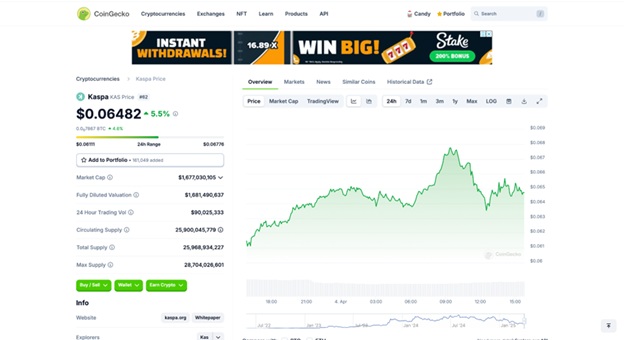
The recovery of Kaspa’s (KAS) price from its two-year low has become a cause of joy among its community members. The Kaspa market value sank to $0.05587 during March which marked a 70% decrease from its previous peak at $0.2075 in August of 2024. The cryptocurrency market faced initial difficulties before KAS achieved its 15% rise which surprised analysts testing the broader market trends.

At the moment, the rise in Kaspa’s value stems from its specialized GHOSTDAG proof-of-work protocol which analysts identify as the main driver. Through its GHOSTDAG protocol Kaspa differentiates itself from regular PoW blockchains and is currently trading at $0.06482.

source: coingecko.com

The Made in America category on CoinMarketCap has generated more investor attention for Kaspa. Based on its current momentum KAS might target $0.0735 alongside $0.08715 should the price maintain its position above $0.060.

Ripple Price Today: The Road To $10,000?

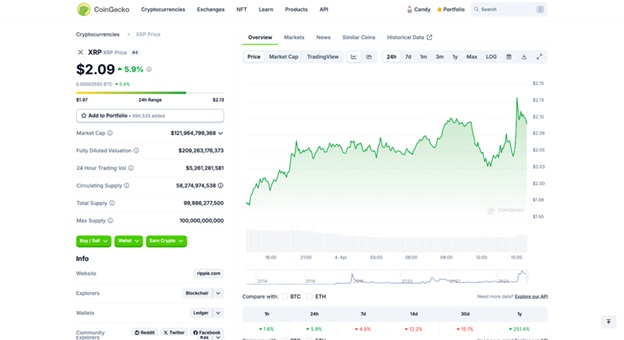
Users who invested in XRP maintain their sights set on a bigger projected rate. Crypto analyst, X Remi Relief X foresees that XRP will soar to $10,000 despite all adversities. Although Ripple price today is currently trading significantly below this projected value some believers remain steadfast in their belief that XRP holds great potential to impact international financial operations.

source: coingecko.com

Some XRP advocates believe the features of Ripple Payments and expanding ecosystem with Ripple stablecoin will transform XRP into a market force that leads to substantial price appreciation. The advocates of the token claim that global banks implementing decentralized cross-border solutions will create conditions for ripple price today to reach unprecedented heights.

Also, the positive market sentiment towards Ripple v. SEC resolution remains a strong driving force leading to bullish predictions about Ripple price today. The settlement between parties removes a significant legal obstacle in front of ripple price today but it does not immediately guarantee new price highs. While all this happens, angel investor Armando Pantoja actively refutes widespread criticism that XRP is a dead coin.

Why Kaspa & XRP Investors Are Turning to Remittix

The market conditions have been challenging for Kaspa as well as XRP since their inception. People in their respective communities have learned to manage market volatility which enables them to identify projects that demonstrate clear growth potentials. The token’s holders are actively purchasing Remittix (RTX) which has collected $14.3+ million and sold 526 million tokens priced at $0.0734 each.

Remittix attracts buyers through its functional approach. As a target market ready for modernization the project shows promise to streamline international money transfer services where conventional systems maintain high costs and slow efficiency. The implementation of blockchain technology for improving international payment speed and cost allows Remittix to target domination of a trillion-dollar market segment.

Both individual and institutional investors gravitate toward the project due to its defined purpose because they seek the next big investment but KAS and XRP holders use it as a stabilization tool to combat their volatile market value. Many investors want to know if Remittix can replicate the speedy expansion that Kaspa and XRP previously experienced. Remittix demonstrates strong investor confidence through its steady growth of users along with its successful token sale.

Experienced crypto enthusiasts will find in Remittix numerous key attributes they seek in promising business ventures because it delivers a cutting-edge payment solution which addresses actual market needs through operational efficiency.

Seize New Opportunity, Join Remittix

Ripple price today and Kaspa’s current market difficulty make it hard to ignore the path Remittix takes. Remittix (RTX) might activate the following major crypto expansion because it addresses universal worldwide needs and shows practical applications. Fundamental strength recognition by investors in an unstable market could lead to valuable participation roles via early Remittix project investments.

Discover PayFi with Remittix by checking out their presale here:

Website: https://remittix.io/

Socials: https://linktr.ee/remittix

Giveaway: https://gleam.io/FHtn5/250000-remittix-giveaway

Analyst Reveals When XRP Price Will Reach $706 And WallitIQ (WLTQ) Will Rally From $0.042 To $11

0

A jaw-dropping forecast has crypto circles buzzing. One analyst claims the XRP price is on track to hit $706. But that’s not all. The emerging token WallitIQ (WLTQ) is also expected to rocket from just $0.0420 to a staggering $11, signalling a shift in the market.

Bold XRP Forecast: $706 Price Target Explained

Crypto analyst and online personality CryptoSensei shared a tweet outlining a bold forecast for XRP price movement through 2026. The tweet featured a video showing someone tapping a pen on various XRP price levels and mapping out a possible trading strategy.

The XRP price started at $2.40 and dropped to $2.13 three days later with a buy signal. A week after that, the XRP price jumped to $7.60 with a sell cue. Two weeks in, the XRP price dipped to $ 3.40, triggering another buy. Seven months ahead, the XRP price was marked at $29.50 with a buy recommendation once again.

The final XRP price projection extended to 2026, predicting an astounding $705.50 with rich written beside it. Though the amounts were shown in euros, the XRP price path outlined matched the text caption, emphasizing a strategy based on accumulation and timely exits.

WallitIQ (WLTQ): The Underrated Token With $11 In Sight

WallitIQ (WLTQ) is quickly emerging as a frontrunner in the AI token space, drawing the attention of a leading crypto analyst who sees its price climbing from $0.0420 to $11 even as XRP price projections aim for a $706 milestone by 2026.

What sets WallitIQ (WLTQ) apart is its cutting-edge security framework, which establishes new digital asset protection standards. The analyst Is particularly impressed by its use of biometric authentication. This system uses unique physical identifiers like facial recognition and fingerprints, offering a secure and user-friendly alternative to outdated methods like passwords or PINs.

This next-level security boosts investor trust and makes the token highly appealing for long-term holders. Adding to its credibility, WallitIQ (WLTQ) recently passed a SolidProof smart contract audit, reinforcing its commitment to transparency and system integrity. The analyst believes the token is positioned for exponential growth to $11 with these protections in place.

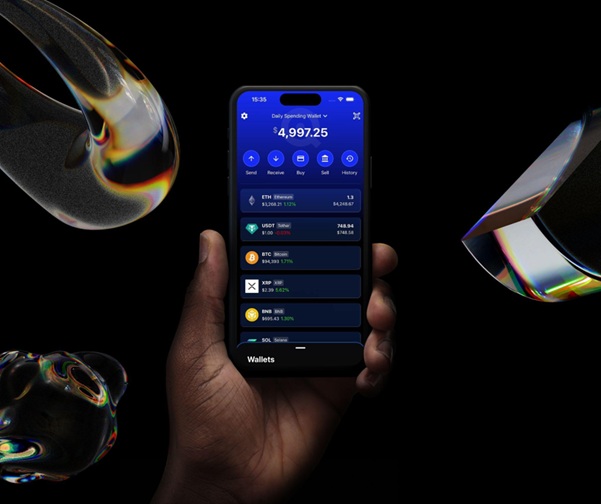
Moreover, WallitIQ (WLTQ) isn’t just about defense; it’s also useful on the user experience front. Its new Crypto Wallet Management Mobile App smoothens operations through QR-powered payments, real-time market insights via CoinGecko, and interactive trading tools. Users also gain access to perks like airdrops, exclusive NFT drops, and VIP features.

With its beta platform gaining traction and early investors seeing promising returns, the analyst predicts WallitIQ (WLTQ) will surge from $0.0420 to $11 soon. As its presale heats up and nears a rapid sell-out, the token is positioning itself as a standout in the evolving AI-crypto landscape.

WallitIQ (WLTQ) Presale Is Live And The Clock Is Ticking

The crypto world is buzzing after a top analyst projected the XRP price could skyrocket to $706 by 2026. However, the spotlight is shifting toward WallitIQ (WLTQ), a rising AI-driven token set to climb from just $0.0420 to $11. WallitIQ (WLTQ) is capturing attention for its growth potential and user-focused features, especially its highly customizable interface.

Users can fully tailor their wallet experience by selecting widgets like live charts, portfolio trackers, and news updates, arranging them however they like. Whether you prefer a sleek dark mode or a vibrant color palette, the wallet adapts to your style and workflow, making it functional and visually appealing.

Beyond looks, WallitIQ (WLTQ) delivers real utility. It offers smooth, low-fee transactions for token swaps, DeFi tools, and smart contract execution, making crypto interaction smooth and cost-efficient. At a presale price of just $0.0420, the analyst believes the AI token is primed for explosive growth.

With the presale nearing full capacity, early adopters still have a limited window to snag a 20% bonus on all purchases. Investors are urged to participate in WallitIQ’s (WLTQ) presale before the opportunity passes.

Join the WallitIQ (WLTQ) presale and community:


Website: https://wallitiq.io/

Whitepaper: https://wallitiq.gitbook.io/wallitiq

Telegram: https://t.me/wallitiqofficial

Twitter/X: https://x.com/wiqnetwork

Instagram: https://www.instagram.com/wallitiqnetwork

S&P 500 Pre-market’s 4% Slide Suggests Potential 5,500 Close —Down 9% in Two Days

0

The S&P 500 dropped 4.9%, marking its worst single day decline since June 2020, as reported by multiple financial outlets like Investopedia and Reuters. This plunge erased nearly $2.4 trillion in market value from S&P 500 companies, triggered by President Trump’s announcement of sweeping tariffs, including a baseline 10% on all U.S. trading partners and a 54% levy on Chinese goods. The Dow fell 1,700 points (4%), and the Nasdaq slid 6%, reflecting a broad market rout driven by fears of a trade war and recession. Reports from CNBC pegged it as the steepest drop since the early pandemic crash, with the VIX fear gauge spiking to 30—indicating high unease, though not outright panic.

Today, April 4, 2025, pre-market futures suggest more pain, with the S&P 500 down over 4% as of 1:11 PM WAT. This follows China’s retaliatory 34% tariff on U.S. goods and mirrors global market tremors—Japan’s Nikkei fell 2.77%, South Korea’s Kospi 0.76%, and Hong Kong’s Hang Seng 1.52%. Investors are reeling from uncertainty over Trump’s “Liberation Day” tariffs, which exceeded Wall Street’s worst-case scenarios. Defensive sectors like consumer staples (e.g., Lamb Weston up 10%) held firm, but tech giants like Apple (-9%) and Nvidia (-7%) got hammered, shedding over $900 billion combined from the “Magnificent Seven” cohort.

The sell-off ties to tariff-driven inflation fears and growth concerns. Goldman Sachs now sees 60% recession odds, per J.P. Morgan’s updated outlook, while markets price in four Fed rate cuts for 2025—up from two—hoping to cushion the blow. Bitcoin’s reversal from $84,600 to $83,000 aligns with this risk-off mood, though its long-term hedge potential lingers. Pre-market signals suggest the S&P 500 might test lower supports—5,300 is Goldman’s three-month target—unless a stabilizing catalyst emerges. Economic data like tomorrow’s jobs report could sway the trajectory, but for now, the markets in freefall mode.

The S&P 500’s 4.9% drop on April 3, 2025—its worst day since June 2020—followed by a pre-market slide of over 4% today, April 4, carries significant implications across the U.S. economy, global markets, and investor behavior.  The trigger—Trump’s 10% tariff on all trading partners and 54% on China, now met with China’s 34% retaliation—threatens a double whammy: inflation and growth stagnation. Higher import costs could push consumer prices up 2-3%, per Morgan Stanley estimates, hitting sectors like retail and manufacturing hardest. Walmart and Target, reliant on Chinese goods, saw pre-market dips of 3-5%, signaling margin pressure.

Meanwhile, export-heavy firms like Boeing or Caterpillar face demand craters in China, a $150 billion market for U.S. goods. Goldman Sachs’ 60% recession odds reflect fears that this trade war redux could tip the U.S. into contraction, especially with GDP growth already softening at 2.1% in Q1 2025 projections. The Fed’s in a bind. Markets now expect four 25-basis-point rate cuts in 2025—double prior forecasts—to offset tariff shocks, but that risks fueling inflation if supply chains don’t adjust. Jobs data due tomorrow could shift this calculus; a weak report might force an emergency cut, though the Fed’s signaled patience so far.

Consumer confidence, already shaky post-election, could nosedive, crimping spending that drives 70% of GDP. The S&P’s plunge isn’t isolated. Asia’s markets—Nikkei (-2.77%), Hang Seng (-1.52%)—and Europe’s STOXX 600 (down 2% pre-market) show contagion as trade war fears spread. China’s stimulus can’t fully offset U.S. tariff pain, and its retaliation might spark a broader tariff spiral with allies like the EU or Canada, fracturing global trade further. Emerging markets, dependent on U.S. demand, face currency pressure; the dollar’s 1% pre-market dip against the yen hints at safe-haven flows, but a prolonged slide could hit import-reliant nations.

Commodities are mixed: Oil (WTI -3% to $68) reflects growth fears, while gold (+1% to $2,700) gains as a hedge. Bitcoin’s $2,000 drop underscores crypto’s risk-asset status, though a prolonged crisis might flip it to a dollar-weakness play. The VIX at 30 signals volatility ahead—options traders on X see it hitting 40 if losses deepen. This rout crushed tech, with $900 billion wiped from the “Magnificent Seven” (Apple, Nvidia, etc.), ending their 2024 dominance. Investors are rotating to defensives—staples like Procter & Gamble (+2%)—and bonds; 10-year Treasury yields fell to 4.1% as cash flows to safety.

Retirement accounts tied to S&P ETFs took a $500 billion hit, per BlackRock data, rattling Main Street. Companies face a strategic mess: reshoring’s too slow to dodge tariffs, and earnings calls next quarter might slash guidance—Bank of America predicts a 10% EPS cut for S&P firms. If tariffs stick, globalization takes another blow, boosting “America First” supply chains but at a cost—JPMorgan estimates a 1% GDP drag by 2026. The S&P testing 5,300 (a 10% drop from its peak) might force a policy rethink or spark a dead-cat bounce if cooler heads prevail.