DD
MM
YYYY

PAGES

DD
MM
YYYY

spot_img

PAGES

Home Blog Page 1494

Finding the Best Real Estate Agents in Nashville, TN

0

Nashville, Tennessee, is one of the most attractive cities in the country for homebuyers and real estate investors. Known for its booming economy, vibrant music scene, and growing job market, Nashville continues to draw people looking for a fresh start or an excellent investment opportunity. If you’re planning to buy or sell a home in this dynamic market, working with a knowledgeable real estate agent is essential.

Why You Need a Real Estate Agent in Nashville

The Nashville real estate market has been growing rapidly over the last decade. With property values increasing and demand at an all-time high, navigating the market on your own can be overwhelming. Whether you’re a first-time homebuyer, a seasoned investor, or looking to sell, partnering with real estate agents in Nashville, TN, can help you make informed decisions and get the best deals.

Professional real estate agents have extensive knowledge of the Nashville market, including neighborhood trends, school districts, and property appreciation rates. Their expertise ensures that buyers find homes that fit their needs while sellers maximize their property’s value.

What to Look for in a Nashville Real Estate Agent

When choosing a real estate agent, there are several key qualities to consider:

1. Experience and Market Knowledge

A great real estate agent will have years of experience in the industry and a deep understanding of Nashville’s housing market. They can provide insights into different neighborhoods, pricing trends, and the best times to buy or sell.

2. Strong Negotiation Skills

Whether you’re buying or selling, an agent’s negotiation skills play a crucial role in securing the best price. A skilled realtor will know how to present strong offers, counter unfavorable terms, and close deals that benefit their clients.

3. Excellent Communication

Real estate transactions require constant communication between buyers, sellers, and multiple other parties. An agent who is responsive, transparent, and proactive will make the entire process much smoother.

4. Proven Track Record

Before hiring an agent, check their past transactions and client reviews. A well-reviewed agent with a history of successful deals is more likely to deliver excellent results.

Exploring the Nashville Real Estate Market

Nashville offers a variety of real estate options, from trendy downtown condos to family-friendly suburban neighborhoods. Areas like East Nashville, Green Hills, and The Gulch are popular among young professionals and creatives, while Brentwood and Franklin provide spacious homes in highly-rated school districts.

With an increasing number of job opportunities in tech, healthcare, and entertainment, Nashville continues to be a desirable place to live and invest. If you’re looking to buy a home, a local agent can help you navigate the competition and find the best properties within your budget.

Where to Find Top Realtors in Tennessee

If you’re searching for highly-rated realtors, there are various resources available to help you connect with the best professionals in the industry. You can check out realtors in Tennessee through online platforms, local agencies, and word-of-mouth referrals. These sources provide reviews, ratings, and detailed profiles of agents to help you find the perfect match for your needs.

Benefits of Working with a Realtor

Hiring a real estate agent offers several advantages:

  • Access to Exclusive Listings – Some properties are not publicly advertised, and a well-connected agent can provide access to exclusive homes.
  • Expert Guidance Through the Process – From paperwork to legal requirements, an agent ensures a smooth transaction.
  • Accurate Market Analysis – A realtor can provide a comparative market analysis (CMA) to determine the best price for a property.
  • Connections to Industry Professionals – Agents often have networks of home inspectors, mortgage brokers, and contractors to help buyers and sellers.

Conclusion

Navigating Nashville’s real estate market can be challenging without the right guidance. Whether you are buying or selling, working with real estate agents in Nashville, TN, will help you achieve your goals more efficiently. If you’re exploring options in the broader Tennessee market, be sure to check out realtors in Tennessee to find professionals who can assist with your real estate journey. With expert advice and strategic planning, you can make the most of the opportunities available in this growing market.


Digital Convenience vs. Cyber Threats: The Hidden Cost of Using Free Download Tools

0

Users no longer have to pay for subscription services to enjoy quality videos and music because there are many free download tools such as YTMP3. These tools provide a smooth and easy way for entertainment, but they come with risks. Most of these applications display multiple ads and could open doors for malware and hacking. Free YouTube to MP3 CC platforms save money on one hand but could potentially damage devices and data. Users must decide between digital security vs convenience and the cyber threats posed by these tools.

Is YTMP3 safe?

The big question users must ask is whether visiting a YTMP3 website is safe. You can access a large library of music and videos by opening the YTMP3 website. However, you cannot be guaranteed about your online safety and fears. The site can become a gate for the entry of phishing, malware, and hacking. The site could expose you to attacks and data threats, but the use of a YTMP3 virus removal kit can help.

The problem with a YTMP3 virus is that it opens loopholes for fake ads and data that affect the entire system. Installing a YTMP3 app provides great convenience, but you must consider the cost. Ask yourself, “Is YTMP3 safe? Will your data, device, and online privacy be secure”? The app lets you enjoy all the free music and videos you desire. However, some ads may contain virus links, and you could receive inconveniencing downloads. You might consider visiting YTMP3 converter safe sites or learn how to remove the YTMP3 virus.

The rising popularity of free YTMP3 website download tools

100% free YTMP3 converter safe tools receive thousands of installations into different services too. People prefer these tools because they have no cost, allowing them to enjoy videos and music without paying. The platforms do not require users to sign up, allowing them to download without creating accounts. Users can access the platforms with one click and gain access to thousands of videos and music.

The problems of using free download tools

Free download tools may look clean and free from hidden threats, but you might not experience the danger until you install them. Users might want to consider security vs convenience before downloading these tools. Here are the dangers that YouTube to MP3 CC tools might cause.

  • Most of these websites use HTTP instead of HTTPS, which results in unsecure connections.
  • The platforms could open holes for malware and viruses, which causes your devices to slow down or behave strangely.
  • The websites display multiple fake buttons leading to malicious websites and scams.
  • Downloaded fake links and apps could be phishing tools that lead to data theft and losses.

Negative experiences that free download tools might cause

Many people lose their entire data due to the installation of free music and video download tools. The data could be locked, deleted, and duplicated until their devices crash. The tools may cause financial losses after hackers use malware to demand ransom or buy unauthorized products with your credit card.

You might download copyrighted content, and rights owners might demand compensation through the courts. Your privacy can be compromised, leading to the exposure of your private messages, images, and videos. Your device could be infected with viruses and fail to work or expose your data further.

Ways to protect yourself from the effects of unsecure downloads

You can continue to enjoy cool music and videos by practicing online safety and avoiding illegal programs. Visit Google Play Store or Apple Store and download a secure digital file download application. Install the latest antivirus software and update your system often.

Install tools for protecting your browsers and do not download files from suspicious websites. Consider subscribing to premium download websites to avoid being bombarded with ads and hundreds of fake click requests.

Why do free download websites allow too many ads?

It is costly to run a website, and developers must create ways to earn money. Providing free download and converting services benefits users but not the website. Due to this, developers allow large pools of online ads so that they can earn money from them.

Hackers often target such websites because they post fake websites, products, and guides to unsuspecting people. The hackers post unethical marketing ads and content. These are the things that make these websites risky, although the free download services they provide are genuine. If you must use the websites, ensure you implement multiple security measures for your protection.

Conclusion

YTMP3 converter and other free download tools are important for accessing and converting music from thousands of libraries. Remember, these tools are not entirely free because developers allow ads to earn money. Allowing many ads helps developers maintain the websites, but this often leads to security breaches. Consider whether you would opt for convenience or allow cyber threats by adopting these websites.

Adopt One Oasis Strategy And Thrive In Your Business

0

According to Tekedia Institute, the One Oasis Strategy is a management framework formulated by Ndubuisi Ekekwe. It focuses on aligning business innovation to favor the best product in the company on utility, value, and cost, which over time helps the firm compete better externally. It’s an inward-looking management system that offers a firm an opportunity to test strategies, models, business systems, and production processes, perfecting them before launching them to outside customers. In essence, with the One Oasis Strategy, a firm refines its process, technology, and product, positioning it for success.

In a Harvard Business Review article, Ndubuisi further explains that the One Oasis Strategy encourages businesses to focus on their strongest product or service as the core driver of value and growth. This “oasis” is the product that generates the most revenue, market share, or brand equity, and other products in the portfolio are then supported and leveraged to enhance the oasis.

Here’s a more detailed breakdown:

1. Identifying the One Oasis:

The goal is to pinpoint the single product or service that is the strongest and most valuable to the business. This could be determined by factors like market share, brand recognition, or profitability. The idea is to concentrate investments around this core product to make it the absolute best it can be. For example, in the case of Amazon, the e-commerce platform is considered the “one oasis”.

2. Accelerating the Oasis:

Once the oasis is identified, the strategy focuses on investing heavily in it to further enhance its strength and dominance. This could involve expanding market reach, improving product features, or strengthening brand recognition. This involves understanding what truly creates value for the customer. Example: For a company selling precision soil sensors, the real value might lie in the farm data generated by the sensors, not just the sensors themselves.

3. Supporting Other Products:

The other products within the business portfolio are then used to support and enhance the “one oasis”. This might involve cross-selling, leveraging the brand equity of the oasis, or using resources and infrastructure to benefit the core product.

4. Monetize the value:

Finally, the strategy involves finding ways to capture the value identified.

This doesn’t necessarily mean monetizing the “one oasis” directly. Example: A logistics company might make more money through invoice financing of the supply chain than from the core transport service itself.

In essence, the strategy emphasizes leveraging existing strengths to drive growth and create new opportunities, rather than spreading resources too thinly across multiple ventures. Adopt One Oasis Strategy and thrive in your business; read my brief here.

Do Environmentalists Still Hate Cryptocurrency?

0

Environmentalists’ views on crypto have evolved, but tensions remain. Many still criticize it due to Bitcoin’s energy-intensive mining—estimates suggest Bitcoin’s network consumes around 200 TWh annually, comparable to some countries’ total energy use. Proof-of-work systems, like Bitcoin’s, drive this, relying on fossil fuels in regions with cheap power. Ethereum’s shift to proof-of-stake in 2022 cut its energy use by over 99%, which some environmentalists see as progress.

However, skepticism persists. Some argue crypto’s overall impact is overstated compared to industries like transportation or manufacturing, while others point to renewable-powered mining operations as mitigation. Yet, for hardline environmentalists, any non-essential energy use is a target, especially when grids are strained or coal plants are kept online for mining. Some users defend crypto’s innovation, others call it an ecological disaster. No universal “hate” exists—it’s more a spectrum of concern tied to specific chains and practices.

Renewable energy in tech is a growing focus, driven by sustainability goals and cost savings. Major players like Google, Microsoft, and Amazon aim for carbon neutrality or 100% renewable energy by 2030 or sooner. Google matched 100% of its electricity use with renewables in 2022, using wind, solar, and hydro via power purchase agreements. Microsoft’s powering data centers with 24/7 clean energy in some regions, targeting negative emissions by 2050. Amazon’s investing in 400+ renewable projects globally, though its total energy mix still includes fossil fuels.

Smaller tech firms and startups are also shifting—many leverage cloud providers with green options. Blockchain tech, like Ethereum post-2022, slashed energy use with proof-of-stake, though Bitcoin mining still guzzles ~200 TWh yearly, increasingly tapping renewables (e.g., hydro in Canada, geothermal in Iceland).  Some praise tech’s green push, others call it greenwashing given ongoing reliance on non-renewable grids.

Challenges remain—intermittency of solar/wind, battery storage costs, and land use for projects. Still, renewables’ share in tech’s energy mix is climbing as costs drop (solar’s down 80% since 2010). It’s not universal—crypto mining in coal-heavy regions lags—but the trend’s clear: tech’s betting big on green to power AI, cloud, and beyond.

Ethereum’s energy shift came with its transition from proof-of-work (PoW) to proof-of-stake (PoS) in September 2022, known as “The Merge.” PoW required miners to solve computational puzzles, consuming vast electricity—estimates pegged Ethereum’s annual use at ~70-80 TWh pre-Merge, rivaling some nations. PoS replaced mining with validators staking ETH to secure the network, slashing energy use by over 99.95%. Post-Merge, Ethereum’s annual consumption is around 0.01 TWh, comparable to a small town.

This shift addressed environmentalist critiques, as Ethereum’s carbon footprint shrank dramatically. Validators now need minimal hardware—a standard computer versus energy-hungry mining rigs—making it feasible to run nodes on renewables or low-power grids. From 2022-2025 show eco-conscious users praising the move, though some argue it’s less decentralized than PoW. Critics also note that Ethereum’s fees (gas) and scalability issues persist, driving traffic to less green chains.

While Ethereum’s greener, its broader impact depends on adoption and whether validators use clean energy. Still, it’s a benchmark for blockchain sustainability, pressuring other networks to follow. Several blockchains have prioritized energy efficiency, following Ethereum’s lead with proof-of-stake (PoS) or other low-energy consensus mechanisms. Solana Uses a hybrid of PoS and Proof-of-History (PoH), enabling high-speed transactions (~65,000 TPS) with minimal energy—around 719 joules per transaction, less than a Google search.

Cardano: Employs Ouroboros PoS, using ~0.55 kWh per transaction, over 1,000 times more efficient than Bitcoin. Focuses on sustainability, with applications in supply chain traceability for eco-friendly goods.

Hedera Hashgraph: Uses a unique Hashgraph consensus, not traditional blockchain, achieving high throughput with low energy (~0.0001 kWh per transaction). Partners with the Crypto Climate Accord for carbon negativity.

Tezos: Runs on PoS with ~0.0001 kWh per transaction. Its self-upgrading protocol reduces overhead, and it’s gained traction for low-impact NFT platforms.

Polkadot: Uses Nominated PoS, enabling interoperability across chains with low energy use. Exact figures are scarce, but its design prioritizes efficiency.

Avalanche: Multi-chain PoS network handling 4,500 TPS, using ~0.0005% of Bitcoin’s energy (0.02 kWh per transaction). Popular for scalable, green DeFi apps. These blockchains leverage PoS or innovative mechanisms to cut energy use drastically compared to proof-of-work systems like Bitcoin. Some, like Solana and Algorand, also pursue carbon neutrality or negativity through offsets. However, energy efficiency varies, and “green” claims can depend on validator energy sources, which aren’t always renewable.

Foreign Brands’ Ad Secrets: Local Brands, Are You Watching?

0

In continuation of our Understanding Digital Integrated Marketing Communication series, this piece examines how foreign and local brands use Facebook, Twitter, and LinkedIn for advertising and promotion. An analysis of over 100 brands reveals a sharp contrast in social media influence between foreign and local players.

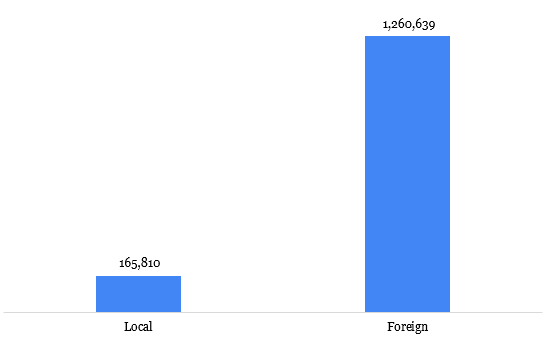
Using follower count as the basis for determining engagement patterns, we found that foreign brands boast an average of 1,260,639 followers, dwarfing the local average of 165,810, a staggering difference of 1,094,829. This average is derived from a cumulative total of over 150 million followers across all the brands. This chasm in digital reach, as indicated in Exhibit 1, suggests a significant advantage for international brands in capturing online attention.

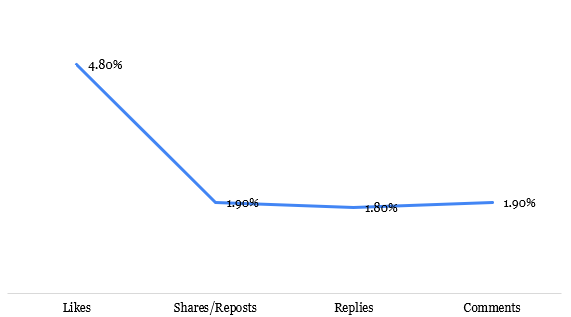
While a substantial follower count may suggest greater potential reach for advertising campaigns, the relationship between followers and engagement is far more complex. Our analysis, visualised in Exhibit 3, aligns with existing research indicating that likes are the most significant form of interaction followers have with brands during digital advertising or promotional periods.

Several factors could be contributing to the observed follower disparity. Ad Spend efficiency is a likely culprit. Foreign brands, with potentially larger marketing budgets, can invest more heavily in social media advertising, directly boosting their visibility and accelerating follower acquisition and by extension, more engagement with ads.  The dominance of foreign brands on platforms like LinkedIn and Twitter also suggests a better alignment with the professional and global nature of these platforms, rather than solely superior content strategies.

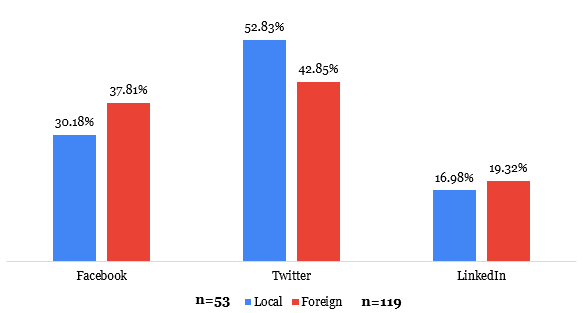
Our analysis further indicates that audience demographics play a crucial role. Younger, urban populations might naturally gravitate towards the personas and messaging styles often adopted by foreign brands, leading to skewed engagement levels. Examining Exhibit 2, which details the frequency of deploying various social media content types, offers further insights into the engagement strategies employed by both groups.

The undeniable power imbalance in social media influence, as clearly illustrated, presents both a significant challenge and a compelling opportunity for local brands. The challenge lies in competing for attention in a digital ecosystem where international players often possess a considerable head start regarding reach and resources. However, this gap also allows local brands to strategically rethink their digital branding approaches and investment priorities to carve out their own competitive space.

Our analysis indicates a critical need for capacity building in digital marketing within the local business landscape. To effectively navigate this evolving digital terrain, local brands must move beyond simply replicating traditional marketing tactics online. They need to cultivate a deeper understanding of platform-specific nuances and audience engagement drivers.

Exhibit 1: Average follower count by brand location

Source: Social media handles of brands, 2025; Infoprations Analysis, 2025

Exhibit 2: Frequency of deploying social media types by brand location

Source: Social media handles of brands, 2025; Infoprations Analysis, 2025

Exhibit 3: Percentage of follower count in engagement pattern

To bridge the digital divide and foster stronger online connections, local brands may need to recognise that each social media platform caters to a unique audience and content format is paramount. Tailoring content and advertising approaches specifically for Facebook, Twitter, and LinkedIn, rather than employing a one-size-fits-all strategy, can significantly enhance engagement and follower growth.

One of the inherent advantages local brands possess is their deep understanding of the local culture, contexts and consumer needs. Crafting compelling narratives that resonate with the local audience, incorporating cultural references, and addressing specific local concerns can foster a stronger sense of connection and loyalty.

Collaborating with local influencers who have established trust and credibility within the target demographic can be a powerful way to expand reach and drive engagement. These partnerships can lend authenticity and relatability that might be harder for foreign brands to replicate.

Building a recognisable and consistent brand identity across all digital touchpoints is crucial for establishing trust and fostering a loyal following. Authenticity in messaging and engagement can help local brands stand out in a crowded digital space.

Infoprations’ Understanding Digital Integrated Marketing Communications Team includes Abdulazeez Sikiru Zikirullah, Moshood Sodiq Opeyemi, and Bello Opeyemi Zakariyha