DD
MM
YYYY

PAGES

DD
MM
YYYY

spot_img

PAGES

Home Blog Page 18

Can Nuclear Fusion Become a Reliable and Affordable Source of Clean Energy?

0

Nuclear fusion has spent decades suspended between scientific triumph and commercial disappointment. Now, however, the technology is experiencing a remarkable investment boom.

Private fusion start-ups are attracting record amounts of capital as investors bet that humanity may finally be approaching a practical source of abundant, low-carbon energy.

The excitement is understandable. The harder question is whether the industry’s commercial timelines can survive contact with the physics and engineering still ahead.

Fusion seeks to reproduce on Earth the reaction that powers stars: light atomic nuclei are forced together under extreme conditions, releasing enormous amounts of energy. Unlike conventional nuclear fission, fusion does not rely on splitting heavy atoms.

Its advocates point to potentially abundant fuel, negligible carbon emissions during operation and the possibility of generating electricity without the intermittency associated with wind and solar power. If commercialized economically, fusion could transform electricity markets, industrial production and the global energy transition.

That possibility has attracted a new generation of companies using different technological approaches. Some are developing tokamak reactors based on magnetic confinement, while others are pursuing stellarators, inertial fusion, magnetized target fusion and other experimental designs.

Their ambitions vary, but the underlying commercial pitch is remarkably similar: decades of publicly funded research have solved enough of the fundamental science for private capital to accelerate the final journey toward a power plant.

Investors appear increasingly willing to believe it. The attraction is not simply environmental. Electricity demand is entering a new era.

Artificial intelligence data centers, electrification, manufacturing, cooling systems and emerging industries are all increasing pressure on power grids. Governments and corporations are simultaneously seeking reliable electricity while attempting to reduce dependence on fossil fuels.

A technology capable of producing large quantities of carbon-free baseload power would therefore have enormous economic value. Yet fusion remains an engineering problem of extraordinary complexity.

Producing a fusion reaction is not the same as producing a commercially viable fusion power plant.

Scientists must sustain extraordinarily hot plasma, control instabilities, develop materials capable of surviving intense neutron bombardment and extract heat efficiently. A reactor must ultimately generate enough usable electricity to cover its own substantial energy requirements while leaving sufficient output for the grid.

This distinction is at the center of the debate over private-sector timelines. Start-ups frequently speak in terms of years or a few decades rather than generations. Such schedules help companies attract investment, employees and political support.

But some scientists argue that these projections underestimate the difficulty of moving from experimental demonstrations to reliable, economical power stations. The disagreement is therefore not necessarily about whether fusion works. It is about how quickly it can become an industrial technology.

That distinction matters for investors and policymakers. A successful laboratory experiment can demonstrate a crucial physical principle without proving that the resulting machine can operate continuously, economically and at commercial scale.

Fusion could succeed while still arriving later and costing considerably more than today’s most optimistic forecasts suggest. There is a danger in treating fusion as a substitute for technologies available today. The prospect of future abundant energy should not become an excuse to postpone investment in existing low-carbon generation, transmission, storage and efficiency.

Still, skepticism should not be confused with dismissal. Private investment is bringing new engineering talent, manufacturing capacity and competitive pressure into a field once dominated by governments and large research institutions.

Even unsuccessful approaches may generate breakthroughs that benefit the wider energy system. The fusion race is therefore best understood as a wager on time. The scientific prize is enormous, but the commercial clock is unforgiving. Investors may be prepared to finance the dream of limitless clean power; physics will determine when, and at what cost, that dream becomes an electricity business.


Wandsworth and the End of Britain’s Low-Tax Experiment

0

Few places embodied the politics of Margaret Thatcher as vividly as Wandsworth. For decades, the south London borough became a showcase for a particular model of Conservative local government:

keep taxes low, restrain spending, run services efficiently and make the state live within tighter financial limits. Wandsworth was frequently presented as evidence that lower taxation could coexist with effective municipal administration.

That experiment is now approaching an extraordinary turning point.

Wandsworth Council has warned that Council Tax may need to rise by £958 for a Band D property, following reforms to local-government funding that the council says will reduce its annual funding by £84 million.

Final Council Tax levels will not be decided until the formal budget process in 2027, but the direction of travel marks a striking departure from the borough’s historic position.  The irony is considerable.

Wandsworth’s political identity was built around the belief that local government could demonstrate the virtues of fiscal restraint. Its exceptionally low Council Tax became almost a political institution in itself.

Even after Labour took control of the council, the administration maintained the tradition: in February 2026, it froze the council’s main element of Council Tax for the fourth consecutive year, preserving Wandsworth’s position as the country’s lowest-taxing council.

What has changed is not simply ideology. It is arithmetic. Wandsworth argues that a new government funding formula disadvantages councils that historically kept Council Tax low.

Under the proposed settlement, the borough says its funding could fall by more than £80 million annually by the end of the three-year period. The council describes this as equivalent to a reduction of about 40 per cent.

The argument exposes a structural problem in Britain’s system of local government. A council can pursue efficiency, maintain reserves and restrain taxation, but its ability to continue doing so depends on the relationship between its own revenues and central-government transfers.

Wandsworth itself says it has some of London’s lowest debt levels and substantial financial reserves. Yet rising costs, growing demand for services and changes to central funding are now putting that model under pressure.

Its September spending review includes tighter procurement, reductions in borrowing, changes to services and the cancellation of some regeneration schemes, while seeking to protect libraries, housing and frontline provision.

That makes the Wandsworth story larger than one council-tax increase. The Thatcherite proposition was that government could become smaller without necessarily becoming weaker. Wandsworth became one of the clearest local demonstrations of that proposition.

But the current dispute asks a different question: what happens when a government rewards councils according to measures of social need rather than historical tax-raising capacity? The government’s rationale is fundamentally about redistribution.

Wandsworth’s leaders see the formula as penalising a borough that has historically kept taxes low. Other councils and policymakers can view the same system as an attempt to address longstanding differences in local-government resources.

Neither interpretation changes the immediate financial pressure. There is also an important political paradox. Wandsworth’s Conservative administration is now arguing against a tax increase while preparing residents for one.

The council says it does not want to impose the increase and is lobbying ministers for a different funding settlement. So the end of Wandsworth’s low-tax era, if it arrives, will not necessarily represent a simple ideological conversion.

It may instead demonstrate the limits of local fiscal exceptionalism in an increasingly centralised funding system. The borough that once made low taxation a political statement is discovering that even the most durable fiscal philosophy eventually meets a balance sheet.

Snap Partners with Nvidia, AWS and Salesforce to Turn $2,195 Specs Into an Enterprise AI Platform

0

Snap is turning to some of the biggest names in artificial intelligence and cloud computing as it tries to push its $2,195 Specs augmented reality glasses beyond consumers and into the workplace, betting that AI agents could finally give AR eyewear a practical business case.

The Snapchat parent is partnering with Nvidia, Amazon Web Services and Salesforce as part of an effort to make Specs useful to businesses, including workers who need access to instructions, information and AI assistance while performing tasks in the field.

Snap CEO Evan Spiegel said the company wants to change how people think about the product, positioning it as a new form of computer rather than another pair of connected glasses.

“We want people to understand that Specs is a computer, not a pair of smart glasses for taking photos,” Spiegel said.

The move is considered smart. Snap’s AR ambitions have so far been easier to demonstrate than to monetize at scale. The latest Specs, unveiled in June, carries a $2,195 price tag, alongside a $200 refundable deposit. While Snap has presented the device as a product for the general public rather than primarily a developer kit, the company’s latest partnerships show that businesses could become an important part of its commercial strategy.

The enterprise market offers a different proposition for expensive AR hardware. A consumer may struggle to justify spending more than $2,000 on glasses that offer incremental convenience. A company, however, could potentially justify the cost if the device reduces downtime, speeds up repairs, or allows technicians to access information without interrupting their work.

Spiegel pointed to field technicians as one example. A worker troubleshooting a piece of equipment could see digital instructions through the glasses while keeping both hands available, communicate with other employees, and potentially use AI agents to identify problems or retrieve relevant information. That is a considerably different proposition from the earlier generation of AR and virtual-reality products, which often struggled to move beyond demonstrations and specialized applications.

Microsoft’s HoloLens and Meta’s Quest devices have shown that immersive computing can work technically, but neither has turned AR or VR hardware into a mainstream computing platform on the scale of smartphones or PCs. Spiegel believes the physical bulk of previous devices was one of the obstacles.

Snap is now trying to combine lighter AR hardware with AI software and enterprise infrastructure, potentially giving Specs a more compelling reason to exist.

Nvidia and Salesforce Give Snap an AI Ecosystem

The partnerships with Nvidia and Salesforce are a big deal because Snap is not attempting to build the entire enterprise AI stack itself.

Spiegel said Nvidia has an open-source extended-reality AI platform on which businesses are already developing applications. Snap wants to make it easier for companies to connect those AI systems with Specs.

“They’ve got an open-source XR AI platform that a number of businesses are already building on top of,” Spiegel said. “The goal with both Salesforce and Nvidia is to make it really easy for businesses to get the benefits of those agentic platforms.”

The reference to agentic platforms is significant. The value proposition of AR glasses changes substantially when AI can do more than display information.

An AI agent could potentially retrieve technical documentation, guide a worker through a repair, summarize information, communicate with enterprise software, or assist with a task based on what the worker is seeing. The glasses then become an interface for an AI system rather than simply a screen mounted in front of the user’s eyes.

AWS adds another piece of the infrastructure. By working with major cloud and enterprise technology companies, Snap can avoid asking businesses to build an entirely new technology stack around Specs before they can deploy it.

For Snap, this is also an attempt to address one of the fundamental problems facing consumer hardware companies: hardware sales alone may not produce a sufficiently large or recurring revenue opportunity. The company has traditionally relied on its consumer platform, particularly Snapchat, but an enterprise business could give Specs a different route to monetization.

Companies can purchase hardware in bulk, pay for software services, and integrate the devices into existing workflows. The challenge is proving that the productivity benefits are large enough to justify the cost.

Snap Wants AI to Make Specs More Than Glasses

Snap is simultaneously expanding the software proposition with Specs Intelligence, an AI assistant that will operate across the AR glasses as well as iPhones and Mac computers.

Spiegel said Snap has not finalized pricing, but the service will include a free tier and “different price points” depending on usage.

The approach suggests Snap does not want Specs Intelligence to be confined to its own hardware. Instead, the company is positioning the AI service as a broader assistant that can follow users across devices, with Specs providing an additional interface when visual information and hands-free interaction are useful.

That could become more important as the technology industry shifts from chatbots toward AI agents capable of taking actions on behalf of users.

But it also raises the stakes for Snap. The company is competing in a market where the largest technology companies have vastly greater AI and cloud resources, while the hardware itself remains expensive.

Snap therefore needs the ecosystem around Specs to do more than demonstrate what AR can do. Nvidia needs to make the AI infrastructure accessible, Salesforce needs to connect enterprise workflows, AWS needs to provide scalable computing infrastructure, and Snap needs to make the glasses useful enough that employees actually want to wear them.

That is a much higher bar than selling an AR novelty.

The company’s timing also comes as the technology industry debates the risks of sophisticated AI systems. Leaders at Anthropic and OpenAI have called for greater caution around frontier AI development, while governments and regulators are considering how to address potential harms.

Spiegel said the concerns are longstanding and argued that policymakers should distinguish between demonstrated risks and hypothetical ones.

“These are concerns that have been raised for a long time,” he said.

“It’s really important that we coordinate an international and thoughtful response. It’s really important that regulators and policymakers consider actual potential harms rather than imagined harms, and so that’s why I think it’s going to be really important for a thoughtful and international group to really get together on this.”

For Snap, however, the more immediate question is if AI can solve the problem that has confronted AR for years: finding a use case compelling enough to move the technology beyond demonstrations and early adopters.

The company’s answer is centered on work rather than entertainment.

If a technician can use Specs to troubleshoot equipment, access instructions, communicate with colleagues, and interact with AI without reaching for a laptop or phone, the $2,195 price becomes easier to evaluate as a business expense rather than a consumer luxury. That is the bet behind Snap’s new partnerships. The company is not simply trying to sell more glasses. It is trying to establish Specs as a new computing interface, with AI agents providing the software layer and Nvidia, AWS, and Salesforce supplying parts of the infrastructure needed to make that vision work.

How to Use a Minecraft Biome Locator Before Building

0

You find a spot that looks pretty good, start thinking about the house, and then realize the biome you wanted is nowhere nearby. Great. Twenty minutes of walking for that.

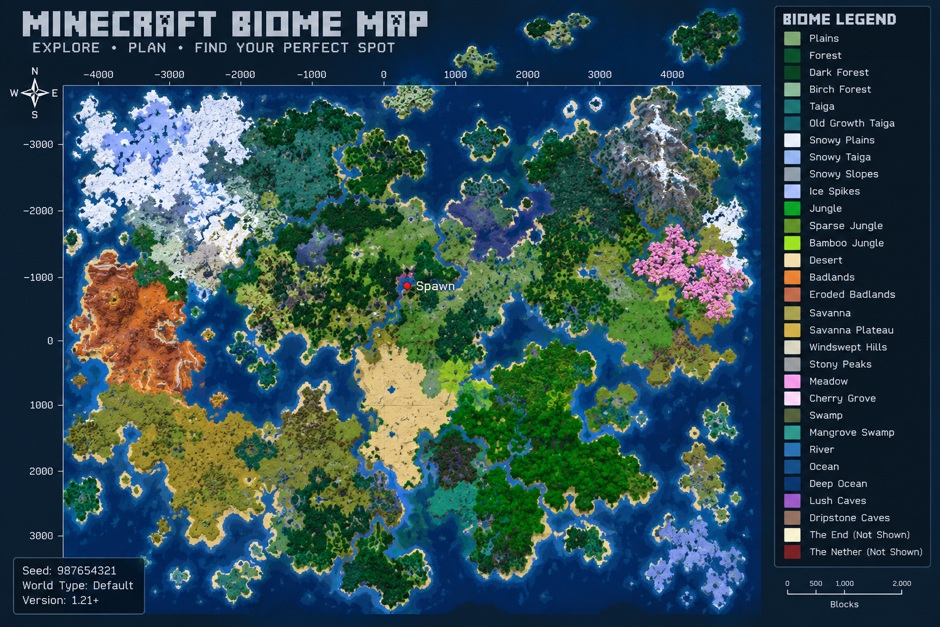
Checking the world first can save some of that wandering. A minecraft biome locator can show you where different biomes sit before you start carrying chests, animals, and half your inventory across the map.

But finding the biome is only the first step. You still need to check what the place looks like in the actual world. 

Decide What You Need From the Biome

Start with the build.

A large medieval town needs very different terrain from a small mountain cabin. For a town, you may want open land, nearby forests, and water. For the cabin, steep terrain and spruce trees might matter more.

The biome can affect what resources are easy to find nearby too. Wood is an obvious example. Building a large wooden base gets annoying pretty quickly when the trees you want are far away.

This is where a minecraft biome map comes in handy. You could just pick a direction and keep walking, sure. Or check the map first and at least know roughly where you’re going. And yeah, look around the biome too, not just at it.

A plains biome next to a forest gives you open building space and easy access to wood. Put the same plains next to a large ocean and you get completely different options.

So don’t search for one biome in isolation.

Check the Seed Before You Start Building

Once you have a seed, take a look at its wider layout.

A seed map minecraft bedrock tool can help you check the world before committing to one location. Look at where the biome sits and what else is close to it.

Say you want to build in a snowy area. Finding snow is easy enough. But what if the nearest useful forest is a long trip away? Or maybe the snowy area is tiny and surrounded by terrain you don’t like.

A seed biome map can make those problems easier to spot early.

Check a few things before choosing the location:

  • How large is the biome?
  • What biomes are next to it?
  • Is there water nearby?
  • Can you reach forests without a long trip?
  • Is there enough room for the planned build?
  • Are there interesting areas nearby for later projects?

You don’t need a perfect answer for every point. You’re just trying to avoid an obvious headache before putting hours into the base.

Don’t Trust the Map More Than the World

Maps help, sure, but they only show so much. A minecraft biome map might get you into the right area. What that place actually looks like? You still need to go see it. It won’t necessarily tell you whether that exact hill, riverbank, or valley feels good once you’re standing there.

chatgpt.com

Load the seed and explore it yourself.

Walk beyond the place where you plan to put the first house. Check the terrain from above if you can. Look for awkward cliffs, deep holes, water, and anything else that could get in the way later.

This matters even more for a large project. A location might have enough room for one house but become cramped once you add farms, storage, paths, and another building.

Tools from Godlike can help with the early search, but the final decision still makes more sense inside Minecraft.

Look a Little Farther Ahead

Your first build probably won’t be your last.

Maybe you start with a house and a farm. Then you add a village. After that, someone decides the hill nearby needs a castle. Suddenly that empty land you ignored matters quite a lot.

Use a minecraft biome locator to find a promising area, then check beyond its borders. A seed biome map is especially handy here because you can see whether other useful biomes are reasonably close.

And don’t worry if the first location isn’t right. That’s the nice part about checking before you build anything serious. You can keep looking without leaving behind hours of work.

A good building spot doesn’t need perfect terrain. It just needs enough space, useful resources nearby, and a landscape you actually want to spend time in.

Irregular Spending Is Still Real Spending

0

Most people do not blow up their budget on coffee, takeout, or a random shopping spree. More often, the damage comes from expenses that feel separate from “normal life.” A car needs new tires. A dog needs a dental cleaning. A cousin gets married in another state. December arrives, as it apparently does every year, and gifts still somehow feel like a surprise.

The Budget Trouble Nobody Sees Coming

That is the quiet trap of irregular spending. It looks optional right up until the moment it is not. If you are building a plan with a spreadsheet, an app, or a mint replacement, the real challenge is not tracking the obvious monthly bills. It is making room for the expenses that are guaranteed to show up eventually, just not on a neat schedule.

A lot of budgets fail because they are designed for a fictional person whose life is perfectly smooth. Real life is lumpy. Real spending comes in waves.

Irregular Does Not Mean Unexpected

One of the biggest mindset shifts in personal finance is learning the difference between surprise and irregularity. A surprise is a tree falling on your roof. Irregularity is your car needing maintenance, your annual insurance premium renewing, or back to school costs landing all at once.

These expenses feel like emergencies mainly because we do not rehearse them mentally every month. Rent gets a category. Electricity gets a category. Groceries get a category. But the yearly vet visit or the holiday travel bill gets treated like a weird exception, even when it has happened three years in a row.

That framing matters. When you call something an emergency, you give yourself permission to raid savings, carry a credit card balance, or shrug and say the month got away from you. When you call it a planned obligation, even if the timing is fuzzy, you start treating it like part of the cost of living.

Your Monthly Budget Is Probably Too Optimistic

A lot of people believe they are doing fine because most months look manageable. The problem is that “most months” is not the same as “the whole year.” If your budget only works in the months when nothing unusual happens, it does not really work.

Think about the categories that tend to hide in the background. Car ownership is a great example. Gas is visible, but maintenance, repairs, registration, tires, and insurance are part of the full picture too. AAA’s annual cost analysis is a useful reminder that driving costs go far beyond fuel alone, and those costs are spread across categories many people forget to build into a plan through the year AAA Your Driving Costs.

The same goes for taxes. Plenty of households think of tax season as a once a year event, but the financial impact can be reduced if withholding is reviewed earlier instead of waiting for a bill or a disappointing refund. The IRS provides tools for adjusting that throughout the year, which is a practical example of treating a periodic money event as something to plan for, not react to IRS Tax Withholding Estimator.

The Better Question Is “How Often Does This Happen?”

Instead of asking whether an expense is monthly, ask how often it tends to occur and what it costs over a full year or two. That one question changes everything.

Maybe your car needs about $1,200 a year in maintenance and repairs on average. Maybe birthdays and holidays add up to $900. Maybe travel to see family usually costs $1,500. Maybe annual subscriptions quietly total $400. Once you name those numbers, they stop being random.

Then the math becomes much kinder. A $1,200 car category is not just a painful repair bill. It is $100 a month. A $900 holiday and gift total is $75 a month. A $1,500 travel pattern is $125 a month. Those monthly amounts may still require tradeoffs, but they are far easier to absorb than one giant hit.

This is the hidden power of sinking funds. They are not fancy. They are just a way of recognizing that the calendar does not care whether your budget is emotionally prepared.

Why This Feels Hard Even When the Math Is Simple

Irregular spending messes with people because it creates a false sense of progress. You get through three calm months and feel ahead. Then one dental procedure, one flight, and one appliance replacement wipe out that margin. Suddenly it feels like you are bad with money, when the real problem is that you were measuring success too narrowly.

There is also a psychological issue here. Monthly bills feel official. Irregular costs feel negotiable. We tell ourselves we will “figure it out later,” partly because later is less annoying than facing the total now. But later usually arrives with less flexibility, worse timing, and more stress.

Treating irregular spending as real spending is less about being strict and more about being honest. It gives your future self fewer unpleasant ambushes.

A More Realistic Way to Budget

If you want a budget that survives actual life, build it around annual reality, not monthly appearances. Start by listing the nonmonthly expenses that showed up in the last year. Not perfect guesses. Actual categories. Home repairs, medical copays, pet care, travel, gifts, school costs, car upkeep, memberships, tax adjustments, and seasonal spending.

Next, total each category across a year or estimate a reasonable average. Divide by 12. That monthly amount becomes part of your regular plan, even if the bill itself does not arrive monthly.

This approach can make your discretionary money look smaller at first. That is not bad news. It is just a clearer picture. You are not poorer than you thought. You are finally counting the whole cost of your life.

The Goal Is Not a Perfect Month

A solid budget is not one that looks clean on the first of the month. It is one that still makes sense when life gets uneven. Irregular expenses are not side quests. They are part of the main story.

Once you stop treating them like interruptions, your finances get steadier. A car repair becomes inconvenient instead of catastrophic. Holiday spending becomes a plan instead of a panic. Annual bills stop feeling like proof that budgeting does not work.

They were always real spending. The win comes when your budget starts admitting it.