DD
MM
YYYY

PAGES

DD
MM
YYYY

spot_img

PAGES

Home Blog Page 2

Visa Stablecoin Platform Brings Innovation to Payments

0

Visa has taken another major step into the digital asset economy with the launch of the Visa Stablecoin Platform, a unified infrastructure designed to help banks, fintech companies, payment providers, and crypto firms issue, manage, transfer, and redeem stablecoins through a single system.

The initiative reflects the growing convergence between traditional finance and blockchain technology, positioning Visa as a key player in the modernization of global payments.

Stablecoins have emerged as one of the fastest-growing segments of the cryptocurrency industry because they combine the speed and efficiency of blockchain transactions with the price stability of fiat currencies.

Unlike cryptocurrencies such as Bitcoin or Ethereum, stablecoins are typically pegged to government-issued currencies like the U.S. dollar, making them suitable for everyday payments, cross-border transfers, and business settlements.

As adoption accelerates, financial institutions are increasingly seeking secure and compliant infrastructure to integrate stablecoins into their operations. Visa’s new platform addresses this need by offering an end-to-end solution that simplifies the entire stablecoin lifecycle.

Rather than building separate systems for issuance, custody, transfers, and redemption, institutions can now access these services through a unified platform. This significantly reduces the technical complexity and operational costs associated with launching stablecoin products while enabling faster deployment.

One of the platform’s most notable features is its ability to allow approved institutions to mint stablecoins directly. Banks and fintech firms can issue digital tokens backed by fiat reserves while maintaining compliance with regulatory requirements.

The platform also includes secure storage capabilities, enabling organizations to safeguard digital assets using enterprise-grade custody solutions. This integrated approach is designed to reduce operational risks while improving efficiency.

The Visa Stablecoin Platform supports instant transfers between participating institutions, making cross-border payments faster and more cost-effective than many traditional banking systems.

International transfers that once required several business days and multiple intermediaries can potentially be completed within minutes on blockchain networks.

This could significantly benefit businesses operating across multiple countries, as well as consumers sending remittances to family members abroad.

Equally important is the platform’s cash-in and cash-out functionality, allowing users to seamlessly convert stablecoins into traditional currencies and vice versa. This bridge between conventional banking and blockchain-based finance removes one of the biggest barriers to mainstream adoption.

The launch aligns with Visa’s broader strategy of expanding beyond traditional card payments into digital asset infrastructure. The company has spent several years experimenting with blockchain technology, collaborating with stablecoin issuers, crypto exchanges, and payment companies.

The new platform represents the next phase of that strategy, transforming Visa from simply supporting crypto-linked payments into providing foundational infrastructure for the digital economy.

The move also comes at a time when governments and regulators worldwide are developing clearer frameworks for stablecoins. As regulatory certainty improves, more financial institutions are expected to explore stablecoin issuance and blockchain-based settlement.

Visa’s established reputation, global network, and compliance expertise could provide confidence for institutions that have been hesitant to enter the digital asset market.

Competition within the stablecoin ecosystem is also intensifying. Payment giants, financial institutions, and blockchain-native companies are all racing to build infrastructure that connects traditional finance with decentralized networks.

Visa’s entry strengthens its competitive position by leveraging its decades of experience in payments while embracing emerging blockchain technologies.

The Visa Stablecoin Platform represents more than just another crypto initiative.

It reflects a broader transformation of the global financial system toward programmable money, real-time settlement, and blockchain-powered commerce. By enabling banks, fintechs, and crypto firms to mint, store, send, and redeem stablecoins through a unified platform.

Visa is helping lay the foundation for a future where digital currencies become a seamless part of everyday financial transactions. As stablecoin adoption continues to expand, platforms like Visa’s could play a central role in shaping the next generation of global payments.


Deadfellaz Unveils The God Pull While Christie’s Hosts Art + Tech Summit

0

The intersection of blockchain technology, digital art, and cultural innovation continues to evolve as major industry players introduce new initiatives aimed at expanding participation and redefining ownership in the digital economy.

Two recent developments highlight this momentum: Deadfellaz co-founder Betty’s announcement of The God Pull, a free-to-mint collectible experience for NFT holders, and Christie’s ninth annual Art + Tech Summit in New York, which brings together leading voices from the worlds of art, technology, and digital assets.

These events demonstrate that the conversation around Web3 has shifted from speculation toward building engaging communities and sustainable creative ecosystems.

Deadfellaz has long been recognized as one of the most influential NFT-native brands, known for its distinctive zombie-inspired artwork and strong emphasis on community engagement.

Co-founder Betty recently announced that The God Pull will launch on July 27 as a free-to-mint experience exclusively designed for holders. Rather than focusing solely on financial incentives, the initiative seeks to restore the excitement and enjoyment of collecting digital assets.

The phrase “make collecting fun again” reflects a broader sentiment within the NFT industry. Following the explosive boom of 2021 and the subsequent market correction, many collectors became increasingly focused on floor prices, trading volumes, and speculative gains.

Projects that once emphasized creativity and storytelling often found themselves overshadowed by market dynamics. By introducing a free-to-mint experience, Deadfellaz appears to be encouraging participants to rediscover the excitement of collecting for its artistic and community value rather than immediate profit.

Free-to-mint models have become increasingly popular because they reduce barriers to entry while allowing communities to grow organically.

Instead of requiring users to pay high mint prices upfront, projects can attract broader participation and reward long-term engagement. If executed successfully, The God Pull could serve as another example of how established NFT brands are experimenting with innovative approaches to maintain relevance in a more mature digital collectibles market.

Christie’s, one of the world’s oldest and most respected auction houses, is hosting its ninth annual Art + Tech Summit in New York. The event brings together artists, collectors, entrepreneurs, investors, and technology leaders for a full day of discussions exploring how emerging technologies are transforming the creative economy.

The summit covers topics ranging from artificial intelligence and blockchain to digital ownership, tokenization, and the future of creative expression. These conversations reflect a growing understanding that technology is no longer simply a tool for artists but an essential component of how art is created, distributed, authenticated, and collected.

Christie’s has played a significant role in legitimizing digital art over recent years, particularly through its support of NFT auctions and blockchain-based artworks.

By continuing to host the Art + Tech Summit, the institution reinforces its commitment to fostering dialogue between traditional art markets and rapidly evolving digital ecosystems. The launch of The God Pull and Christie’s Art + Tech Summit illustrate two complementary sides of the Web3 movement.

One focuses on grassroots community participation through innovative NFT experiences, the other emphasizes institutional engagement and intellectual discussion around the future of digital creativity. Both approaches contribute to a healthier ecosystem where artists, collectors, builders, and cultural institutions can collaborate.

As blockchain technology continues to mature, success will increasingly depend on creating meaningful experiences rather than chasing short-term hype. Whether through community-driven NFT initiatives like The God Pull or influential gatherings such as Christie’s Art + Tech Summit.

The future of digital art appears to be centered on accessibility, creativity, and long-term cultural value rather than speculation alone.

Sam Altman-Backed World Raises $52.5m Through Crypto Token Sale To Expand Digital Identity Network

0

World, the digital identity and online verification project co-founded by OpenAI Chief Executive Sam Altman, has raised $52.5 million through a private sale of its WLD cryptocurrency token, securing fresh capital as it seeks to expand a platform designed to distinguish humans from AI-generated accounts in an increasingly automated internet.

The fundraising was completed through a token sale subject to a 12-month lockup, requiring participating investors to hold the tokens for at least one year before they can be sold or traded.

According to the company, the lockup reflects investors’ long-term commitment to the project’s growth rather than short-term speculation, a notable feature in a cryptocurrency market often characterized by volatile trading.

The proceeds will be directed to the World Foundation, a Cayman Islands-based nonprofit organization responsible for overseeing the development and expansion of the World network.

The financing was led by Pantera Capital, one of the world’s largest venture capital firms focused on blockchain and digital assets. Other participants included Bain Capital Crypto, Susquehanna Crypto, Eightco Holdings and Selini Capital, alongside several additional institutional investors.

The fundraising comes as digital identity is emerging as one of the fastest-growing segments of artificial intelligence infrastructure. The rapid spread of generative AI has made it more difficult to distinguish between human users and AI-powered bots across social media, financial services, online marketplaces and enterprise applications.

That challenge has created growing interest in technologies capable of verifying human identity without requiring users to reveal personal information. World aims to address that problem through what it calls “proof of human” technology, allowing users to demonstrate that they are real people rather than automated systems or AI agents.

The project is operated by San Francisco-based startup Tools for Humanity (TFH), which was founded by Altman and Chief Executive Alex Blania.

Unlike conventional identity verification systems that rely on government-issued documents or usernames and passwords, World has developed a biometric authentication system centered on iris recognition. Users seeking the highest level of verification receive a World ID by scanning their eyes using a device known as the Orb, a metallic spherical scanner that captures an image of the iris and converts it into a unique encrypted cryptographic identifier.

According to the company, the identifier enables users to prove they are human while preserving anonymity, avoiding the need to disclose personal information during authentication.

The Orbs have been deployed at World offices and selected retail partner locations in multiple countries as the company works to expand adoption.

Industry analysts expect demand for digital identity verification to increase significantly as AI agents become more common across online platforms.

Originally launched under the name Worldcoin, the project combined cryptocurrency with biometric identity verification by rewarding users with WLD tokens after completing iris scans. The company later rebranded the broader initiative as World, seeking to emphasize digital identity rather than cryptocurrency following heightened regulatory scrutiny and skepticism surrounding crypto assets after the industry’s downturn.

While WLD remains central to the ecosystem, functioning as both a utility token and digital asset held within World’s mobile application, the company’s strategic focus has increasingly shifted toward identity infrastructure.

The app also functions as a custodial cryptocurrency wallet, allowing users to hold, transfer and trade WLD tokens alongside identity credentials. World has recently sought to broaden its commercial relevance through partnerships with mainstream technology companies.

In April, the company introduced a redesigned application and announced integrations with Tinder, Zoom and DocuSign, aiming to demonstrate practical uses for verified digital identity across online dating, video conferencing and electronic document signing.

Such partnerships indicate that the company is embedding World ID into everyday digital services rather than positioning it solely as a cryptocurrency project. Even so, commercial adoption has progressed more slowly than many investors anticipated.

The Mounting Challenges

Despite its ambitious goal of building a global digital identity network, World has struggled to persuade consumers that biometric verification is necessary for everyday internet use. The project has also faced questions from privacy advocates and regulators in several jurisdictions regarding the collection, storage, and handling of biometric data, although the company maintains that its system is designed to preserve user anonymity through cryptographic techniques.

The challenges have extended to its operations. In June, Tools for Humanity conducted layoffs as part of an effort to streamline the business while continuing to invest in product development and international expansion.

The latest funding provides additional resources as the company attempts to scale its network during a period when artificial intelligence is rapidly changing how people interact online.

The investment also underscores continued institutional interest in digital identity infrastructure, an area many investors believe could become increasingly important as AI-generated content proliferates. Rather than betting solely on cryptocurrency appreciation, investors are now backing platforms that combine blockchain technology with practical applications such as authentication, fraud prevention and identity verification.

However, the central challenge for World remains convincing users and businesses that proof of human identity will become an essential layer of the internet.

Anthropic Launches Cheaper Claude Opus 5 As AI Pricing War Intensifies

0

Anthropic on Friday unveiled Claude Opus 5, its newest flagship artificial intelligence model, positioning it as its strongest balance of performance and affordability as competition among leading AI developers increasingly shifts from raw capability to commercial value and cost efficiency.

The San Francisco-based AI startup said Opus 5 outperforms its previous flagship, Claude Fable 5, across key benchmarks for software engineering, coding and knowledge work while cutting usage costs by 50%. Anthropic also said the model is designed for everyday enterprise workloads rather than niche or experimental applications.

Vendors in the AI industry are now under pressure to justify the enormous investments being poured into model development and AI infrastructure. As enterprises become more selective about AI spending, model providers are competing not only on benchmark performance but also on cost, efficiency, and measurable business outcomes.

Claude Opus 5 will cost $5 per million input tokens and $25 per million output tokens, compared with significantly higher pricing for Fable 5. Anthropic said the lower pricing does not come at the expense of capability, describing Opus 5 as its best-performing and most cost-effective model across multiple industry evaluations.

The company added that while Opus 5 delivers stronger performance in coding and knowledge-intensive tasks, it is not its most capable model for high-risk dual-use applications, such as offensive cybersecurity research. That distinction remains with Claude Mythos 5, Anthropic’s specialized cybersecurity-focused model.

The announcement comes at a time when the economics of artificial intelligence are becoming as important as technical leadership. Companies are deploying AI at scale but are increasingly demanding lower inference costs, predictable pricing and stronger returns on investment after years of heavy infrastructure spending.

“Enterprises, in our feedback and with our customer base, are looking for value,” Dianne Penn, Anthropic’s Head of Product Management for Research, told CNBC.

“If it’s a cheaper model or a cheaper offering, but it’s not accomplishing a similar level of quality, it’s actually not useful.”

The pricing move also underlines the mounting competitive pricing pressure across the AI industry.

Anthropic is competing against OpenAI, Google, Microsoft and Amazon, while Chinese developers including Moonshot AI, Alibaba, Z.ai and MiniMax have introduced capable open-weight models at substantially lower operating costs. Those releases have intensified pricing competition and challenged assumptions that frontier AI models must remain expensive to operate.

The latest model also arrives as investors scrutinize AI companies’ spending more closely. Industry-wide capital expenditures on AI infrastructure continue to surge into the hundreds of billions of dollars, prompting customers to seek models that can deliver comparable performance with lower operating costs.

Anthropic’s strategy suggests the company is attempting to expand beyond customers willing to pay premium prices for frontier capabilities by offering a model that balances performance with commercial practicality.

The release follows a turbulent few months for the company.

In April, Anthropic introduced Claude Mythos Preview, a cybersecurity-focused model that demonstrated advanced vulnerability discovery and exploitation capabilities during controlled testing. Anthropic later launched Mythos 5 alongside Claude Fable 5 in June, describing Fable 5 as its most capable general-purpose model to date.

Shortly after those releases, the U.S. government temporarily suspended access to both models under national security-related export controls before lifting the restrictions roughly two weeks later following discussions between Anthropic and government agencies.

Penn said Anthropic continues to work closely with U.S. authorities during model evaluation and deployment.

According to the company, Opus 5 remains less capable than Mythos 5 in sensitive areas such as offensive cybersecurity and biological research, reflecting Anthropic’s continued separation between its commercial AI offerings and its highest-capability research models.

However, the release of Opus 5 is seen as an indication that leading developers are beginning to emphasize cost efficiency, inference economics, and practical enterprise deployment.

Executive Briefing: The Executive’s Guide to Rapid Upskilling in the Age of AI Disruption

0

There is a shift taking place within the boardrooms and executive suites of organizations across the globe. For decades, the primary focus of senior leaders has been on developing and executing a solid strategic plan. They would spend countless hours poring over data and crafting a three-year plan to achieve the company’s objectives. The majority of their time would be spent putting the plan into action, relying on the input from market data and trends that were relatively predictable.

When technologies first came out, they were “cutting edge.” Six months later, however, they have become table stakes for any company looking to remain competitive. With the pace of technological shift happening at unprecedented rates, many senior leaders are struggling to make key technology buying decisions for their companies when they do not even have a good working knowledge of the technologies that are in play.

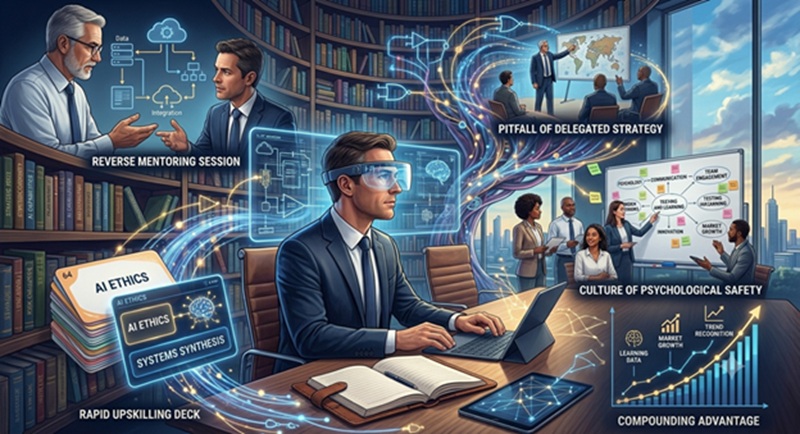
Delegating technical understanding to the technical teams is no longer sufficient for senior leaders to make decisions regarding technologies and practices that have not yet had time to mature and gain widespread adoption. Modern senior leaders must develop their own upskilling practice in order to lead with the necessary clarity and authority in a rapidly changing environment.

The Pitfall of Delegated Strategy

One of the biggest mistakes that a leadership team can make in an environment that is changing fast is treating technical knowledge as if it were a low-level task that can be delegated to someone else. That’s the line of thinking that says the leader of the organization has got to have a high level vision, that the leader of the organization has got to be able to think about the really big strategic issues of the organization, and that the technical details of how things work, the technical details of how new tools work, that those are things that can be left to the specialists.

Delegating certain tasks to technical specialists is necessary for organizations to scale, but it is not wise for senior leaders to remain completely detached from the technical realities of the tasks that are being delegated. The senior leader must understand enough about the new tools and processes to evaluate the risks involved in their adoption, to recognize opportunities to increase the operational efficiency of the organization, and to avoid investing large sums of capital in solutions that are likely to become outdated before they have a chance to pay back their cost.

Moreover, when leaders lack the necessary knowledge, their teams quickly recognize the discrepancy and begin to doubt the leader’s ability to provide relevant and effective guidance. Because the leader is not able to provide reliable insights into the operational aspects of the work, guidance will lack substance and become irrelevant.

Upskilling as an executive is not necessarily to learn to code or to build software. Its primary function is to help the executive understand the capabilities and limitations of technology and how it can be integrated into business processes to gain a competitive advantage.

Building a System for High Velocity Learning

The biggest obstacle executives face when upskilling is time. When your calendar is packed with back-to-back meetings, deep study sessions feel like an impossible luxury.

To make rapid learning work, you must build high-efficiency habits into your existing routine. The goal is to maximize knowledge absorption while minimizing time friction.

First, focus on structural synthesis. Instead of trying to read entire technical books or lengthy whitepapers, leverage modern processing workflows. Converting dense technical reports, industry updates, or a complex PDF to flashcards allows you to break down overwhelming documents into bite-sized review decks. This enables active recall during tiny pockets of downtime, like waiting for a flight or traveling between meetings.

Second, leverage internal expertise as a learning resource. Schedule brief reverse mentoring sessions with senior engineers or product specialists within your own organization. Ask them to explain key concepts, current bottlenecks, and emerging tools in plain language.

Third, test your understanding through direct application. Explain a new concept back to someone else, or use it to re-evaluate a current business process. Active recall and immediate application accelerate retention far faster than passive reading.

Cultivating Psychological Safety and Learning Agility

Rapid upskilling requires embracing being a beginner again. This is hard for many Senior Executives as they have spent years building the knowledge and expertise to become a Subject Matter Expert, and want to continue to command a room. They fear appearing to not know the answer, especially when others in the room are unlikely to know the answer either.

Showing an organization that learning is a process for everyone during a time of disruption and uncertainty leads to a culture where, when a CEO shows that he or she doesn’t have all the answers, that allows for psychological safety for others to do the same. This leads to a culture and organization that learns together and, thus, adapts together.

Creating a culture of psychological safety at work means your employees will feel safe experimenting, trying new things, and learning from their mistakes. This is very important in an era of change and for companies that want to adapt quickly to the market.

The Compounding Advantage of Strategic Curiosity

Executives who successfully navigate through disruption are not necessarily the most technically savvy. More importantly, they are people with strategic curiosity who continue to learn and absorb as many new concepts as possible.

Whether the new technological changes have occurred within your industry or outside of it, consistently finding the time to upskill will open your eyes to new concepts and make your strategic intuition sharper. Not only will you start to recognize trends early enough to prepare your business for the changes to occur before they hit your market, but also be able to more critically evaluate vendor proposals to find the best solution to add value to your organization on a sustainable basis.

Finally, upskilling as an executive is not a short-term campaign, but rather a discipline that must be practiced on an ongoing basis to enable a business to become resilient, relevant and ready for the future.