DD
MM
YYYY

PAGES

DD
MM
YYYY

spot_img

PAGES

Home Blog Page 212

Amazon Web Services to Invest $5bn in South Korea as AI Boom Spurs Global Infrastructure Race

0

Amazon Web Services (AWS) will invest at least $5 billion in South Korea by 2031 to build new artificial intelligence data centers, the South Korean presidential office announced on Wednesday.

The investment marks the escalating global race among major technology companies to build the infrastructure needed to sustain the next wave of AI development.

The announcement came during a meeting between AWS Chief Executive Officer Matt Garman and South Korean President Lee Jae Myung on the sidelines of the Asia-Pacific Economic Cooperation (APEC) summit in Gyeongju. President Lee said the investment will help “accelerate the growth of an ecosystem for the AI industry in South Korea,” reaffirming the government’s ambition to transform the country into one of the world’s top three AI powers.

Garman said the project forms part of AWS’s broader global expansion plan, which includes $40 billion in additional investments across 14 non-U.S. APEC countries by 2028.

“That $40 billion actually drives an additional $45 billion in U.S. GDP and downstream benefit, benefiting all of the APEC economy,” Garman said during a business event on the sidelines of the summit.

AWS plans to construct the new data centers on the outskirts of Seoul. Once completed, the facilities are expected to bolster South Korea’s AI infrastructure, providing data-processing capabilities for domestic tech startups and multinational corporations alike. The investment will also support Seoul’s national strategy to become a regional leader in cloud computing and advanced digital services.

The move follows AWS’s $4 billion investment announced in June to collaborate with South Korea’s SK Group in building the country’s largest data center in Ulsan. It also mirrors a global pattern among major tech firms racing to secure the computing infrastructure essential for AI model training and deployment.

The acceleration of artificial intelligence has pushed companies such as Amazon, Microsoft, Google, and OpenAI to rapidly expand data center construction both inside and outside the United States. The surge in demand for AI computing power has also transformed data center development into one of the most capital-intensive sectors of the global technology industry.

In India, AWS announced a $12.7 billion investment earlier this year to expand its cloud infrastructure by 2030, with major data hubs planned in Telangana and Maharashtra. Microsoft has likewise committed to expanding its Indian data centers in Hyderabad, while Google has accelerated its own AI-focused expansion in the country to serve its growing base of enterprise customers.

Beyond Asia, AWS has announced multi-billion-dollar data center projects in Australia, Japan, and Singapore, all aimed at supporting local AI research and enterprise adoption. In Japan, the company is investing $15 billion to expand its cloud footprint through 2027, while in Australia, it plans to inject over $9 billion to build facilities powering AI, cybersecurity, and energy-efficient computing.

The global rush reflects a new phase in the AI infrastructure arms race, driven by unprecedented demand for high-performance chips, cloud storage, and energy-efficient data processing. With AI models like ChatGPT and Gemini requiring enormous computational capacity, hyperscalers such as AWS and Microsoft Azure are positioning themselves as the backbone of the emerging AI economy.

South Korea, with its powerful semiconductor industry and growing AI ecosystem, has become a focal point in this race. Earlier this month, the country’s presidential office confirmed that OpenAI plans to establish joint ventures with Samsung and SK Group to build two data centers—dubbed a “Korean-style Stargate”—with an initial 20-megawatt capacity. OpenAI has also signed initial chip-supply deals with Samsung Electronics and SK Hynix.

Taken together, the recent commitments from AWS and OpenAI highlight South Korea’s emergence as a key node in the global AI infrastructure network. The wave of foreign investment marks not just a technological milestone for Seoul, but a strategic moment in its ambition to redefine its global economic identity—shifting from a manufacturing powerhouse to a digital innovation hub at the forefront of the AI revolution.
Flutterwave Taps Polygon Labs to Unlock Real-Time Stablecoin Payments Across Africa

0

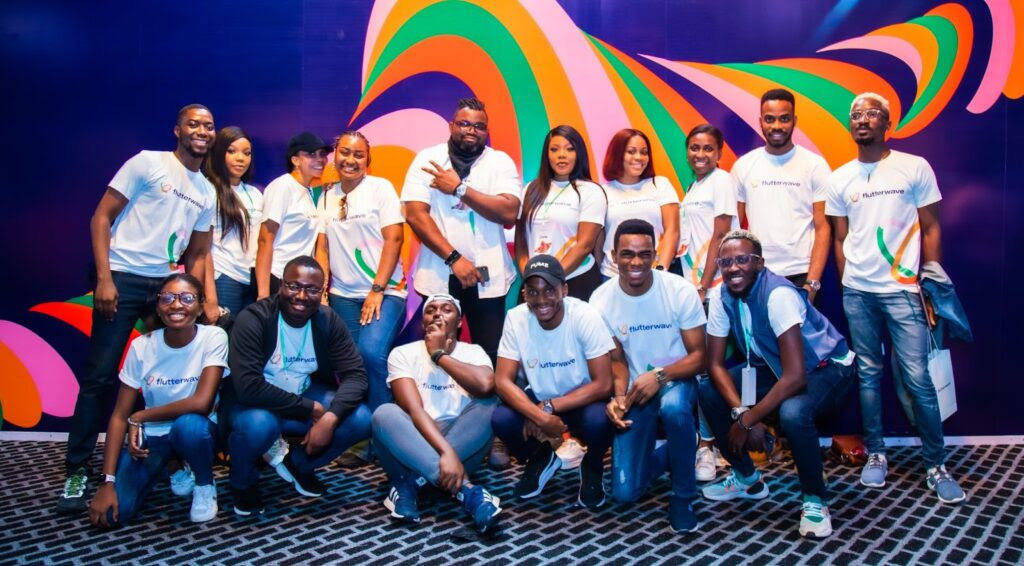
Flutterwave, Africa’s leading payments technology company, has announced a major collaboration with Polygon Labs as the default blockchain network for its new border payments product.

The partnership marks a significant step in Flutterwave’s long-standing mission to make cross-border payments faster, cheaper, and borderless, and as well connect Africa to the world, and the world back to Africa.

Since its inception, Flutterwave has focused on simplifying payments across Africa, enabling businesses and individuals to send and receive money seamlessly across borders. With its new integration on Polygon’s blockchain architecture, the company is taking that mission to the next level by enabling the transfer of stablecoins such as USDC and USDT across its network.

This innovation is designed to address one of Africa’s biggest financial challenges—slow, expensive, and inefficient cross-border transactions. Millions of Africans move money daily to send money back home, or expand their businesses, but many still face delays, high fees, and outdated settlement systems.

Flutterwave’s move aims to eliminate these barriers and make real-time, low-cost transactions possible across borders. The recent partnership with Polygon, comes as the blockchain network cements its position as the go-to stack powering global payments, moving billions in assets, instantly.

Recent milestones include:

  • Processing half of all USDC transfers in the $100–$1,000 range.
  • Powering BlackRock’s BUIDL Fund tokenization through Securitize, which now exceeds $1 billion AUM.
  • Supporting mainstream applications like Polymarket, which has surpassed $1.1 billion in volume and recently received a $2 billion investment from ICE.

Faster Settlements for Enterprises

Large enterprises and International Money Transfer Operators (IMTOs) have long struggled with settlement delays, often waiting two to three business days for transactions to clear. Through Flutterwave’s integration with Polygon, that wait is reduced to Instant real-time settlement. The result is improved liquidity, capital efficiency, and the ability for global organizations to scale into African markets without running into legacy payment bottlenecks.

Empowering Small and Medium Businesses (SMBs)

Thousands of African SMBs already rely on Flutterwave to receive payments. However, many face friction when paying international suppliers, dealing with long delays, intermediary banks, and the complexities of the SWIFT network.

With the new stablecoin payment rail, SMBs can receive global payments instantly, pay international suppliers without delays, and improve inventory turnover and supply chain efficiency. This means faster growth cycles, better cash flow, and greater access to global markets, giving African SMBs the modern financial infrastructure they deserve.

Stablecoins: The Next Financial Infrastructure for Emerging Markets

In the evolving landscape of global finance, Stablecoins stands out as a transformative force for emerging markets. Once seen merely as digital representations of the U.S. dollar, the digital assets are rapidly emerging as the next layer of financial infrastructure for economies long underserved by traditional banking systems.

For decades, emerging markets have struggled with fragmented payment systems, currency instability, and limited access to global liquidity. Cross-border payments remain slow, opaque, and expensive — often taking days to clear and costing up to 10% in fees.

Stablecoins are changing that equation. Built on blockchain rails, they enable instant, low-cost, borderless transactions, making it possible for individuals and businesses in Africa, Latin America, and Southeast Asia to send and receive money as easily as sending a text message.

Whether it’s USDC, USDT, or newer regional stablecoins, these digital assets are creating a parallel payment infrastructure — one that operates beyond the constraints of legacy systems.

Building Africa’s Financial Infrastructure for the Future

Flutterwave’s collaboration with Polygon Labs goes beyond technology integration, it represents a bold infrastructural leap tailored to Africa’s unique scale and complexity.

As Africa’s most-licensed non-bank financial institution, Flutterwave operates across more than 34 countries, providing compliant, secure, and reliable payment solutions. By leveraging stablecoins, Flutterwave is positioning itself at the forefront of next-generation payments infrastructure—one that bridges traditional finance with the decentralized future.

Stablecoins, once considered experimental, are now proving essential to Africa’s growing digital economy. Together, Flutterwave and Polygon are bringing this innovation to life, creating a payments ecosystem that works for everyone—from global enterprises to small businesses and everyday users.

The pilot phase of the Flutterwave–Polygon collaboration is scheduled to launch in 2025, focusing on select enterprise clients. The first rollout focuses on enterprise clients and multinationals like Uber and Audiomack, enabling them to move money faster and more efficiently across borders.

Subsequent phases will bring the same speed and affordability to millions of individuals using Flutterwave’s Send App, driving down remittance costs and increasing accessibility. A full rollout will follow in 2026, expanding access to businesses using Flutterwave for Business and consumers via the Send App across Africa and beyond.

Looking ahead

With this move, Flutterwave continues to bridge the gap between traditional finance and the emerging global payments economy. The company remains committed to empowering businesses, creators, and individuals, fueling Africa’s growth in the digital age. As Flutterwave puts it, this is only the beginning of a new era of borderless, instant, and inclusive financial connectivity for Africa.

BNB & ATOM Prices Dip, While BlockDAG’s $435M+ Presale Explodes After Coinbase-Kraken Listing Leak!

0

Market sentiment appears fragile as the Cosmos (ATOM) price forecast signals deep uncertainty, with indicators pointing strongly toward bearish movement. Similarly, the Binance Coin (BNB) price drop, though moderate, highlights the ongoing short-term volatility gripping digital assets. With these top names showing instability, many are wondering where to turn for the best crypto to buy in 2025.

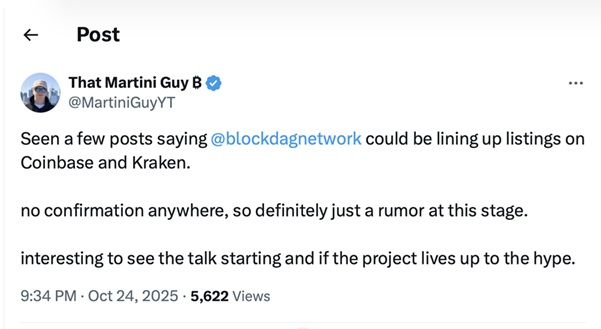
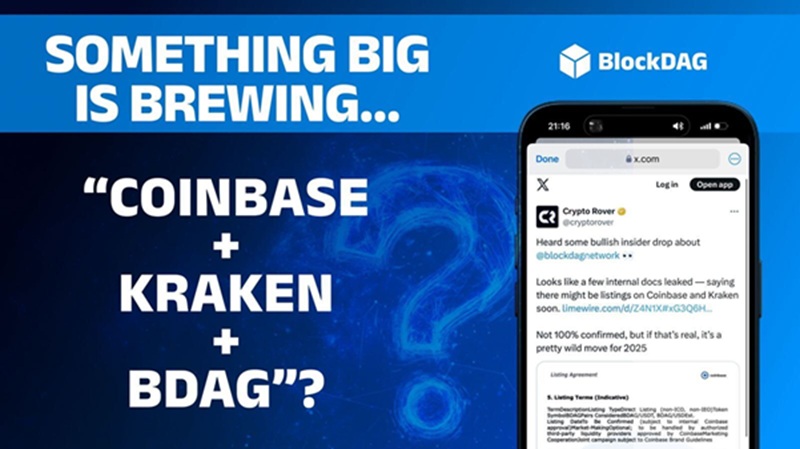
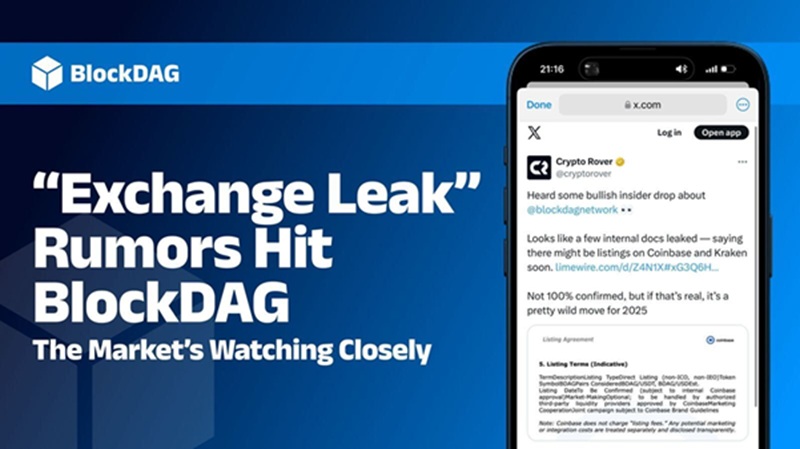
Forget the noise, a major leak has taken center stage. Sources, including AltcoinGordon, revealed that BlockDAG (BDAG) is preparing for high-profile listings on Coinbase and Kraken. Reportedly, internal documents mention BDAG/USDT trading pairs for Coinbase and a signed agreement with Kraken involving $300,000 for marketing and another $200,000 in USDT for liquidity support.

BlockDAG Exchange Leaks Fuel Massive Presale Growth

New reports from AltcoinGordon indicate that BlockDAG is moving closer to Tier-1 exchange listings. Leaked materials circulating online show specific details about Coinbase and Kraken partnerships. This revelation comes as BlockDAG’s presale continues to impress, raising over $435 million in funding. BlockDAG is now in Batch 32, priced at $0.005, with its official listing set for February 10, 2026.

With only 4.5 billion coins left in the presale, this marks the final stretch before BlockDAG’s highly anticipated market debut. Many notable crypto influencers, including Crypto Rover, have hinted that major developments are unfolding behind the scenes.

According to the alleged documents, Coinbase’s memorandum outlines BDAG/USDT and BDAG/USD pairs labeled as “Pairs Considered,” along with marketing collaboration and compliance checks.

Meanwhile, the Kraken agreement reportedly solidifies the deal, detailing $300,000 for technical integration, $300,000 for promotions, and a $300,000 liquidity deposit. These developments strengthen claims that BlockDAG is among the best cryptos to buy in 2025. For traders searching for the best crypto to buy in 2025, this leak points to BlockDAG’s presale window as a potential game-changer while it remains open.

Cosmos (ATOM) Price Forecast: Struggling to Recover

Cosmos has recently faced mounting pressure. The coin took a heavy hit in the recent $20B market pullback, with prices ranging between $3.18 and $3.29. Current data reflects roughly 91% bearish sentiment, coupled with a fear index score of 30, showing a lack of confidence among market participants. Technical charts continue to display strong resistance levels across major moving averages, leaving ATOM nearly 93% below its all-time high.

However, the Cosmos network remains active despite price weakness. Developers have introduced a new real-world assets (RWA) protocol, and USDC transfers now operate natively across platforms such as dYdX and Injective. These integrations improve interoperability and add utility to the ecosystem. Still, the Cosmos (ATOM) price forecast for late 2025 remains divided, with analysts suggesting possible lows near $3.09 or rebounds reaching $5.87, making ATOM’s future uncertain in the near term.

Binance Coin (BNB) Price Drop: Temporary Setback or Trend Reversal?

BNB continues to exhibit a pattern of sharp surges and quick pullbacks, recently peaking around 100,074 INR before dipping to 96,850 INR. Though the Binance Coin (BNB) price drop might alarm some, the medium-term analysis indicates the asset is still trading within an ascending channel. Analysts see the dip as normal volatility rather than a lasting decline.

The October 25 correction, where BNB dropped slightly before rebounding, reinforced the idea of resilience. Technical support remains strong near $690, while resistance lies around $1,300. Market experts view this as a healthy consolidation period that may precede another upward breakout. For now, the movement seems to represent typical market adjustments rather than sustained weakness.

In a Nutshell

While Cosmos faces heavy selling pressure and Binance Coin displays minor corrections, the true momentum could be shifting toward BlockDAG. The leaked details regarding Coinbase and Kraken collaborations hint at significant progress behind closed doors.

Reportedly, Kraken’s parent company, Payward Inc., has allocated $300,000 for marketing and another $300,000 for liquidity, a clear signal of intent. If accurate, these moves position BlockDAG as the best crypto to buy in 2025, particularly as its presale approaches completion with prices expected to rise in upcoming batches.

Presale: https://purchase.blockdag.network

Website: https://blockdag.network

Telegram: https://t.me/blockDAGnetworkOfficial

Discord: https://discord.gg/Q7BxghMVyu


BNB Tests Resistance & PENGU Eyes Breakout While BlockDAG’s Exchange Leaks Push Presale Past $435M

0

The past 24 hours have been eventful across major crypto assets, with traders closely watching Binance Coin (BNB) as it wrestles with resistance and Pudgy Penguins (PENGU) showing renewed strength after a technical recovery. Yet, amid these familiar names, a different project has taken center stage in analytical circles: BlockDAG.

Attention has sharply turned to a relatively under-the-radar project: BlockDAG (BDAG). Speculation around its centralized exchange (CEX) listings intensified significantly after a major document leak, which led to headlines like, “BlockDAG’s CEX Rumor Just Went Nuclear, AltcoinGordon’s Tweet Sparks FOMO Avalanche!” This development positions BlockDAG as a serious contender in the market.

Supported by verified internal documents, what was once mere conjecture has now solidified into a credible Tier-1 exchange launch story, demanding immediate attention from traders and analysts alike.

BlockDAG Tier-1 Launch Validated

Market speculation surrounding BlockDAG’s exchange listings has shifted from mere conjecture to near-confirmation, thanks to newly leaked internal documents. These reports indicate that the project’s team has undertaken a high level of preparation with Tier-1 exchanges, including Kraken and Coinbase, signaling an imminent and highly structured rollout. According to documentation from Kraken (Payward Inc.), BlockDAG transferred $300,000 in USDT to support technical integration and initial liquidity. The agreement also includes a 30-day liquidity lock-up, emphasizing institutional-grade preparation rather than typical presale hype.

Meanwhile, a separate Listing Framework Agreement with Coinbase outlines proposed trading pairs (BDAG/USDT and BDAG/USD) and coordinated marketing initiatives. While the Coinbase agreement remains indicative, it demonstrates the project’s strategic approach to securing visibility and liquidity on major exchanges.

BlockDAG’s presale metrics further highlight its strong performance: $435M+ raised. BlockDAG is now in Batch 32, priced at $0.005, with its official listing set for February 10, 2026. With only 4.5 billion coins left in the presale, this marks the final stretch before BlockDAG’s highly anticipated market debut. With a confirmed mainnet launch target of $0.05, the potential upside for early participants remains significant.

Combining verified exchange plans, deep liquidity preparation, and a growing community, BlockDAG presents one of the most compelling crypto opportunities available today, appealing to both analysts and institutional traders seeking structured, high-potential projects.

BNB Price Prediction: Strength Meets Resistance

Binance Coin (BNB) continues to display strong technical resilience, but its next phase will depend on whether bulls can clear a significant resistance ceiling. After a 16% daily surge, BNB reached $1,370 before retracing to $1,173. The move reflected renewed confidence within Binance’s ecosystem, supported by increased staking flows and on-chain activity.

However, major resistance between $1,350 and $1,400 remains the critical barrier. A double-top pattern has begun to emerge, and negative funding rates suggest that some traders are turning defensive. Should BNB sustain support near $1,192 and $1,048, its mid-term trend remains constructive, but losing those zones could shift the price outlook sharply.

In summary, the BNB price prediction remains cautiously optimistic, but traders appear to be seeking diversification toward alternative opportunities, particularly those with verifiable exchange pipelines like BlockDAG.

Pudgy Penguins Price Update, Mainstream Appeal

The Pudgy Penguins (PENGU) price update indicates that the token is entering a technical inflection point. Currently priced around $0.02, PENGU has built strong support near the base of a falling wedge pattern, a formation often preceding breakout moves.

Whale accumulation has been evident on-chain, suggesting strategic positioning ahead of a possible rally. Analysts now watch resistance between $0.024 and $0.027, with a confirmed breakout potentially triggering a 30% gain toward the $0.027 target.

Beyond technicals, PENGU’s mainstream crossover remains its biggest strength. The project’s partnerships, including collaborations with DreamWorks’ Kung Fu Panda and Walmart’s retail collectibles, demonstrate its branding success beyond crypto circles. With speculation about a Spot PENGU ETF and the launch of the Pudgy Party mobile game, PENGU is expanding from meme roots to real-world consumer reach.

Bottom Line: Fundamentals Now Outweigh Speculation

As the broader crypto market balances recovery with caution, BNB and PENGU continue to offer valuable short-term trading setups. Yet the emergence of BlockDAG changes the analytical landscape. The confirmed Kraken and Coinbase integrations, multi-million-dollar liquidity preparation, and measurable network growth shift it from rumor to reality.

For traders and traders comparing established assets to new entrants, BlockDAG provides a data-backed case for inclusion among the top crypto to buy right now. Its strategic approach to liquidity, community scalability, and verified exchange readiness reflects an evolution in how modern blockchain projects reach maturity. In a market still defined by speculation, BlockDAG stands as a case study in deliberate execution and perhaps the next catalyst for market-wide recalibration.

Presale: https://purchase.blockdag.network

Website: https://blockdag.network

Telegram: https://t.me/blockDAGnetworkOfficial

Discord: https://discord.gg/Q7BxghMVyu

Crypto Market Hit by $825M Liquidation Wave Amid 2% Cap Decline

0

The cryptocurrency market is experiencing significant turbulence today, October 30, 2025, with total liquidations surpassing $825 million in the past 24 hours—primarily driven by long positions—as the overall market capitalization slips roughly 1.6-2% to around $3.8 trillion.

This aligns closely with reports of a “sell-the-news” reaction following the Federal Reserve’s recent 25-basis-point rate cut, where Chair Jerome Powell hinted it could be the last of 2025, dampening risk appetite despite initial optimism.  Total Liquidated: $825.4 million, affecting over 163,000 traders 79%+ from long positions.

Bitcoin (BTC) Dominates Losses: $310.3 million in BTC long liquidations alone, with BTC dipping ~1.6% to ~$111,000. Ethereum (ETH) and Altcoins follow: ETH saw notable shorts, while altcoins like Solana (SOL) and XRP dropped sharply up to 10-15% intraday, contributing to broader cascades.

Market Cap Impact: Down ~1.6% from recent highs, now hovering below $3.8T—fueled by excessive leverage, post-Fed uncertainty, and waning momentum around new ETF launches (e.g., Solana and Litecoin ETFs).

This event echoes the massive $19B liquidation crash earlier in October, triggered by U.S.-China tariff threats, which wiped out $500B+ in market value and marked the largest single-day wipeout in crypto history.

Today’s dip, while smaller, highlights ongoing fragility: over $28B liquidated across the month, with much of that capital unlikely to rotate back soon. Powell’s comments signaled a cautious Fed path, leading to profit-taking in risk assets like crypto.

High-leverage longs up to 100x on some platforms amplified the downside, creating forced selling loops. Despite ETF hype, retail FOMO post-FOMC turned to fear, with whales shorting aggressively (e.g., $59M in Hyperliquid bets).

Lingering effects from the mid-October crash have reduced short-term risk tolerance, per Kraken economists. BTC could test $105K if momentum sours; ETH eyes $3,800.

Options markets are pricing in more swings—hedging demand is surging. Upcoming U.S. elections or positive trade news could spark a rebound, but expect choppiness.

Solana (SOL) ETFs in late October 2025 mark a pivotal milestone for the ecosystem, building on the Bitcoin and Ethereum ETF successes by unlocking institutional capital and mainstream accessibility.

While the immediate price reaction has been muted—contributing to the broader crypto market’s 2% dip and $825M liquidation wave—the long-term outlook is strongly bullish, with projections for $3B+ in inflows and SOL price targets exceeding $300.

This “sell-the-news” dynamic echoes Ethereum’s ETF launch in 2024, where initial profit-taking gave way to sustained rallies.

Despite hype, SOL dipped 2-3.6% post-launch from ~$200 highs to $191, aligning with the overall market’s risk-off tilt from Fed signals and U.S.-China tensions. This erased early gains, with open interest in SOL perpetuals down 7% weekly due to profit-taking.

Whales accumulated stealthily pre-approval, but funding rates turned negative, signaling caution. Analysts estimate $3-6B in Year 1 for Solana ETFs alone 5% of BTC’s, 22% of ETH’s market cap scaling, with JPMorgan at $1.5B.

Staking ETFs like BSOL 82% staked via Helius Labs offer 7% yields, locking 5-10% more SOL supply and boosting network TVL currently $5B. Daily chart shows a golden cross; RSI oversold at 29.4. Support at $180-191; resistance at $210-220.

Broader Market Ripple: 92 crypto ETFs queued; approvals fast-tracked altcoins like XRP/HBAR. Solana’s commodity status SEC nod via Western Union stablecoin tie-up enhances legitimacy, potentially driving Q4 altcoin rally.

ETFs position Solana as a “revenue powerhouse” with yield-bearing exposure—unlike BTC/ETH products—appealing to allocation committees. Pre-launch, $4.1B sat in SOL ETPs; Hong Kong’s ETF adds global momentum.

Overall, the Solana ETF is a net positive, fueling long-term growth despite near-term chop. It’s not rocket fuel yet, but as one analyst noted, “staking changes everything for allocation committees.” With Bitcoin testing $105K support, a relief bounce could ignite SOL’s next leg up.