DD
MM
YYYY

PAGES

DD
MM
YYYY

spot_img

PAGES

Home Blog Page 221

Myriad Prediction Markets Goes Live on BNB, As 1X Launches the NEO Home Robot

0

Myriad, a next-generation prediction markets protocol, officially launched on BNB Chain, expanding its multichain presence after previous integrations on Abstract and Linea.

This move aims to tap into BNB’s vibrant ecosystem, potentially reaching over 200 million users, with a strong focus on Asia through upcoming Mandarin-language support and localized experiences.

Automated Markets: A new feature enabling fast-paced, continuous 5-minute price action markets with auto-resolution and short settlement cycles, designed for simplicity and high liquidity without lengthy waits.

Full support for EVM wallet sign-ins, native bridging between chains, and leaderboard activity that incorporates BNB Chain volume for rewarding top performers. Incoming BNB-specific markets for ecosystem tokens, communities, and events, further boosting engagement.

Myriad’s co-founder and COO, Ilan Hazan, emphasized the user-centric vision: “This expansion represents both sides of what we’re building: deep technical flexibility and a global, user-first vision.”

The protocol is now live http://myriad.markets/bnb where users can immediately access these features. This deployment underscores the growing maturity of prediction markets in crypto, making them more accessible and dynamic for global traders.

Myriad taps BNB’s 200M+ users especially Asia with 5-min markets ? high-volume, retail-friendly betting on crypto, sports, events. Auto-resolution + short cycles attract scalpers; BNB’s low fees amplify ROI vs. Ethereum. Native bridging + token-specific markets deepen BNB DeFi moat.

1X Launches the NEO Home Robot

1X Technologies, a Palo Alto-based AI and robotics firm, opened pre-orders for NEO, hailed as the world’s first consumer-ready humanoid robot tailored for household use.

NEO is engineered to automate mundane chores and provide personalized assistance, turning sci-fi concepts into practical home helpers. At just 66 pounds, it’s lightweight and safe for family environments, with deliveries starting in the U.S. in 2026 and expanding globally by 2027.

Core features of NEO

Chores Automation handles tasks like folding laundry, organizing shelves, tidying spaces, emptying dishwashers, and serving drinks. Users can schedule chores via app or voice commands, or request real-time execution.

Learning and Assistance: Built-in AI for task learning; for unfamiliar jobs, an “Expert Mode” connects a 1X specialist via VR to guide NEO remotely, accelerating its adaptation. Bio-inspired with tendon-driven motors for gentle movements, soft 3D-polymer body pinch-proof, 22 degrees of freedom in hands for human-like dexterity, and integrated Wi-Fi, Bluetooth, 5G for indoor/outdoor use.

Household Labor Shift: $20K humanoid automates chores ? early premium adopters free 5–10 hrs/week; subscription model tests “robot-as-service.”

AI-Robotics Milestone: Expert Mode + on-device learning accelerate real-world training data; 2026 deliveries pressure Tesla Optimus timeline.

Market Signal: $300B+ humanoid sector now has a priced, pre-orderable product ? VC and supply-chain race intensifies.

It features emotive “ear rings” for status indicators and doubles as a Bluetooth speaker. Battery life supports up to 4 hours, with auto-docking for charging. Pricing at $20,000 outright purchase with $200 deposit for pre-order or $499/month subscription 6-month minimum.

CEO Bernt Børnich described the milestone: “Humanoids were long a thing of sci-fi… today—with the launch of NEO—humanoid robots become a product.” Pre-orders are available at 1x.tech/neo, positioning NEO as a competitor to emerging rivals like Tesla’s Optimus in the $300 billion+ humanoid market.

This launch marks a pivotal shift toward consumer robotics, addressing labor shortages by creating “abundant physical labor” in homes, though early adopters should note its evolving autonomy.
OpenAI Unveils New Reasoning Models that Can Be Used Across Sites to Tackle Online Safety Harms

0

OpenAI on Wednesday announced two new artificial intelligence reasoning models — gpt-oss-safeguard-120b and gpt-oss-safeguard-20b — designed to help developers detect and classify online safety harms on their platforms.

The models, introduced as open-weight systems, mark one of OpenAI’s most significant steps yet in improving transparency and safety across digital ecosystems increasingly shaped by generative AI.

According to the company, the models are fine-tuned versions of its gpt-oss family, first announced in August. Their numerical names reflect their size, with the 120-billion and 20-billion parameter variants offering different levels of computational power and precision. Both are built to enable developers to implement custom moderation frameworks or adapt the models to specific content policies.

Unlike open-source systems, where the full code is available for public modification, open-weight models make only their trained parameters accessible. This approach, OpenAI said, allows developers to study and deploy the systems while maintaining integrity over their design and operation.

These models can be configured to reflect an organization’s unique policy needs, because they are reasoning models that show their work, developers can gain clearer insight into how an output was produced — and why.

Practical Applications Across Platforms

The company illustrated several possible use cases for the new safeguard models. A product review site, for instance, could use them to automatically detect fake or manipulated reviews, improving the credibility of its listings. Likewise, a video game forum could deploy the models to classify or flag posts discussing cheating or game exploits.

The models are designed to reason through nuanced policy definitions rather than rely solely on keyword matching or predefined rule sets — a capability that could make moderation more context-aware and less error-prone.

The models were co-developed with Robust Open Online Safety Tools (ROOST), an organization that builds open frameworks for digital safety research. OpenAI said the collaboration with ROOST reflects its renewed focus on making AI safety tools accessible to the broader community, not just to major corporations or regulators.

ROOST was joined in testing by partners including Discord and SafetyKit, both of which provided feedback during the models’ pilot phase. The models are currently being released in research preview, and OpenAI said it will gather insights from safety experts and academic researchers before expanding access.

“As AI becomes more powerful, safety tools and fundamental safety research must evolve just as fast — and they must be accessible to everyone,” said Camille François, President of ROOST.

In tandem with the model release, ROOST is launching a model community for researchers and practitioners who work on using AI to secure online spaces. The group will focus on sharing best practices, developing open benchmarks, and identifying weaknesses in emerging AI systems.

The rollout of the safeguard models comes amid heightened scrutiny of OpenAI’s commercial growth and safety posture. The company, now valued at $500 billion, has faced criticism from some members of the research community who argue that it has expanded too rapidly without fully addressing ethical or security risks tied to powerful AI systems.

OpenAI is thus signaling a willingness to prioritize transparency and invite external oversight by making these safety models open-weight — a move analysts see as an attempt to rebuild trust among regulators and researchers.

OpenAI’s flagship product, ChatGPT, has become the most widely used AI chatbot globally, with more than 800 million weekly active users. The company’s scale has made its safety architecture a focal point of debate among policymakers and technology ethicists alike.

A New Chapter After Recapitalization

The announcement also follows OpenAI’s completion of a recapitalization process on Tuesday, which officially cemented its structure as a nonprofit-controlled organization with a majority stake in its for-profit arm.

The company, originally founded as a nonprofit research lab in 2015, has since transformed into the most valuable U.S. startup, driven largely by the success of ChatGPT and enterprise adoption of its GPT models.

OpenAI confirmed that eligible researchers and developers can download the model weights on Hugging Face, a leading AI repository and collaboration platform. The research preview phase will focus on gathering feedback from the online safety community, particularly around model interpretability, bias detection, and effectiveness across different languages and cultural contexts.

With the new safeguard models, OpenAI is effectively extending its AI portfolio into the domain of digital safety infrastructure, an area increasingly seen as critical to the responsible use of artificial intelligence.

IBM Launches “Digital Asset Haven” Platform

0

IBM officially announced the launch of IBM Digital Asset Haven. This new platform is designed to provide secure, scalable infrastructure for managing digital assets like cryptocurrencies, stablecoins, and tokenized assets, specifically tailored for highly regulated entities such as banks, governments, and large enterprises.

It’s a timely move amid surging institutional interest in blockchain, with crypto market activity rebounding and tokenized assets gaining traction in traditional finance.

IBM Digital Asset Haven acts as a “full-stack” operational backbone, integrating custody, transactions, settlement, and compliance tools into a single platform.

Multi-Chain Support; Operates across 40+ public and private blockchains like Ethereum, Bitcoin, Solana. Enables seamless asset management without siloed systems, reducing fragmentation.

Secure Custody and Wallets; Combines IBM’s hardware-level security via IBM Z mainframes with programmable wallets, multi-party approvals, and cold storage options. Meets bank-grade standards for sovereignty, encryption, and access controls, minimizing risks like hacks.

Built-in AML/KYC, policy-driven workflows, and regulatory reporting aligned with global standards (e.g., ISO 20022). Helps institutions avoid penalties while scaling from pilots to production.

Lifecycle Management; Automates routing, monitoring, settlement, and integration with third-party services via DeFi yields, payments. Streamlines operations from asset storage to real-time transactions, supporting tokenized RWAs and stablecoins.

Deployment Flexibility; SaaS/Hybrid SaaS available now; on-premises in Q2 2026. Allows customization for cloud, on-prem, or hybrid setups to fit enterprise needs. The platform was developed in partnership with Dfns, a Coinbase-backed digital wallet provider, leveraging Dfns’ custody tech with IBM’s renowned reliability in mission-critical systems.

As Tom McPherson, GM of IBM Z and LinuxONE, stated: “With IBM Digital Asset Haven, our clients have the opportunity to enter and expand into the digital asset space backed by IBM’s level of security and reliability.”

This launch comes as institutions ramp up crypto involvement. Banks are eyeing tokenized assets and stablecoins for efficiency in payments and capital markets, with platforms like this addressing integration barriers.

It positions IBM against rivals like Oracle’s Blockchain Platform, Microsoft’s Azure Web3, and Amazon’s Managed Blockchain, especially after recent AWS outages highlighted reliability needs.

Broader trends aligns with moves like Citi-Coinbase partnerships for digital payments and France’s proposed 420K BTC strategic reserve.

Analysts noted it as IBM’s “most ambitious crypto infrastructure push for U.S. businesses and governments.” This could accelerate mainstream crypto use—thoughts on how it might impact tokenized real-world assets?

IBM-Dfns Partnership: This collaboration combines IBM’s enterprise-grade security and infrastructure expertise with Dfns’ specialized custody and wallet management capabilities to create a full-stack solution for regulated entities handling digital assets like cryptocurrencies, stablecoins, and tokenized real-world assets (RWAs).

The partnership aims to bridge traditional finance with blockchain, enabling seamless operations from pilot projects to production-scale deployment. The partnership builds on an existing relationship between IBM and Dfns, including a prior integration of Dfns’ wallet technology with IBM’s Hyper Protect Virtual Servers for hardware-backed security in institutional wallets.

Announced alongside the platform launch, it was formalized to address the growing institutional demand for compliant, scalable digital asset tools amid surging crypto activity with Bitcoin surpassing $115,000 and stablecoin supply exceeding $300 billion.

Dfns specializes in wallet-as-a-service (WaaS) solutions and has created over 15 million wallets for more than 250 clients, including fintechs and enterprises. It raised $16 million in a Series A round in January 2025, led by Further Ventures, emphasizing compliance-heavy environments.

IBM, with over a decade in blockchain via Hyperledger, sought Dfns’ expertise to handle the “last mile” of digital asset operations—custody and programmable wallets—while layering on its mainframe reliability.

This integration was highlighted in Dfns’ recent announcement of OSO support, directly tying into the platform’s cold storage features. Lowers barriers to entry by providing a single, integration-ready platform that evolves tokenized assets from experiments to core services.

It supports scalability for high-throughput sectors like finance and healthcare while navigating global regulations. Positions IBM against competitors like AWS via Cronos partnership and aligns with trends like Ripple’s Absa Bank custody deal in Africa.

Clarisse Hagège, CEO of Dfns: “For digital assets to be integrated into core banking and capital markets systems, the underlying infrastructure must meet the same standards as traditional financial rails. Together with IBM, we’ve built a platform that goes beyond custody to orchestrate the full digital asset ecosystem, paving the way for digital assets to move from pilot programs to production at a global scale.”

Nigerian Lawmakers Advance Bill to Establish Fintech Regulatory Commission

0

The House of Representatives has taken a significant step toward strengthening Nigeria’s financial technology ecosystem, as lawmakers passed the Bill for an Act to Establish the Nigerian Fintech Regulatory Commission through its second reading during Tuesday’s plenary session.

Sponsored by Hon. Fuad Kayode Laguda, member representing Surulere I Federal Constituency, the proposed legislation seeks to create a comprehensive regulatory framework for the nation’s rapidly expanding fintech sector. The bill’s primary objective is to establish a Regulatory Commission responsible for licensing, supervising, and regulating fintech companies and their business activities across Nigeria.

The bill establishes two main categories of operating permission: individual licences and class licences. The Commission will maintain registers of every licence issued, suspended, revoked, surrendered, or amended. Also, it will have a governing board consisting of a chairman, a Director-General, executive and non-executive commissioners, and other members appointed by the President, subject to confirmation by the National Assembly.

Notably, it will have offices in all geopolitical zones and develop its own staff structure, conditions of service, and administrative systems. Funding will be through appropriations by the National Assembly and other sources, such as fees, charges, fines, and gifts.

Some Nigerians have expressed skepticism about the proposed Fintech Regulatory Commission Bill, questioning the need to establish a new agency. They argue that the creation of another regulatory body could lead to duplication of roles and bureaucratic inefficiency, given that the Central Bank of Nigeria (CBN) already oversees many aspects of the fintech industry.

One concerned user on X, remarked that lawmakers seem “too eager to create new agencies instead of strengthening existing ones,” adding that the CBN has been “doing a commendable job regulating fintech operations.” This sentiment reflects a broader concern among stakeholders that the bill, rather than streamlining regulation, might complicate Nigeria’s fintech regulatory landscape with overlapping mandates and increased administrative costs.

Currently, Nigeria lacks a single, unified regulatory body overseeing the practices and operations of fintech operators and service providers, despite their growing role in national development and digital transformation. The country’s fintech space is regulated by multiple agencies, such as the Central Bank of Nigeria (CBN), the Securities and Exchange Commission (SEC), and NITDA each overseeing specific aspects.

According to the bill’s sponsor, the establishment of the commission will foster public trust and industry growth by enhancing consumer protection, improving financial stability, encouraging innovation, increasing competition, and promoting collaboration among stakeholders. The creation of a central Fintech Regulatory Commission would unify oversight, reducing regulatory overlap, confusion, and compliance burdens for fintech operators.

The fintech industry has been instrumental in reaching unbanked and underbanked populations. With stronger regulation, the Commission can coordinate efforts between fintechs, banks, and regulators to deepen financial inclusion initiatives, especially in rural and underserved areas.

With more fintech products entering the market, incidents of fraud, misuse of personal data, and service failures have become growing concerns. The Commission would likely introduce standards for transparency, dispute resolution, and data privacy, protecting consumers from unethical practices and improving trust in digital financial services

By working alongside existing institutions such as the CBN, SEC, and NCC, the Commission could facilitate inter-agency coordination to create a more coherent and forward-looking regulatory ecosystem that reflects Nigeria’s growing digital economy

The bill has been referred to the House Committees on Banking Regulations, Digital & Electronic Banking, Science & Technology, and Communications for further legislative consideration and refinement.

Top 3 Breakout Tokens to Watch Before the Bull Run Peaks

0

Crypto bull markets don’t just reward those who buy strong assets—they reward those who identify breakout tokens before the peak hits. As momentum builds heading into the next explosive phase, smart investors are watching key assets that combine strong narratives, technical strength, and early-stage potential.

Pepe, Ethereum, and Ozak AI are three tokens currently drawing significant attention from both retail traders and whales. Each comes from a different segment of the market—meme coins, mounted potential, and early-level innovation—but all present the potential to supply breakout gains earlier than the bull run peaks.

Pepe

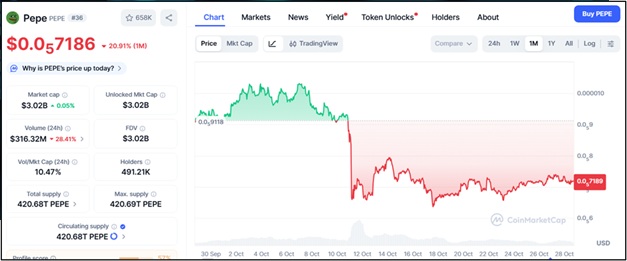
Pepe has been step by step hiking, presently trading around $0.000007186. Key resistance levels sit at $0.000007950, $0.000008600, and $0.000009500, while robust assist holds at $0.000006500, $0.000005800, and $0.000005200.

Pepe has speedily grown to be one of the most dominant meme coins available on the market, with an energetic network and high liquidity. Its simple, viral nature makes it a magnet for retail traders looking for rapid-transferring possibilities. As meme narratives warm up in the later tiers of bull cycles, Pepe is properly positioned to ride the retail wave and doubtlessly deliver big short-term profits.

Ethereum (ETH)

Ethereum remains one of the strongest large-cap properties in the market, trading close to $4,100. Resistance tiers are positioned at $4,450, $4,780, and $5,000, while support lies at $3,950, $3,720, and $3,500. Ethereum’s dominance in DeFi, NFTs, and Layer-2 solutions gives it both fundamental energy and long-term growth capability.

Institutional demand continues to grow, and as capital rotates from Bitcoin to top altcoins, ETH is often the first to benefit. Many analysts expect Ethereum to set new all-time highs before the bull run peaks, making it a core asset for both conservative and aggressive investors.

Ozak AI Emerges as a High-Upside Project

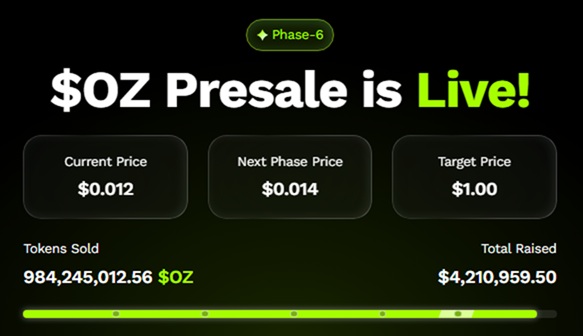
While Pepe and Ethereum bring strong narratives from opposite ends of the market, Ozak AI is turning heads as an early-stage project with explosive upside potential. Currently in its 6th OZ presale stage at $0.012, Ozak AI has raised over $4.2 million and sold more than 980 million tokens—a sign of growing investor confidence.

Unlike meme tokens, Ozak AI’s foundation lies in its AI-powered prediction agents that deliver real-time trading signals, intelligent market insights, and automation tools. This combination of AI and blockchain is one of the most powerful narratives heading into the next bull run.

A key reason Ozak AI stands out is its strategic partnerships with Perceptron Network, HIVE, and SINT. These collaborations enhance its technological capabilities, predictive accuracy, and integration into broader blockchain ecosystems. For whales and early investors, this isn’t just another presale hype—it’s a project with utility, vision, and momentum.

Pepe, Ethereum, and Ozak AI: Three Projects, One Goal—Breakout Gains

As the bull run accelerates, Pepe could ride the meme coin wave, Ethereum may solidify its blue-chip dominance, and Ozak AI could become the standout early-stage rocket.

Together, these three tokens cover retail frenzy, institutional trust, and innovation—all key narratives that tend to thrive before a cycle peaks. Investors positioning early in breakout assets like these could be the ones who capture some of the largest returns before the next market top.

About Ozak AI

Ozak AI is a blockchain-based crypto project that offers a technology platform that specializes in predictive AI and advanced facts analytics for financial markets. Through machine learning algorithms and decentralized community technology, Ozak AI enables real-time, accurate, and actionable insights to help crypto enthusiasts and businesses make the precise decisions.


For more, visit:

Website: https://ozak.ai/

Telegram: https://t.me/OzakAGI

Twitter: https://x.com/ozakagi