DD
MM
YYYY

PAGES

DD
MM
YYYY

spot_img

PAGES

Home Blog Page 2267

Crypto Experts Set Targets for ADA, XRP, and DTX This Year, Here’s What to Expect

0

Following a general market recovery, XRP and ADA have regained some of their losses and are on track to reclaim critical support levels. Market participants believe these top altcoins are set to deliver massive gains despite broader market struggles if the broader market sentiments shift. Cardano’s price could reach $2 soon, whereas XRP’s could hit $8.70.

As XRP and ADA prices battle market uncertainty, the DTX Exchange presale steams up, with analysts highlighting it could deliver $10 post-listing. The project has over 500K holders on board and over $13.40 million raised, all thanks to its hybrid trading protocol that combines crypto innovation with real-world financial tools. This approach has fueled its fast rise, as analysts view it as one of the cryptos to watch in 2025. Let’s uncover why these three cryptos are stealing the spotlight in the market.

ADA Price Could Soar $2 in 2025

Cardano (ADA) has significantly rebounded and is poised for substantial upside momentum. The driver behind the bullish momentum is the growing interest from whales, long-term holders, and investors. The Cardano token could be on track to break its $1 psychological level. On the daily chart time frame, Cardano price has formed a bullish engulfing candle following a consolidation period.

This signaled renewed buying pressure. Additionally, the Bollinger Bands indicate that the ADA coin has bounced off from the lower band, highlighting a mean reversion move toward the midline near $1. Its upper band is around $1.11, aligning with the next resistance zone, suggesting this is the next key short-term target. The MACD and VWAP have reinforced the bullish outlook. A decisive close above the $1 level would set the stage for a rally toward the $1.20 level.

Based on the Elliot Wave pattern, Cardano’s price could rally around 110% to $2 if the next bull wave comes through. Its rising chances of spot ADA ETFs and on-chain metrics have underscored investors’ optimism. Moreover, recent upgrades like the Plomin hard fork could see ADA prices move further. However, the broader market uncertainty has faltered ADA price performance, forcing investors to diversify.

Can XRP’s Market Capitalization Reach $500 Billion?

Ripple experienced a sharp decline below the $2.00 psychological level, sparking $103 million in futures liquidations on Feb.3. Following a broader market recovery, XRP price is set to reclaim the $3.00 psychological level. A close above this level could trigger a move to tackle its seven-year high resistance of $3.40. However, the XRP coin faces a descending trendline resistance, extending from Jan 16.

If the altcoin clears this resistance alongside the $3.40 level, the token could soar to a new all-time high above $3.55. Its relative strength index and Stochastic Oscillator (Stoch) point upward, with the latter crossing above the neutral level. This suggests a rising bullish momentum. Peter Brandt recently shared that the price of XRP formed a bullish flag pattern on its chart, predicting that if the pattern completes within six weeks, XRP’s market capitalization could jump to $500 billion.

This ambitious XRP price prediction would mark a massive rally from its current valuation of around $150 billion, potentially pushing the price of XRP to around $8.70. Meanwhile, Amonyx, a crypto analyst, has also shared an optimistic prediction, suggesting that the altcoin has not yet started its breakout rally and that there is a real chance it could reach $20 in 2025. Market participants continue to watch key levels to determine its next big move.

 DTX Exchange (DTX) Could Jump To $10 Post Listing

While ADA and XRP battle market uncertainty, DTX Exchange aims to revolutionize decentralized finance (DeFi) as we know it. It has merged the speed of blockchain technology with the reliability of traditional finance, creating a hybrid platform that enables users to trade more than 120,000 financial instruments, including crypto, stocks, NFTs, and tokenized ETFs, all under one roof. Traders will not need to switch between apps, as DTX has aggregated global markets into a seamless interface.

The VulcanX layer-1 blockchain will power the ecosystem, clocking 200,000 transactions per second (TPS) during testnet trials. Additionally, it has minimized gas fees and slashed latency. Even more interesting is that the 1000x leverage feature will open up institutional-grade tools for retail traders, enabling them to maximize their gains. But the perks don’t stop there; its AI-powered trading bots will allow traders to scan markets 24/7, auto-compound gains, execute strategies, and maximize their profits with modest investments.

The project has also prioritized transparency. Crypto assets are stored in noncustodial wallets as its decentralized structure eliminates single points of failure. DTX token is a game changer. Holders can enjoy discounts and share the platform’s trading revenue and governance rights. With more than $13.40 million raised in its presale and potential listing on top-tier exchanges, demand is skyrocketing. So far, DTX is selling for $0.16 in the final phase of its presale (up from $0.02 in stage 1). Experts say DTX exchange could be on track towards a $10 post listing.

DTX Exchange Attracts ADA and XRP Investors

XRP and ADA price struggles have sparked speculation about their potential rally. Some are optimistic that ADA and XRP could push toward $2 and $20, respectively. At the same time, DTX Exchange could transform traditional finance. It offers stability through innovation, combining crypto agility with traditional finance tools. With strong market demand and growing adoption, DTX Exchange could skyrocket to $10 post listing.

Find out more information about DTX Exchange (DTX) by visiting the links below:

Buy Presale

Visit DTX Website

Join The DTX Community


FUET and the Ogoni Struggle: A University Built on Justice and Hope

0

For decades, the Ogoni people have carried the weight of environmental degradation, economic marginalization, and political neglect. Their struggle, led by the Movement for the Survival of the Ogoni People (MOSOP) and encapsulated in the Ogoni Bill of Rights (OBR), has been a relentless call for justice. When President Bola Tinubu signed the bill establishing the Federal University of Environment and Technology (FUET) in Tai, Ogoniland, it was more than just an administrative act. It represents a significant symbol in the land, revealing one of the successes of decades of struggle.

A Legacy of Struggle and the Dawn of a New Era

For years, the people of Ogoniland have lived with the consequences of oil exploration—polluted waters, barren farmlands, and deteriorating health conditions. The cries for justice echoed globally, from the courtrooms to the United Nations. Ken Saro-Wiwa and his fellow activists gave their lives to this cause, believing that Ogoniland would rise from the ashes of exploitation. The establishment of FUET is, in many ways, a realization of that vision, an acknowledgement that the Ogoni struggle was not in vain.

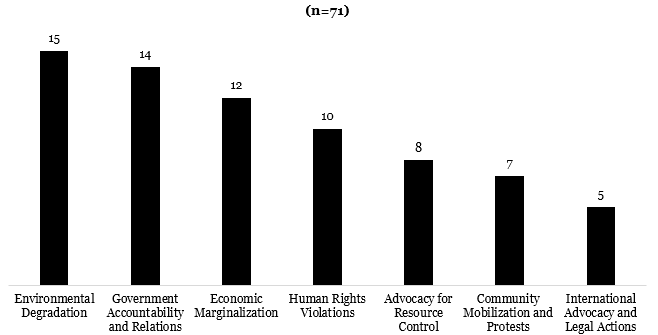
Exhibit 1: Frequency of views regarding social, environmental and economic justice in Ogoniland between 1990 and 2025

Source: Newspapers, technical reports, research reports and databases of national and regional organisations 1990-2025; Infoprations Analysis, 2025

This university is more than a place of learning; it symbolises redemption. It represents the recognition of past wrongs and a commitment to forging a future where education and knowledge fuel sustainable development. With its focus on environmental and technological studies, FUET stands as an institution built on the very issues that have defined Ogoniland’s history (environmental justice, economic empowerment, and self-determination).

Reclaiming the Land Through Knowledge

For too long, Ogoni soil has been poisoned by oil spills, leaving the people without means to farm or fish—their traditional sources of livelihood. The OBR explicitly called for environmental restoration, but solutions have been slow and often insufficient. FUET presents a tangible step forward, offering a dedicated space for research and innovation in environmental restoration.

Through FUET, Ogoni students will no longer have to leave their homeland to seek expertise on issues that directly affect them. Instead, the knowledge will be cultivated from within, with cutting-edge research on oil spill remediation, sustainable land use, and clean energy solutions. The university has the potential to equip the next generation of Ogoni scientists, environmentalists, and engineers with the tools to heal their land—turning the region into a global leader in environmental sustainability.

Economic Liberation: From Protest to Prosperity

The OBR did not just call for environmental justice, it demanded economic inclusion. Despite the wealth extracted from Ogoniland, its people have remained economically sidelined, watching from the margins as their resources fueled the nation’s prosperity. The creation of FUET is a strategic win in reversing this trend.

This institution will create a ripple effect in the local economy. Jobs will emerge, from academic staff to construction workers, from administrators to small business owners serving the student population. Education will empower Ogoni youths in high-demand fields such as renewable energy, environmental law, and technology. Funding and investment will follow, as the university attracts national and international research grants, fostering further development.

Our analyst notes that the shifting from a history of protest to one of proactive change has placed the power of transformation directly in the hands of the Ogoni people. No longer will they have to depend on external forces for progress; they will become the architects of their future.

A Global Stage for the Ogoni Struggle

The Ogoni struggle has long been a global issue, drawing attention from human rights organizations and environmental activists worldwide. FUET will further amplify this platform, creating opportunities for international collaboration. Partnerships with global universities, NGOs, and policymakers could bring: Research funding for sustainable development projects, Legal advocacy for environmental reparations and a model for other communities facing similar environmental challenges. Ogoni will no longer be seen solely as a land of suffering, it will be recognized as a land of solutions.

Salesforce Cuts Over 1,000 Jobs While Doubling on AI Hiring

0

Salesforce, an American cloud-based software company is kicking off 2025 with a significant round of layoffs, with reports indicating that more than 1,000 employees will be affected. This amounts to over 1% of its total workforce.

It is unknown which divisions may see staff reductions, but affected workers will be able to seek other roles within the company. Reports reveal that Salesforce is simultaneously hiring aggressively for AI-focused gigs especially in sales, to drive its next phase of growth.

This comes after the company’s CEO Marc Benioff speaking at a company event in San Francisco last year, stated that the business software giant aims to hire 2,000 people to sell its Agentforce AI platform.

“We’re adding another couple of thousand Salespeople to help sell these products. We already had 9,000 referrals for the 2,000 positions that we’ve opened up. It’s amazing”, he said.

The company which debuted its AI agent platform, Agentforce, in October, said the software’s second generation will be available in February 2025. Agentforce is a proactive, autonomous AI application that provides specialized, always-on support to employees or customers.

Employees can use Agentforce directly in Slack to handle busy work, answer questions, and deliver instant expertise, to enable them to stay focused on high-impact work. Agentforce will be able to tackle sophisticated questions in Salesforce’s Slack communications app, based on all available data. Users can equip Agentforce with any necessary business knowledge to execute tasks according to it its specific role.

The company’s CEO Benioff said Salesforce’s homepage now features an experimental Al agent that can respond to user queries about the company’s products. Salesforce customers in need of assistance can visit a chat-based help page that conducts 32,000 conversations a week. About 5,000 are getting escalated to humans as a result of current Al capabilities, down from 10,000 before, Benioff said.

Salesforce has long positioned Al as a critical pillar of its future, integrating advanced Al tools into its enterprise solutions. The CEO has been vocal about the potential and risks of Al adoption, reinforcing its strategic importance for the company.

Notably, Salesforce is restructuring its workforce to focus on Al innovation, betting that Al-driven products will generate higher revenue and efficiency. However, this raises concerns about job displacement as Al continues to transform traditional roles in tech.

The recent round of layoffs in favor of Al hiring highlights a growing trend that Al is reshaping the job market by automating certain roles while creating demand for new, highly specialized Al-related jobs.

What This Means for Human Jobs

1. Al is replacing repetitive tasks – Many jobs in customer service, sales, and data entry are being automated by Al-driven chatbots, virtual assistants, and machine learning models. Companies see Al as a way to reduce costs and increase efficiency.

2. Al is creating new job opportunities – While Al eliminates some roles, it creates demand for new ones, such as Al engineers, data scientists, machine learning specialists, and Al ethics consultants. These roles require advanced skills in Al development, deployment, and oversight consultants. These roles require advanced skills in Al development, deployment, and oversight.

3. The workforce must adapt – Employees in traditional roles may need to reskill or upskill to remain relevant. Learning Al-related skills can help them transition into Al-driven careers.

4. Al augments rather than fully replace some jobs – In many cases, Al is not eliminating jobs but changing how they are done. For example, Al in customer support (like Salesforce’s Agentforce) helps human workers handle more complex cases while automating routine queries.

It is worth noting that several giant tech companies, which include Meta, Google Microsoft, and IBM, amongst others, are prioritizing Al investments. Also, businesses are shifting focus to Al-driven growth, meaning workers in traditional roles must prepare for continuous industry disruption.

Nigeria’s External Reserves Decline by $1.19bn in Under a Month Amid Naira’s Struggle

0

Reserves Drop Raises Concern Over Foreign Exchange Stability

Nigeria’s external reserves have dropped by approximately $1.19 billion in just three weeks and five days, raising fresh concerns about the country’s ability to meet its foreign obligations and stabilize the exchange rate.

According to data from the Central Bank of Nigeria (CBN), the gross external reserves, which ended 2024 at $40.877 billion, briefly climbed to $40.920 billion on January 6, 2025, before embarking on a steep decline. By January 31, 2025, the reserves had plummeted to $39.723 billion, marking a significant reduction within a short period.

This rapid decline comes as the CBN has yet to publish the external reserves figures for February, fueling speculation about the state of Nigeria’s foreign exchange (FX) buffers. Analysts warn that the ongoing depletion of reserves could further strain Nigeria’s economic stability, particularly in the face of mounting debt repayment obligations and exchange rate volatility.

A report by Financial Derivatives Company (FDC), led by renowned economist Bismarck Rewane, projects that Nigeria’s gross external reserves will drop by 11.47% in 2025, reaching $36.21 billion, before recovering slightly to $37.65 billion in 2026. This projection highlights the persistent economic headwinds facing Africa’s fourth-largest economy.

The exchange rate outlook is equally concerning. The FDC analysts forecast that the dollar/naira exchange rate will average N1,586/$ in 2025 and N1,575/$ in 2026, compared to an average rate of N1,615/$ in 2024, indicating continued volatility in Nigeria’s currency markets.

Naira Strengthens Temporarily Amid Policy Adjustments

However, the naira appreciated recently, hitting an eight-month high of N1,474.78/$ at the official foreign exchange market, as dollar demand eased. In the parallel market, the naira strengthened slightly, trading at N1,595/$, compared to N1,599.33/$ the previous day.

This temporary stabilization has been attributed to a combination of CBN policies, including increased FX market interventions, tighter liquidity controls, and the extension of BDC access to FX, allowing Bureau De Change operators to continue buying directly from the Nigerian Foreign Exchange Market (NFEM) until May 30, 2025.

Nigeria Returns to Eurobond Market Amid Debt Pressures

As the CBN grapples with dwindling reserves, the Nigerian government has returned to the international debt market for the first time in over two years, issuing $2.2 billion in Eurobonds to boost foreign reserves and finance the budget deficit.

The issuance, which was oversubscribed, was structured into two tranches:

  • $700 million maturing in 2031
  • $1.5 billion maturing in 2034

Despite attracting strong investor demand, and generating an order book of over $9 billion, the issuance has also increased Nigeria’s external debt burden, adding further pressure to foreign exchange reserves and debt servicing obligations.

Nigeria’s foreign debt servicing costs continue to surge, significantly contributing to the declining reserves. According to CBN data, Nigeria spent $3.6 billion servicing external debt between January 31 and September 30, 2024, representing a 39.8% increase from $2.6 billion in the same period of 2023.

Analysts at CardinalStone Partners have warned that Nigeria’s Eurobond maturities, averaging $1.33 billion annually over the next decade, will continue to drain reserves. When coupon payments are factored in, annual debt servicing costs could exceed $2.24 billion, adding further pressure to the country’s foreign exchange reserves.

“Debt repayment and servicing costs are likely to remain high in the near to medium term. However, Nigeria’s external debt-linked ratios remain within the IMF’s prescribed thresholds,the analysts stated in their 2025 economic outlook report,Pressure to the Plateau.”

Some financial experts have argued that Nigeria may have been better off waiting until 2025 to issue Eurobonds, when the U.S. Federal Reserve is expected to lower interest rates, potentially making borrowing cheaper for emerging markets.

While the CBN attributes the decline in reserves to debt servicing and FX interventions, a financial expert who spoke on anonymity notes that the full picture is more complicated.

“Reserves are used for many reasons, not just by the CBN. When Nigeria repays external loans, pays Eurobond coupons, or makes USD-based expenditures from the budget, all these withdrawals affect reserves,the expert explained.

Additionally, the expert dismissed speculation that the CBN was actively defending the naira, arguing that the volume of its market intervention is below 10% and that the recent appreciation of the naira was not artificially engineered.

The Naira Remains Weak on the Back of Reserves Growth

Against the backdrop of dwindling reserves, Nigeria’s gross external reserves had actually risen before this recent decline, climbing from $33.85 billion in October 2023 to $40.92 billion in January 2025. Additionally, the CBN recently announced that it had cleared all outstanding FX obligations, which had been a major factor in market uncertainty.

However, despite these positive developments, the naira’s performance in the FX market has not shown significant improvement. The currency remains volatile, fluctuating between N1,474 and N1,600 per dollar in various markets.

Economic experts have warned that if Nigeria fails to increase FX inflows through higher non-oil exports, remittances, and foreign direct investment (FDI), the country may continue to struggle with exchange rate volatility, even as reserves fluctuate.

Nigeria Approves N4.5 Billion for HIV Treatment Amid Shift in USAID Policy

0

The Federal Executive Council (FEC) has approved an allocation of N4.5 billion for the procurement of HIV treatment packs to support Nigerians living with HIV/AIDS, a move seen as a critical intervention following uncertainties in international funding.

The decision comes after the United States government granted an emergency humanitarian waiver, reversing a controversial funding pause on HIV treatment in developing countries, including Nigeria. The funding pause was initially imposed under an executive directive by US President Donald Trump, as part of a broader reassessment of America’s foreign aid commitments.

Following the temporary waiver granted by the US government, Nigeria’s FEC moved swiftly to approve N4.5 billion for HIV treatment to prevent further disruptions in care. The government plans to procure 150,000 HIV treatment packs over the next four months, ensuring that patients continue to receive life-saving medication.

Announcing the approval, Ali Pate, Minister of Health and Social Welfare, emphasized that the move signified Nigeria’s commitment to health sovereignty and its determination to ensure uninterrupted access to HIV treatment.

“This allocation is critical for ensuring that those living with HIV continue to receive necessary treatments without interruption,” Pate stated.

The FEC also established a committee tasked with developing a long-term sustainability plan for HIV/AIDS funding. The committee comprises representatives from the Ministries of Finance, Budget, Defence, Environment, and the Nigeria Governors Forum (NGF).

“This is about ensuring that no Nigerian loses access to treatment during this period of adjustment,” Pate added.

While Nigeria remains grateful for the US government’s contributions to its health sector over the past 20 years, Pate stressed that the administration of President Bola Tinubu is now focusing on transforming Nigeria’s health sector through domestic financing and national health system strengthening.

The Trump-Era Suspension of USAID and Its Impact on Nigeria

The funding pause that triggered Nigeria’s current response was part of broader foreign aid cuts initiated by Trump, who is aggressively pursuing policies aimed at reducing America’s financial commitments to international health programs. As part of his “America First” approach, Trump seeks to drastically cut funding for global health initiatives, including those under the United States Agency for International Development (USAID) and the US President’s Emergency Plan for AIDS Relief (PEPFAR), which had played a pivotal role in sustaining HIV/AIDS treatment in countries like Nigeria.

In 2017, Trump’s administration attempted to slash the US global health budget by nearly $2 billion, including proposed cuts to PEPFAR, family planning services, and maternal health programs. While Congress ultimately blocked the most extreme cuts, Trump’s executive orders still restricted the disbursement of foreign health aid, introducing strict new conditions for funding approval.

The freeze on USAID follows an executive order signed by Trump on January 20, initiating a 90-day pause on foreign development aid to assess its efficiency and alignment with U.S. foreign policy. Notices were sent to USAID contractors and partners, instructing them to immediately cease operations. One such directive was received by Chemonics, a major USAID contractor responsible for delivering essential medicines globally.

This decision directly affected HIV/AIDS treatment funding, leading to delays in drug supplies and creating fears of a treatment crisis for millions of patients who depended on free antiretroviral drugs from US-funded programs.

For Nigeria, the impact was going to be severe. The country has the largest HIV epidemic in West Africa, with an estimated 1.8 million people living with the virus. For nearly two decades, Nigeria’s HIV response has been heavily reliant on donor funding, with PEPFAR alone providing over $6 billion in assistance since 2004.

However, the funding pause and its immediate consequences triggered widespread backlash, both internationally and within Nigeria, following Trump’s executive order. While many criticized the Trump administration’s decision as reckless and detrimental to global health, others turned their focus to Nigeria’s dependence on foreign aid, describing it as embarrassing and unsustainable.

Several health experts, activists, and policy analysts condemned Nigeria’s over-reliance on foreign funding, arguing that the government should have long developed a self-sufficient model to fund HIV/AIDS treatment and other critical health interventions.

The frustration was not limited to medical professionals. Many Nigerians expressed anger over government waste and corruption, questioning why a country with vast natural resources could not afford to provide life-saving medications for its citizens. Civil society organizations highlighted that despite billions in oil revenue, Nigeria continued to rely on foreign donors to handle critical health crises.

Recognizing that health funding challenges extend beyond HIV treatment, the FEC has also approved a broader $1 billion initiative—the HOPE (Human Capital Opportunities for Prosperity and Equity) program—designed to enhance governance and strengthen Nigeria’s primary healthcare system.

The HOPE program, developed in collaboration with the International Development Association (IDA), will allocate $500 million towards governance reforms and another $500 million towards expanding primary healthcare services.

According to Pate, the governance component will encourage states to recruit and train teachers and healthcare workers, while the healthcare portion will focus on expanding access to primary care, improving service delivery, and strengthening health sector resilience.

“This programme aligns with our administration’s vision—to invest in the human capital of Nigerians. People are at the centre of the Renewed Hope Agenda,” he said.

While the N4.5 billion allocation for HIV treatment and the HOPE program underpins a shift towards health sector independence, sustainability challenges remain. Health experts warn that without sustained financial commitment, Nigeria risks falling back into dependence on donor aid.