DD
MM
YYYY

PAGES

DD
MM
YYYY

spot_img

PAGES

Home Blog Page 25

Bitcoin Tops $90,000, But On-Chain Signals And Geopolitical Risks Temper Bullish Euphoria

0
CREATOR: gd-jpeg v1.0 (using IJG JPEG v80), quality = 82

The price of Bitcoin (BTC) briefly surged above the $90,000 mark after spending weeks consolidating between the $80,000 and $90,000 range.

While the breakout initially sparked optimism, fresh on-chain data and renewed geopolitical tensions suggest investors may need to remain cautious.

According to Burak Kesmeci, an analyst at CryptoQuant, Bitcoin’s short-term holder (STH) realized price—currently around $99,600 as of late December 2025 remains a critical resistance level. This metric represents the average cost basis of recent buyers, many of whom are still underwater at current prices.

Kesmeci noted that until Bitcoin achieves a decisive close above this level, there is little reason for excitement. In his words, there can be no true bull market until short-term investors “with a broken heart” return to profitability.

On-chain data shows a convergence of resistance between $99,000 and $102,000, reinforcing the importance of this zone for sustained upside momentum.

As of January 4, 2026, Bitcoin was trading around $90,000, following approximately $161 million in short liquidations. However, the rally proved fragile. With traditional markets closed, BTC attempted to hold early-year gains ahead of futures reopening on Sunday.

Momentum above $90,000 was cut short after reports of explosions in Venezuela triggered a sharp sell-off. Reports revealed that the US had launched airstrikes in the Venezuelan capital. Within an hour, Bitcoin dropped from near $91,000 to below $90,000, underscoring how quickly geopolitical headlines can unsettle crypto markets.

The episode reflects a familiar pattern. During periods of heightened geopolitical tension, Bitcoin has often behaved like a risk-sensitive asset rather than a standalone hedge.

The price briefly slid toward the $87,500 region, erasing gains from the previous day and halting the recovery attempt. A modest rebound followed, with BTC stabilizing near $90,000 at the time of reporting.

Throughout 2025, Bitcoin repeatedly reacted to global macro and geopolitical developments, ranging from U.S. government shutdown concerns to U.S.–China trade tensions and conflicts in the Middle East. Just days into 2026, the trend appears to be continuing, with Bitcoin once again responding sharply to global risk events.

Market commentators remain divided but cautiously optimistic. The analytics account @Wealthmanager attributed the dip to short-term selling pressure linked to U.S. actions involving Venezuela, while maintaining a bullish near-term outlook.

The account suggested that if tensions do not escalate, the move could prove temporary, with a recovery toward the $96,000–$100,000 range in the coming days or weeks.

Crypto trader and analyst Michaël van de Poppe echoed this view, describing the pullback as a “classic” reaction to Venezuela-related headlines. He emphasized that the broader January trend remains upward, as long as Bitcoin holds above its 21-day simple moving average, currently around $87,850.

Outlook

In the short term, Bitcoin’s price action is likely to remain headline-driven, with geopolitical developments and broader risk sentiment playing an outsized role. Elevated volatility could persist if global tensions intensify.

From a structural perspective, however, the $99,000–$102,000 zone remains the key hurdle. A sustained break above the short-term holder realized price would likely restore confidence among recent buyers and strengthen the case for a renewed bull phase.

Until then, Bitcoin may continue to oscillate between optimism and caution, reacting swiftly to both on-chain signals and global events.

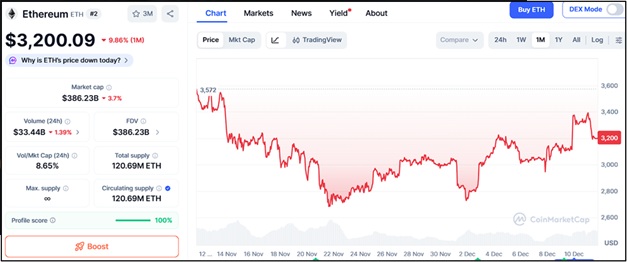
Top 3 Crypto Price Predictions: Ethereum Eyes $5K, Solana $200, Ozak AI $1

0

Crypto market momentum continues strengthening as analysts outline bold predictions for the next major bull cycle, placing Ethereum, Solana, and Ozak AI at the center of high-confidence forecasts. Sentiment is shifting toward assets that combine strong fundamentals with clear long-term narratives, and all three projects are entering 2025 with powerful catalysts.

Ethereum is regaining dominance across the smart-contract space, Solana is accelerating with explosive user activity, and Ozak AI is emerging as the fastest-growing intelligence-driven ecosystem in Web3. Together, they form one of the most compelling trios heading into the next market expansion.

Ethereum (ETH)

Ethereum continues to build one of the strongest structural styles in the market as its space expands through Layer-2 scaling, real-world asset tokenization, and institutional-grade settlement. Trading near $3,200, ETH remains firmly supported by key levels around $3,150, with deeper structural help at $3,080 and $2,960, zones that traditionally attract smart-money accumulation at some stage in consolidation stages.

On the upside, ETH approaches the first breakout zone at $3,280, followed by $3,345 and $3,420, levels that tend to unlock rapid multi-week surges when cleared with strong volume. Analysts now place Ethereum on a realistic path toward $5,000 in a full-scale bull cycle, driven by rising L2 throughput, increasing staking participation, and expanding institutional use cases. Ethereum remains the backbone of Web3—but its multiplier potential is naturally capped compared to emerging early-stage intelligence assets.

Solana (SOL)

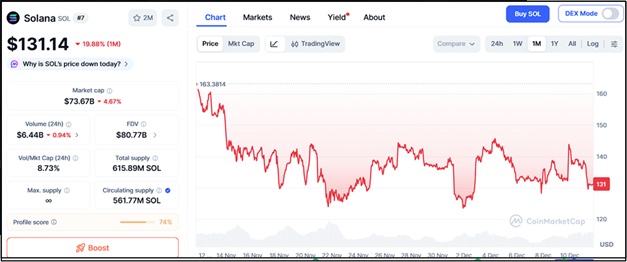
Solana maintains one of the most bullish trajectories among large caps, fueled by explosive developer activity, surging user growth, and increasing adoption across consumer applications. SOL trading near $131 shows strong structural support at $129, reinforced by deeper demand around $124 and $119, areas repeatedly associated with aggressive dip-buying.

On the resistance front, Solana must clear $136, $141, and $148 to unlock its next expansion phase. Once above these levels, historical patterns show SOL accelerating quickly into multi-week breakout territory. Analysts increasingly view $200 as a realistic target for Solana in the early phases of the bull market, with its long-term potential extending far beyond that if ecosystem momentum continues rising. Solana remains a top performer—but again, as a large-cap, its growth follows a more linear path.

Ozak AI Forecast Toward $1

Ozak AI enters this prediction trio as the most aggressive long-term performer due to its intelligence-driven architecture and early-stage valuation. As an AI-native engine equipped with millisecond-speed predictive processing, Ozak AI leverages HIVE’s 30 ms signals, Perceptron Network’s 700K+ node data backbone, and SINT-powered autonomous agents to analyze multi-chain conditions in real time.

This continuous data ingestion means the system grows more accurate and more capable every hour it runs—creating a compounding intelligence effect that no traditional blockchain asset can replicate. With the Ozak AI Presale now surpassing $5M, early investors are positioning before further stage increases as analysts outline a realistic path toward $1 based on adoption curves, utility expansion, and growing multi-chain integration.

Because Ozak AI enters the market at a low initial valuation with rapidly expanding intelligence infrastructure, its multiplier potential far exceeds that of ETH and SOL. A move toward $1 represents one of the most aggressive early-stage projections in the market today. 

The Trio That Defines the Next Cycle

Ethereum is preparing for a strong run toward the $5K range. Solana is building momentum toward the $200 region. Ozak AI is rapidly evolving toward a trajectory that could send it toward the $1 mark—a move that outpaces both major assets in terms of pure ROI. Ethereum and Solana look powerful, but Ozak AI remains the standout for exponential growth in 2025–2026.


About Ozak AI

Ozak AI is a blockchain-based, totally crypto project that provides an era platform that specializes in predictive AI and advanced data analytics for economic markets. Through machine learning algorithms and decentralized network technologies, Ozak AI allows real-time, accurate, and actionable insights to help crypto fans and corporations make the suitable decisions.


For more, visit:

Website: https://ozak.ai/

Telegram: https://t.me/OzakAGI

Twitter: https://x.com/ozakagi

Only Days Left! Can BlockDAG’s 16.67x Jump Leave Cardano Price & Solana Price Holders in the Dust?

0

The opening of 2026 highlights which projects are maintaining strength, and the findings offer an interesting perspective on the current market. The Cardano price is presently testing a critical support zone following its recent dip, prompting analysts to investigate if ADA can successfully build a recovery structure.

At the same time, the Solana price continues to deal with downward pressure, even as the network reports record levels of real-world engagement. This creates a notable gap between technical chart weakness and high fundamental utility.

While these major assets navigate their respective challenges, BlockDAG (BDAG) is moving with massive momentum. The project has secured $441 million through its presale, establishing itself as one of the most successful fundraising efforts in the industry. CEO Antony Turner recently signed a Letter of Intent (LOI) to move the network toward full community ownership. With a shrinking supply and a rapidly approaching deadline, BlockDAG is being highlighted as the next crypto to explode this year. 

Cardano Price Evaluates Major Support Thresholds

A recent decline has moved Cardano into a bearish territory, shifting the primary focus to the future of the Cardano price. Analysts are watching for the formation of a five-wave recovery structure, a pattern often required to confirm a true trend reversal. Because this structure is not yet complete, the market remains in a defensive stance.

Key levels between $0.48 and $0.50 are currently being monitored, as a firm bounce from this range could clear a path toward $0.60. Despite the volatility, data shows that quiet accumulation is happening behind the scenes, suggesting long-term interest remains intact. As the broader market experiences sharp fluctuations, the Cardano price continues to show a steady, measured behavior that keeps it on the radar for a potential comeback.

Solana Price Deals With Technical Hurdles Amid Ecosystem Expansion

Solana is entering the new year under significant pressure, with the Solana price reflecting some of its most challenging chart patterns since 2022. While holders are currently navigating losses and waiting for a cleaner entry signal, the underlying network is actually thriving. Solana’s expansion is increasingly tied to tangible, real-world assets.

Recent milestones include the launch of tokenized gold from Bhutan, a $500 million institutional fund from Keel, and fresh liquidity products from Ondo Finance. Millions of new active addresses and wallets confirm that the network is being used more than ever, even as the Solana price struggles to find its footing on the charts. This growing utility remains a key reason why demand for the ecosystem has not disappeared.

BlockDAG CEO Finalizes Community Ownership Transition

The $441 million raised by BlockDAG has solidified its position as the standout presale of the cycle, with only 3.5 billion coins left in the remaining supply. The project has now reached a new milestone regarding its governance and future.

CEO Antony Turner recently confirmed that a Letter of Intent has been signed, officially beginning the transfer of the project into full community ownership. This agreement outlines the handover of all essential assets, including presale capital, the blockchain infrastructure, intellectual property, and all technical development tools, into a structure guided by the community. Turner noted that BlockDAG is unique as a Layer-1 network for building in decentralization from the very beginning rather than adding it years later.

This transition is expected to take four to eight weeks, providing the community with the operational power to scale the project independently. Until the handover is ratified through a formal vote, Turner and the leadership team will continue to manage the project transparently. The roadmap remains firm: the presale is scheduled to close on February 26, and all launch strategies are moving forward as planned.

For a limited time only, BlockDAG is offering its coins at a special presale price of $0.003 per coin, giving you one last chance to step in before launch pricing kicks in. BlockDAG is currently selling at $0.003, and when BlockDAG launches at $0.05, that’s a massive 16.67x difference, a +1,566% upside from today’s price to launch price.

The final days of the presale and promo are here. Did you arrive late to BlockDAG? Don’t worry, this is your window. Once this stage ends, this price is gone for good. There will be no resets, no extensions, and no second chances. Buy now or miss it forever.

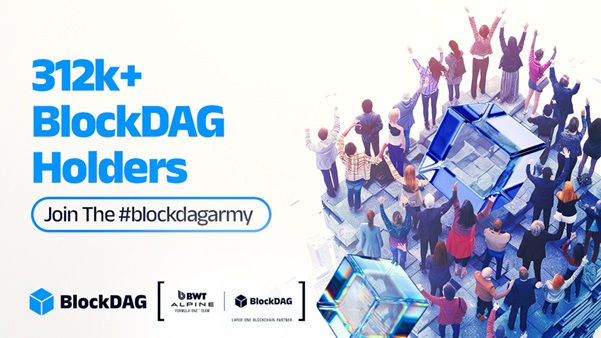
With over 312K holders and 3.5M X1 app users already active, experts are naming BlockDAG the next crypto to explode in 2026. The ownership shift and the limited $0.003 price point have created a rush of activity before the February 10 deadline.

Which is the Next Crypto to Explode?

Both Cardano and Solana are approaching critical technical moments. The Cardano price stays near a support zone that could still trigger a recovery, while the Solana price is balancing weak technicals against a thriving real-world ecosystem.

However, BlockDAG is operating on an accelerated timeline. With $441 million secured, a move toward full community ownership, and a confirmed $0.05 launch price, its trajectory is clear. The current $0.003 special offer provides a final entry point before the February 26 close. As the supply continues to dwindle, the market is increasingly viewing BlockDAG as the next crypto to explode.

Presale: https://purchase.blockdag.network

Website: https://blockdag.network

Telegram: https://t.me/blockDAGnetworkOfficial

Discord: https://discord.gg/Q7BxghMVyu

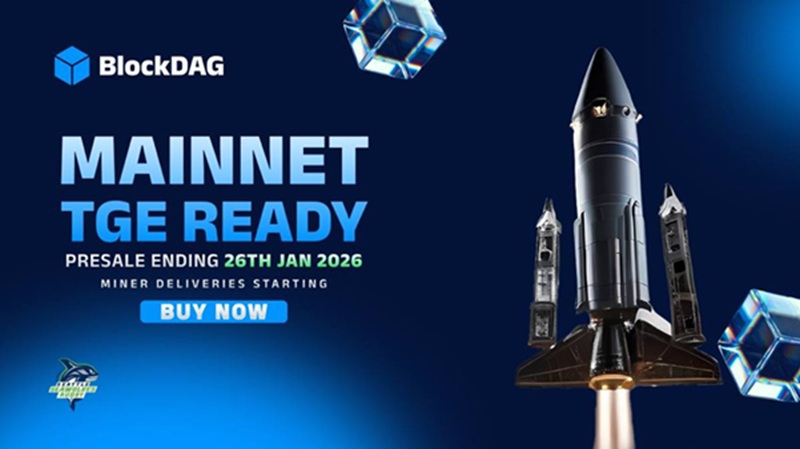
The Jan 26th Countdown: BlockDAG Presale Finishing Soon While TRON & Polkadot Struggle to Move!

0

Trust is the ultimate currency in the digital asset market, and right now, investors want more than just temporary rallies. TRON (TRX) movement remains flat with a tiny 0.07% rise to $0.2796, while the Polkadot (DOT) price faces intense pressure, leaving many to wonder if it can ever reclaim its $50 peak. These legacy coins are moving, but they lack the fresh security foundations that modern traders demand.

BlockDAG has taken a different approach. By completing rigorous security audits with industry leaders CertiK and Halborn, and resolving all technical issues before its January 26 presale close, BlockDAG (BDAG) has built a rock-solid infrastructure. For a limited-time $0.003 per coin, investors get entry at a fraction of the $0.05 launch price, giving a 16.67× potential upside. While others chase short-term trends, BlockDAG focuses on verified safety measures and early access, positioning itself among the top crypto gainers for the long haul.

TRON Movement Stalls Within a Narrow Trading Bracket

The latest TRON (TRX) movement shows a minor 0.07% uptick, bringing its value to $0.2796. Since its inception in 2017, TRON has focused on content sharing and decentralized apps, building a global reputation for high speed and low fees. It is an established ecosystem that functions exactly as designed.

However, at $0.2796, TRON (TRX) movement reflects a mature asset that has lost its explosive edge. Stability is good for a utility network, but it rarely produces the massive returns found among top crypto gainers. For investors seeking high-velocity growth, TRON’s steady, sideways performance suggests it is now a safe harbor rather than a growth engine.

Polkadot Price Faces Uncertainty & Technical Hurdles

The Polkadot (DOT) price continues to struggle, casting doubt on speculative targets like the $50 mark. Launched in 2020 to solve cross-chain communication through its parachain model, Polkadot remains a technical marvel. Yet, technical merit has not translated into price strength in this current cycle.

Market sentiment remains cold toward DOT, and the Polkadot (DOT) price today is more a reflection of broader market fatigue than internal network flaws. For those tracking top crypto gainers, Polkadot currently represents a “wait-and-see” risk. Without a major new catalyst or a total shift in market appetite, the asset remains stuck in a cycle of speculation without a clear recovery path.

BlockDAG: Why Security-First Investors Are Watching Jan 26

While TRON sees minor growth and Polkadot navigates a period of uncertainty, BlockDAG has created a new standard: trust through verified security. The presale is officially finishing on January 26, and that date is significant because it marks the debut of a platform that has successfully passed intense testing from CertiK and Halborn, two of the most respected names in blockchain safety.

CertiK performed a deep dive into BlockDAG’s vesting system, which manages how coins are distributed to ensure long-term team accountability. They identified seven minor findings, none critical, and the team resolved every single one. To make the framework even more robust, BlockDAG integrated advanced safety protocols like multi-signature authorization and time-delay execution.

Simultaneously, Halborn conducted a separate audit of the smart contracts, with a specific focus on the Treasury Vesting mechanisms. Any potential vulnerabilities were identified and immediately corrected. By utilizing two top-tier auditors and fully resolving all findings, BlockDAG has proven it prioritizes technical discipline and protection far more than typical projects.

As a Layer 1 network, BlockDAG uses a hybrid DAG-based Proof-of-Work consensus. This allows for parallel processing that is significantly faster and more secure against exploits than standard blockchains. The ecosystem is launch-ready, featuring built-in safeguards, fully transparent audit reports, and a technical infrastructure built to handle high-volume institutional demand.

BlockDAG has already secured $441 million from over 312,000 holders and is currently in Batch 34 at $0.0106, but for a limited-time $0.003 per coin, early investors can grab ground-floor access, a 16.67× potential upside from the $0.05 launch price. This combination of heavy capital support and elite security verification is why BlockDAG is now a primary focus for those tracking top crypto gainers who value structural integrity over simple market hype.

Summary: Positioning for Long-Term Growth

The current TRON (TRX) movement and the Polkadot (DOT) price show that established assets are struggling to find a new narrative. TRON is steady but slow, and Polkadot is technically sound but price-weak. Neither currently offers the “security-first” launch story that high-conviction traders are looking for today.

The BlockDAG presale concludes on January 26, ending the window for early-stage participation. For a limited-time $0.003 per coin, investors can secure ground-floor access, a 16.67× potential upside from the upcoming $0.05 launch price. By prioritizing completed audits and resolving every vulnerability, BlockDAG is positioning itself to be more than just another name on a list of top crypto gainers; it is building for sustainability and long-term adoption. With $441 million already committed, 312,000 holders, and 3.5 million X1 app users, the market is signaling its preference for verified, battle-tested infrastructure. The clock is ticking, Jan 26 is your final chance to get in before the presale closes.

Presale: https://purchase.blockdag.network

Website: https://blockdag.network

Telegram: https://t.me/blockDAGnetworkOfficial

Discord: https://discord.gg/Q7BxghMVyu

Airtel Africa Deepens Buyback Push, Returns N122.7bn as Investors Watch Share-Price Impact

0

Airtel Africa is quietly but steadily tightening its equity base, signaling confidence in its balance sheet and cash-generation capacity even as it continues to pour capital into networks and mobile money across the continent.

The telecoms group has now repurchased 40.93 million shares under the first tranche of its $100 million share buyback programme, reinforcing its growing reliance on capital management as a tool to support shareholder value.

In a corporate disclosure filed with the Nigerian Exchange (NGX) on Friday, January 2, 2026, Airtel Africa said it bought back an additional 40,000 ordinary shares on December 31, 2025, continuing the programme launched in December 2024. The shares were repurchased at prices ranging between 354.00 pence and 357.00 pence, with a volume-weighted average price of 355.95 pence.

Since the start of the programme, the company has repurchased 40.93 million shares in aggregate at a cumulative average price of 152.24 pence per share. Using an exchange rate of about N1,970 to the British pound, the total value of the buyback so far translates to roughly N122.7 billion.

The transaction, executed by Barclays Capital Securities Limited, was carried out under the authority granted by shareholders and in line with the revised buyback framework announced in September 2025. As with earlier repurchases, Airtel confirmed that the shares will be cancelled, permanently reducing its issued share capital.

At a mechanical level, the strategy is straightforward. By shrinking the number of shares in issue, Airtel Africa is creating incremental support for per-share metrics such as earnings per share and free cash flow per share, provided operating performance remains stable. For long-term investors, the cancellation of shares also increases their relative ownership in the business over time.

Management’s decision to sustain the buyback alongside ongoing capital expenditure sends a broader signal. It suggests confidence that the group can fund network expansion, data growth, and mobile money scale-up across its African footprint while still returning capital to shareholders. This balance has become a key focus for investors assessing large telecom operators in emerging markets, where growth opportunities remain strong, but funding pressures can be acute.

Details of the December 31 transaction point to disciplined execution. The shares were acquired within a narrow price band and spread across multiple trading venues, a structure designed to limit market impact. The London Stock Exchange accounted for the bulk of the volume, with 26,245 shares bought at a volume-weighted average price of 355.79 pence. Additional liquidity was sourced from BATS Europe, CHI-X Europe, Aquis Exchange, and Turquoise.

Market participants note that such multi-venue execution is typical for UK-listed companies running buyback programmes, particularly when purchases are made in relatively small daily tranches. The approach allows brokers to source liquidity efficiently while avoiding sharp price distortions that could undermine the programme’s effectiveness.

Following the cancellation of the repurchased shares, Airtel Africa’s issued ordinary shares now stand at about 3.66 billion, with 7.49 million shares held in treasury. Total voting rights have been reduced to roughly 3.65 billion. The company said shareholders should use the updated figure when assessing disclosure obligations under UK Financial Conduct Authority rules, especially around threshold crossings.

While each individual reduction in voting rights is modest, the cumulative effect steadily increases the proportional stake of remaining shareholders. Over time, this can become meaningful, particularly for institutional investors focused on long-term value accretion rather than short-term price movements.

Attention is now turning to how the buyback may influence Airtel Africa’s share price on both the NGX and the London Stock Exchange. On Friday, January 2, 2026, the stock closed at N2,270.00 per share on the NGX, making it the fourth most valuable listed company on the exchange with a market capitalization of N8.53 trillion, or about 8.55% of total equity market value.

The shares reached a year high in late May 2025 before moderating and then largely stagnating through the second half of the year. The flat price action has sharpened investor focus on capital returns, with some seeing the buyback as a way to underpin valuation while the market waits for clearer catalysts from earnings growth, currency stability, or improved macro conditions across key operating markets.

Since announcing the $100 million programme, Airtel Africa has increasingly leaned on buybacks as part of a broader capital-allocation strategy. Alongside continued investment in 4G and 5G networks and the expansion of its mobile money platform, the buyback reflects an effort to strike a balance between growth and returns in a market environment that remains volatile.

For 2026, investors are expected to closely monitor how much headroom remains under the authorization, the pace at which shares are repurchased, and whether sustained execution begins to feed through more clearly into the stock’s performance.