DD
MM
YYYY

PAGES

DD
MM
YYYY

spot_img

PAGES

Home Blog Page 254

Oil Prices Soar as U.S. Sanctions Hit Russia’s Energy Giants Rosneft and Lukoil, Forcing China and India to Reassess Imports

0

Oil prices climbed sharply on Thursday, marking their biggest daily gains in four months, after Washington imposed sweeping sanctions on Russian oil majors Rosneft and Lukoil, tightening pressure on Moscow over its war in Ukraine and jolting the global energy market.

Brent crude rose $3.40, or 5.4%, to settle at $65.99 a barrel, while U.S. West Texas Intermediate (WTI) crude advanced $3.29, or 5.6%, to $61.79. The two benchmarks hit their highest levels since early October, underscoring how the U.S. measures against two of Russia’s largest energy companies are reshaping global supply expectations.

“The announcement of sanctions by the U.S. on Rosneft and Lukoil is a major escalation in the targeting of Russia’s energy sector and could be a big enough shock to flip the global oil market into a deficit next year,” said David Oxley, chief climate and commodities economist at Capital Economics.

Russia was the world’s second-largest crude producer in 2024, behind only the United States. The sanctions mark the most aggressive step yet by Washington to restrict Moscow’s oil revenues, as previous measures had left Russian exports largely intact through alternative shipping and payment routes.

The immediate market reaction was swift. U.S. diesel futures surged nearly 7%, driving refining margins to their highest levels since February 2024. Analysts said the move reflects tightening supply fears as refiners in Asia begin reassessing their reliance on Russian barrels.

Ole Hansen, head of commodity strategy at Saxo Bank, explained that “refineries in China and India, major buyers of Russian oil, will need to seek alternative suppliers to avoid exclusion from the Western banking system.”

According to multiple trading sources cited by Reuters, Chinese state oil giants have already suspended seaborne purchases from Rosneft and Lukoil, signaling a potential redirection of Asian crude flows that could further tighten global markets.

Kuwait’s oil minister said the Organization of the Petroleum Exporting Countries (OPEC) would be ready to compensate for any supply shortfall by rolling back existing output cuts. Yet Moscow’s response suggested defiance rather than retreat.

“This is, of course, an attempt to put pressure on Russia,” President Vladimir Putin said. “But no self-respecting country and no self-respecting people ever decides anything under pressure.”

The U.S. government, meanwhile, warned that more sanctions could follow if Moscow refuses to agree to an immediate ceasefire in Ukraine.

Pavel Molchanov, an investment strategy analyst at Raymond James, said the latest sanctions may raise logistical costs for Russia but were unlikely to completely derail its exports.

“The various U.S. and EU sanctions thus far have had essentially no effect on Russia’s ability to export oil, so we doubt that this latest round will be game-changing,” he said. “That said, the Kremlin may need to use more intricate methods to ship its oil covertly, thereby increasing costs.”

Molchanov noted that Russian crude accounts for roughly 7% of global oil supply, making the sanctions a potentially destabilizing factor for a market already vulnerable to geopolitical risks.

The sanctions come amid a broader Western campaign to limit Russia’s energy income. Britain recently sanctioned Rosneft and Lukoil, while the European Union this week approved its 19th package of Russia-related penalties, including a ban on imports of Russian liquefied natural gas (LNG). The EU also added two Chinese refiners—together capable of processing 600,000 barrels per day—and Chinaoil Hong Kong, a PetroChina trading arm, to its sanctions list.

UBS analyst Giovanni Staunovo said the full impact on global oil markets will depend largely on how India responds.

“If Indian refiners comply fully, the short-term disruption could be significant. But if Russia quickly finds new buyers, the market impact may ease,” he said.

India has been one of the biggest beneficiaries of discounted Russian oil since 2022, when Western buyers shunned Moscow’s exports after the invasion of Ukraine. But industry insiders say the new round of U.S. sanctions is already prompting a shift.

Sources told Reuters that privately owned Reliance Industries, India’s top buyer of Russian crude, plans to scale down or completely halt such imports to remain in compliance with U.S. restrictions. The move, analysts say, could also help New Delhi advance negotiations on trade and energy deals with Washington.

For now, the sanctions have injected new uncertainty into an already volatile market. If both Chinese and Indian refiners significantly cut Russian imports, analysts warn that the resulting supply gap could push Brent prices back toward the $70 mark in the coming weeks—unless OPEC steps in with additional output.
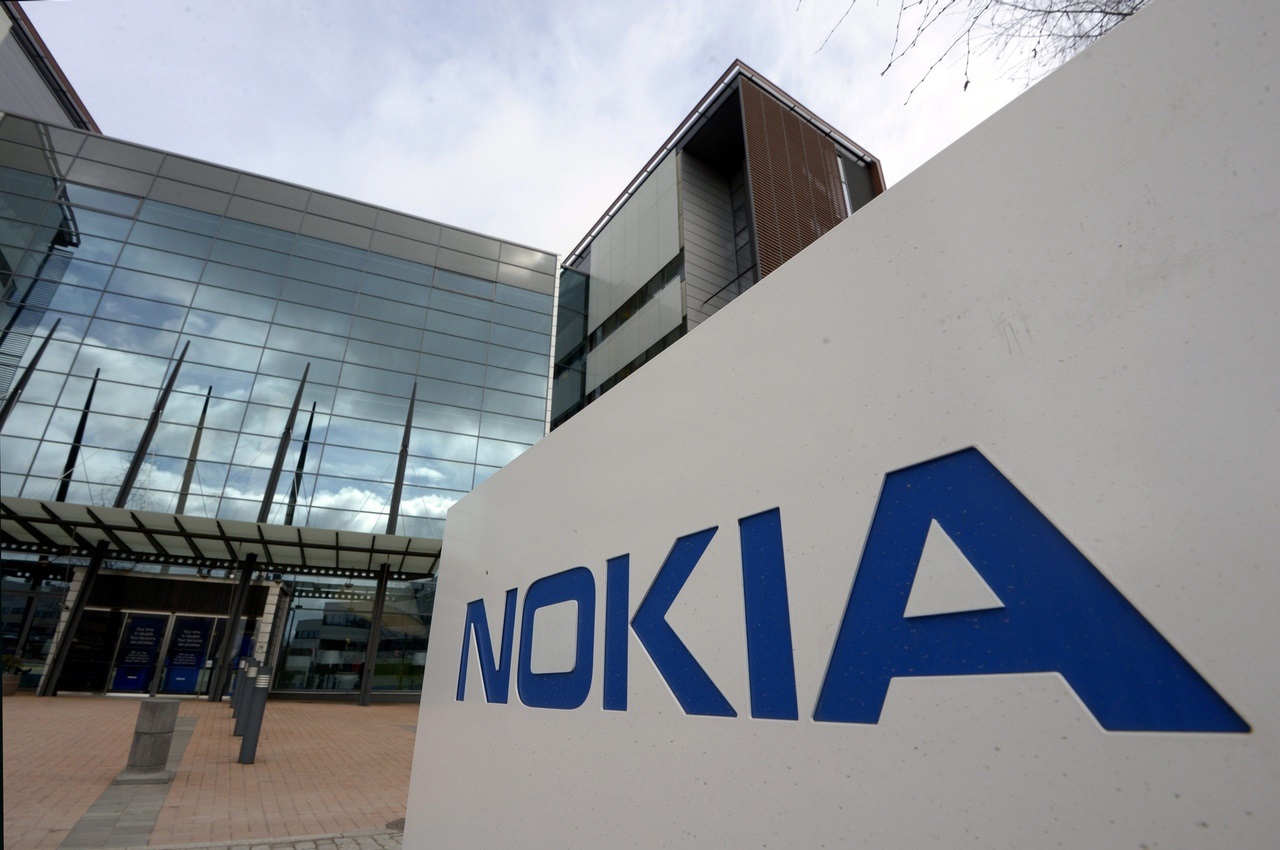

Nokia Shares Surge 10.6%, Highest in Three Years, as AI and Cloud Demand Power Strong Third-Quarter Results

0

Nokia reported stronger-than-expected third-quarter earnings on Thursday, boosted by surging demand for optical networks and AI-driven cloud services following its acquisition of U.S. optical networking firm Infinera.

The Finnish telecom equipment maker’s shares jumped 10.6% to €5.20 — their highest level in more than three years — adding roughly €3 billion to its market capitalization.

Comparable operating profit for the quarter through September rose to €435 million ($507 million), easily beating analyst expectations of €342 million, according to data compiled by LSEG. Group net sales climbed 12% to €4.83 billion, ahead of the €4.6 billion forecast. The results marked a sharp rebound for Nokia, which only months earlier had issued a profit warning amid U.S. tariffs, currency headwinds, and a slowdown in global telecom spending.

CEO Justin Hotard said the company’s pivot toward high-capacity data networks and AI-related infrastructure is now bearing fruit.

“AI and data center demand continues to be robust. In fact, it continues to accelerate from our perspective,” Hotard told reporters during a post-earnings call.

Nokia stated that AI and cloud customers accounted for 6% of the company’s total group sales and 14% of its network infrastructure revenue, underscoring the growing significance of the company’s non-mobile segments. Its Optical Networks division was a standout performer, expanding 19% on a constant-currency basis — driven by hyperscaler demand and next-generation data center connectivity.

The results come amid a period of strategic repositioning for Nokia after years of losing ground to rivals in its core mobile networks business. U.S. carrier AT&T began phasing out its 5G contract with Nokia in favor of Swedish rival Ericsson, which secured a $14 billion deal in 2023. The setback prompted Nokia to expand into new growth areas like optical networking and AI-powered cloud infrastructure to diversify revenue streams.

The Infinera acquisition, completed earlier this year, has strengthened Nokia’s position in high-speed optical transmission, an increasingly critical backbone for AI workloads and cloud computing. Analysts say it also gives Nokia a stronger foothold in the North American enterprise market, where demand for next-generation data links is accelerating despite weakness in telecom operator spending.

In an effort to maintain momentum, Nokia said it now expects full-year operating profit to range between €1.7 billion and €2.2 billion, up slightly from a previous upper limit of €2.1 billion. The company reiterated its guidance that the second half of 2025 would outperform the first, helped by seasonal demand and improved supply-chain conditions.

The upgrade partly reflects changes in how Nokia reports results from its venture fund, after it announced plans to scale down passive investment activities and focus on core operational performance.

Despite persistent challenges from a weaker dollar and price competition in Europe and Asia, Nokia’s ability to offset declining mobile sales with strong optical and cloud momentum marks a crucial inflection point for the 159-year-old firm. It also pinpoints how firms are boosting growth by pivoting to AI infrastructure and cloud services.

With major AI infrastructure investments sweeping across global markets, Nokia’s repositioning appears well-timed. Its renewed focus on optical technology, cloud interconnectivity, and AI-centric networking positions it to capture a growing slice of the digital infrastructure powering the next phase of global connectivity.

Top Crypto Losers Today: MYX Finance Leads the Decline, Is Nexchain AI Token Presale Testnet Bonus the Smart Move for Investors Looking to Recover?

0

In today’s market, several cryptocurrencies experienced notable declines. MYX Finance, Zcash, and Story were among the top losers, each seeing significant drops in value. On the other hand, Nexchain AI’s token presale continues to generate a lot of attention. Backed by the momentum of its Testnet 2.0 Bonus, the project offers early investors an exciting entry point at a competitive price. As Nexchain AI gains attention, it presents a promising opportunity for those looking to capitalize on its potential growth ahead of its official launch.

MYX Finance, Zcash, and TRON Lead the Losses with Notable Drops in Price

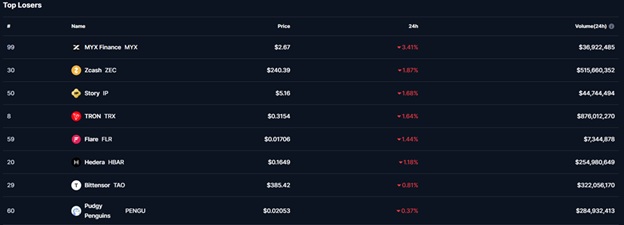
In the last 24 hours, MYX Finance (MYX) saw a 3.41% decrease, dropping to a price of $2.67 with a trading volume of $36,922,485. Zcash (ZEC) experienced a 1.87% decline, now priced at $240.39, with a volume of $515,660,352. Story (IP) fell by 1.68%, reaching a price of $5.16, with a 24-hour volume of $44,744,494. TRON (TRX) saw a 1.64% drop, trading at $0.3154, with a volume of $876,012,270.

Source: CoinMarketCap

Flare (FLR) declined by 1.44%, now valued at $0.01706, with a volume of $7,344,878. Hedera (HBAR) decreased by 1.18%, bringing its price down to $0.1649, and a trading volume of $254,980,649. Bittensor (TAO) fell by 0.81%, now priced at $385.42, with a trading volume of $322,056,170. Pudgy Penguins (PENGU) experienced a 0.37% drop, reaching a price of $0.02053, with a volume of $284,932,413.

Why Nexchain AI’s Token Presale Stands Out

As the crypto market faces volatility, Nexchain AI’s token presale emerges as a promising opportunity for investors looking to recover their losses. The token presale for Nexchain AI has already raised millions, with the price per NEX token steadily increasing with each stage.

Investors in Stage 25, priced at $0.1 per NEX, saw a rapid sellout with $9.3 million raised. The trend continued in Stage 26, which raised $10.1 million, followed by Stage 27 at $0.108 per token, accumulating $11.02 million. Currently, in Stage 28, 90% of the target has been achieved with the token presale priced at $0.112 per NEX.

This steady accumulation shows that Nexchain is gaining serious investor interest, positioning itself as a key contender in the token presale space. The project’s unique approach integrates AI to enhance blockchain scalability, security, and efficiency, an evolution of traditional blockchain that has captured the attention of both whales and everyday investors alike.

Testnet 2.0: A Game-Changer for Nexchain Investors

Nexchain’s Testnet 2.0 is an important feature of the token presale offering. Launched on October 13 and continuing until November 28, Testnet 2.0 brings significant advancements to the project, further boosting its appeal to potential investors.

The testnet introduces a new design and critical AI events, including the implementation of AI Risk Scores.  These scores will provide users with real-time risk assessments before confirming transactions, protecting them from potential scam activity, and mitigating risks associated with MEV (Miner Extractable Value).

By adding this feature, Nexchain is setting the stage for a highly secure and efficient blockchain platform that will be ready for the mainnet launch. With the Testnet 2.0 bonus still active, users can take advantage of a 100% bonus on purchases, further incentivizing participation in the crypto presale.

Airdrop Continues to Reward Early Investors

As part of its ongoing efforts to engage with the community, Nexchain has also launched a rewarding airdrop campaign. The token presale airdrop continues to grow with new short-term quests, allowing investors to earn rewards and increase their chances of securing larger rewards at the finale. The token presale has been active in rewarding early supporters, with tasks that unlock additional points and boosts for those who stay engaged.

The upcoming rewards offer even more value to investors who are taking part in the token presale. In addition to the Testnet 2.0 features and airdrop opportunities, the presale is supported by CERTIK’s security protocols, ensuring that the platform remains secure and trustworthy for all participants. As the market faces downturns, Nexchain AI’s token presale presents an opportunity for recovery and growth.

With the ongoing Testnet 2.0 advancements, AI-driven security features, and an expanding airdrop, Nexchain is positioning itself to be a major player in the blockchain space. Investors looking to capitalize on the growing demand for scalable and secure blockchain solutions would be wise to consider the potential of the crypto presale. With the token presale nearing its final stages, now is the time to join the Nexchain movement and secure long-term gains in the rapidly evolving blockchain landscape.

More Details:

Website: https://nexchain.ai/

Telegram: t.me/nexchain_ai/3

X: https://x.com/nexchain_ai

Airdrop: https://nexchain.ai/airdrop

Dow Narrows Losses as U.S. Gulf Coast Expansion and Cost Cuts Cushion Global Chemical Slump

0

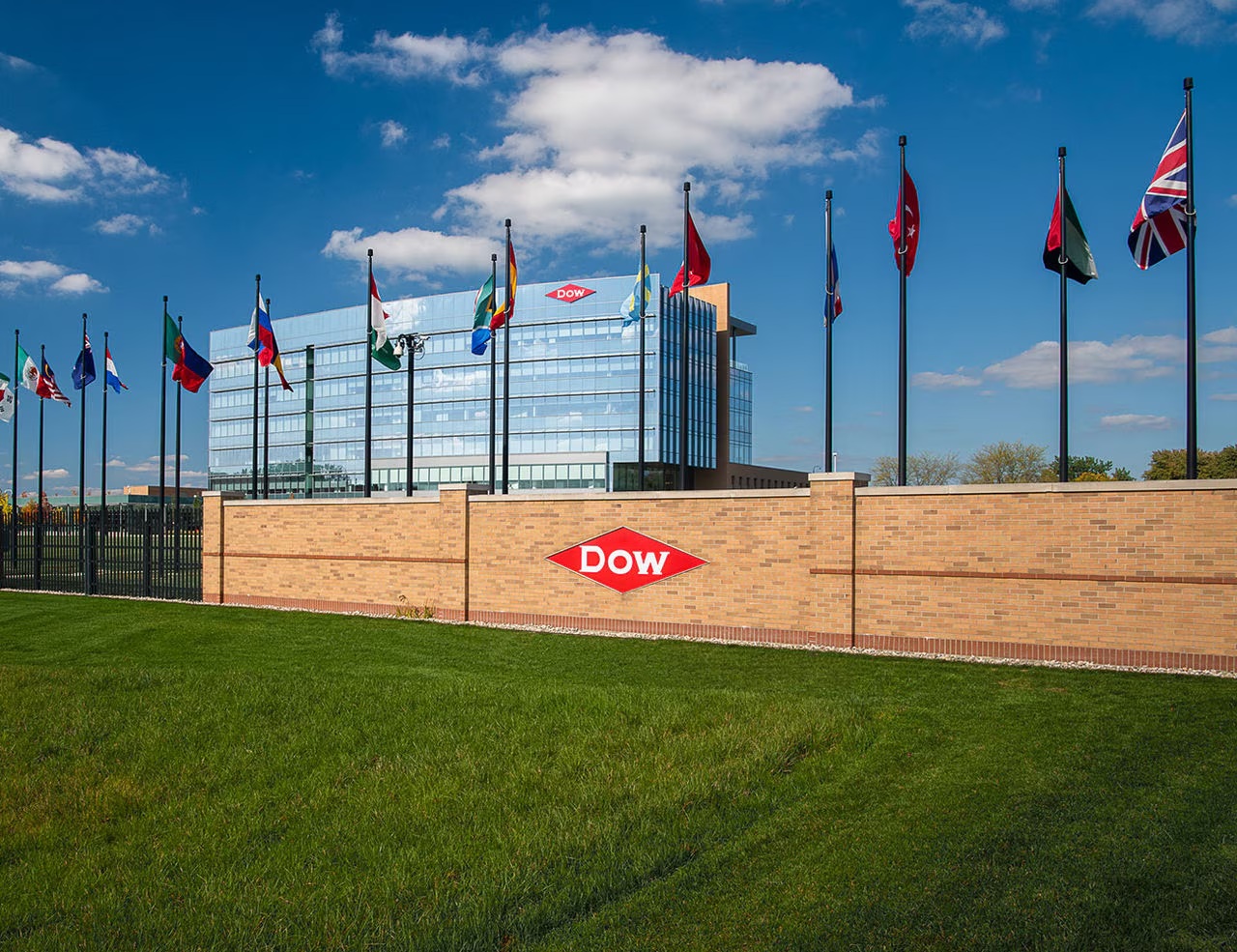
Dow Inc on Thursday reported a smaller-than-expected adjusted loss for the third quarter of 2025, buoyed by cost discipline and the ramp-up of new U.S. Gulf Coast assets that offset the persistent weakness in global chemical prices.

The result, which came amid ongoing macroeconomic sluggishness and pricing pressures across key international markets, sent the chemical giant’s shares surging 10.7% in early trading.

Dow said it posted an adjusted loss of 19 cents per share for the quarter ended September 30, beating analysts’ average estimate of a 29-cent loss, according to data compiled by LSEG. Net sales for the period came in at $9.97 billion, slightly below Wall Street’s expectation of $10.23 billion.

Chief Executive Officer Jim Fitterling credited the company’s cost discipline and operational efficiency for the performance, highlighting the impact of its new polyethylene and alkoxylation assets in the U.S. Gulf Coast.

These assets have expanded Dow’s export capabilities and bolstered its competitive edge in polymer and specialty chemical production, particularly in regions where the company benefits from cheaper U.S. natural gas feedstocks.

The results mark a modest but significant recovery for the Midland, Michigan-based chemical producer, which has spent much of the past two years grappling with falling global demand, inventory gluts, and pressure on margins due to weak industrial activity in China and Europe. The company’s ongoing $6.5 billion near-term cash support plan — which includes $1 billion in capital spending cuts and accelerated cost-reduction initiatives — has now surpassed its halfway mark. Dow said it is on track to meet its targets by the end of 2026.

Chief Financial Officer Jeff Tate, speaking during the company’s earnings call, said the broader macroeconomic landscape “remains largely unchanged,” though early signs from monetary policy shifts could support a mild recovery.

“Recent monetary policy shifts and the beginning of a rate-cutting cycle could start to more positively influence demand,” Tate said.

He, however, cautioned that customer order visibility still points to a cautious operating environment.

Dow has been restructuring its global footprint, particularly in Europe, where energy costs and regulatory hurdles have significantly eroded the competitiveness of heavy manufacturing. The company began a strategic review of several of its European assets in 2024, a move analysts interpret as part of a broader effort to consolidate operations in more cost-advantaged regions such as the United States and the Middle East.

Europe’s chemical sector has been struggling with high gas prices and weak demand, prompting several producers to consider shutdowns or capacity reductions. Dow said that addressing its regional challenges, including European plant shutdowns, is expected to deliver an adjusted core profit uplift of nearly $200 million beginning in mid-2026.

The company also warned of potential pricing pressure in Europe, the Middle East, Africa, and India, as Asian exporters divert volumes away from the U.S. market, where they face anti-dumping duties. This dynamic, Dow said, is reshaping trade flows and intensifying competition in regions already suffering from weak industrial output.

In September, Fitterling noted that the company had observed stable volumes, strong export capabilities, and low-cost positions in the United States during the third quarter, underscoring the relative resilience of the American market compared to Europe and Asia.

Despite the upbeat response from investors, Dow maintained a cautious tone for the remainder of the year, projecting fourth-quarter net sales of $9.4 billion — below analysts’ forecast of $10.14 billion. The company said it expects “challenging conditions to persist,” citing sluggish demand recovery across key end markets, including packaging, construction, and automotive materials.

Dow’s performance points to the shifting balance in the global chemical industry, where U.S. producers are benefiting from cheaper feedstocks and efficiency gains, while European peers face a combination of high energy costs and environmental compliance burdens. The company’s strategy appears increasingly focused on leveraging its U.S. Gulf Coast assets to capture export growth and improve margins, positioning itself more competitively for a potential upturn in global demand.

Still, much hinges on how quickly global monetary easing translates into industrial activity. Analysts believe Dow’s cautious optimism reflects the chemical sector’s broader reality — a slow, uneven recovery where cost control and regional repositioning remain crucial for survival.

Dow’s management has also emphasized its commitment to maintaining liquidity and shareholder returns while continuing to invest in operational efficiency. The company’s recent actions suggest a shift toward greater resilience, balancing short-term cost containment with long-term competitiveness through new production capacity and technological upgrades.

Cryptocurrency Transactions Volume Surged By 50% In the United States in First Half of 2025

0

A recent report from blockchain intelligence firm TRM Labs confirms that cryptocurrency transaction volume in the US surged by approximately 50% in the first half of 2025 compared to the same period in 2024, reaching over $1 trillion.

This marks the US as the world’s largest crypto market by absolute volume, driven by a combination of retail investor enthusiasm and institutional momentum. The growth reflects a multi-year trend, with stablecoin transactions which account for about 30% of total crypto volume jumping 83% year-over-year to a record $4 trillion by August 2025.

Several policy and market shifts under the Trump administration have fueled this boom. The SEC launched “Project Crypto” in August 2025 to position the US as the “crypto capital of the world,” ending prior enforcement actions.

In April, the Department of Justice scaled back crypto prosecutions. The GENIUS Act, signed in July, established stablecoin reserve requirements. Exchange web traffic rose 30% in late 2024 and early 2025, signaling strong professional interest.

Individual-led transactions grew over 125% from January to September 2025, with memecoins playing a key role in onboarding new users. While the US leads in total volume, grassroots adoption is hotter elsewhere: India: Fastest-growing region in South Asia, with higher per-capita usage rates.

Egypt, Morocco, Algeria, and Tunisia rank in the global top 50 for crypto usage, despite bans. Europe: Ownership jumped sharply, e.g., UK from 18% to 24% and France from 18% to 21% of adults.

The $1 trillion transaction volume underscores crypto’s growing role in the US economy. Institutional inflows and retail enthusiasm 125% growth in individual-led transactions signal increased liquidity and market maturity, potentially attracting more traditional investors and boosting related industries like blockchain tech and fintech.

With stablecoins driving 30% of volume and growing 83% year-over-year, they’re becoming a backbone for practical applications like remittances, cross-border payments, and DeFi. This could challenge traditional financial systems, especially for dollar-based transactions.

While retail participation is up, the concentration of crypto wealth may exacerbate wealth gaps if speculative gains favor early adopters or high-risk investors. The Trump administration’s moves—SEC’s “Project Crypto,” DOJ’s reduced enforcement, and the GENIUS Act—signal a friendlier regulatory environment.

This could sustain growth but risks oversight gaps, potentially leading to fraud or market manipulation if not balanced with consumer protections. The US’s push to be the “crypto capital” may pressure other nations to clarify their regulations, fostering a global race for crypto-friendly policies.

However, this could also spark tensions with jurisdictions like the EU, which prioritize stricter oversight. Surging transaction volumes complicate tax reporting and anti-money laundering (AML) enforcement, requiring updated frameworks to track and regulate high-frequency crypto activity.

Rising ownership from 20% to 22% of US adults and a 30% spike in exchange traffic reflect crypto’s shift from niche to mainstream. Memecoins, despite volatility, are onboarding younger and less crypto-savvy users, reshaping financial literacy and investment culture.

While the US leads in volume, grassroots adoption is stronger in regions like India and North Africa. This highlights a divide where developing nations use crypto for necessity (e.g., remittances, inflation hedges), while US growth leans speculative, potentially influencing global perceptions of crypto’s utility.

The retail surge, particularly in memecoins, raises concerns about speculative bubbles, which could erode trust if crashes occur, especially among new investors drawn by hype. Crypto’s growth offers inclusion for underbanked populations but also exposes users to volatility and scams, especially without robust education or regulation.

Increased adoption could accelerate blockchain innovation, from DeFi to tokenized assets, but may strain infrastructure. The US’s crypto embrace could strengthen its financial dominance but risks alienating allies with stricter policies, impacting global trade and sanctions enforcement.

These implications suggest a transformative moment for crypto in the US, with benefits tied to innovation and access but tempered by risks of instability and regulatory challenges.

Other 2025 reports align on modest US ownership gains from 20% to 22% of adults, but TRM’s volume metric highlights the scale of activity. Overall, crypto’s mainstreaming continues, with stablecoins enabling practical uses like remittances and payments.