DD
MM
YYYY

PAGES

DD
MM
YYYY

spot_img

PAGES

Home Blog Page 26

Solana Expands Its Transaction Capacity as BitMine Nears 5% Supply Target

0

Solana is entering another phase of network expansion as its mainnet transaction-size limit rises from 1,232 bytes to 4,096 bytes, more than tripling the amount of data that can be carried in a single transaction.

At the same time, BitMine’s continued accumulation of Solana has pushed its holdings to approximately 4.9% of the cryptocurrency’s total supply, leaving roughly $359 million in purchases between the company and its stated 5% target.

The developments highlight two different but increasingly connected dimensions of Solana’s evolution: improving the blockchain’s technical capacity and deepening institutional exposure to its native asset.

The larger transaction ceiling is significant because blockchain applications increasingly require more information to be processed within individual transactions. Solana’s previous 1,232-byte limit could constrain transactions involving complex cryptographic operations, particularly as decentralized applications become more sophisticated.

Raising the limit to 4,096 bytes creates additional room for larger zero-knowledge proofs, multisignature transactions and other data-intensive instructions. Zero-knowledge technology is particularly relevant. ZK proofs allow one party to demonstrate that a statement is valid without revealing all of the underlying information.

As these systems become more prevalent across privacy applications, scaling solutions and decentralized finance, larger proofs can create additional transaction-data requirements. Solana’s expanded capacity therefore gives developers greater flexibility to construct applications around increasingly sophisticated cryptographic infrastructure.

The upgrade does not mean that every Solana transaction will suddenly become larger. Rather, it increases the upper boundary available to developers and applications that need it. That distinction matters because blockchain performance depends on more than transaction size. Validator resources, bandwidth, execution efficiency and network propagation remain important considerations.

A larger maximum can provide greater functionality, but it also requires careful engineering to ensure that the network retains its performance characteristics.

Meanwhile, BitMine’s accumulation introduces a different signal about Solana’s investment narrative. With its holdings approaching 5% of total supply, the company is positioning itself as a major institutional holder of SOL.

The remaining $359 million required to reach the target is relatively small compared with the scale of its existing position, making the 5% milestone increasingly visible to the market. Such accumulation can influence perceptions of supply dynamics.

When a large holder steadily removes tokens from liquid circulation, market participants may begin to reassess the available supply, particularly if the purchases are viewed as part of a long-term strategy rather than short-term trading.

However, concentration also creates a potential risk: a significant holder can become an important source of market liquidity or volatility if its strategy changes. The two developments reinforce Solana’s broader transition from a high-performance blockchain into an infrastructure platform supporting increasingly complex financial and cryptographic applications.

Larger transactions expand what can be built, while BitMine’s accumulation demonstrates growing conviction around SOL as an institutional asset. The more important question is whether technical expansion and institutional demand can develop together sustainably.

Solana’s challenge will be to preserve reliability and decentralization as transaction requirements grow, while investors will need to distinguish genuine network adoption from capital concentration.

If both trends continue, Solana could find itself at an important intersection between blockchain infrastructure and institutional digital-asset strategy—where improvements in network capability increasingly shape the investment case for SOL itself.

5% Treasury Yield Raises New Risks for U.S. Stocks, Corporate Debt and Bitcoin

0

The U.S. bond market has once again become the center of attention for investors, with the 10-year Treasury yield climbing above 5% on Monday for the first time in three years.

The move represents more than another milestone in the fixed-income market. It signals a broader repricing of risk that could increasingly shape the direction of stocks, corporate borrowing and digital assets.

The latest bond selloff also highlights the difficulty facing the Trump administration as it attempts to stabilize financial markets.

Efforts to calm investors have so far failed to prevent yields from pushing higher, suggesting that market forces are becoming more powerful than political reassurance.

Investors appear increasingly focused on inflation, government borrowing requirements, economic resilience and the supply of Treasury debt rather than simply waiting for policy signals from Washington.

For equity investors, the 5% threshold carries particular significance. Antony Ghee of Merrill and Bank of America identified a sustained break above that level as the biggest near-term threat to stocks.

The concern is straightforward: when government bonds offer increasingly attractive yields, investors have less incentive to accept the additional risk associated with equities. Higher Treasury yields also affect companies directly.

Rising benchmark rates increase financing costs for businesses that rely on debt to fund expansion, acquisitions, capital expenditure or refinancing. Companies with weaker balance sheets can face an even greater burden.

At the same time, higher discount rates reduce the present value investors assign to future corporate earnings, creating particular pressure for growth stocks whose valuations depend heavily on profits expected years into the future.

The consequences extend beyond Wall Street. Government borrowing becomes more expensive when Treasury yields rise, potentially increasing the cost of servicing the U.S. national debt. That can create a difficult feedback loop: larger interest expenses require greater government financing.

While increased Treasury issuance can place additional pressure on bond prices and yields if demand fails to keep pace. The shift is also relevant to Bitcoin. The cryptocurrency was trading near $77,800 and showed relatively little reaction to the Treasury move ahead of Wednesday’s Federal Reserve decision.

That resilience is notable because Bitcoin has increasingly traded alongside broader macroeconomic liquidity conditions. Yet its muted response suggests that investors may currently be waiting for clearer signals before repositioning aggressively.

Bitcoin’s behavior also illustrates the changing character of digital assets. Rather than responding mechanically to every move in traditional markets, the cryptocurrency increasingly reflects a combination of liquidity expectations, institutional positioning, ETF flows, dollar conditions and investor appetite for risk.

The Federal Reserve’s upcoming decision therefore arrives at a delicate moment. Markets are confronting a bond market that is demanding higher compensation for holding long-duration government debt, while equities remain vulnerable to tighter financial conditions.

A sustained 5% Treasury yield could become a new reference point for asset allocation across stocks, bonds, real estate and crypto. The Treasury market is sending a message that investors cannot easily ignore. The era of treating government bonds as a low-yield alternative to risk assets has changed.

If the 10-year yield remains above 5%, capital markets may have to adjust to a world where safe assets once again compete aggressively for investment dollars.

Musk’s X and SpaceXAI Drop Antitrust Claims Against Apple, Keep OpenAI Fight Alive

0

Elon Musk’s X Corp and SpaceXAI have agreed to resolve their antitrust claims against Apple, bringing an unexpected end to one front of Musk’s legal campaign over the competitive structure of the artificial intelligence market while leaving OpenAI in the crosshairs.

In a court filing on Monday, X and SpaceXAI, a division of SpaceX, asked the court to dismiss their claims against Apple and OpenAI. The filing did not disclose the reason for the dismissal or indicate whether Apple had reached a settlement with Musk’s companies.

The companies said, however, that they would continue pursuing their claims against OpenAI, leaving the legal dispute over Apple’s relationship with the chatbot maker only partially resolved.

The development removes Apple from a high-profile case that had placed one of the world’s most valuable companies at the center of a broader fight over access to the rapidly expanding generative AI market.

X and SpaceXAI had accused Apple of violating antitrust law by favoring OpenAI’s ChatGPT in Apple Intelligence, the company’s suite of AI features integrated into iPhones and other Apple devices. Musk’s companies argued that Apple’s partnership with OpenAI effectively shut out competing AI providers, including Musk’s xAI.

The lawsuit alleged that Apple and OpenAI had “locked up markets to maintain their monopolies and prevent innovators like X and xAI from competing.”

A judge’s decision in November allowing the case to proceed had represented an early legal victory for Musk. But the latest filing means the claims against Apple will no longer move forward, at least in their current form.

OpenAI Says It Was Not Part of the Agreement

The circumstances surrounding the resolution remain unclear. OpenAI said in a separate court filing on Monday that it was not involved in the agreement between X, SpaceXAI and Apple and did not know its terms.

The AI company said it had asked X to provide the agreement because its contents could affect both the allegations remaining in the lawsuit and OpenAI’s defense. That leaves a potentially important distinction between the resolution with Apple and the continuing litigation against OpenAI. The filing by Musk’s companies does not indicate that the underlying allegations about competition in AI chatbots have been abandoned.

OpenAI and Apple have both denied wrongdoing.

Apple has argued that its integration of ChatGPT into Apple Intelligence is not exclusive, pushing back against the central premise of Musk’s antitrust case. OpenAI, meanwhile, has accused Musk of conducting a “campaign of lawfare” against the company.

The withdrawal removes a potentially costly and politically visible antitrust dispute at a time when Apple is increasingly integrating third-party AI into its devices. For OpenAI, the litigation remains another challenge from a rival whose business is increasingly built around competing directly with ChatGPT.

The dispute also shows how distribution is becoming an integral part of the next phase of the AI market. Chatbot companies can build increasingly capable models, but reaching hundreds of millions of consumers depends heavily on access to operating systems, devices, applications and other distribution channels.

Apple’s position gives it considerable influence over which AI services become visible to its enormous installed base of users. Musk’s companies have argued that such control can become an antitrust issue when a platform operator partners with one AI provider while competing services seek comparable access.

Apple’s defense is that offering ChatGPT as an integration does not amount to excluding competing services.

Musk’s AI Battle With OpenAI Continues

The retreat from the Apple claims does not end Musk’s broader legal confrontation with OpenAI.

Musk has pursued multiple legal actions against the company he helped establish, stating that it has departed from its original mission of developing artificial intelligence for the benefit of humanity rather than for profit.

In May, OpenAI prevailed in a separate lawsuit brought by Musk over the company’s evolution away from its original nonprofit structure.

The continuing antitrust case marks a different line of attack. Rather than focusing primarily on OpenAI’s corporate structure and mission, the allegations against OpenAI concern its position in the competitive AI market and its relationship with major technology platforms.

That fight has become relevant to Musk’s own ambitions.

ChatGPT became the fastest-growing consumer application in history following its launch in late 2022, establishing OpenAI as one of the most recognizable consumer AI brands. Musk subsequently positioned xAI as a direct competitor, while his acquisition of X for $33 billion gave the AI company access to a large social platform and a substantial stream of user-generated data for chatbot development.

The combination of X and xAI has given Musk a distribution and data ecosystem with which to challenge OpenAI, while OpenAI has strengthened its own position through partnerships with major technology companies such as Apple.

The Apple dispute therefore represented more than a conventional antitrust complaint. It was also seen as part of a larger struggle over who controls the consumer gateway to AI.

The resolution with Apple could indicate that Musk’s companies have decided the dispute is no longer worth pursuing, or that an agreement outside the disclosed court filing has changed the incentives. The filing itself does not provide enough information to determine which.

For OpenAI, however, the immediate consequence is narrower. The company remains a defendant and says it was not a party to the agreement that resolved the Apple claims. That leaves the most consequential part of Musk’s legal campaign intact. His question is whether the growing concentration of AI capabilities and distribution among a small number of technology companies is creating barriers that prevent rivals such as xAI from competing on equal terms.

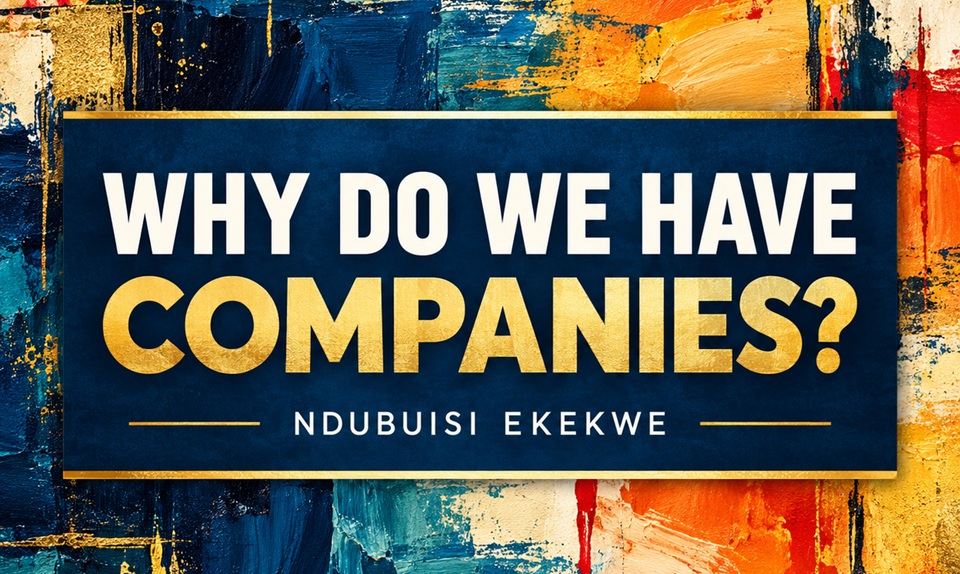
Why Do We Have Companies?

0

The live Zoom sessions for the 21st edition of the Tekedia Mini-MBA will begin on Saturday at 7:00 p.m. WAT. I will open our academic excursion with a lecture on the mission of firms and the fundamental reason companies exist.

That understanding is foundational as we begin a 12-week journey to master the mechanics of building great companies and advancing professional careers.

Every company has three primary elements with which to operate: tools, people and processes. How those elements are assembled, organized and combined will determine the capacity of the firm to transform inputs, including the foundational factors of production, into outputs, to fix market frictions. That transformation of inputs into outputs is what companies do. But business is not a game in which companies award themselves points. The output must resolve a friction experienced by the customer.

When a company creates a great product or service, customers respond by supporting its mission. They pay because the company has solved a problem for them. Hahaha…when they pay, the company earns revenue, and that revenue becomes the compensation for removing the friction. We will examine case studies.

In secondary school physics, friction is a resistive force that must be overcome by another force before an object can move from one state to another. Business operates on the same construct.

A hungry person faces the friction of hunger. Food becomes the force that moves that person from hunger to satisfaction. Making that “force of food” exceptional is the foundation of a great restaurant business.

In all forms and dimensions, companies create forces called products and services. The finest companies become known by the quality and relevance of the forces they produce to overcome frictions: Apple for the iPhone, Dufil Prima for Indomie noodles, Dangote for cement and McKinsey for advisory services.

Build a great force, deploy it against an important market friction, and the market will reward your mission. Your customers will become your finest investors, funding your progress through their purchases. That is why companies exist: they are the most effective vehicles ever invented for organizing the factors of production to create products and services that resolve frictions in markets.

I welcome everyone to Africa’s finest school for understanding the physics of entrepreneurial capitalism. We continue to welcome co-learners; join us here as we begin https://school.tekedia.com/course/mmba21/

Ndubuisi Ekekwe
Lead Faculty, Tekedia Institute

South Korea’s Stock Rally Fuels Surge in Retail Investment Scams, With Losses Near $250 Million

0

South Korea’s spectacular stock-market rally has created a lucrative hunting ground for investment scammers, with retail investors claiming losses of about $250 million from stock-tip chatroom fraud in the first half of 2026, according to police data reviewed by Reuters.

Police investigated 3,506 cases involving stock-tip chatrooms between January and June, with 336 billion won ($246.57 million) in money involved, the data showed. The number of cases increased 4.1% from the same period a year earlier, but the amount of money involved jumped 19.8%, suggesting that scammers are extracting substantially larger sums from victims.

The increase came during an extraordinary period for South Korean equities. The KOSPI was the world’s best-performing major stock benchmark during the first half of the year, attracting enormous attention from retail investors. But the rally also demonstrated how quickly sentiment can turn: the index subsequently fell as much as 44% from its June 19 peak.

The combination of rapid gains and sharp reversals created fertile conditions for fraudsters, lawyers specializing in financial crime said.

“Volatility creates favorable conditions for criminal organisations,” said Kim In-ho, an investigator at Jeongbyeok Law Firm who specializes in helping fraud victims.

The scams exploit a familiar psychological cycle. When markets rise rapidly, investors fear missing out on further gains. When prices become volatile, uncertainty increases, and investors become more receptive to people claiming to possess information, expertise, or access that ordinary investors do not have.

In South Korea, lawyers say fraudsters have adapted their methods to capitalize on that environment.

From Crypto and Property to Stock Tips

Investment scams have long targeted South Koreans through cryptocurrencies and property schemes. But the market rally has shifted the focus toward equities, particularly retail investors eager to capitalize on surging technology stocks.

One common method involves impersonating or exploiting the reputations of legitimate financial professionals.

Scammers post comments beneath videos featuring well-known brokerage analysts or financial influencers, directing viewers toward private investment chatrooms. Victims may believe they are joining a community connected to a recognizable securities company or market expert when, in reality, they are entering a network operated by fraudsters.

Once inside, the groups can take several forms.

Some charge subscription fees ranging from thousands to hundreds of thousands of dollars for supposedly exclusive stock recommendations. Others encourage members to transfer money directly to accounts controlled by the scammers, often promising unusually high returns.

The rapid KOSPI rally has become part of the sales pitch. According to one lawyer, fraudsters pointed to the market’s gains, fueled in part by debt-financed bets on technology stocks, as evidence that victims should put more money into equities.

“When market volatility rises, so does uncertainty and that’s when retail investors’ psychology gets shakier,” said Lee Tae-kyung, a lawyer at Wanbong Law Firm. “These groups exploit that, telling people to trust them.”

The scale of the losses also means individual cases can conceal multiple victims. Police said each investigation may involve several people who were persuaded to transfer money through the same operation.

South Korea’s Financial Supervisory Service said it does not maintain data specifically covering illegal stock-tipping chatroom cases because such investigations fall under law enforcement. The regulator did not respond to questions about whether it was considering additional measures to protect investors.

A Scam Built Around Trust

A case uncovered by Seoul police illustrates how far these operations can go. In June, police said they arrested 10 people after uncovering a Cambodia-based operation that allegedly defrauded 59 South Koreans of approximately 9.9 billion won over two years through February.

Members of the group allegedly impersonated employees of securities firms and persuaded victims to purchase stocks recommended by artificial intelligence through fake investment applications.

Police said the alleged ringleader was a foreign national, while Korean personnel operated call centers. The case has been referred to prosecutors and is awaiting a court date.

For victims, the danger is often not simply the promise of an implausibly high return. The schemes can be designed to manufacture credibility gradually, beginning with ordinary market commentary before introducing aggressive investment opportunities.

That was what happened to Jay, a 47-year-old South Korean logistics worker who said he lost 60 million won after joining a chatroom in February, according to Reuters.

Jay asked to be identified only by his English name because his family does not know about his losses.

He found the group through a TikTok video he believed had been posted by the director of a well-known securities firm. The video directed him to a chatroom on Naver, South Korea’s dominant online platform.

“At the time there was a lot of discussion around not putting your money into real estate, but to put it in stocks,” Jay said. “That mood was prevalent and I got pulled along without realizing it.”

Initially, the chatroom appeared to provide ordinary market commentary. Members later began discussing large profits supposedly generated by investing six- and seven-figure sums through employees of the securities firm.

The claims persuaded Jay to borrow money and initially invest 20 million won.

The operation then introduced what it described as a rare opportunity involving a construction company expected to benefit from potential post-war reconstruction in Iran. Believing the person managing the chatroom was an employee of the securities firm, Jay transferred another 40 million won and was told his investment could rise by 600%.

The opportunity disappeared along with the people offering it.

The chatroom went silent and shut down in April. Jay has since filed a criminal complaint with the police and a civil complaint against the holder of the bank account into which he transferred the money.

Jeonbuk Bank, which hosts the account, said it was aware of ongoing fraud cases and would continue improving its systems for detecting scams. Naver said it takes action against chatrooms when they are reported and is strengthening its monitoring.

He is now working two additional jobs to repay the debt incurred after the fraud.

His experience illustrates why the market’s extraordinary performance can become a vulnerability as well as an opportunity. A rising market creates legitimate stories of investors making large gains, making fraudulent claims of extraordinary returns easier to believe. Sharp volatility then provides another tool, allowing scammers to frame urgency and uncertainty as reasons victims should act before an opportunity disappears.

The result is a market where the risks are no longer limited to whether an individual stock will rise or fall. Retail investors also have to determine whether the person offering the investment opportunity is who they claim to be, whether the trading platform is legitimate, and whether the promised returns bear any relationship to the underlying asset.