DD
MM
YYYY

PAGES

DD
MM
YYYY

spot_img

PAGES

Home Blog Page 2652

AI16Z ELIZA Token Launch Causes Controversy with Existing Community Coin

0

The cryptocurrency market is no stranger to controversy, and the recent events surrounding the AI16Z team and the ELIZA token have certainly captured the industry’s attention. The AI16Z team, known for its innovative approach to integrating artificial intelligence with blockchain technology, announced the launch of the ELIZA token. However, this move has sparked a significant dispute within the crypto community, particularly with the holders of an existing community coin.

The controversy began when the AI16Z team’s intention to launch the ELIZA token was preempted by another group that released a token with the same name through the Pump.fun platform. This led to confusion and conflict among investors, as there were now two tokens with the same ticker in circulation. The situation was further complicated when Jupiter DEX decided to verify both tokens, leaving the community to question which token would prevail.

The market reacted swiftly, with both versions of the ELIZA token experiencing significant market capitalization and volume. However, the lack of clarity regarding the legitimacy of each token led to price disparities and the formation of whale wallet clusters, indicating that some wallets held a substantial percentage of the supply. This has raised concerns about the potential risks associated with trading these tokens, given their relatively low liquidity and high volatility.

This incident is reminiscent of the NEIRO token debacle, where similar ticker confusion resulted in substantial financial losses for uninformed traders. The current ELIZA token controversy has raised questions about the verification process of tokens, the responsibilities of development teams, and the implications of such events on investor trust and market stability.

The team has acknowledged the confusion caused by the simultaneous launch of two tokens with the same name and has made efforts to differentiate their token from the community-generated version. AI16Z team emphasized their commitment to transparency and the value they place on the trust of their investors and the broader community.

They have initiated a verification process for both tokens on the Jupiter DEX platform to ensure clarity and prevent further confusion. Additionally, they have communicated their intention to work closely with the community to navigate the challenges posed by this incident and to find a constructive path forward.

To alleviate the impact on investors who were affected by the token confusion, AI16Z has announced a plan to airdrop a portion of the new ELIZA token’s supply to the holders of the original token. This gesture is seen as an attempt to restore faith in the project and to compensate those who may have suffered financial losses due to the unexpected launch.

The AI16Z team’s response highlights the complexities of the cryptocurrency market and the importance of clear communication between project teams and their communities. As the situation continues to develop, the team has promised to keep the community informed and to take necessary measures to uphold the integrity of their project and the interests of their stakeholders

The AI16Z team has since attempted to address the issue by verifying both tokens on the Jupiter DEX platform, but the community’s response remains mixed. Some view the move as a step towards transparency, while others see it as an inadequate response to a situation that could have been prevented with better communication and foresight.

As the dust settles, the crypto community is left to ponder the lessons learned from this incident. It highlights the need for clear communication channels between project teams and their communities, the importance of thorough due diligence before investing, and the unpredictable nature of the cryptocurrency market. The ELIZA token controversy serves as a reminder that in the fast-paced world of crypto, innovation must be balanced with responsibility to maintain investor confidence and market integrity.


Bitcoin Surges Past $98,000, Becomes 12th Biggest Currency in The World

0

The largest digital cryptocurrency asset Bitcoin, has crossed the $98,000 threshold for the first time on Thursday, overtaking Taiwan’s dollar to become the 12th biggest currency in the world.

The leading cryptocurrency was last reported trading up more than 3%, reaching $97,930. Major crypto-related stocks also saw gains, with Coinbase rising 3% in premarket trading and MicroStrategy, often regarded as a proxy for Bitcoin, surging by 11%. 

Additionally, more than $88 million in short positions were liquidated in the past 24 hours, further propelling the cryptocurrency upward.

The sharp rise in Bitcoin has been driven by several major developments in the cryptocurrency space, which includes the introduction of options trading for BlackRock’s Shares Bitcoin Trust and speculation surrounding Former US President Donald Trump’s social media company exploring a deal to acquire crypto trading firm Bakkt.

Reports reveal that Trump’s move to acquire Bakkt has raised expectations of a potentially favorable environment for cryptocurrencies under his influence. This news has led to renewed interest in Bitcoin as a financial asset, further driving its price upward.

Also, Bitcoin’s meteoric rise has been fueled by expectations of a Trump administration that could usher in favorable regulations for the crypto industry.

“Bitcoin continues its bullish streak creating a new all-time high of $95,000. Market sentiment grew stronger from Bloomberg’s report of Trump’s plan to establish a dedicated White House role for crypto policy,” said Edul Patel, CEO Of Mudrex.

As Bitcoin continues to rally upward, several analysts predict that the next significant test would be the psychological $100,000 level, which could be reached in the coming weeks. Investors are speculating that another Trump term may result in larger budget deficits, higher inflation, and potential shifts in the global role of the dollar- all factors that could further benefit Bitcoin’s price. With a gain of over 130% in 2024 so far, Bitcoin’s rally underscores its resilience and appeal as a hedge against economic uncertainty.

Notably, the introduction of options trading for BlackRock’s Shares Bitcoin Trust marks a turning point in Bitcoin’s journey. It highlights growing institutional interest and provides, investors with more ways to gain exposure to the asset.”

Institutional inflows post Trump’s election victory Since Trump’s election victory, US spot Bitcoin exchange-traded products have attracted approximately $4.2 billion in inflows. This represents 15% of the total inflows since such products were introduced on US exchanges earlier this year. Analysts suggest that these inflows are a reflection of increased investor confidence in Bitcoin as a mainstream asset class.

Bitcoin’s consistent price rally signals a broader shift toward mainstream adoption. Industry analysts believe that institutional participation, along with growing retail interest, is paving the way for cryptocurrencies to become a part of global investment portfolios.

Tekedia Capital Welcomes Conductor Quantum

0

Conductor Quantum is building quantum computers on silicon chips by developing AI software to create qubits (the basic information unit in quantum computing, analogous to bits in classical computing) 1000x faster than current methods. Tekedia Capital is honoured to be an investor in this pioneering company with generation-shaping market implications.

Advertisers Versus Audience in the Branded Content Era

0

The digital revolution has radically transformed how brands communicate with audiences, ushering in the era of branded content. Unlike traditional advertisements, branded content blurs the line between promotion and storytelling, aiming to inform, entertain, or inspire while subtly promoting a product or service. Platforms like Facebook, Instagram, and YouTube have become fertile grounds for branded content, offering advertisers direct access to diverse and highly interactive audiences. However, the interplay between advertisers and their audiences is far from one-dimensional.

In this analysis, we delve into the dynamics of branded content reception, focusing on the power balance between advertisers and audiences using content shared on the official Facebook pages of two selected Nigerian newspapers. Through this perspective, we explore how branded content connects—or fails to connect—with its target audience, drawing insights from a recent analysis of audience comments on these branded posts.

Branded Content: The Advertiser’s Perspective

For advertisers, branded content is a dream come true. It combines the persuasive power of traditional ads with the engagement potential of storytelling. A well-crafted branded post does more than sell; it fosters emotional connections, builds brand loyalty, and sparks conversations.

Consider Larva Tech Academy’s Facebook post, published by The Newspaper,  promoting skill acquisition through tech courses. The content targeted a key demographic—aspiring professionals—promising affordable skill-building opportunities. Similarly, Samsung’s launch of the Galaxy A06 appealed to tech-savvy individuals seeking a balance between performance and affordability. These posts illustrate how advertisers carefully encode their messages to align with audience needs, desires, and pain points.

However, this effort to align content with audience expectations does not always translate to desired outcomes. The audience is not a passive receiver of content; it actively decodes, interprets, and often challenges the message based on personal experiences, social realities, and cultural contexts.

Audience Reception: Decoding Branded Content

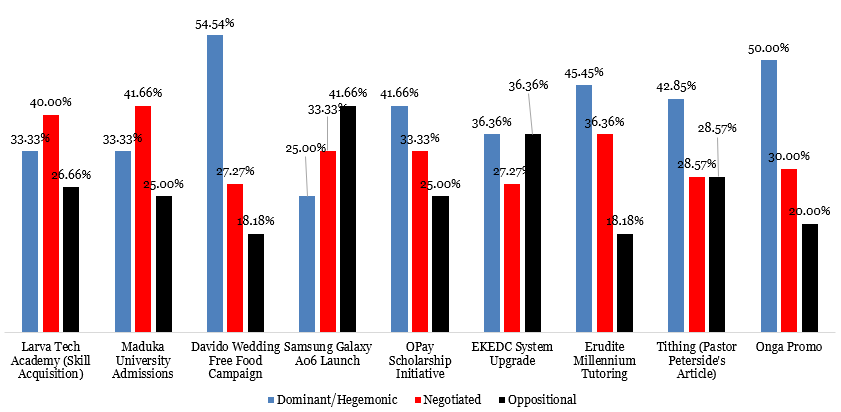
Hall’s model identifies three ways audiences interpret media messages: dominant/hegemonic, negotiated, and oppositional. A quantitative analysis of 108 comments across branded posts reveals the following breakdown:

Dominant/Hegemonic Responses. Approximately 44.4% of the comments reflected full agreement with the advertiser’s intended message. For instance, a commenter on OPay’s scholarship initiative remarked, “This is a ray of hope for Nigerian students. Kudos to OPay!” This shows a strong alignment with content that emphasizes tangible benefits or societal impact.

Negotiated Responses. About 35.2% of the comments partially agreed with the message but raised concerns or questions. For example, a comment on Larva Tech Academy’s post read, “Why charge ?70,000 for a skill we can learn online for free?” These responses highlight a mix of acceptance and skepticism shaped by personal or socio-economic contexts.

Oppositional Responses. Roughly 20.4% of the comments directly challenged the advertiser’s narrative. On Samsung’s Galaxy A06 launch, one user commented, “This is substandard tech for Africa. The phone is overpriced for the specs.” These oppositional reactions often stem from perceived inconsistencies between brand claims and audience expectations.

Exhibit 1: Conflict or consensus in the age of branded content

branded content
Source: The Punch, 2024; Vanguard, 2024; Infoprations Analysis, 2024

Challenges for Advertisers in the Branded Content Era

Audience Fragmentation. The digital landscape is incredibly diverse. What resonates with one segment may alienate another. For example, while 33% of Maduka University’s branded content comments expressed strong support for their admission drive, another 25% raised affordability concerns, and 17% outright rejected the message, describing the initiative as another elitist venture inaccessible to average Nigerians.

Skepticism Toward Marketing. Digital-savvy audiences are increasingly critical of branded content, scrutinizing claims and motives. Samsung’s Galaxy A06 post, for instance, received 41.7% oppositional responses, reflecting dissatisfaction with the product’s perceived value relative to its price and features.

Cultural and Economic Realities. Audience reactions are often filtered through socioeconomic lenses. A comment on the Davido wedding campaign encapsulates this: “This is just an attempt to trend and gain business visibility. It’s not really about Davido or charity.” While 54.5% of the comments supported the initiative, a significant portion (18%) expressed skepticism about the true motives behind the campaign.

Strategies for Bridging the Gap

Authenticity and Transparency. Brands must prioritize genuine messaging over hyperbole. Audiences value honesty and attempts to overpromise or manipulate perceptions often backfire.

Audience-Centric Design. Tailoring content to specific audience segments ensures relevance. Data-driven insights can help identify the needs, preferences, and pain points of different demographics, enabling advertisers to craft more resonant messages.

Active Engagement. Responding to comments, addressing concerns, and fostering two-way communication build trust. Acknowledging feedback—whether positive, negotiated, or oppositional—demonstrates respect for the audience.

Cultural Sensitivity. Advertisers must align their messaging with the cultural and socio-economic realities of their audience. For example, emphasizing the practical benefits of a tech product or educational initiative over abstract promises may resonate better in economically constrained contexts.

A Symbiotic Relationship

The branded content era represents both an opportunity and a challenge for advertisers. The power has shifted from one-way communication to a symbiotic relationship where the audience plays an active role in shaping brand narratives. Advertisers must evolve beyond the mere dissemination of polished messages; they must listen, adapt, and co-create meaning with their audience.

In Nigeria’s dynamic digital ecosystem, this is particularly critical. Economic realities, cultural nuances, and heightened skepticism demand a nuanced approach to branded content. By embracing authenticity, fostering engagement, and leveraging insights from audience feedback, advertisers can transform the challenges of audience reception into opportunities for meaningful connections.

The insights demonstrate the complexity of audience reactions: while 44.4% support branded content, 35.2% negotiate its value, and 20.4% oppose it. These outcomes emphasize the need for advertisers to adopt a more interactive and adaptive approach. When advertisers and audiences meet halfway, the results are not just more effective campaigns but stronger relationships built on mutual understanding.

Nvidia Posts Record 94% Growth in Q3, Beating Estimates as AI Revolution Fuels Chips’ Demand

0

Nvidia Corp. reported unprecedented growth for its fiscal third quarter, with surging revenue and profit driven by the explosive global demand for AI-focused GPUs.

The Santa Clara-based company announced revenue of $35.08 billion for the quarter ending October 27, a 94% year-over-year increase from $18.12 billion. Its net income more than doubled, reaching $19.31 billion compared to $9.24 billion during the same period last year.

Adjusted for one-time items, Nvidia reported earnings of 81 cents per share, surpassing Wall Street’s expectations of 75 cents per share on revenue of $33.17 billion, according to FactSet.

Despite the stellar performance, Nvidia’s stock dipped 1% in after-hours trading, a modest decline given its staggering 195% rise this year. The company’s market capitalization now exceeds $3.5 trillion, positioning it as the most valuable publicly traded company and a bellwether for the booming AI sector.

Driving Forces Behind Nvidia’s Growth

Nvidia’s GPUs are at the heart of the AI revolution, powering the large language models and generative AI applications that underpin a global shift toward artificial intelligence. These chips are integral to AI data centers run by tech giants such as OpenAI, Google, and Microsoft.

The company’s data center segment posted revenue of $30.8 billion in Q3, representing a 112% increase year-over-year. This growth was driven by the success of the Hopper computing platform, which supports generative AI applications and recommendation engines.

“The age of AI is in full steam, propelling a global shift to Nvidia computing,” CEO, Jensen Huang, said.

Nvidia’s next-generation Blackwell GPUs are poised to become the company’s next growth driver. Blackwell production shipments are scheduled to begin in fiscal Q4 2025, with demand expected to exceed supply well into fiscal 2026, according to CFO Colette Kress.

“Every customer is racing to be the first to market,” Kress said. “Blackwell is now in the hands of all of our major partners, and they are working to bring up their data centers.”

The strong demand for Blackwell chips signals the continued appetite for advanced AI hardware, further cementing Nvidia’s market dominance. Huang noted that Nvidia would deliver more Blackwell units than initially anticipated in the current quarter, reflecting robust interest from enterprise customers.

Nvidia’s legacy gaming segment also showed impressive gains, with revenue rising 15% year-over-year to $3.3 billion. The company’s graphics processors remain a top choice for PC gaming enthusiasts, even as AI dominates its revenue streams.

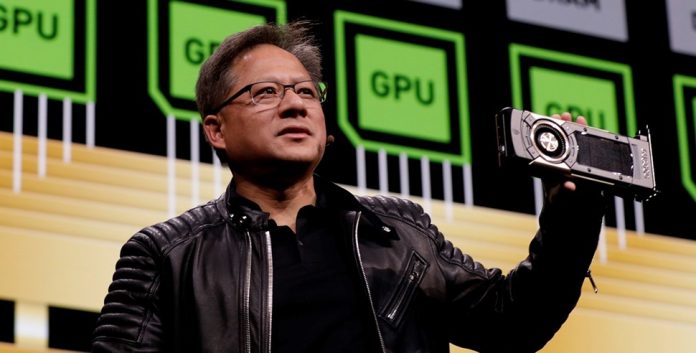
Nvidia’s invention of the GPU in 1999 revolutionized computer graphics and laid the foundation for its leadership in AI hardware today.

In addition to gaming and data centers, Nvidia is expanding into automotive and edge computing markets. Revenue from its automotive segment grew 15% year-over-year, reaching $500 million. Nvidia’s AI platforms for autonomous driving and advanced driver assistance systems (ADAS) are gaining traction among automakers.

The company is also pushing into edge computing, where AI chips process data locally rather than in centralized data centers. This shift is critical for applications in robotics, industrial automation, and smart cities.

Supply Constraints and Other Challenges

While Nvidia’s growth story remains compelling, it faces significant supply constraints. Both Hopper and Blackwell GPUs are in high demand, and production capacity is expected to lag behind market needs.

“The demand for Blackwell is expected to exceed supply for several quarters in fiscal 2026,” Kress acknowledged.

These constraints highlight the ongoing global semiconductor shortage, which has impacted industries ranging from consumer electronics to automotive manufacturing.

Mixed Stock Performance

Despite its strong quarterly results, Nvidia’s guidance for Q4—revenue of $37.5 billion (plus or minus 2%)—fell slightly short of some analysts’ expectations. This tempered guidance contributed to a minor pullback in Nvidia’s stock, though analysts view the dip as temporary.

Dan Ives, an analyst at Wedbush Securities, described the earnings as a testament to Nvidia’s leadership in the AI revolution.

“We view this as a Nvidia earnings press release that should be hung in the Louvre,” Ives said.

Path to $4 Trillion Valuation

Nvidia’s market cap now exceeds $3.5 trillion, and analysts predict it could surpass $4 trillion by 2025. The company’s dominance in AI hardware positions it to capture a significant share of the growing market for AI-enabled technologies.

David Volpe, senior fund manager at Emerald Insights Fund, noted that Nvidia’s growth remains unmatched.

“There’s nothing touching it in terms of the growth,” Volpe said.

As demand for generative AI tools continues to grow, Nvidia’s chips are becoming essential for companies building AI-driven applications. The company’s leadership in AI hardware has turned it into a cornerstone of the tech industry, driving investments from major players like Microsoft, Google, and Amazon.

“The age of AI is upon us,” Huang said. “And it’s large and diverse.”

Nvidia is doubling down on its AI strategy while expanding into new markets. The company’s ongoing investments in R&D, coupled with its partnerships across industries, means it will remain a leader in the rapidly evolving AI industry.