DD
MM
YYYY

PAGES

DD
MM
YYYY

spot_img

PAGES

Home Blog Page 2850

Caroline Ellison will be sentenced today for her role in the FTX collapse

0

The FTX collapse, one of the most significant events in the cryptocurrency world, has led to various legal proceedings, including the sentencing of Caroline Ellison, a key figure in the case. Ellison, who served as the CEO of Alameda Research, a trading firm closely associated with FTX, pleaded guilty to multiple charges related to the collapse of the crypto exchange.

Ellison’s cooperation with federal prosecutors has been a pivotal element in the investigation, providing substantial information that contributed to the prosecution of Sam Bankman-Fried, the founder of FTX. Her testimony, which detailed fraudulent activities and the mismanagement of customer funds, was crucial in the trial that resulted in Bankman-Fried’s conviction.

Here’s a concise exploration of the primary factors that led to the downfall of FTX:

Misuse of Customer Funds: At the heart of FTX’s collapse was the misappropriation of customer deposits. The exchange’s executives, including Sam Bankman-Fried, faced charges for using billions of dollars of customer funds for personal gain and risky investments.

Overleveraging with Alameda Research: FTX had an unusually close relationship with Alameda Research, a trading firm also founded by Bankman-Fried. The exchange was heavily leveraged with Alameda, which raised concerns about the sustainability of its financial practices.

Questionable Financial Practices: The financial accounting metrics employed by FTX were precarious. The reliance on their own native exchange token, FTT, and other speculative cryptocurrency tokens for valuation, rather than more stable assets, was a significant red flag.

Lack of Liquidity: A surge in customer withdrawals triggered by these revelations forced FTX into insolvency. The lack of liquidity and the inability to honor these withdrawals was a critical factor in its bankruptcy declaration.

Market Distrust: The exposure of these issues led to a loss of trust in the market. Investors and customers rapidly withdrew their funds, exacerbating the liquidity crisis and leading to the eventual collapse of the exchange.

As Ellison faces her sentencing, there is much speculation about the potential outcome. The possibility of a lenient sentence has been suggested by some, considering her extensive cooperation with the authorities. Legal experts have weighed in, discussing the impact of her testimony against the backdrop of the billions lost in the cryptocurrency fraud.

The case has highlighted the complexities of the cryptocurrency industry and the need for robust regulatory frameworks to prevent such collapses in the future. Ellison’s sentencing is not just a conclusion to her legal journey but also a significant moment for the crypto community, as it reflects on the consequences of unchecked growth and the importance of accountability in the financial sector. The FTX saga serves as a cautionary tale for the cryptocurrency industry, emphasizing the need for transparency, robust financial oversight, and ethical management to foster a stable and trustworthy financial ecosystem.

The outcome of today’s sentencing will undoubtedly have far-reaching implications, not only for Ellison but also for the broader discourse on corporate governance and ethical conduct in the volatile world of cryptocurrency trading. As the industry continues to evolve, the lessons learned from the FTX collapse will likely shape its path forward, emphasizing the need for transparency and integrity in all aspects of business operations.

BlackRock’s New 12-Hour Withdrawal Requirement for Bitcoin ETF

0

In a significant development for the cryptocurrency market, BlackRock, the world’s largest asset manager, has amended its Bitcoin exchange-traded fund (ETF) to require on-chain withdrawals to be processed within 12 hours by Coinbase Exchange, the fund’s custodian. This move comes amid heightened investor concerns over the transparency and efficiency of on-chain settlement practices.

The amendment, filed with the Securities and Exchange Commission (SEC), underscores the growing demand for faster and more reliable access to digital assets. It reflects a broader trend in the industry towards greater accountability and responsiveness from key players in the cryptocurrency ecosystem.

BlackRock’s decision is particularly noteworthy given its stature in the financial world and its influence on market practices. By setting a 12-hour window onchain requirements for Bitcoin withdrawals, BlackRock is sending a clear message about the importance of prompt settlement times in maintaining investor confidence and ensuring the smooth operation of its ETF.

Coinbase, as one of the leading cryptocurrency exchanges and custodians, plays a pivotal role in the execution of this requirement. The exchange is responsible for the custody of 10 out of 11 spot Bitcoin ETFs and eight out of the nine recently approved Ether (ETH) ETFs in the US. Coinbase’s ability to meet this new standard will be closely watched by investors and industry observers alike.

The amendment also addresses the concerns that have been circulating about the possibility of “paper BTC,” or Bitcoin IOUs, being used in place of actual on-chain settlement. Such practices could potentially suppress the price of Bitcoin and undermine the integrity of the ETF. BlackRock’s proactive stance aims to quell these fears by ensuring that all transactions are verifiably settled on-chain within the stipulated time frame.

Brian Armstrong, co-founder and CEO of Coinbase, has responded to these concerns by emphasizing the company’s commitment to transparency and regulatory compliance. He pointed out that Coinbase undergoes annual audits by Deloitte and is a publicly traded company, suggesting a level of scrutiny and accountability that should reassure investors.

The implications of this development are far-reaching. It could set a new standard for the industry, prompting other asset managers and custodians to adopt similar measures. Moreover, it highlights the evolving nature of cryptocurrency markets and the need for traditional financial institutions to adapt to the unique challenges and opportunities they present.

As the cryptocurrency market continues to mature, the integration of traditional financial mechanisms like ETFs with blockchain technology will likely become more intricate. BlackRock’s amendment is a step towards harmonizing these two worlds, ensuring that the innovative spirit of cryptocurrencies is matched by the reliability and trustworthiness of established financial practices.

In conclusion, BlackRock’s new requirement for a 12-hour on-chain withdrawal window is a landmark moment for the cryptocurrency industry. It demonstrates a commitment to investor protection and market integrity that could pave the way for further innovations and improvements in the way digital assets are managed and traded. As the market evolves, such measures will be crucial in building the trust necessary for the continued growth and mainstream adoption of cryptocurrencies.

The AI Era of “The Best or Nothing”, As Companies Plough $Billions for Talent

0

Three things:

At least 64 public or nonprofit universities and colleges have closed, merged, or announced closures or mergers since March 2020, in the United States. Yes, many US colleges are fading because in the age of abundance, who influences demand runs the show. There is no need to be studying in that crappy university when a better one is a click away. So, the competition is now both local and global with the best schools absorbing more and more students via different clusters of programs.

Google dropped $2.7 billion to re-hire a staff member who left to start his own company, in a deal structured to avoid antitrust, as companies prefer to license technologies from the small companies over acquiring them. But look deeper, it is a pure aqui-hire as over time that small company does nothing but serve the big acquirer. 

OpenAI co-founder and ex-chief scientist, Ilya Sutskever, raised $1 billion for his new AI firm Safe Superintelligence (SSI) within months after leaving the generative AI pioneer. SSI was valued at about $5 billion even though it will take months to have the products ready.

The decision by Google to throw that money for an AI great tells you that it has modeled that having the guy back is better than spending $billions on R&D with no assurance. For A16, Sequoia, DST Global and SV Angel which invested $1 billion in SSI, they have modeled that they have a higher odds of winning with SSI, than spreading that money over other 100 infant AI companies. Then the students who think they can get clear results over those local schools make the same case.

Have you thought that your company can just close the R&D unit because a 3-person team of techies have the results they want? And those results are exponential in impacts. Check well, bigtech is reducing footprints in their R&D efforts in the developing world as they fight for supremacy in the fledgling AI world where the rule is “the best or nothing”!

This is consistent with my thesis in a Harvard Business Review article here: the game will be played at home for North America and Western Europe, reshaping how they helped China to advance economically via outsourcing.

 In its attempts to industrialize, Africa has looked toward China’s success. China designed and executed a policy that shrank the industrialization process in a mere 25 years — something many economies took at least a century to do. That redesign has brought immense dislocation in global commerce and industry, enabling China to become one of the world’s leading economies. African leaders have been pursuing policies designed to mimic China’s path. But despite these efforts, Africa has yet to advance in its industrialization at the same speed China did. Put simply, the things that worked for China will not work for Africa. Africa must change its focus: It must encourage internal consumption and intra-trade, push forward the African Continental Free Trade Agreement, create a single African currency, improve infrastructure, and invest in education.

PolyMarket is considering a token launch to raise $50M

0

The world of decentralized finance is abuzz with the news that PolyMarket, a leading blockchain-based predictions market platform, is considering a significant move to raise $50 million through a token launch. This strategic decision comes at a time when the platform has been gaining momentum, especially as a hub for election betting during the 2024 US presidential race.

PolyMarket has been a standout in the predictions market, allowing users to place bets on the outcomes of real-world events. The platform operates on the Ethereum and Polygon blockchain networks and has seen a surge in popularity, with trade volumes reaching impressive heights. In August alone, PolyMarket reportedly added 75,000 new accounts, indicating a growing interest in political prediction markets.

The potential token launch is seen as a way for PolyMarket to transition from its current no-fee model to one where the token plays a crucial role in user interaction. Investors in the upcoming funding round are expected to receive warrants, giving them the option to buy tokens if PolyMarket moves forward with its token issuance.

A token launch could also mean a valuable airdrop for users, though the parameters and snapshot date remain unknown. This has raised expectations among the PolyMarket community, as they anticipate the benefits that could come with holding the native token.

The platform’s accuracy is rooted in the collective intelligence of its diverse user base, which includes casual bettors, professional traders, and companies with vested interests in certain outcomes. By aggregating the predictions of these participants, PolyMarket can offer real-time probabilities that reflect the most current and accurate odds.

The mechanism behind PolyMarket’s operation is relatively straightforward but highly effective. Users buy and sell shares representing possible outcomes of various events, and the price of these shares fluctuates based on supply and demand. This market-driven approach ensures that the share prices represent the collective belief about the likelihood of each outcome, thus providing a dynamic and constantly updated forecast.

Moreover, the integration of blockchain technology enhances the transparency and security of the transactions. Operating on the Ethereum and Polygon networks, PolyMarket benefits from the scalability and efficiency these platforms provide. The decentralized nature of the platform means that it operates without a central authority, which helps to prevent manipulation and maintain trust among users.

One of the key factors contributing to the accuracy of PolyMarket’s predictions is the economic incentive for traders. Since traders combine all available information, including news, polls, and expert opinions, to make informed trades, they are motivated to ensure that the market price accurately reflects the true current odds. This economic incentive drives the market towards efficiency, as savvy traders will buy undervalued shares and sell overvalued ones, thus correcting the market prices.

However, launching a token is not without its challenges. PolyMarket would need to navigate the complex regulatory landscape, especially if the token is classified as a security. This would require compliance with securities laws affecting its marketing and distribution. The Commodity Futures Trading Commission (CFTC) has already warned PolyMarket and other offshore platforms about potential enforcement if they continue offering derivatives contracts to U.S. customers without registration.

Despite these challenges, the potential for a $50M funding round and a token launch represents a significant development for PolyMarket and the broader crypto community. It reflects the growing interest in decentralized finance and the increasing acceptance of blockchain technology in mainstream financial markets.

As PolyMarket ponders this major step, the crypto world watches with keen interest. A successful token launch could pave the way for other platforms to follow suit, marking a new era of growth and innovation in the predictions market space.

Pricing Controversy: Dangote Calls for Total Removal of Fuel Subsidy

0

Since its inception, the Dangote Refinery has been hailed as a transformative project poised to reshape Nigeria’s energy sector. Yet, beneath the optimism surrounding the facility lies a series of challenges that have tested the resilience of the multi-billion-dollar venture.

While the refinery finally began fuel production in September 2024, its path has been far from smooth, navigating pricing disputes, and an unfriendly policy environment, all while carrying the burden of immense expectations from a nation long dependent on imported fuel.

Aliko Dangote, the billionaire behind the project, has been open about the obstacles his refinery has faced. Built at a staggering cost of $20 billion, the Dangote Refinery was expected to alleviate Nigeria’s reliance on imports and stabilize its currency. However, the refinery began operations shortly after Nigeria removed fuel subsidy – which became a key hurdle for its product pricing.

President Bola Tinubu took office in May 2023 with a bold move to remove the longstanding fuel subsidy, a policy shift that has since caused gasoline prices to skyrocket and inflation to soar. The subsidy had long been a point of contention, draining government resources to the tune of trillions of naira. While Dangote supported its removal, he recognized that this transition was not without complications, particularly for his refinery.

However, the subsidy has not been totally removed. The government has been paying to keep the cost of fuel at around N600 per liter. But with the refinery in place, Dangote thinks it’s time the subsidy is totally removed, which will help among other things, to know the actual volume of fuel being consumed in Nigeria.

“Subsidy is a very sensitive issue. Once you are subsidizing something, then people will bloat the price, and the government will end up paying what they are not supposed to be paying. It is the right time to get rid of subsidies,” Dangote explained in a Bloomberg Television interview on Monday, but this was only part of the equation.

“But this refinery will resolve a lot of issues out there, you know, it will show the real consumption of Nigeria, because, you know, nobody can tell you. Some people say 60 million liters of gasoline per day,” he added.

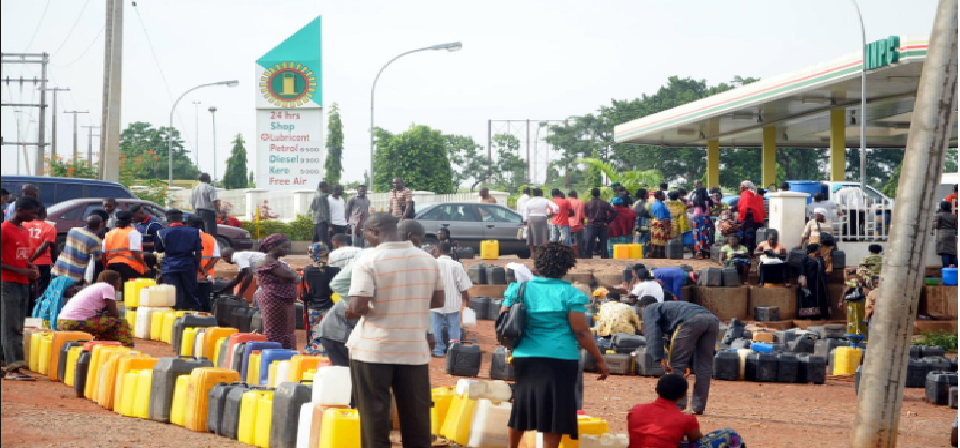
As fuel prices increased dramatically, rising to N950 per liter in Lagos and even surpassing N1,500 per liter in other parts of Nigeria, Dangote’s refinery became central to the discourse on affordability. The refinery had just started lifting petrol when the price hikes came into effect, drawing widespread attention and setting off a series of controversies about pricing structures.

A major struggle came with the pricing disagreement between the Dangote Refinery and the Nigerian National Petroleum Company Limited (NNPCL). While initial reports suggested a dispute, Dangote clarified that the issue stemmed from the NNPC’s pricing strategy, which applied a uniform price for fuel, even though the refinery’s product was reportedly cheaper than imported alternatives.

“There wasn’t really a disagreement, per se. NNPC bought from us on the 15th of September at the international price, which they also bought, about 800,000 metric tons of gasoline imported. So the one that they bought from us is actually cheaper than the one they are importing,” Dangote revealed.

He said, however, that the NNPC announced a price that did not reflect the lower cost of Dangote’s locally produced fuel.

“And so when they announced our price, the guy, I don’t know whether he was authorized. It wasn’t really the real price. What they have announced is most likely that is what it cost them, including profit and other expenses.

“And then the other one is one that they imported. But the people don’t know how much they spend in terms of imports, but their importation is almost, maybe about 15 percent more expensive than ours, you know.

“So what they are supposed to do is to sell at a basket price, or if they want to remove subsidy, they can announce that they will remove subsidy, which is okay, everybody you know will adjust it.

“What they have announced is most likely what it cost them, including profit and other expenses,” Dangote said.

This he said, led to confusion in the market, with consumers unaware that the price announced by NNPC was not reflective of the true cost difference between imported and locally produced fuel.

While negotiations with the NNPC are still ongoing, Dangote said he remains optimistic that a final agreement will balance the interests of both parties, providing the government with an affordable supply while allowing the refinery to operate profitably.

“Well, you see, we have a choice of either one. We produce, we export, and when we produce, we sell locally. But we are a big private company. And yes, it’s true, we have to make a profit. We build something worth $20bn so definitely we have to make money.

“The removal of subsidies is totally dependent on the government, not on us. We cannot change the price, but I think the government will have to give up something for something. So I think at the end of the day, this subsidy will have to go,” he said.

Beyond pricing issues, the refinery is grappling with broader market dynamics. The removal of the fuel subsidy has unleashed inflationary pressures, pushing the inflation rate to 34% before moderating slightly to 32.15% in August 2024. The naira, meanwhile, has lost nearly 70% of its value against the U.S. dollar since currency restrictions were lifted, creating additional difficulties for businesses like Dangote’s that operate on the global stage but sell domestically.

Dangote has also noted the profound impact of fuel importation on Nigeria’s foreign exchange reserves, explaining that “petroleum products consume about 40 percent of our foreign exchange.” He expressed confidence that his refinery could help stabilize the naira by reducing the country’s need for imports.

“What that will do is that it’s going to remove 40 per cent pressure on the naira. So because, see, the petroleum products consume about 40 percent of foreign exchange, so you know, and then, you know, it’s like you have 40 percent of demand been taken out so that can actually stabilize the naira and even if they subsidize, they would know what they are paying for,” he said.

Despite these challenges, Dangote said he is committed to the project’s long-term vision. In addition to its refinery operations, the Dangote Group also owns two oil blocks in the upstream sector, with production expected to begin next month. This diversification is part of a broader strategy to cushion the refinery against market volatility.

Dangote speaks optimistically about crude oil sales expected to commence in October — deals he hopes will be conducted in naira to further ease pressure on the currency.

“We will sell the crude in naira after we have bought in naira. So now we are currently working out with the committee how the exchange rate is going to be priced. It is going to be normal pricing, you know, if crude is at $80, we will pay that price at an agreed exchange rate.

“The deal is to give the government something that they want. It’s also a win-win situation for all and it would benefit the country.

“Currently, discussions are still ongoing to determine the details of the agreement. They are working out something that I think would be a win-win between us and the NNPCL.

“The agreement is very robust. Well, first of all, we would have energy security where they will give us crude. For example, in October, they’re going to give us 12 million barrels, which is on average, about 390,000 barrels a day, which will sell both gasoline, diesel, and aviation fuel,” he said.

The ongoing negotiations and expected crude sales are crucial steps in the refinery’s journey, but they also highlight the intricacies that the refinery has been mired in since it started operation.

Dangote’s interview has revealed that besides delivering energy security to Nigeria, the refinery is expected to help in addressing fiscal and currency challenges, a monumental task for any private enterprise.