DD
MM
YYYY

PAGES

DD
MM
YYYY

spot_img

PAGES

Home Blog Page 3

China Rejects EU Push to Cap Chinese Car Sales as Trade Tensions Escalate

0

China has rejected a reported European Union proposal to voluntarily limit Chinese hybrid vehicle sales in the bloc, warning that any export restrictions would violate global trade rules and could prompt Beijing to take measures to protect Chinese automakers.

The Financial Times reported on Thursday that the European Union had asked China to voluntarily restrict hybrid vehicle sales to about 15% of the EU market as part of efforts to avoid a trade war.

Beijing did not confirm that the EU had formally made such a request. Instead, China’s Foreign Ministry and Commerce Ministry responded to the reports with warnings that any such arrangement would face strong opposition from Beijing.

“We hope the EU will honor its commitments to market openness and free trade, abide by WTO rules, and provide a fair, just and non-discriminatory business environment for enterprises from all countries,” Chinese Foreign Ministry spokesperson Guo Jiakun said on Friday.

The Commerce Ministry was more explicit in rejecting the reported approach.

“So-called voluntary export limits seriously violate WTO rules and run counter to the dynamics of market economy and the principles of fair competition. China firmly opposes this,” it said.

The ministry added that any agreement between China and the EU would have to comply with World Trade Organization rules and domestic laws on both sides while taking into account the interests of their respective automotive industries.

The wording leaves room for negotiations, but it also establishes a clear boundary for Beijing. China appears unwilling to accept a managed export arrangement that would effectively restrict the ability of its automakers to compete in the European market.

Europe Tries to Contain China’s Automotive Surge

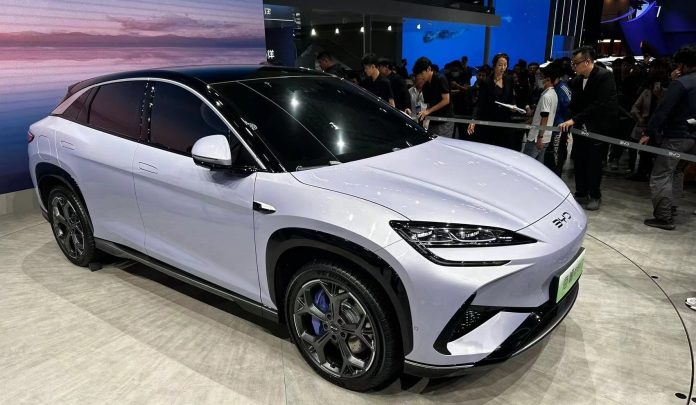
The dispute comes as Chinese automakers expand rapidly across the European market. Companies such as BYD and other Chinese manufacturers have built their competitive position around lower-cost electric vehicles, increasing pressure on European automakers that have invested heavily in their own transition from internal combustion engines to electric vehicles.

The competitive threat has also evolved beyond battery-electric cars. Hybrid vehicles are becoming an increasingly important part of the debate because they allow Chinese manufacturers to compete in a wider portion of Europe’s automotive market while consumers continue to transition gradually toward fully electric vehicles.

That creates a difficult policy problem for Brussels.

Restricting Chinese imports can provide additional protection for European manufacturers, but tighter trade barriers can also raise vehicle prices, limit consumer choice, and invite retaliation against European companies operating in China.

A voluntary export restriction could theoretically offer Brussels an alternative to imposing additional tariffs. But Beijing’s response suggests that such a mechanism could be politically and legally difficult to negotiate.

China’s objection that export limits violate WTO principles is impactful because both sides have an interest in presenting their trade policies as consistent with international rules.

The dispute therefore goes beyond the number of Chinese cars entering Europe. It raises a broader question over how governments should respond when an industrial sector in one economy becomes significantly more competitive in another market.

Tariffs Are Not the Only Pressure Point

The EU has already taken trade measures against Chinese electric vehicles, meaning the latest dispute could represent an attempt to find a mechanism that limits competitive pressure without escalating tariffs further.

For Beijing, accepting an export ceiling could also create a precedent that other markets might seek to replicate. China has invested heavily in expanding its automotive manufacturing capacity, with companies competing aggressively on price, battery technology and increasingly sophisticated vehicle software. That production capacity needs access to overseas markets, particularly as competition intensifies within China itself.

An export restriction imposed through negotiation with the EU could therefore constrain one of the industry’s most important avenues for growth.

The calculation is equally complicated for European manufacturers. Protection from Chinese competition could provide additional time for companies to restructure their businesses and improve the economics of electric and hybrid vehicles. But prolonged protection could also reduce competitive pressure at a time when European automakers are trying to catch up with Chinese companies in areas such as battery technology, supply chains and software.

The risk for Brussels is that a trade response designed to protect Europe’s car industry could become another source of friction with one of its most important trading partners.

Beijing Leaves Door Open for Negotiation

China’s Commerce Ministry did not simply reject engagement with the EU. It said any solution must “ensure a balance of interests” and take into account the industries on both sides. That suggests Beijing is leaving room for discussions, but on terms that it considers mutually acceptable rather than through unilateral restrictions on Chinese exports.

The distinction could become important in negotiations.

An arrangement based on individual companies, investment commitments, production inside Europe, or other mechanisms could be easier for Beijing to accept than a fixed ceiling on Chinese vehicle sales. Such measures could also give European policymakers a way to support domestic production without formally imposing another trade barrier.

For now, however, neither side has confirmed that an agreement is close. The immediate issue is whether the reported 15% ceiling develops into a formal EU proposal and, if so, whether Beijing is willing to negotiate around it.

The stakes extend well beyond the European car market. China and the EU are already dealing with broader disagreements over industrial subsidies, market access, technology and trade. The automotive sector has become one of the clearest pressure points because it combines manufacturing jobs, industrial policy, consumer prices and China’s growing export competitiveness.

A compromise would allow both sides to avoid another escalation. Failure to reach one could push the dispute back toward tariffs and retaliation, making Chinese cars in Europe another front in the wider economic contest between China and the West.


Elon Musk Predicts AI Will Roughly Double U.S. GDP Growth Next Year

0

Elon Musk offered a notably specific near-term economic forecast, stating that artificial intelligence is likely to roughly double U.S. GDP growth next year.

In a post on X, the Tesla and xAI CEO wrote, “My guess is that AI roughly doubles US GDP growth next year from 2% to 4%. Maybe even more.”

While speaking at the G20 summit, Musk estimated that Artificial Intelligence could expand the global economy by 20% to 30%, translating to roughly $20 trillion to $30 trillion in additional economic output annually.

He also predicted that AI could become capable of performing virtually any digital task by the end of next year, arguing that the technology would be able to handle anything that does not require the physical shaping of atoms by hand.

Musk’s projection stands out because it is more measured and nearer-term than some of his earlier statements, while still implying a meaningful acceleration relative to current conditions.

Recent U.S. economic data shows growth running near the lower end of the range Musk referenced. Real GDP expanded at an annualized rate of 1.5% in the second quarter of 2026 after 2.1% in the first quarter, according to Bureau of Economic Analysis figures.

Federal Reserve officials’ median projections in the September Summary of Economic Projections put 2026 growth at 2.3%, with private forecasters generally clustering around 2% or slightly higher for the year. Musk’s baseline of roughly 2% therefore aligns with the prevailing consensus before any major AI-driven productivity surge materializes.

The Tesla CEO has consistently argued that rapid advances in AI and robotics will produce outsized economic effects. In late 2025 he predicted double-digit U.S. GDP growth within 12 to 18 months and suggested that treating “applied intelligence” as a proxy for growth could eventually support triple-digit rates over a longer horizon.

More recently, at a G20 event, he estimated that AI alone could increase the size of the global economy by 20% to 30%, equivalent to $20–30 trillion annually.

Days later he raised the stakes further, posting that “AI + robots will more than double the global economy in less than 10 years.” His latest comment appears to scale those longer-term views down to a concrete, one-year U.S. growth-rate effect.

The mechanism Musk and other AI optimists emphasize is a sharp rise in productivity. Widespread deployment of advanced AI systems could automate or augment large portions of knowledge work, software development, design, and analysis, while humanoid robots begin addressing physical tasks.

Tesla’s Optimus program and broader investments in autonomous systems are frequently cited by Musk as examples of the hardware side of this transition. If those capabilities scale quickly, the argument goes, the economy could expand faster without a proportional increase in human labor hours.

Mainstream economists and institutions remain far more cautious. Most official and private forecasts continue to project trend growth near 2%, with AI expected to add only modest incremental percentage points over the next several years rather than an abrupt doubling of the growth rate.

Factors such as energy constraints for data centers, the pace of real-world adoption outside leading tech firms, regulatory hurdles, and potential labor-market disruptions are commonly cited as reasons for tempered expectations. Musk himself has acknowledged power-supply challenges, estimating significant shortfalls for AI computing as early as 2027.

Whether next year’s growth lands closer to 2% or approaches 4% will depend on how quickly AI tools move from impressive demonstrations into broad, measurable productivity gains across industries. Musk framed his view explicitly as a “guess,” leaving room for the usual uncertainties that accompany any economic forecast.

Outlook

The outlook for AI-driven economic growth will largely depend on whether productivity gains from the technology translate into measurable improvements across the broader U.S. economy.

If businesses accelerate AI adoption and the technology begins to automate a wider range of high-value tasks, productivity growth could strengthen and contribute to faster GDP expansion.

However, reaching Musk’s 4% growth projection would require a substantial acceleration from current forecasts. The impact of AI is also likely to vary across industries, depending on adoption costs, workforce adaptation, infrastructure availability, and the pace at which AI systems become reliable enough for widespread commercial use.

BOJ, Federal Reserve and ECB Navigate Inflation Risks From Higher Energy Prices

0

Central bankers have spent the week confronting a familiar problem in an unfamiliar form: inflation is being pushed higher by an energy shock that monetary policy cannot directly produce or remove. The response has been increasingly similar.

The Federal Reserve raised its benchmark rate to 3.75%-4%, the European Central Bank has also tightened policy, and on Friday the Bank of Japan lifted its policy rate to 1.25%, its highest level since 1995.

Japan’s decision is particularly significant. For years, the Bank of Japan operated with exceptionally low interest rates as it attempted to escape deflation and generate a more durable inflation cycle.

The latest increase represents another step in monetary normalization, but it arrives as the Japanese economy faces an external inflation shock. Energy costs have become an increasingly important consideration as geopolitical conflict disrupts global oil markets.

The Strait of Hormuz sits at the centre of that concern. Japan is heavily dependent on imported energy, meaning disruptions to crude shipments can quickly raise costs for businesses and households. When oil becomes more expensive, the effects do not stop at the petrol station.

Transportation, manufacturing, electricity, food distribution and other supply chains can all face higher expenses. Central banks then confront the difficult possibility that an initially external price shock could eventually become embedded in broader inflation expectations.

That is why the policy decisions in Washington, Frankfurt and Tokyo matter beyond their individual economies. Higher interest rates are intended to restrain demand and prevent temporary price pressures from becoming persistent inflation.

Yet they also make borrowing more expensive, potentially slowing investment, housing activity and consumer spending. Policymakers therefore face a narrow path between controlling inflation and weakening economic growth. The United Kingdom is currently taking a different position.

The Bank of England held Bank Rate at 3.75% for a sixth consecutive meeting on September 17, although three policymakers voted for an increase to 4%. The central bank acknowledged that Middle East tensions have pushed energy prices higher and warned that UK inflation could rise further.

Governor Andrew Bailey has emphasized an important distinction. Higher energy prices have already affected the near-term inflation outlook, but there has so far been limited evidence that those costs are generating significant second-round effects through wages and broader price-setting.

Bailey said the transmission into general inflation remains subdued, although the longer energy prices remain elevated, the greater the risk becomes.

This distinction could determine the next phase of monetary policy. If businesses absorb higher energy costs through narrower margins and households reduce consumption, inflation may eventually moderate without aggressive additional tightening.

If companies pass costs to consumers and workers demand compensation through higher wages, central banks may face a more persistent inflation cycle. The global economy is therefore entering a complicated monetary-policy environment.

Central banks are responding to similar energy pressures, but their economies differ in exposure, domestic demand, labor-market conditions and inflation dynamics. The result is unlikely to be a perfectly synchronized tightening cycle.

For investors, the central question is no longer simply where interest rates are headed. It is how long the energy shock lasts and how deeply it travels through the global economy. If elevated oil prices remain temporary, policymakers may eventually regain room to pause.

If the shock becomes entrenched, the world could face the more difficult combination of slower growth, tighter financial conditions and persistent inflation. This week’s decisions demonstrate that energy has once again become a monetary-policy variable.

Central bankers may control interest rates, but they cannot control the flow of crude through a geopolitical chokepoint. Their challenge is managing what happens after that energy shock reaches consumers, businesses, wages and expectations.

Temu Affiliate Program FAQ: Sign Up, Login, Sharing, and First Steps

0

If you’re looking for a practical way to monetize your online presence, the Temu affiliate program offers a streamlined path to earning commissions by sharing trending products and deals. Whether you’re a beginner or a seasoned marketer exploring new Temu affiliate opportunities, understanding the platform’s mechanics is fundamental to your success.

To help you hit the ground running without the guesswork, we’ve compiled this essential Temu Affiliate Program FAQ. We’ll walk you through almost everything from your initial sign up and login to the strategic sharing techniques that turn simple clicks into consistent conversions.

What Is the Temu Affiliate Program?

The Temu Affiliate Program helps eligible partners earn by sharing Temu products, offers, and referral opportunities through groups, communities, deal channels, and other relevant traffic sources. It is especially suitable for group-based promoters, bloggers, coupon sharers, forum posters, and other publishers who can bring targeted traffic.

Unlike complicated partner models, the Temu Affiliate Program focuses on clear actions and practical sharing tools. Once registered and verified, you can promote offers that fit your audience and track results inside your account.

Who Is the Temu Affiliate Program For?

The Temu Affiliate Program can appeal to different types of promoters, including:

  • deal and coupon sharers
  • group and community promoters
  • forum posters
  • beginners exploring affiliate marketing
  • bloggers and niche site owners
  • people who already recommend products casually online

This matters because many users think affiliate programs are only for large creators. In reality, a strong fit often comes from relevance, not just audience size.

Temu Affiliate Program FAQ

1. How do I complete the Temu Affiliate Program sign up?

Temu Affiliate Program sign up usually starts at the official recruitment page. From there, users can begin the onboarding process, enter basic information, and move into the setup flow for the program. You can also simply search “affiliate” directly in the Temu app to find the recruitment page.

For most people, the key point is not just signing up, but understanding what comes next. Joining is only the first step. A better question is: once you finish the Temu affiliate program sign up, what should you do to start sharing effectively?

That is where your traffic source, audience type, and posting style begin to matter.

2. How does the Temu affiliate login work?

Temu affiliate login is the account access step that allows users to enter the affiliate flow, manage their setup, and continue using the program after registration.

People searching for Temu affiliate login are often looking for more than just a sign-in page. They usually want answers to questions such as:

  • where to access the account 
  • what happens after sign-in 
  • how to find links or offers 
  • what the next action should be 

That is why a useful FAQ should not stop at login instructions. It should also explain what a new affiliate should do after getting inside the program.

3. What should I do right after joining?

After joining the Temu affiliate program, the most important first step is choosing a simple and realistic sharing path.

New users often try to do too much at once. A better approach is to start with one clear traffic source and one simple sharing format. For example, you can begin by:

  • sharing useful offers in a deal-focused community 
  • posting relevant recommendations in a group 
  • answering product-related questions in a forum 
  • sharing shopping-related content through an existing audience channel 

The goal is to create a low-friction first action. In the early stage of the Temu affiliate program, simplicity usually performs better than complexity.

4. What can I share in the Temu Affiliate Program?

Within the Temu Affiliate Program, users generally focus on shareable content that feels useful and clear to the audience. This may include:

  • referral offers 
  • discount-led promotions 
  • shopping recommendations 
  • trending products 
  • product roundups 
  • practical recommendations tied to a community topic 

The strongest content usually does not feel like a hard sell. It feels like a useful tip, a timely recommendation, or a relevant shopping find.

That is especially true for beginners. A post that is easy to understand often performs better than one that tries too hard to sound promotional.

5. Where can I share offers and links?

The best answer depends on where your audience already pays attention.

Many users in the Temu affiliate program begin with channels such as:

  • online communities 
  • deal-sharing spaces and forums
  • shopping groups 
  • niche blogs 
  • messaging groups 
  • content platforms

The important part is not trying every possible platform. It is choosing the platform where your recommendations feel most natural.

For example, if you already participate in a deal group, you may have a stronger starting point than someone trying to build a new audience from zero.

6. Do I need experience to start?

Not necessarily.

One reason many people explore the Temu affiliate program is that it can feel more approachable than traditional affiliate setups. Instead of requiring advanced technical skills, it often rewards people who understand audience intent, relevance, and useful sharing.

That means someone who already knows how to share a good deal in the right place may have a stronger starting point than someone with a bigger but less engaged audience.

7. What is the best first sharing strategy?

For most new users, the best first strategy is to keep things simple and focused.

A practical early-stage approach to the Temu affiliate program usually looks like this:

  • Choose one traffic source – Start with the place where you already have the most natural connection to users.
  • Share one clear type of content – This might be a deal, a useful recommendation, or a simple new-user-friendly offer.
  • Write with context – Do not just post a link. Explain why the post matters.
  • Make the next step easy – If users need to click, sign up, or use a code, keep the explanation short and clear.

A first win often comes from reducing friction, not from posting more.

8. What mistakes should new affiliates avoid?

A lot of early problems in the Temu affiliate program come from avoidable mistakes.

The most common ones include:

  • Trying too many channels at once – New users often spread themselves too thin instead of focusing on one path.
  • Posting links without context – A link with no explanation gives people little reason to care.
  • Sounding too promotional – Useful language usually performs better.
  • Ignoring audience fit- Not every offer works for every group or platform.

Expecting instant scale -Affiliate growth usually comes from repeatable, relevant sharing rather than one quick push.

9. How can I make my sharing more effective?

If you want better results in the Temu affiliate program, focus on clarity, relevance, and trust.

A stronger post usually does three things well:

  • it shows the value quickly 
  • it fits the audience 
  • it feels natural within the platform 

This is true whether you are sharing in a coupon channel, a forum, a Facebook group, or another kind of community. The better the fit between the offer and the audience, the better your chances of getting useful engagement.

10. Is the Temu Affiliate Program good for beginners?

For many users, yes.

The Temu Affiliate Program is often appealing to beginners because it can be approached in a practical way. You do not need to start with a massive content operation. You can begin with one audience, one sharing angle, and one repeatable format.

That is often the best way to learn what works.

Quick Start Checklist for New Users

If you want a simple way to begin, use this checklist:

  • Sign up for the Temu Affiliate Program
  • Log in to your Temu affiliate account — search for “affiliate” in the Temu app
  • choose one main traffic source 
  • identify one offer or content angle to start with 
  • write one clear post with context 
  • track what type of sharing gets the best response 
  • repeat what works and simplify what does not

This checklist keeps the first stage of the Temu Affiliate Program manageable and action-oriented.

Unlock New Income Streams

From initial new-user offers and marketing asset libraries to subsequent commission and performance tracking, the Temu Affiliate Program empowers partners to scale their earnings. Get started with Temu affiliate and unlock high-converting offers instantly.

? Start Earning With Temu

Blockworks’ Agentic Detection Signals a New Era for Real-Time Crypto Intelligence

0

Crypto markets operate on a clock that is increasingly difficult for traditional monitoring systems to match. A protocol exploit, governance decision, token migration, network outage or regulatory announcement can move markets within seconds, while the process of identifying and verifying that information can take considerably longer.

Blockworks is now attempting to close that gap with the launch of Agentic Detection, an AI-powered monitoring system designed to deliver market intelligence almost as events unfold.

Agentic Detection is integrated into Blockworks Monitoring and allows customers to receive alerts generated by AI agents before an analyst has reviewed them.

Previously, developments were subject to analyst verification before alerts reached customers. According to Blockworks, that process could take minutes, creating a potentially significant information gap for exchanges, custodians, risk desks and other institutional market participants.

The new system is built around speed and breadth. Blockworks says its agents continuously monitor sources including X, GitHub, governance forums, Discord, Telegram, project channels, blogs and thousands of news sources. The system tracks more than 1,000 assets and identifies developments across different categories of market activity.

The significance becomes clearer in a practical trading scenario. Imagine an exchange has listed a token connected to a blockchain bridge. A security vulnerability is reported by developers and begins circulating across project channels.

Under a slower monitoring process, analysts might need to identify the report, investigate the underlying evidence, determine whether it is credible and then issue an alert. By that time, traders could already have reacted.

Agentic Detection is designed to surface the development within seconds, allowing the risk team to begin investigating immediately.

Blockworks says the new system can produce alerts in roughly five seconds, compared with an earlier workflow that could take approximately eight to ten minutes. That difference illustrates why AI-driven monitoring is becoming increasingly relevant to digital-asset infrastructure: information is not merely valuable because it is accurate; its usefulness can depend on when it arrives.

Yet Blockworks has not removed humans from the process. Instead, Agentic Detection creates a two-stage system. An event can first appear as an agent-generated detection, with the underlying sources attached, before analysts investigate and add context.

Once reviewed, the development can move into an analyst-verified state. Customers can therefore distinguish between an early warning and a human-reviewed finding.  This distinction is particularly important for institutional users.

A risk manager may want an immediate warning about a possible exploit, while a compliance team may prefer to rely primarily on verified information before taking formal action.

Blockworks allows teams to configure monitoring views around their particular requirements, preserving analyst verification as the default while giving customers the option to activate agent-generated detections.

The launch also represents a significant step in Blockworks’ broader evolution from crypto media and research toward market infrastructure. It follows the company’s acquisition of Messari and builds on technology originally developed within Messari’s monitoring product.

The combination of proprietary analyst knowledge, automated detection and real-time distribution points toward a future in which institutional crypto intelligence becomes increasingly machine-readable and API-driven.

Agentic Detection reflects a fundamental change in how information can be consumed in digital-asset markets. The objective is not simply to replace analysts with artificial intelligence. It is to allow machines to perform continuous surveillance at scale while humans concentrate on verification, interpretation and decisions.

As crypto markets become faster and more institutionally integrated, that combination of automated detection and human judgment could become an increasingly important layer of market infrastructure.