DD
MM
YYYY

PAGES

DD
MM
YYYY

spot_img

PAGES

Home Blog Page 30

Nvidia Gets Trump’s Nod to sell H200 chips to China — but Beijing’s Approval is Not Certain

0

Nvidia is poised to regain a foothold in the world’s largest AI market after securing U.S. government approval to sell its high-end H200 chips to China.

The move marks a significant reversal from Washington’s earlier blanket restrictions that barred Nvidia from shipping advanced AI semiconductors to the country. Yet the question now is not whether Nvidia can sell to China, but whether Beijing will let its companies buy.

Under the new arrangement, Nvidia can ship the H200 to “approved customers,” but must hand over 25% of revenue from those sales to the U.S. government. The company had already run up against roadblocks earlier this year, which forced it to design the lower-performance H20 chip specifically to meet export rules.

Reports soon suggested Beijing discouraged local firms from purchasing the H20, and industry watchers have treated the H200 with similar skepticism. The Financial Times reported China would “limit access” to the chip, citing unnamed sources. Earlier this year, Beijing expressed security concerns over Nvidia’s H20, following Washington’s approval for the chip’s supply.

Looking at comments from Nvidia CEO Jensen Huang and tracking Beijing’s behavior over the past year provides hints about how this latest approval might play out.

A political green light from Washington does not guarantee enthusiasm in Beijing. Huang had earlier this month said he was still unsure whether Beijing would even allow Chinese firms to buy the company’s proposed H200 artificial intelligence chips, even if Washington greenlights sales.

China’s reasons to hold off on the H200

On paper, the H200 is one of Nvidia’s most advanced AI accelerators, widely used for training state-of-the-art models. But China has spent years trying to reduce its dependence on American technology, pouring resources into domestic semiconductor programs that can eventually rival Nvidia’s performance.

Neil Shah, partner at Counterpoint Research, told CNBC the U.S. approval may reopen access to American chips, but it does little to change China’s strategic direction.

“The strategic train has already left the station,” he said.

Huang himself has helped set expectations. In a May interview with Bloomberg, he described Huawei’s semiconductor lineup as “probably comparable” to the H200 — a notable endorsement for a company Washington has tried for years to cripple. Huawei’s Ascend chips, once seen as niche competitors, are now being deployed in massive clusters as the company seeks to close the gap in total compute capacity.

In June, Huang told CNBC that if Nvidia were cut off permanently from China, Huawei would eventually meet the country’s chip needs entirely.

China’s technology giants, Alibaba, Tencent, and Baidu, have also been using stockpiled Nvidia chips purchased before restrictions took effect. Combined with accelerating advances in local AI silicon, these companies have been able to train competitive models without depending on new U.S. hardware.

Shah warned that relying heavily on Nvidia carries political risks for Chinese companies. Being “locked in” to an American supply chain, he said, is a “liability with a hanging sword of political uncertainty.” Beijing’s national strategy is built on the opposite idea: reducing exposure to foreign pressure.

For that reason, domestic self-sufficiency remains the overriding priority.

Why China may still want the H200 — at least for now

Despite the political calculus, the H200 remains far more capable than local alternatives, and shortages across China’s semiconductor ecosystem could create immediate demand.

Trump said Chinese President Xi Jinping “responded positively” to the export approval. Meanwhile, Alibaba CEO Eddie Wu recently pointed to supply constraints across the entire chip supply chain — a shortage that stretches from training-grade GPUs to networking components.

Ben Barringer, head of technology research at Quilter Cheviot, said China’s tech firms are likely to buy the H200 simply because the alternative is slower progress.

“There will be demand for H200 as it is a better chip than H20 and there is a shortage of chips in China,” he told CNBC. “The big Chinese tech companies will want to use Nvidia and AMD if possible.”

China may be catching up, but it is still behind.

The country remains unable to manufacture top-tier semiconductors at scale, largely due to U.S. export restrictions that block access to the lithography tools required to produce cutting-edge chips. Even Huawei’s newest products fall short in power efficiency and peak performance when compared to Nvidia’s H200 and AMD’s MI300 series.

Shah said that ramping up domestic systems that can match Nvidia’s efficiency remains “elusive,” making it a costly and time-consuming alternative. “The gap between Nvidia, AMD and Huawei and others is still quite wide,” he said.

For now, the H200 offers an immediate boost that domestic silicon cannot match.

The long game still belongs to Beijing

Even if Chinese firms buy the H200 in the near term, analysts agree that Beijing will not deviate from its self-reliance strategy.

George Chen of The Asia Group said Jensen Huang has a “time window” to sell the H200 in China, but it will not last indefinitely.

“Xi will not be foolish that today Trump can sell H200, and then China just totally relies on U.S. chips,” he said.

China’s leading companies — Huawei, Alibaba, and Baidu — remain essential to the country’s long-term ambition: winning the global AI race without depending on the United States.

The approval gives Nvidia a renewed opportunity to generate revenue from the world’s second-largest AI market. But the combination of political uncertainty, rising domestic alternatives, and Beijing’s long-term industrial strategy means the H200 will be competing not just with local chips — but with the entire direction of China’s semiconductor future.

If Chinese firms buy the H200 now, it may be because they need it — not because Beijing plans to make room for U.S. chips in the years ahead.


Send App by Flutterwave Launches Naira Travel Card For Nigerians in The Diaspora

0

Send App by Flutterwave has announced the launch of the Send App Travel Card, a new physical Naira card designed specifically for Nigerians in the diaspora returning home for the festive season.

Developed in partnership with technology provider Odysy and powered by AfriGO, Nigeria’s domestic card scheme, the Travel Card aims to eliminate long-standing payment challenges faced by travelers and provide a seamless, reliable, and secure spending experience across the country.

Every December, Nigeria experiences one of its most heartwarming annual traditions; the massive homecoming of Nigerians living abroad. From the United States to the United Kingdom, Canada, Europe, and beyond, thousands of Nigerians in the diaspora return home to reconnect with family. While December is filled with excitement and celebration, many Nigerians in the diaspora also encounter financial and payment-related challenges such as cash shortages, unstable exchange rates, foreign card failures, and limited card acceptance during their visits. These issues can disrupt plans and create unnecessary stress.

The Send App Travel Card addresses these issues by allowing customers overseas to pre-order the card, pay for it within the Send App, receive it before traveling, and begin using it immediately upon arrival. The card works across POS terminals, ATMs, and contactless payment systems nationwide. Users can fund the card directly with their UK, US, or EU cards via the Send App’s remittance platform, ensuring a smooth and familiar experience.

In Nigeria, Send App operates under Flutterwave Tech Payment Limited, which holds approval from the Central Bank of Nigeria (CBN) to function as an International Money Transfer Operator (IMTO). This license ensures that all remittance flows processed through Send App are compliant, secure, and aligned with Nigerian regulatory standards for international money transfers.

The introduction of the Travel Card marks a significant step in Send App’s mission to bridge financial distance for the diaspora. By offering not just a channel to send funds home but also a secure and convenient way to spend locally, the platform enables Nigerians abroad to participate more fully in life back home during visits.

Harvey Bahia, Head of Send App Business at Flutterwave, described the launch as a major milestone,

“The Travel Card is a major step forward for Send App. For years, we’ve helped Nigerians abroad support life at home through fast, reliable remittances. Now, for the first time, we’re giving them a physical way to spend with the same ease and control when they return. It’s a significant milestone in making Send App the most complete financial companion for the diaspora.”

Chinonso Nwosu, CEO of Odysy, emphasized the partnership’s shared mission:
“Partnering with Send App on the Travel Card aligns perfectly with our mission to make travel spending seamless, reliable, and accessible. Nigerians in the diaspora deserve a dependable way to spend locally, and together with AfriGO, we’ve built a product that works effortlessly across the country.”

Also commenting, Ebehijie Juliet Momoh, Managing Director/CEO of AfriGO, highlighted the value of powering a product built for Nigerians.

she said, 
“We are delighted that AfriGO is the preferred domestic card scheme powering the Send App Travel Card. By enabling a payment solution designed in Nigeria, for Nigeria, this partnership reinforces our commitment to customer-focused innovation. AfriGO ensures secure Naira-denominated transactions, local data control, instant merchant settlements, and broad acceptance—even in low-connectivity environments.”

The Send App Travel Card can be ready within 24 hours of ordering, with same-day delivery available in Lagos and Abuja for orders placed before 4 PM. Users can lock, freeze, or replace their cards directly within the app. No ATM activation is required, allowing customers to begin spending immediately upon receiving the card.

The launch of the Send App Travel Card signals a major step forward in how Nigerian diaspora travelers manage their finances when returning home. With holiday travel increasing each year, demand for convenient, reliable, and locally compatible payment tools is expected to rise sharply. The card’s ability to bypass foreign card failures, unpredictable exchange rates, and cash limitations positions it as a strong solution for seasonal travelers.

Bitcoin Corrects After Rally Above $94,000 Amid Uncertainty Over Interest Rates

0

Bitcoin has experienced a modest pullback after trading above $94,000, reaching a recent high of $94,583, as traders digest the effects of a rapid rally and await key signals from the Federal Reserve. While the digital asset managed to hold support above $91,000, selling pressure emerged near critical resistance levels, keeping BTC in a delicate balance.

Despite the pullback, buyers re-entered near the $92,000 support zone. At the time of writing, Bitcoin is trading around $92,057. Over the past few days, the crypto asset has fluctuated within a wide range, but the broader momentum has favored the upside rising from below $89,408 to reclaim the mid-$94,000 region. While this acceleration has reignited bullish sentiment, some market watchers warn that the move could be a bull trap.

Crypto analyst Xanrox has echoed this caution, noting that the current rally may offer strategic selling opportunities if momentum weakens. Similarly, investing platform Investtech observed that Bitcoin recently broke above a short-term falling trend channel but described the broader technical outlook as “slightly negative,” citing support near $84,000 and resistance around $107,000.

Analyst Ted further highlighted Bitcoin’s ongoing consolidation around the $90,000 area, pointing to the lack of decisive buying pressure. According to Ted, the slowdown in institutional appetite reflected in weaker spot Bitcoin ETF inflows, has kept BTC range-bound and limited its ability to break through major resistance levels.

Market Turns to Federal Reserve Decision

The Federal Reserve is set to announce its interest rate decision today, followed by Chair Jerome Powell’s press conference. While a 25 basis point rate cut appears almost certain, with traders assigning roughly 85% probability, analysts believe the rate cut alone may not significantly move markets. Instead, the focus will be on Powell’s tone and the Fed’s economic projections regarding 2026 policy.

If Powell suggests that aggressive rate cuts are unlikely next year, risk assets such as Bitcoin could face renewed pressure. Options market activity already indicates that traders are positioning for potential downside, reflecting defensive sentiment ahead of the announcement.

Market strategist Michaël van de Poppe noted that fully expected rate cuts rarely serve as bullish catalysts. With $92,000 acting as a key resistance zone, he warns that a rejection at current levels may trigger a broader correction. Should Powell adopt a hawkish stance, Bitcoin could fall toward the $78,000–$82,000 range before any recovery attempt. Conversely, a clearly dovish signal could support sustained upward momentum and keep the breakout scenario intact.

Outlook

Bitcoin’s near-term direction will likely be shaped by both technical resistance and macroeconomic developments. Holding above key support levels around $91,000–$92,000 will be crucial for sustaining upward momentum, while rejection near $94,000 could trigger a deeper correction toward $88,000–$89,000.

Investors are also closely monitoring the Federal Reserve’s interest rate decision and Jerome Powell’s commentary, as signals on future rate cuts or tighter monetary policy could influence risk appetite. A dovish stance from the Fed may reinvigorate bullish sentiment and support a breakout above $94,500, while a hawkish tone could see BTC testing lower support zones near $78,000–$82,000.

Overall, Bitcoin remains range-bound in the short term, with institutional flows, market sentiment, and policy signals serving as key drivers of price movement in the coming days.

Analysts Expect the USE.com Presale To Become One of the Strongest Early Opportunities

0

USE.com is rapidly becoming one of the most talked-about new exchange projects of the year, and its presale has drawn significant attention from analysts and early-stage investors across global markets. As the cryptocurrency sector enters a new cycle defined by performance, compliance, and institutional-grade technology, USE.com is positioning itself as a next-generation trading platform capable of competing with top-tier exchanges from day one.

The presale announcement places the project at the front of a growing trend, where traders increasingly seek access to early exchange ecosystems built with strong fundamentals rather than speculative narratives. With a Beta release approaching and a complete trading infrastructure already developed, USE.com is being viewed as an opportunity with unusually high credibility for an early launch phase.

A New Exchange Designed for Modern Trading Standards

The interest surrounding the presale is grounded in the advanced engineering behind the platform. USE.com is built around a high-performance matching engine capable of low-latency trading, deep liquidity support, and rapid execution under heavy market conditions. This level of infrastructure is critical for spot and perpetual futures markets, especially during periods of volatility where execution speed directly affects profitability.

Security is equally central to the exchange. Institutional-grade custody practices, strong internal controls, and global compliance alignment give USE.com a stability profile that many emerging exchanges lack. For early contributors, these elements offer reassurance that the platform is being developed with long-term durability as a priority.

A Presale Backed by Real Utility and a Fully Developed Trading Ecosystem

One of the biggest differentiators for the USE.com presale is the presence of an operationally mature ecosystem at launch. Rather than introducing a presale before the product exists, the platform already includes spot trading, perpetual futures, earning tools, and launch infrastructure. This gives early supporters confidence that they are participating in a platform with real utility and an actionable roadmap.

The integration of these features positions USE.com as a complete exchange ecosystem rather than a single-product concept. This strengthens the presale’s relevance and increases interest among traders who want access to next-generation platforms with broad functionality.

Timeline Alignment Creates Strong Market Momentum

The timing of the presale ahead of the Beta phase is strategic. Traders who join early will be among the first to see the platform in action. This creates an immediate value cycle: early access allocation combined with real-time validation of the exchange’s interface, execution engine, and liquidity design.

Market analysts note that this type of synchronized rollout often accelerates user growth, as early contributors gain practical insights into platform performance and can evaluate its long-term potential firsthand.

Why Traders Are Paying Close Attention

Across global trading communities, there is growing frustration with aging exchange infrastructures, inconsistent liquidity, high fees, and unclear regulatory direction. As a result, traders are increasingly exploring modern exchanges that offer stronger foundations and better long-term alignment with market evolution.

USE.com enters this environment with a clear advantage: next-generation engineering, transparent design, global readiness, and a presale that opens the door to early participation in the platform’s development.

This combination has led many traders to label the USE.com presale as one of the standout early opportunities of the upcoming market cycle.

Analyst Perspective

From an analytical standpoint, USE.com demonstrates several hallmarks of projects that scale rapidly once launched. It has a high-performance core architecture, a compliance-focused operational framework, a complete trading suite, and a clearly defined roadmap aligned with market expectations. With momentum building, the presale may become one of the defining early events of this cycle—especially if the Beta phase validates the platform’s technical strengths.

Telegram: https://t.me/useglobal

X: https://x.com/useexchange

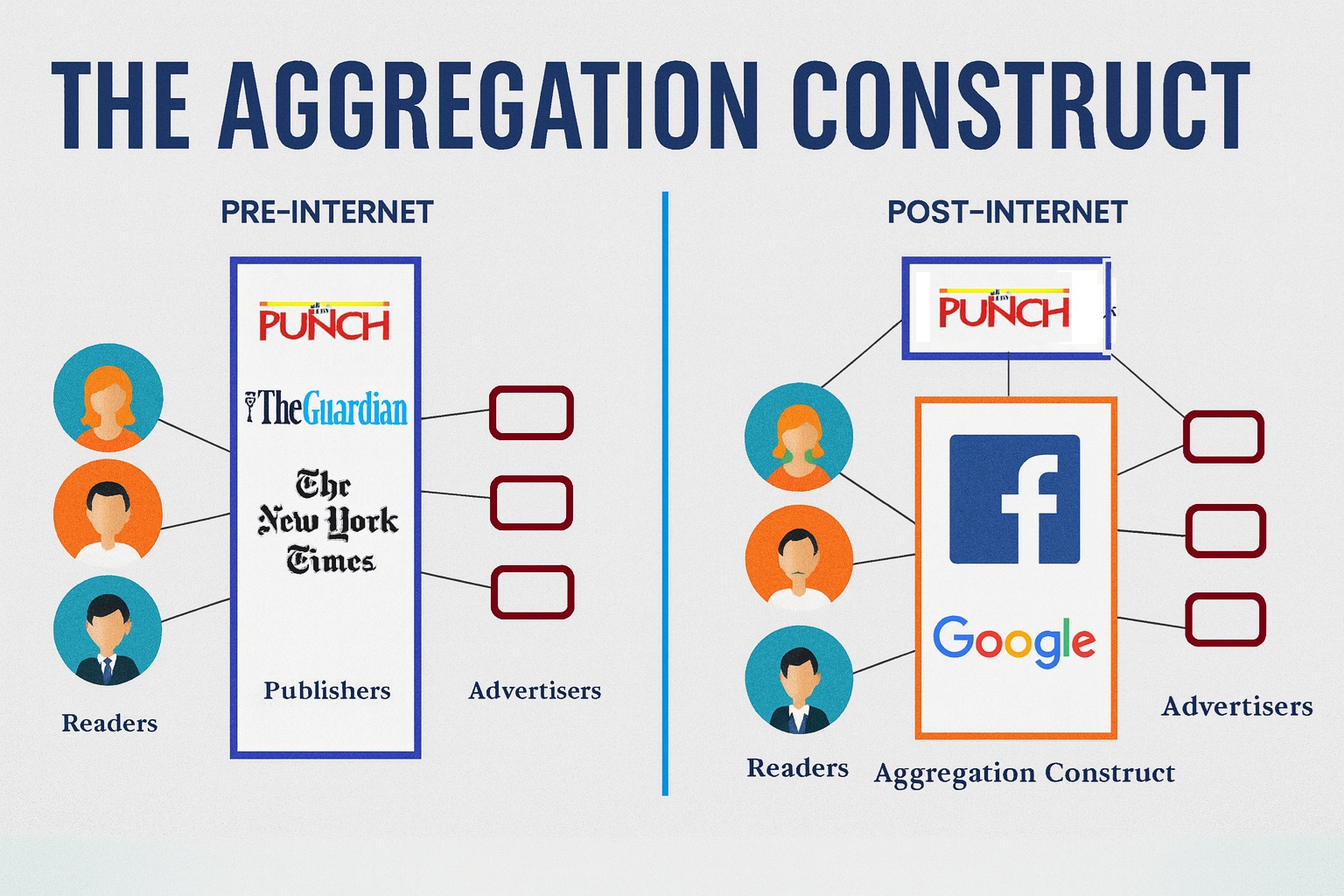
The Aggregation Construct: How Digital Platforms Redesign Markets

1

In the architecture of modern commerce, a silent redesign is taking place, one that shifts power away from producers and hands it to digital platforms. I have called this redesign the Aggregation Construct, a foundational pillar for understanding how value is created, migrated, and captured in the digital economy.

Before the Internet, the market equation was straightforward: those who produced controlled distribution, pricing power, and customer relationships. For example, newspapers wrote stories and sold them directly to readers. In this world, producers sat at the center of value creation.

But the arrival of the Internet collapsed the distance between producers and consumers. It democratized access, opened distribution, and introduced abundance. Yes, an abundance of information, options, and channels. Yet, instead of empowering producers, this abundance created a new scarcity: attention. And the companies that mastered attention became the new landlords of commerce.

This is where aggregation emerges. In the post-Internet era, entities like Google, Facebook, Airbnb, and Uber have become aggregators, platforms that do not necessarily produce the core product but aggregate users, data, and demand in such high concentration that they become the new centers of gravity in their industries.

Google does not write the news, yet it distributes more journalism than any newspaper in Nigeria. Netflix does not produce most of its films, yet it dominates viewership. Uber owns no vehicles, yet it commands mobility ecosystems across continents. In each of these cases, the aggregator captures the value while the producer bears the cost.

Here are four forces that make aggregation inevitable:

First is demand accumulation. Aggregators gather immense user bases, creating digital plazas where everyone converges. Where people converge, money follows.

Second is frictionless distribution. Aggregators eliminate the need for users to visit multiple websites, stores, or platforms. A single interface delivers the entire world’s options, reducing search and matching costs dramatically.

Third is data advantage. Every click, view, and transaction enriches the aggregator with data, data that becomes the fuel for personalization, prediction, and market dominance. This data flywheel compounds advantage in a way traditional producers cannot replicate.

Fourth is disintermediation. Once distribution is captured by a platform, producers lose their direct connection to customers. And once that connection is lost, pricing power and strategic leverage evaporate. The producer becomes a dependent participant in an ecosystem controlled by the aggregator.

My central thesis is clear: in the digital economy, the entity that controls demand, not supply, wins. This is the inversion of the industrial age, where scarce supply conferred power. Today, abundant supply and distributed access mean that the scarce asset is attention, and the companies that capture and organize attention become the new monopolies.

The consequences of this shift are profound. Producers must rethink their business models. Content creators, retailers, manufacturers, banks, and even governments must redesign how they deliver value in a world where distribution is no longer theirs. Nations must recognize that without indigenous aggregators, they risk economic dependence on foreign digital platforms. And industries must adopt platform thinking, moving from isolated production to ecosystem orchestration.

In summary, the Aggregation Construct explains the physics of modern markets. Aggregators, by mastering users, data, and convenience, reshape industries and capture outsized economic reward even when they do not produce the underlying product. It is one of the most important ideas in contemporary business strategy. In the digital era:

Whoever controls the user controls the value.