DD
MM
YYYY

PAGES

DD
MM
YYYY

spot_img

PAGES

Home Blog Page 3036

Intel Announces Plan to Cut 15,000 Jobs Following $10bn Cost-saving Plan

0

Intel, a once-dominant force in the semiconductor industry, is embarking on a significant downsizing as part of a broader cost-saving initiative aimed at stabilizing its financial outlook and revitalizing its market position. The company has announced plans to reduce its workforce by over 15%, translating to more than 15,000 job cuts out of its current 125,000 employees.

This reduction is part of a comprehensive $10 billion cost-saving plan set to be implemented by 2025. Intel CEO Pat Gelsinger shared the difficult news with employees, acknowledging the profound impact of the layoffs.

“This is painful news for me to share. I know it will be even more difficult for you to read,” he stated in a memo to the staff.

The company aims to streamline operations by cutting research and development (R&D) and marketing expenditures by billions each year through 2026, reducing capital expenditures by over 20% this year, and halting non-essential work. Additionally, Intel will conduct a thorough review of all active projects and equipment to ensure cost efficiency.

Financial Performance and Challenges

Intel reported a loss of $1.6 billion for Q2 2024, a significant increase from the $437 million loss in the previous quarter.

“Our Q2 financial performance was disappointing, even as we hit key product and process technology milestones,” Gelsinger admitted.

Despite the company achieving critical milestones, revenues have not grown as anticipated, and Intel has yet to fully capitalize on emerging trends such as artificial intelligence (AI).

The company’s second-quarter revenue stood at $12.8 billion, a slight 1% decrease year over year. While Intel has faced substantial losses in its Foundry business—$7 billion in operating losses in 2023 and another $2.8 billion this quarter—its PC and server businesses remain profitable. The company is also set to receive up to $8.5 billion in U.S. government funding from the CHIPS Act, providing some financial relief.

Investors have been critical of Intel’s financial performance, as the company has oscillated between losses and profits over the past two years, resulting in a cumulative gain of just $1.1 billion between Q2 2022 and Q1 2024. Intel has been the worst-performing tech stock in the S&P 500 this year, as noted by CNBC.

From a technological standpoint, Intel has struggled to establish a strong foothold in the AI server chip market, where competitors like Nvidia dominate. The company has also faced challenges in the graphics sector and had to significantly overhaul its flagship laptop chips to compete with energy-efficient ARM chips from Qualcomm and Apple.

Additionally, Microsoft recently opted for Qualcomm chips over Intel for its latest consumer hardware, further highlighting the competitive pressure Intel faces.

On the earnings call, Intel CFO David Zinsner emphasized that while the company’s next flagship AI laptop chip, Lunar Lake, shows promise, it alone will not be sufficient to reverse the company’s fortunes.

“The AI PC is a big winner for the company,” Zinsner stated but noted that Lunar Lake is a “narrow targeted product” relying on external wafers from TSMC. The subsequent product, Panther Lake, which will be internally sourced and have a much-improved cost structure, is expected to ramp up in the second half of 2025 with significant volume benefits by 2026.

Intel is now in the process of restructuring, suspending its dividend, and reducing overall spending while maintaining core investments to execute its strategic vision and build a resilient and sustainable semiconductor supply chain both in the U.S. and globally.

Detailed Breakdown of Intel’s Cost-Saving Measures

  • Workforce Reduction: Over 15,000 job cuts, representing more than 15% of Intel’s current 125,000 employees.
  • R&D and Marketing Expenditure Cuts: Billions of dollars in annual reductions through 2026.
  • Capital Expenditure Reduction: More than 20% reduction this year.
  • Operational Streamlining: Halting non-essential work and reviewing all active projects and equipment for cost efficiency.
  • Restructuring and Dividend Suspension: Maintaining core investments while reducing overall spending.

The company plans to complete the majority of the announced layoffs by the end of 2024, with a companywide enhanced retirement offering and voluntary layoff applications available to eligible employees starting next week.

Meanwhile, Microsoft has listed OpenAI, a company with which it has a long-term strategic partnership, as a competitor in its annual report. This move has sparked discussions about the evolving dynamics between the two companies, with some users expressing surprise and others anticipating potential conflicts. The shift highlights the competitive landscape in the AI and search engine sectors, where Microsoft now views OpenAI as a rival alongside other major players like Google and Amazon.


Farewell to the Elegant Stallion – Onyeka Onwenu Passes On

0

Building on my March 2020 Tribute to Dr Victor Olaiya – Highlife’s “Evil Genius”, in May 2020, I paid tribute to Another African Music Legend, Tony Allen, but more recently, the singer, actor, broadcaster and activist, Onyeka Onwenu, whose love ballads and songs about women’s rights were a soothing balm during Nigeria’s rocky 1980s and earned her the nickname “Elegant Stallion”, has died at 72.

As reported in the UK Guardian Newspaper, she had just finished a performance at a private party in Lagos when she became ill and died hours later at a nearby hospital, having suffered a heart attack. She was best known for the disco anthem One Love (1986), and You and I (1991), which was repurposed for the 1999 movie, Conspiracy – which she also starred in – and is widely regarded as one of the most iconic soundtracks of Nollywood, the world’s second-largest film-production industry.

Just in case you missed it, one song that stands out for me and is etched in my memory is, and remains, Odenigbo calling for the unification of her homeland, Nigeria.

Adieu “Elegant Stallion” aka Onyeka Onwenu.

Understanding US Debt-to-GDP Ratio of 200% by 2045

0

The trajectory of the United States’ federal government debt has been a topic of significant concern and discussion among policymakers, economists, and the public. As we look towards the future, projections indicate a challenging fiscal landscape. The Treasury Department’s forecast suggests that by 2045, the federal government’s debt could approximate 200% of the Gross Domestic Product (GDP). This projection aligns with various analyses, including those from the International Monetary Fund and the Congressional Budget Office, which also predict a substantial rise in debt relative to GDP over the coming decades.

The debt-to-GDP ratio is a critical metric for assessing a country’s fiscal health. It compares the national debt to the country’s economic output as measured by GDP. A higher ratio implies a larger debt size relative to the economy, which can affect a country’s borrowing costs and financial stability.

Factors Contributing to the Rise

Several factors contribute to the projected increase in the debt-to-GDP ratio. These include demographic shifts, such as an aging population leading to higher Social Security and Medicare costs, and structural budgetary imbalances between federal revenues and expenditures. Additionally, interest rates are expected to play a role, as they influence the cost of servicing existing debt.

The forecasted debt levels pose significant policy challenges. They necessitate a reevaluation of fiscal strategies to ensure long-term sustainability. Policy options may include reforming entitlement programs, adjusting tax policies, and exploring avenues for economic growth to increase revenues without disproportionately raising the debt.

Economic growth can mitigate the impact of rising debt by expanding the GDP against which the debt is measured. Policies that foster innovation, productivity, and workforce participation are essential for promoting growth. However, growth alone is unlikely to resolve the debt issue without accompanying fiscal reforms.

The issue of high government debt levels is a matter of concern for economists and policymakers worldwide. When a nation’s debt reaches an elevated level compared to its Gross Domestic Product (GDP), it can lead to several potential economic and fiscal consequences.

High levels of debt can be inherently inflationary, as they may provide a stimulus to the economy, accelerating hiring and wage growth. If the economy is already at full employment, this could lead to higher inflation rates.

As debt levels rise, so can the interest rates on that debt. This increase in interest rates can lead to higher borrowing costs for the government, which in turn can crowd out private investment and slow economic growth.

Increased government debt can lead to greater market volatility. Investors may become hesitant to buy government debt securities if they doubt the government’s ability to repay, which can hurt the economy

It’s worth noting that while the U.S. faces its own fiscal challenges, it is not alone. Many developed nations grapple with high debt-to-GDP ratios, navigating the balance between growth, fiscal responsibility, and social welfare.

As we approach 2045, the decisions made today will significantly shape the fiscal reality of tomorrow. It is crucial for ongoing dialogue and action to address the rising debt in a manner that secures economic stability and prosperity for future generations.

The conversation around the U.S. federal government debt is complex and multifaceted, involving economic theories, policy debates, and ethical considerations. What remains clear is the need for informed and proactive measures to manage the nation’s fiscal future responsibly.

Meanwhile, in Nigeria, the Senate has amended the Central Bank of Nigeria (CBN) Act to enable the government to take more loans from the apex bank: “The Senate on Wednesday amended the Central Bank of Nigeria (CBN) Act to increase the borrowing limit the bank can offer the federal government from five per cent to 10 per cent. The borrowing, popularly called Ways and Means, is a loan facility through which the CBN finances the federal government’s budget shortfalls.”

Segmenting Opportunities in AI (Artificial Intelligence) Industry [video]

0

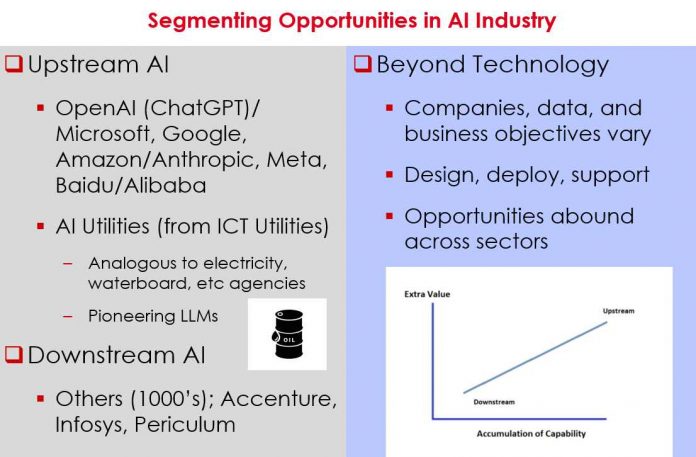
Everyone will have opportunities in this AI (artificial intelligence ) world. I draw from the oil industry to explain why even though the AI utilities will capture most of the opportunities, the downstream players will still capture value. At Tekedia AI in Business masterclass, we are helping professionals understand the emerging AI world here.


AI summarized this video as below:

In the realm of artificial intelligence (AI), a nuanced discussion is unfolding around segmenting opportunities within the industry, drawing intriguing parallels with the established oil sector. To grasp this discourse effectively, people should first acquaint themselves with AI technology and its diverse applications across industries.

Understanding the concepts of upstream AI—encompassing companies focused on core AI development—and downstream AI—comprising entities utilizing AI for specific products or services—is crucial. Key themes underpinning this dialogue include industry segmentation, market dynamics, competition, value capture strategies, and the integration of technology into varied business models. By juxtaposing historical contexts between the growth trajectories of both sectors—the evolutionary path of AI and the profound impact of oil on global economies—a richer understanding emerges regarding their comparative analyses.

Recent events shaping the landscape of AI, such as technological advancements, notable industry developments like mergers and acquisitions, or regulatory shifts impacting sector operations are pertinent considerations in this narrative. Moreover, exploring how other industries have been segmented can offer valuable insights into common trends in market dynamics and competitive landscapes.

Looking ahead to potential future scenarios in the AI domain suggests a trajectory marked by increased consolidation among dominant upstream players alongside ongoing innovation within downstream sectors. Regulatory adjustments may be on the horizon to address concerns related to market concentration issues while new business models leveraging cutting-edge AI technologies are poised to emerge.

Delving deeper into ethical implications surrounding essential services powered by AI or examining societal impacts stemming from its pervasive influence could serve as compelling extensions to this overarching discussion on segmenting opportunities within an ever-evolving industry landscape.

Windfall Tax: Getting the Economy to Work for All – By  Femi Otedola

0

I write to express my strong support for the implementation of a windfall tax in Nigeria and to highlight the critical role this measure plays in fostering a fairer and more equitable economic environment.

This endorsement aligns with the ongoing efforts to reform the Nigerian banking sector, aimed at enhancing economic stability and integrity within our financial institutions. Windfall taxes are levies on companies or individuals who receive substantial, unexpected profits due to circumstances beyond their usual control or investment. Taxing these extraordinary gains ensures a fairer distribution of wealth, allowing those who benefit disproportionately to contribute more significantly to the broader societal good.

The revenue generated from windfall taxes can be channeled into essential public services such as healthcare, education, and infrastructure, benefiting all citizens and helping to reduce social inequalities. The recent announcement of a windfall tax on the extraordinary profits earned by Nigerian banks is a significant first step towards achieving these goals. The consolidation of various foreign exchange rate systems into a single investors and exporters (I&E) window led to the depreciation of the Naira and substantial increases in the value of bank assets denominated in United States Dollars.

This extraordinary gain should be redistributed to fund critical infrastructure development, education, healthcare access, and public welfare initiatives, addressing the intense pressure on public finances and alleviating the cost-of-living crisis many Nigerians face. Furthermore, the financial statements of manufacturing, telecoms, and SMEs indicate that many of these companies may not be able to pay corporate tax for at least the next two years, as they are currently showing negative equity. It is essential for the government to step in and provide support to bridge these gaps, ensuring revenue generation and fostering economic development.

The importance of aligning financial priorities with Nigeria’s broader economic development goals cannot be overstated. The Federal Government’s reforms are both timely and essential for the sustainable growth of our economy.

By taking decisive action to implement these changes, the Federal Government is demonstrating a commitment to ethical leadership and accountability. These reforms will empower our banking sector to play a pivotal role in driving Nigeria’s economic development, ultimately securing a prosperous future for all Nigerians.

I also commend the recent recapitalization initiative in the banking sector, which sets minimum capital requirements of N500 billion for international banks and N200 billion for national banks. This move is designed to strengthen the banking sector’s capacity to support Nigeria’s broader economic development goals. It is crucial for banks to focus on operational efficiency, technological innovation, and customer service, rather than executive extravagance.

Amid the progress with banking sector reforms, there is an urgent need to address entrenched issues within the Nigerian banking sector.

A concerning trend has emerged where some bank chief executives prioritize personal gain over their duty to shareholders and customers. The core values of banking—trust, integrity, and service—must be upheld. I am particularly critical of the culture of flamboyance, especially the ownership and operation of private jets.

Nigerian banks are spending an estimated $50 million annually just on maintaining private jets, with over $500 million gone into purchasing nine private jets by four banks. This level of extravagance significantly erodes public trust in our financial institutions and diverts crucial resources away from vital areas such as operational efficiency, technological innovation, and customer service.

To regain the trust of the Nigerian public and fulfill its pivotal role in the nation’s economic development, the banking sector must realign its financial priorities. Investments should be channeled into areas that directly improve customer services and enhance technological infrastructure.

I urge all stakeholders in the Nigerian banking sector and the broader economic community to rally behind these visionary reforms. It is time for our financial institutions to embody the highest standards of integrity and service, ensuring a stronger and more resilient economy for all Nigerians.